testAuthor: Michael Beebe

After years of investing in advertising & tech companies, I found myself leading one

From imposter syndrome to the principles that shape how I show up

I joined Dstillery in 2017 after more than two decades in the investment community as a sell-side analyst, buy-side analyst, and portfolio manager at some of the world’s most prominent investment firms.  Over the course of that career, I followed a wide variety of industries, including ad agency holdcos, media, internet, technology and, yes, adtech.

When I made the transition to a corporate job, it was with the explicit objective of being a principal contributor to value creation by applying what I had learned as an investor.

Despite that intentional approach, I will admit I had a bad case of imposter syndrome at first.

While confident in my ability to understand the role of growth, margins, returns on capital and cash flows in value creation, there was a lot I did not know about how leaders deliver those positive outcomes.  I had studied hundreds of companies across 5 key domains:  financial, strategic, operational, culture and governance.  There are many I admired and theoretically learned from, but the truth is that I had essentially zero relevant experience.

When I was unexpectedly thrust into the CEO role after just 6 months as a CFO, I had no choice but to figure it out.  I turned to a set of principles I had developed to guide my actions over the course of my investing career.

These are not principles that tie back to financial statements or stock picking, but more of a behavioral operating system.  They are guidelines for problem-solving and decision-making, and they have been a roadmap to navigating the challenges of the transition to a job that was beyond my depth.

Even after all this time, I still am often asked what is the connective tissue between my investment career and my leadership role at Dstillery.  This framework is the answer, and I have shared it over the years with my team, my peers and my former investment colleagues.

I wrote down the first five of these principles when I launched Mojave Capital, a hedge fund seeded by Tiger Management.  Tiger’s Julian Robertson inspired the sixth.

When I joined Dstillery, I applied these principles first to my role as CFO, and then as CEO.  I applied them by default because they were what I knew, and because they comprised the person I wanted to see when I looked in the mirror.

Since Chrome introduced the feature of multiple tabs on a browser, a Google Doc with these exact principles has been always open on my computer as a reminder and reference. I have barely edited them over my nine-year tenure.

  1. Process matters.  Decisions need to be made in a structured, predictable, repeatable way.  They can still be simple, but they need to be thorough and clear.  Over time, processes are meant to evolve and improve.
  2. Leverage data. Use data and tools whenever available to make better decisions.  Trust the data over human biases and intuition.
  3. Find your conviction. Develop conviction through a data-driven process that is tested and proven.  Conviction is not certainty; that is too high a bar.  Conviction is the confidence you need to make an informed decision with imperfect information, to trust your own judgment over the judgment of others.
  4. Transparent communications. Be clear about what decision was made and how.  Emotion should be removed from communication, and good and bad news should receive equal weight and bandwidth.  Do not sweep mistakes or challenges under the rug.  They are your best feedback mechanism for continual improvement.
  5. Act with urgency. Once you come to a decision with conviction, act upon it.  The world changes fast, and circumstances that inform your decision can change quickly.  A good decision unexecuted is a failure of process.
  6. Grow people. Find good people and empower them.  Give talented young people more responsibility as quickly as they can handle it.  Remove people who hold you back.

Who I aspire to be

Generally speaking, what you learn to do as an investor is make and act on high-stakes decisions with imperfect, incomplete information.  To do so, you have to have a reliable process, gather as much data as you need to develop conviction in your decision, communicate the reasons for your decisions with stakeholders, and act.  Over time, you want to inspire and develop talented young people who will follow that blueprint, enhance the process and results, and help you scale.

As I found myself in the deep end of the pool, first as Dstillery’s CFO and then CEO, it dawned on me that the real reason to apply these principles to my leadership role is because they are directly relevant.  They transcend the investment process.  The core function of a corporate leader — making critical decisions through the lens of value creation — is identical to the core function of an investor.

The framework of these principles is aspirational.  I often fall short of the standards that I set for myself.  Sometimes, applying one principle may get in the way of another.  While I am gathering the data I need to find my conviction, I may delay decision-making, running afoul of my principle of urgency.  Such is life in the real world.

The lessons I learned as an investor about value creation, about myself, and about how the world works are an invaluable, reliable foundation for my role leading Dstillery.  They encode rigor, humility, intellectual honesty, curiosity, self-reflection, and collaboration.

When I look in the mirror today, I no longer see an analyst play-acting at being a CEO.  I see a confident leader with a clear, battle-tested framework, learned through a varied career for which I am deeply grateful.  I have conviction that no matter what challenges the future holds, these principles provide a foundation for decisions that will create real, lasting value.

Though it still flares up from time to time, I have largely gotten over my imposter syndrome.  I have come to believe that we all have experiences we can apply to our careers, our decisions, and our growth vectors.

As you look back over your career, think about your mentors, and take note of what you have learned.  Write it down.  Share with colleagues, loved ones, mentors.  I promise you will be dazzled, inspired and liberated by the range of learnings you can apply to your current role, or your next.

Empowering the ‘Let’s Goers’ unlocks acceleration

Change is scary. As a general rule, people do not like it. Change creates uncertainty, and most people’s sense of personal security is built on continuity and the expectation that tomorrow will be very much like today.

When we perceive that tomorrow is going to be very different from today, most people experience fear or anxiety. Tomorrow could be worse. I could lose my job. I might not know how to do the thing that I will now have to do. Things that I love or value might be somehow worse. Depression. Global warming. Famine! Apocalypse!!

Not everyone hates change

I have repeated the aphorism that “people hate change” many times, as if it is an undisputed and universal fact. But it is not. As with everything related to the human experience, there is a lot more nuance, and a wider range of realities.

My friend and mentor (and Dstillery director) David Bell recently shared his view with me that with regard to change, there are three types of people:

  1. Past-clingers
  2. Wait-and-seers
  3. Let’s-goers

Past-clingers are so uncomfortable with the uncertainty created by change that they deny it, resist it, and push back against it. Their denial is a circular reference that activates the very risk that they fear, which is being left behind.

Wait-and-seers, well that is obvious. They are skeptical, but willing to be convinced.

Then there are the let’s-goers. These are the people who experience the uncertainty of change as an exciting opportunity to learn and grow.

The dust will not settle

Today, I have the privilege of moderating the following session at Velocity, an event hosted by The Athena Project in partnership with Northwestern University Medill School.

We Live in Dusty Times: How Media Agency Leaders Manage Innovation, Complexity & Fear.

Media agencies are navigating one of the most profound reinventions in their history, as AI, multimodal consumer experiences, and new forms of intelligence reshape how audiences are discovered, understood, and influenced. How are today’s agency CEOs leading through this complexity while helping clients embrace innovation without losing sight of trust, creativity, and business results? This conversation explores how leaders prepare themselves, their teams, and their clients for a future defined by extraordinary opportunity—and equally profound disruption.

It is a brilliant topic, and I am thrilled to have the opportunity to delve into it with Lisa Collings of Mindshare, Domenic Venuto of Horizon Media and Shelby Saville of Starcom.

In my preparation to moderate, I discovered the meaning behind the title “We Live in Dusty Times.” It is from this (excerpt of a) post by Shelby:

⚡ Change is the new normal.

The pace isn’t slowing. And that’s okay. I was recently asked what this industry will look like “when the dust settles.” My answer is that it won’t. We live in dusty times, my friends. For our clients and our people, leading with focus, clarity, and transparency matters more than ever, even when the path ahead isn’t clear. When I’m unsure, a mix of perspective, pragmatism, and purpose has been my superpower. And I’m never afraid to say, “I don’t know.” Because my teams and clients know we’ll figure it out, together.

Are you a past-clinger?

It is unnerving to realize that we have little choice but to lean into change without a clear idea of where it will lead us, and that we cannot simply wait for the dust to settle.

It led me to an introspection exercise.

Open your mind, look in the mirror, and ask yourself whether you are a past-clinger, a wait-and-seer, or a let’s-goer. Answer honestly, and ask yourself why. And finally, ask yourself whether that is who you want to be.

Me? I am somewhere between a wait-and-seer and a let’s-goer.

I have a deep respect and even envy for the let’s-goers. They are the ones who are going to do exciting things and have tons of fun. Some may become trillionaires.

But a 20+ year career as an investor imbued me with healthy respect for risk that slows me down a step relative to the let’s-goers. In any decision, I seek conviction before I act. Conviction is the governor between waiting to see how things will unfold and diving in.

Rooting for the let’s goers

The profound value of David’s insight is not the categorization of people. It is that companies thrive when they empower and unleash the let’s-goers. Remove organizational obstacles. Give them permission to pursue opportunities. Reward their initiative, and celebrate their achievement.

The idea is that the more visibility and influence the let’s-goers have, the more past-clingers will be inspired to become wait-and-seers, and wait-and-seers to become let’s-goers. The more people we can move across the continuum, the faster we will go as a company.

I love this model for acceleration, because it does not impose the unrealistic standard that we are all going to be let’s-goers. Instead, it allows the let’s-goers to bring the rest of us along, and to be agents of acceleration.

Growth comes from change. Change is constant. So we all can and should be constantly growing. Whichever category we find ourselves in, we all ought to be rooting for the let’s-goers.

Advertising alpha: brand marketers are hedge fund managers now

“Now, we are hedge fund managers.”

Dave Kersey, Global Head of Media for SharkNinja, made that assertion on a panel that I attended at Horizon Media‘s HorizonOS Labs day.  He believes that brand marketers have become solutions engineers, supply chain analysts and, yes, hedge fund managers.

It struck a chord with me because it resonated with an idea I have been developing for a while: that brand marketers and the supply chain that serves them ought to be pursuing something that hedge fund managers call “alpha.”

The pursuit of alpha

I have had an unusual career path.  I joined Dstillery as CFO after spending the first 23 years of my career as an equity analyst and hedge fund manager, and had a battlefield promotion to CEO after only 7 months on the job.

I am often asked how that happened.  The underlying questions are: what is the connective tissue between the two?  What did you learn as an investor that prepared you to be CEO of an adtech company?

Alpha is part of the answer.

Across all the roles and firms I worked in during my investment career, my #1 priority was the pursuit of alpha, whether explicitly or implicitly.  In layperson’s terms, and in its most elementary form, alpha is the amount of excess return over the market that an investor can generate from their skill.

The simplest way to understand alpha is through an example.  If the market is up 10% over a year and my portfolio is up 15%, I have generated alpha of 5%. (To my hedge fund comrades, let’s leave the arguments about Sharpe ratios, risk-adjustments, leverage, and beta aside for now.)

Portfolio managers generate alpha through superior security selection and sizing.  Having large positions in stocks that go up more than the market, and small or no positions in stocks that go down, leads to strong alpha generation.

One of the key ways I sought to drive alpha was to identify data that could drive more informed investment decisions with greater conviction.  Government macro data, commercially available credit card data, survey data, web-scraped data — you name it.  My investment process was deeply committed to the idea that data-informed decisions drive better outcomes.

That notion was explicitly a part of my decision to join Dstillery.  During my career transition from the investment community, my due diligence revealed that Dstillery’s data science was famously good, and that it drove consistently strong results for programmatic ad campaigns.

In essence, Dstillery is in the business of generating advertising alpha.

Optimizing programmatic performance

Within advertising, the programmatic channel is primed for alpha generation.  Like financial markets, it is an electronic marketplace that requires real-time decisioning in auctions that bring together buyers and sellers to optimize the value of ad impressions.

The advertising community has adopted a lot of language from the investment community.

Media agencies have “investment management” teams and “principal trading” operations.

Programmatic ads are bought by “traders” who work on “trading desks,” and the industry’s strongest independent buying platform is actually called “The Trade Desk”.

And, for better or worse, many adtech businesses are fundamentally digital media “arbitrageurs”.

However, there are two fundamental differences between alpha in financial markets and alpha in advertising:

1 – No S&P 500 for Advertising

In financial public markets, performance is easy to both measure and benchmark.  Your returns can be stacked up vs. the S&P 500 return or the 10-year treasury rate.  In advertising, both measurement and benchmarking are less straightforward.

In terms of measurement, different campaigns have different KPIs.  There are dozens of measurement models, and even more vendors, to choose from.  The question of which attribution methods are best is a debate without an objective answer. Brands choose their preferred method among various imperfect alternatives.

Meanwhile, the closest thing to a market benchmark is the “run-of-network” (RON) performance of a campaign, which is the KPI result that would have been achieved just by randomly buying impressions.  It can be measured for an individual campaign with a control budget, but there is no publicly available benchmark similar to the S&P 500.

2 – Advertising’s fuzzy invisible hand

Financial markets are nearly a pure performance-incentive mechanism — investors who generate alpha are directly and handsomely rewarded for achieving that performance.  An asset manager who consistently underperforms loses assets under management and ultimately their job.

For advertising professionals, that clarity of incentives does not exist.

Most compensation models for agencies (and the rest of the advertising supply chain) do not directly reward performance.  The percent-of-media model incentivizes bigger budgets and cost efficiencies to drive the most revenue and margin.  The cost-plus model also favors bigger budgets, but instead of efficiency actually incentivizes higher costs, to which a margin “-plus” can be added.  Neither model has alpha-seeking baked in.

Despite those financial incentives, many advertising businesses conscientiously work to drive the best possible campaign performance.  However, it is often a secondary goal, intended to ensure client retention, and comes only after the scale and margin objectives have been satisfied.

If performance goals are subordinated to other factors and not directly compensated, they are more of a nice-to-have than a driver of behavior.

Compounding competitive advantage

Over my nine years with Dstillery, it has become clear to me that there is alpha to be had in advertising, and particularly in programmatic advertising.

It is not easy to consistently generate outperformance.  The digital advertising ecosystem is complex, fragmented, and opaque.  With over 5,000 companies in the LUMAscape, it can be challenging to discern which partners and technologies are truly adding value.

Challenging, but not impossible.

Just as in the financial markets, superior results in advertising can be achieved through a rigorous process focused on leveraging the best available data and technologies, objectively measuring results, optimizing to those strategies and tactics that perform, and ruthlessly eliminating underperformers.

Not all brands care about performance.  That leaves more opportunity for those that do, like SharkNinja.  Brand marketers who pursue alpha with the same rigor that a hedge fund manager brings to security selection will be rewarded with better outcomes and, over time, will create a compounding competitive advantage.

Alpha is indeed a thing in programmatic advertising.  Brand marketers are, among other things, hedge fund managers.

Adtech has a trust problem. AI will solve it.

In his Marketecture Live session in March, LUMA’s Terry Kawaja made ten predictions about the impact of AI on adtech.  While they were all thought-provoking, #8 was particularly intriguing, in that it suggests a solution to the industry’s principal fundamental challenge:

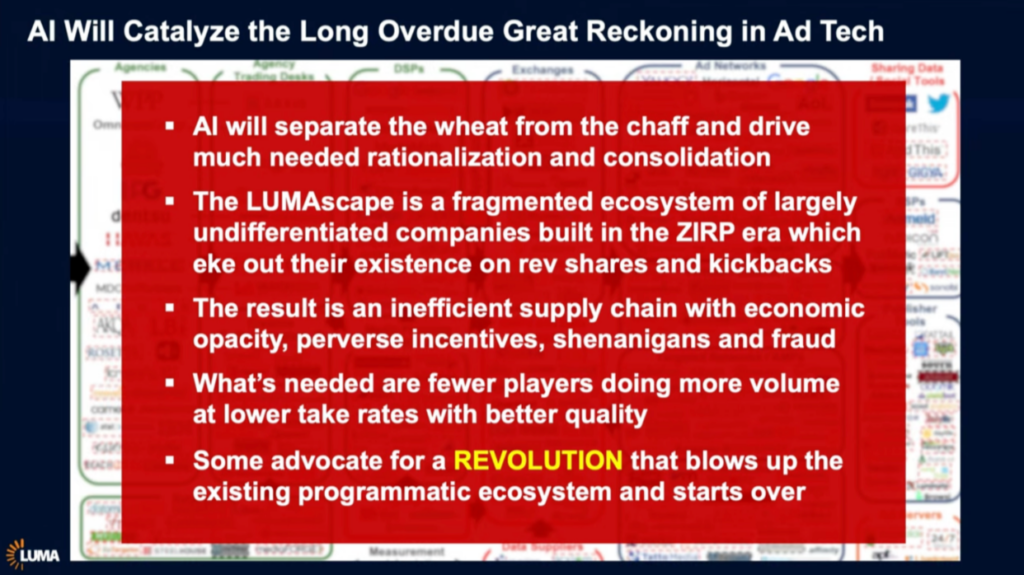
“AI will catalyze the long overdue great reckoning in adtech.”

Before joining Dstillery, I spent over twenty years as an equity analyst.  For many of those years, I covered media, advertising and technology, and for many I was a generalist across industries.  In all those years and across the dozens of industries that I have covered, I have not encountered another industry like adtech.

As Terry tells it: “The LUMAscape is a fragmented ecosystem of largely undifferentiated companies built in the ZIRP era that eke out their existence on rev shares and kickbacks.”

Prediction #8 from LUMA Partners Marketecture Live presentation, March 2026

Low barriers to entry

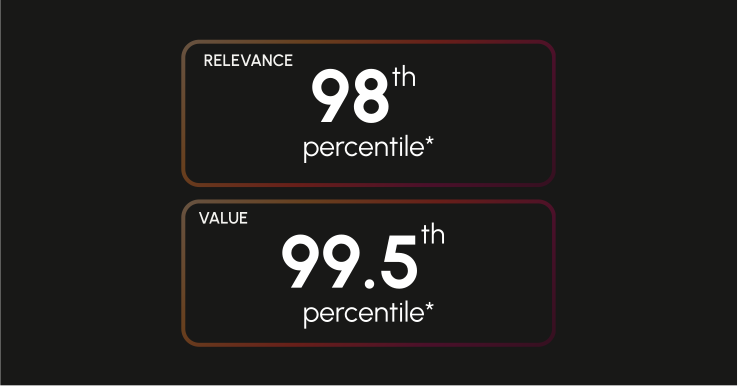
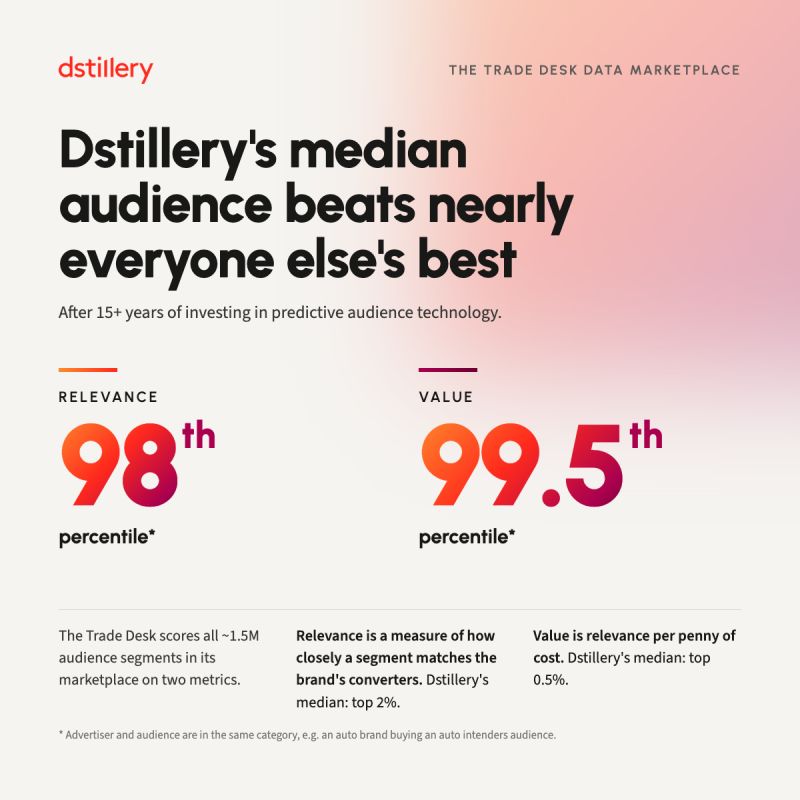
There are over 5,000 adtech companies in the LUMAscape, competing across dozens of different market segments that often blur together.  Just within the narrow US audience targeting segment that Dstillery competes in, there are about 250 different providers in The Trade Desk’s data marketplace, with over a million audiences available.

This fragmentation reflects the reality that barriers to entry for the industry are quite low.  New adtech companies can be started with very modest amounts of capital and many business models have very low breakeven points.  Meanwhile, the industry is enormous, with over $1 trillion of annual global ad spend, and it is highly dynamic.

That combination of circumstances encourages new company formation. Though many VCs steer clear of the industry due to its structural challenges, seed money is readily available for good ideas — or for marginal ideas promoted by repeat adtech entrepreneurs with lots of industry friends and family.

Differentiation is difficult to discern

I strongly disagree with Terry’s assertion that adtech companies are undifferentiated.  Rather, I believe that the industry’s fragmentation, complexity and opacity make it difficult for adtech companies to simply communicate their differentiation, or advertisers and their agencies to understand it.

Every one of the 5,000+ LUMAscape companies says that its technology, data, service or solution generates the best outcomes for campaigns, and every one claims some sort of unique competitive advantage.  As often as not, those claims are untrue, and with some effort, proveably so.

It takes a lot of work for buyers to confidently separate those adtech companies that add value from those that do not, and the constant innovation means that that work is never done.  In light of that, many buyers cynically simplify their work by just assuming, as a matter of convenience, that all companies, products and technologies are commodified, and there is little distinction of value. Even those who try to differentiate in good faith may give up in frustration.

AI will reveal who is swimming naked

Warren Buffett famously said “Only when the tide goes out do you discover who’s been swimming naked.” In the context of investing, it means that all companies might seem successful when the economy is strong, but an economic downturn exposes bad businesses, fragile financial profiles and/or excessive risk-taking.

Consistent with Terry’s prediction of a reckoning, this aphorism applies to the tide of AI that is coming to the adtech industry.

As more advertisers, agencies and adtech platforms bring AI into their digital media buying processes in search of efficiency and performance, the adtech supply chain will become more transparent and accountable, the cornerstones of trust in any industry.  It will become much easier to understand — objectively and confidently — which adtech partners are providing differentiated value, which are commoditized, and which are just exploiting industry inefficiencies and opacity to keep the lights on.