In his Marketecture Live session in March, LUMA’s Terry Kawaja made ten predictions about the impact of AI on adtech. While they were all thought-provoking, #8 was particularly intriguing, in that it suggests a solution to the industry’s principal fundamental challenge:
“AI will catalyze the long overdue great reckoning in adtech.”
Before joining Dstillery, I spent over twenty years as an equity analyst. For many of those years, I covered media, advertising and technology, and for many I was a generalist across industries. In all those years and across the dozens of industries that I have covered, I have not encountered another industry like adtech.
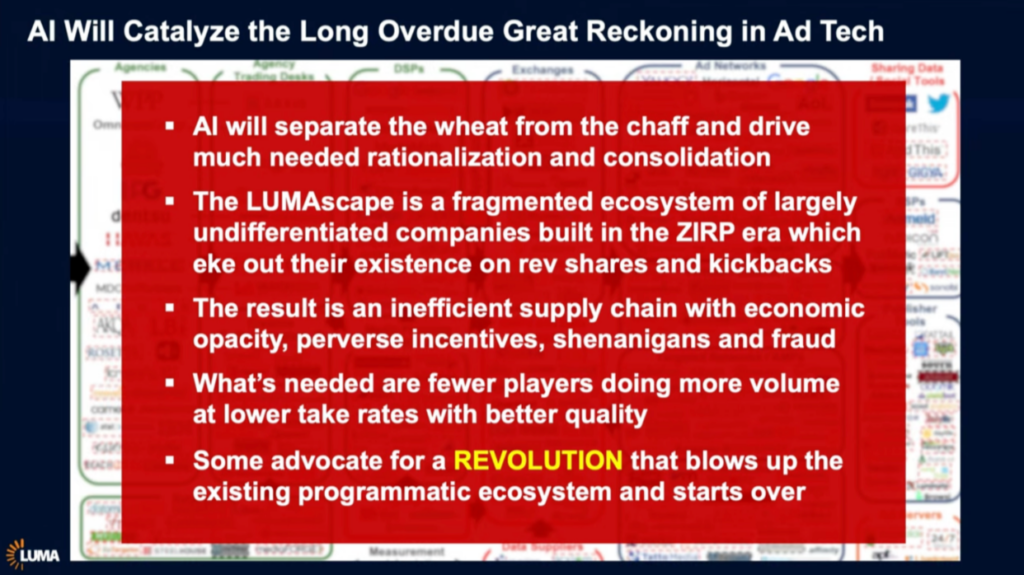
As Terry tells it: “The LUMAscape is a fragmented ecosystem of largely undifferentiated companies built in the ZIRP era that eke out their existence on rev shares and kickbacks.”
Low barriers to entry
There are over 5,000 adtech companies in the LUMAscape, competing across dozens of different market segments that often blur together. Just within the narrow US audience targeting segment that Dstillery competes in, there are about 250 different providers in The Trade Desk’s data marketplace, with over a million audiences available.
This fragmentation reflects the reality that barriers to entry for the industry are quite low. New adtech companies can be started with very modest amounts of capital and many business models have very low breakeven points. Meanwhile, the industry is enormous, with over $1 trillion of annual global ad spend, and it is highly dynamic.
That combination of circumstances encourages new company formation. Though many VCs steer clear of the industry due to its structural challenges, seed money is readily available for good ideas — or for marginal ideas promoted by repeat adtech entrepreneurs with lots of industry friends and family.
Differentiation is difficult to discern
I strongly disagree with Terry’s assertion that adtech companies are undifferentiated. Rather, I believe that the industry’s fragmentation, complexity and opacity make it difficult for adtech companies to simply communicate their differentiation, or advertisers and their agencies to understand it.
Every one of the 5,000+ LUMAscape companies says that its technology, data, service or solution generates the best outcomes for campaigns, and every one claims some sort of unique competitive advantage. As often as not, those claims are untrue, and with some effort, proveably so.
It takes a lot of work for buyers to confidently separate those adtech companies that add value from those that do not, and the constant innovation means that that work is never done. In light of that, many buyers cynically simplify their work by just assuming, as a matter of convenience, that all companies, products and technologies are commodified, and there is little distinction of value. Even those who try to differentiate in good faith may give up in frustration.
AI will reveal who is swimming naked
Warren Buffett famously said “Only when the tide goes out do you discover who’s been swimming naked.” In the context of investing, it means that all companies might seem successful when the economy is strong, but an economic downturn exposes bad businesses, fragile financial profiles and/or excessive risk-taking.
Consistent with Terry’s prediction of a reckoning, this aphorism applies to the tide of AI that is coming to the adtech industry.
As more advertisers, agencies and adtech platforms bring AI into their digital media buying processes in search of efficiency and performance, the adtech supply chain will become more transparent and accountable, the cornerstones of trust in any industry. It will become much easier to understand — objectively and confidently — which adtech partners are providing differentiated value, which are commoditized, and which are just exploiting industry inefficiencies and opacity to keep the lights on.