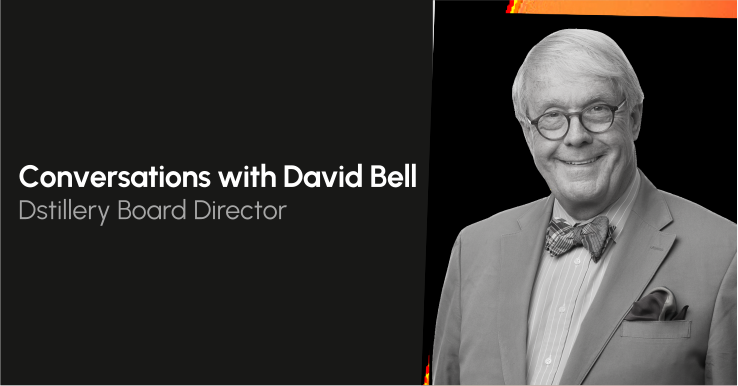
Few people have influenced the advertising industry as profoundly as David Bell.
Over the course of his distinguished career, David has helped shape the evolution of modern marketing – from building one of the world’s leading media agencies to advising and investing in the next generation of advertising technology companies. Today, as a member of Dstillery’s Board of Directors, he continues to bring a unique perspective on the trends, technologies, and ideas transforming our industry.
At the 2026 Cannes Lions International Festival of Creativity, David sat down with some of advertising’s most respected executives for a series of candid conversations exploring the forces reshaping media, marketing, and technology. Rather than formal interviews, these are thoughtful discussions between industry peers, covering everything from AI and data innovation to entrepreneurship, creativity, client transformation, and the future of agency leadership.
The result is Conversations with David Bell: a collection of insightful interviews with the people helping define what’s next for advertising.
Each conversation offers a different perspective, but together they tell a compelling story. AI is accelerating change across every corner of the industry. Trust and transparency are becoming increasingly important. And while technology continues to evolve, success still comes down to people – their curiosity, creativity, and willingness to adapt.
Featured conversations: leaders shaping what’s next
The inaugural Conversations with David Bell series features interviews with:
Together, these interviews paint a compelling picture of an industry in transition. Spanning topics from agency leadership and mentorship to AI, data strategy, and measurement, the conversations reveal both diverse viewpoints and a shared vision for the future of marketing.
Click here to view the highlights from the conversations.
AI is changing everything, but people remain the differentiator
Across nearly every interview, executives agreed that AI is fundamentally reshaping advertising. Yet the consensus was equally clear: technology is most powerful when it amplifies human creativity, strategic thinking, and collaboration rather than replacing them.
Trust and transparency matter now more than ever
As AI becomes increasingly embedded across organizations and teams, leaders emphasize the importance of transparency, responsible data practices, and trusted partnerships. Success won’t come from technology alone; it will come from organizations that earn and maintain client confidence.
Innovation thrives through collaboration
Whether discussing agency partnerships, open technology ecosystems, or client relationships, guests repeatedly highlighted collaboration as a competitive advantage. The future belongs to organizations willing to learn, adapt, and innovate together.
Leadership requires curiosity
Many conversations turned to leadership itself and how to guide teams through rapid change, encourage experimentation, embrace failure as part of growth, and remain relentlessly curious in an industry that never stops evolving.
Conversations with David Bell are more than interviews
These aren’t traditional executive interviews. They’re candid conversations between industry peers, exploring the challenges and opportunities shaping advertising today and the decisions leaders are making to prepare for tomorrow.
Whether you’re interested in AI, media strategy, entrepreneurship, data-driven marketing, or agency leadership, you’ll find valuable insights throughout the series. We’re grateful to each executive who joined David during a busy week in Cannes to share their perspectives, experiences, and vision for the future.
Watch all the Conversations with David Bell on our videos page to hear directly from the leaders helping define the next era of advertising.
Editor’s Note: This interview was originally featured in The Female Quotient’s Leaders Spotlight from their newsletter on June 2, 2026.
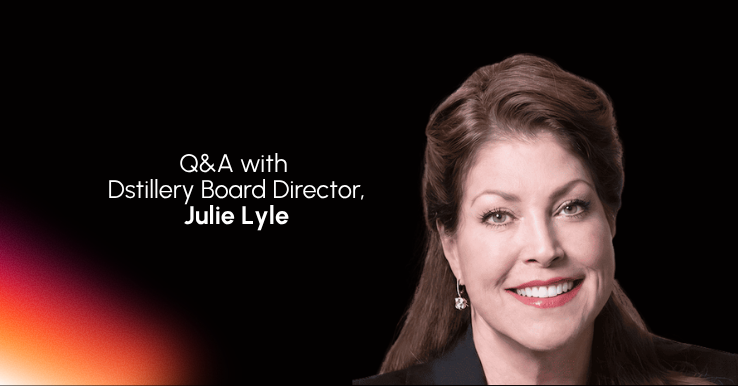
Julie Lyle is a Board Director at Dstillery, the leading predictive AI audience targeting company. She is also President and Board member of TCC Global, where she leads efforts to help retailers worldwide drive customer loyalty, develop data strategies, and implement marketing programs at scale. Julie began her career as an entrepreneur before moving into executive roles at Walmart, Prudential plc, and Barnes & Noble, building deep expertise at the intersection of commerce and consumer behavior. In addition to her operating roles, she is a seasoned investor and advisor, serving on the board of meetsynthia.ai. Julie is widely recognized for her perspective on how brands can build lasting customer relationships through data and personalization.
What’s the most unexpected opportunity you’ve gotten in your career?
Early in my career, Mitch Hart, who is a venture capitalist and Founder of The Hart Group, recognized my potential and gave me the role of functionally reporting to 5 portfolio company CEOs, while administratively reporting to Mitch as Chairman. Through that job, I learned to successfully navigate internal politics, build trust among competing executives, and master conflict among big personalities. It was challenging, and the skills I gained were invaluable.
What’s the worst career advice you’ve gotten?
“If people allow you to take advantage of them, they deserve what they get.” I categorically disagree with that. I believe we all have a moral imperative to do well by doing good, as companies and as people. At the end of the day, your integrity is all that matters.
What was a heartbeat moment for you in your career?
It was when my mother was diagnosed with cancer. While she fought valiantly, she eventually had to be transitioned to hospice care. I was CMO of Walmart at the time, and I immediately resigned so that I could go and take care of her. It was a heartbeat moment for me because I loved my job. It was difficult to go from managing multi-billion-dollar profit and loss statements to changing bedpans and IVs, but I wouldn’t change that decision for the world. Those last months I had with my mom will always be precious to me.
Who is one person you’d love to give flowers to from your career that influenced your journey? What advice or lesson did you learn from them?
I would give flowers to Dan Burnham, who, when he was CEO at Raytheon, gave me a “tough love” challenge to be more intentional about how I managed my career. I took his advice to heart and developed a 7-part marketing plan with time and action schedules that I implemented and followed for the next 25 years. It had an incredible impact on my career growth and income. I eventually turned it into a curriculum and convinced Walmart to offer the program to 2,500 female managers in an effort to empower them with a clear path for growth and development. Even though it was 18 years ago, I still receive notes from women who used those growth insights to achieve success. I’m grateful to Dan for challenging me, bringing out my best, and allowing me to pay it forward.
Where have you caused some good trouble in your career?
During the 2008 global financial crisis, I was leading a team charged with accelerating growth in Prudential’s Asian insurance business. Market confidence was at an all-time low, and we had very little brand awareness in Asia. After careful research, we went against industry standards and took a big risk. We shifted our entire marketing strategy from typical financial services messaging to focus on families with children under the age of 12. We developed music videos, apps, games, and characters around a financial learning program for kids. We shifted our advertising dollars from the major news and financial media outlets to Nickelodeon. It was a huge success, and our sales, recruitment, and brand recognition soared.
Want to nominate a Female Quotient “Troublemaker” you admire? You can do so here.
Editor’s Note: This blog is inspired by Dstillery Board Director Julie Lyles’ presentation at the Food Industry Summit, 4/17/26, St. Joseph’s University.
For decades, loyalty has been won at the moment of choice, from the shelf to the feed to checkout. Today, that paradigm is breaking down.
A new model called agentic commerceis emerging, where AI systems increasingly act on behalf of consumers, researching, evaluating, and completing purchases. Gartner reports that a growing share of digital commerce interactions will soon be influenced or executed by AI agents. At the same time, research from McKinsey & Company finds that over 70% of consumers already expect brands to anticipate their needs, accelerating the shift toward automated decision-making.
This fundamentally changes the role of marketing.
Dstillery POV: The most important decisions are no longer happening in the moment; they are being modeled in advance. Brands are no longer just competing to be chosen by consumers; rather, they are competing to be pre-selected by the systems that decide.
The Collapse of the Decision Moment
Historically, marketing strategy has focused on influencing behavior within the consumer journey. This has largely been done through promotions, channel retargeting, and checkout conversion optimization.
It is essential to note that this model assumes a human actively navigating options. Agentic AI removes that assumption, is apt to learn from behavioral signals, evaluate options, and execute purchases autonomously. Research from Deloitte projects that customers will increasingly hand over not just recommendations, but also purchasing authority to autonomous agents, prompting brands to consider how they earn influence and embed into automated workflows.
Dstillery POV: The “moment of decision” is no longer a moment; it’s a model. What used to be a discrete interaction is now the output of continuous prediction. The implication is that brands that rely on actively intercepting consumer decisions will lose ground to those shaping the model upstream.
From Influence to Prediction
We are moving beyond influence into something more powerful: predictive preference modeling. Traditional commerce has historically focused on influencing decisions, optimizing conversions, and reacting to consumer behavior. In the age of agentic commerce, AI systems can effectively predict consumer decisions, optimize the likelihood of selection, and model behavior before it occurs.
Dstillery POV: The next stage in the evolution of marketing is prediction, not persuasion.
At Dstillery, this is the foundation of how modern audience targeting should work. AI is not just identifying who a consumer is: it is identifying and predicting who they are likely to become in a given context. This distinction matters.
In an agentic marketplace, the brand that wins is not the one that always reacts the quickest. Instead, it’s the one already aligned with the anticipated outcome.
The Commoditization Trap
As AI intermediates transactions, traditional levers of differentiation erode. Price, convenience, and availability become instantly comparable, continuously optimized, and algorithmically interchangeable.
According to NielsenIQ, in categories like grocery, purchasing is largely driven by habitual, repetitive behaviors, with returning buyers accounting for a significant share of brand revenue. When those habits are handed to AI, the system defaults to efficiency unless directed otherwise.
Dstillery POV: If your brand is only winning on efficiency, you are training the system to replace you. Without strong preference signals, brands become indiscernible and substitutable.
What AI Can’t Optimize (Yet)
AI excels at optimizing functional outcomes, such as finding the lowest price, the fastest delivery, and the highest-rated option. However, loyalty is not built purely on functionality.
Research from Accenture indicates 63% of consumers show increased loyalty to brands that align with their values.
Dstillery POV: The most valuable signals are the hardest to quantify and the hardest to displace. These signals include emotional connection, brand trust, cultural relevance, and perceived identity fit. Preferential signals don’t disappear to agentic systems; instead, they become inputs. The question is whether your brand is generating them strongly enough to be recognized.
The New Loyalty Equation
In an agentic world, loyalty is no longer built at the point of purchase. It is built before the system begins evaluating options.
Dstillery POV: The Pre-Decision Advantage
The brands that win will:
Model intent early, moving upstream from conversion to intent formation
Create durable signals that AI systems can learn from, such as behavioral patterns and contextual relevance
Reinforce preference continuously, ensuring signals are not episodic, but instead, persistent
Align with machine logic, structuring brand signals in ways legible to AI systems
The Role of AI-Powered Advertising
In an agentic landscape, fragmented signals create blind spots, causing identity-based approaches to struggle as signal loss increases. What’s needed is a system that can operate without dependency on identifiers, while still modeling high-intent behavior. This is where our approach at Dstillery becomes critical.
Dstillery POV: Identity is not required to understand intent: prediction is.
Dstillery’s AI-driven approach synthesizes behavioral and contextual signals across environments to identify patterns of emerging intent and build custom AI audiences based on likelihood to act. This enables brands to engage consumers earlier in the decision cycle, influence both human- and AI-mediated outcomes, and shape preferences before they are formalized into action.
From Targeting to Training
As AI reshapes advertising, the role of targeting is evolving. Finding demand is no longer enough – brands must also train the systems that ultimately determine who wins it.
Dstillery POV: Impressions now serve a dual purpose: driving immediate conversion while simultaneously informing future decision systems. This shift reframes campaigns as both performance engines and signal generators. In turn, media evolves from a distribution channel into a persistent data ecosystem—one where every outcome contributes to cumulative impact.
Brands that understand this will think beyond short-term ROI, invest in long-term signal strength, and build compounding advantage gradually.
An Opportunity to Lead
What feels experimental today will quickly become standard. The shift into the agentic commerce era creates a clear divide between brands that optimize for today’s decisions and brands that shape the decisions of tomorrow. According to Deloitte, over half of leading retailers believe AI agents will handle most customer interactions within five years. McKinsey reports that agentic AI commerce will likely generate up to one trillion dollars in the United States alone by 2030, with global projections as high as five trillion. Ultimately, agentic AI isn’t the add-on in commerce: it’s the infrastructure.
Dstillery POV: The brands that win in an agentic world won’t just participate in the ecosystem; they will influence how it thinks.
Preference Is the New Currency
Loyalty has always been rooted in economics. In an era where convenience is assumed, comparison is automated, and decisions are delegated, preference becomes the most valuable currency of all.
Dstillery POV: If you are not shaping preference, you are competing on leftovers. The question isn’t if your brand wins at the moment of choice; it’s whether it has already been chosen before that moment arrives.
Multimodal learning is the next frontier in machine learning. It allows machines to combine different types of data to understand more than is possible from any one source.
Think of the example of understanding a scene in a play. As humans, our brains seamlessly integrate visual cues, auditory input, text, and prior knowledge. In a scene, we may see a waiter fall and drop a tray of drinks, we hear the crash of objects falling, we hear language spoken as someone reacts to the accident, and we read a caution sign saying the floor is wet. From this input, we easily conclude that the waiter slipped on the wet floor and dropped the drinks. This is due to our brains combining visual cues, auditory input, text, and prior knowledge. Without the combination of all of these inputs, we risk drawing the wrong conclusion about the scene. Auditory input alone might tell us an accident occurred, while visual cues may show a waiter slipping and drinks falling – but without reading the sign that says the floor is wet, we can’t fully understand why it happened.
Multimodal machine learning allows machines to perform a similar fusion of different data modalities, giving machines the ability to understand context, respond naturally, and make smart decisions in complex environments.
At Dstillery, we are experts at using AI to perform ad targeting. A powerful data modality in this space is user browsing behavior. The success of ad targeting campaigns is often measured by a conversion event performed online, such as purchasing a product or visiting a homepage. The journeys a user takes across the internet can be very predictive of whether they are likely to perform a particular online conversion or not.
For example, online retail sites visited by a consumer tells us the user’s style and the amount they may be willing to pay, and gives clues to demographic attributes such as gender and age. It is intuitive to see how this leads to useful features in an ad targeting campaign for a clothing brand. With the recent development in LLMs and generative AI, highly accurate text features can be generated for almost anything. This gives a second highly performing data modality we can use in our ad targeting campaigns.
We have built a modular, scalable multimodal architecture to integrate these data modalities and produce high-performing CTV ad targeting. Our patent-pending approach combines web behavioral features and text features to generate richer predictions, better personalization, and smarter automation of CTV ad targeting.
Our Approach: A Modular Multimodal Architecture for CTV Ad Targeting
Our CTV ad targeting system is built on a modular multimodal architecture that combines a foundation model with a lightweight mapping model. The foundation model is trained on large-scale web browsing behavior, while the mapping model enables us to extend that model’s capabilities to other data types — such as text — by projecting them into the same embedding space.
Foundation Model: Learning Behavioral Embeddings from Web Journeys
At the core of our system is a foundation model trained on web visitation sequences, producing what we call MOTI embeddings — short forMap Of The Internet. These embeddings are learned using self-supervised learning on billions of sequential website visits. The model is trained to predict the next website in a user’s browsing journey, allowing it to learn the behavioral patterns and intent behind web visits.
This results in a rich embedding space that captures user behavior across the open web — not just what sites users visit, but why and in what context. MOTI embeddings provide a strong signal for predicting future behavior, especially web-based conversions.
Mapping Model: Extending MOTI Embeddings to New Modalities
To enable multimodal learning, we train a mapping model that projects from text space into the MOTI embedding space. This allows us to represent any domain described by text — such as CTV content metadata — using the behavioral signal embedded in our foundation model.
We train this mapping model by aligning two modalities:
MOTI embeddings for a large set of websites.
LLM-generated keyword embeddings extracted from the same websites using generative AI.
By training a model to predict MOTI embeddings from LLM embeddings, we learn a cross-modal projection that allows us to map new text inputs (e.g., CTV parameters) into our MOTI space — effectively teaching the text modality to “speak the language” of web behavior.
Brand-Specific Models: Optimizing for Conversions
Clients often wish to drive outcomes measurable by web conversions — such as site visits, keyword searches, or product views. Since MOTI embeddings capture real behavioral intent, they serve as high-performing features for building client-specific models trained on conversion outcomes.
These models learn what types of behavior (in MOTI space) are most predictive of desired outcomes for each brand — allowing us to personalize targeting at scale.
CTV Targeting: Scoring Content Using Behavioral Signals
Once we’ve trained a brand-specific model in MOTI space, we can use it to score any other domain that can be described in text. For CTV ad targeting, we use generative AI to extract semantic features from content metadata — such as series, title, genre, language, rating, and channel.
These features are embedded using an LLM, then mapped into MOTI space via our mapping model. This allows us to use the brand’s web conversion model to score and rank CTV inventory based on how closely it aligns with high-performing web behaviors — creating a seamless link between behavioral intent and CTV content.
This architecture enables us to fuse two distinct data modalities — behavioral browsing data and structured text — through a shared representation space. It’s a powerful, scalable approach to multimodal learning: one that leverages foundation models, bridges across modalities, and delivers measurable performance in production systems. You can think of it as teaching the text modality to speak the behavioral language of MOTI embeddings, allowing both modalities to contribute meaningfully to targeting decisions.
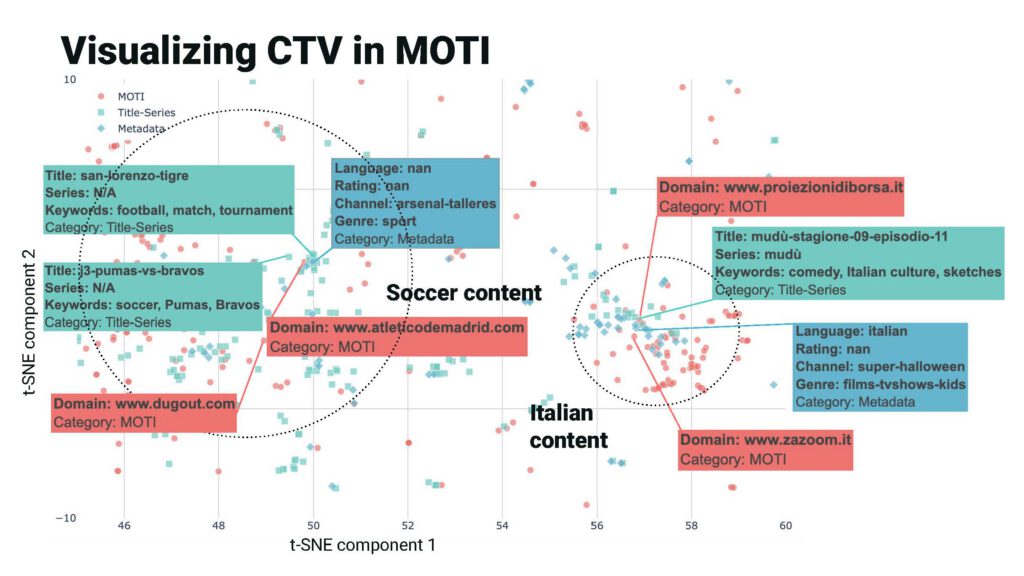
FIGURE: TSNE visualization of CTV attributes (series, title, language, rating, channel, genre) in the same space as websites in MOTI. As indicated by the left dotted circle, CTV attributes related to soccer, as well as soccer related domains are close by in the MOTI space. Another example indicated by the right dotted circle shows CTV attributes and nearby domains are related to Italian content.
A powerful, flexible approach to multimodal learning
Scalable: Leveraging an existing foundation model trained on large amounts of streaming data allows the training of CTV models at scale. Training a model for each of our clients is fast and efficient.
Flexible: As text features from LLMs improve, or new CTV shows are aired, we can represent this new data in our multimodal model without retraining our large and computationally expensive foundation model.
Composable: As text features have emerged over the past couple of years, if there is a new data modality that is useful for ad targeting we can simply train a new mapping model and produce a multimodal solution with a new modality
Interpretable: Our solution is highly interpretable because we can query the joint representation space easily, giving us a clear understanding of the relationship between modalities
Results in the real world
Our modular multimodal targeting system has delivered strong, measurable performance across verticals, proving its value in real-world, ID-free environments.
An automotive client sought to reach high-intent car shoppers using an ID-free CTV strategy. Using our modular multimodal architecture, we built a custom brand model for the campaign.
– The ID-free CTV model outperformed the client’s ID-based audience from day one, ultimately achieving a 98% higher video completion rate (VCR) by the end of the campaign. – The model also delivered better cost efficiency, producing more CTV conversions at a lower cost per conversion (CPC), obtaining a CPC of $9.13. – The client’s agency concluded that adding ID-free targeting alongside traditional ID-based models significantly expanded reach without sacrificing performance.
Kitchen Appliance Brand: Sustained Success Across CTV and Display
A kitchen appliance brand partnered with Dstillery to raise awareness for their new products using CTV and display media. They measured success using VCR and clickthrough rate (CTR) as KPIs.
– The campaign achieved a 94% average VCR on CTV beating the client benchmark of 70%. – Display ads delivered a 0.14% CTR beating the 0.10% benchmark. – Top-performing CTV channels included AT&T TV, Discovery Channel, and Food Network Kitchen — all aligned with high behavioral intent signals captured in our MOTI embeddings.
Multimodal AI for CTV: A Real-World Blueprint for Smarter Ad Targeting
Our solution is a framework for practical multimodal AI. When there are two complementary data sources and a unimodal foundation model exists for at least one of the modalities, a fast and efficient solution to multimodal machine learning is to train a model to learn a mapping from one modality to another. This produces an efficient multimodal solution that is interpretable and adaptable. You don’t need to train all modalities together from day one. Multimodal learning can be layered, modular, and immediately impactful. Multimodal learning isn’t just about giant models – It’s about combining signals to see more clearly and building systems that grow with your product.
Following our Dstillery sponsorship of the first annual BrXnd AI event last May in NYC, our Executive Director, Taylor Zamora, and I attended the first LA version at the NeueHouse Hollywood.
BrXnd AI Founder Noah Brier has emerged as a leading authority on how brands can and should use, and are using, generative AI tools at all stages of the marketing process. Brier’s team consults with companies of all shapes and sizes about using AI, publishes a newsletter and Marketing AI landscape, and hosts in-person events.
Reflecting on a day of learning and inspiration, I am thoroughly convinced that AI is not overhyped. It is having real impact.
The first half of the day was mostly about the state of AI and trends in how brands are using it. The second half was essentially demos/pitches. Both were impressive and thought-provoking. A few themes emerged:
– The consensus view is that we are still very much in the discovery & experimentation stage with AI
– The LLM model itself is a tool, and our collective imagination in using it to solve business challenges is the value-add
– ROI is hard to measure at this stage and it is premature to try and assign dollar values
Having sponsored and attended BrXnd NYC’s 2024 event, we saw some amazing progress. There were fewer demos of working AI technology in action. Tools were not ready, so the conference was heavy on trends and themes and light on specifics. We have come a long way.
The audience for the products is marketers and agencies, and there were some VERY cool demos of tools that simplify and speed up agency and digital media workflows, opening up new opportunities. Here are a few of our favorites:
– And my personal favorite, the Waldo.fyi research assistant
These are very cool customer-facing tools that help brands and agencies do their work better, faster, and more cheaply. Eight months ago, they did not exist. Now, they are compelling workflow tools gaining adoption among our clients. I am blown away by the pace of the progress.
Above all, I am convinced after the BrXnd AI showcase that we are only just getting started.
Back in January 2020, when Google first announced its intention to deprecate third-party cookies, marketers and advertisers started exploring alternative strategies to reach audiences effectively. And while third-party cookies are technically still here, the need for new privacy-safe targeting solutions remains.
Two popular approaches are ID-free® targeting and contextual targeting. While both methods help deliver privacy-friendly advertising, they are distinct in how they operate and how they identify the best audiences.
Understanding ID-free Targeting
Dstillery’s patented ID-free targeting is a revolutionary technology that employs a totally different approach than basic content analysis. ID-free targeting is rooted in data science and machine learning, leveraging sophisticated algorithms to find the right audiences without relying on any form of personal identification, cookies, or device IDs. By analyzing the aggregated behaviors of an anonymous consumer panel, such as browsing behavior, content consumption, and time of day, ID-free targeting finds your best audiences based on behavioral inventory signals. What’s more? ID-free predicts which sites are likely to convert for your brand without any user profiles or tracking.
The power of our ID-free technology lies in its ability to be adaptive and intuitive. It allows advertisers to reach users who are most likely to engage with their messages, based on patterns of behavior that indicate interest, rather than matching specific topics or keywords. This level of precision not only enhances campaign performance but also meets the growing need for privacy-safe solutions.
What is Contextual Targeting?
Contextual targeting is an advertising method that involves placing ads based on the content of the webpage, or the context in which the ad is served. For example, an ad for gym clothes might appear in a blog article about workout routines. This approach uses keywords, page topics, and sentiment analysis to ensure that ads align with the content that users are currently viewing.
While contextual targeting can effectively place ads in relevant environments, it is limited by its reliance on immediate content. It does not account for user behavior beyond the current page the way ID-free does which will cause advertisers to miss out on reaching pertinent audiences.
Contextual targeting is a good way to understand the keyword clusters an audience member might search for along their digital journey. However, if you craft a deep profile of understanding around your audience, only a tiny fraction of that audience will be targeted by contextual solutions.
Key Differences Between ID-free and Contextual Targeting
ID-free technology
Contextual Targeting
Audience Precision
Leverages complex data science techniques to identify ideal audiences based on anonymous behavioral signals
Matches ads to specific content, ignoring interest patterns or user journeys
Privacy Standards
Privacy-safe, does not rely on any personal data
Privacy-safe
Adaptability
Dynamically adjusts to shifting behaviors and trends in real-time, enabling brands to stay relevant
Tied to specific page content and may not capture broader audience interest shifts
Choosing the Right Solution for Your Brand
As more and more people opt out of cookies, it’s crucial to understand the differences between ID-free and contextual targeting. While contextual targeting is effective in aligning ads with relevant content, ID-free offers a powerful alternative for brands and their agencies aiming for audience precision without sacrificing privacy.
If you’d like to test ID-free targeting in your next campaign, reach out to get started.
As digital marketers and advertisers know, effective audience targeting can make or break your campaigns. With the right audience, brands can spark more engagement, stretch their ad dollars, and maximize return on investment (ROI). However, as marketers strive to connect with their ideal customers, they face a crucial targeting decision: Should they rely on Pre-built audiences or invest in Custom Built audiences that cater specifically to their campaigns’ needs?
Let’s decide together. At Dstillery, we offer advanced audience targeting solutions built using patented AI technology. In this blog, we’ll walk you through the ins and outs of our Pre-built and Custom audiences, so you can decide which option will give your campaigns the edge they need. With the right insights, you’ll be ready to make smart moves that drive results and perfectly align with your unique campaign goals.
Understanding Audience Targeting
What is audience targeting and why does it matter? Audience targeting is the marketing practice of identifying and segmenting specific groups of consumers to deliver personalized messages. It’s a vital component in the success of any digital marketing campaign – getting your ads in front of the right people who are most likely to engage with your brand.
In today’s data-driven world, the ability to refine your audience based on demographics, behavior, and interests is more powerful than ever. Whether you’re using Pre-built or Custom Built solutions, when you hit the mark with your targeting, you’ll see increased conversions, stronger customer relationships, and a much smarter use of your ad dollars.
Creating a custom audience is where the magic happens. Marketers often utilize data sources like first-party data from CRM databases, website traffic, or third-party data to build audiences that target specific customer personas. The result? You get precise and effective communication with the people who matter most to your brand.
What Are Dstillery’s Pre-built Audiences?
Pre-built audiences are Dstillery’s off-the-shelf audiences, powered by behavioral, demographic, search-based, and partner data. These audiences are high-performing, ready-to-activate, and proven to drive qualified reach.
Advantages of Pre-built Audiences
Convenience: You can easily select from a variety of predefined audience categories. Click here to browse Dstillery’s library of over 15,000 Pre-built audience segments.
Speed: All Pre-built audiences are available for immediate activation, allowing you to launch campaigns quickly and seamlessly.
If you’re launching upper-funnel digital campaigns optimized for driving reach or building brand awareness, Pre-built audiences are for you. Pre-built audiences are ideal for broad brand awareness campaigns or testing new markets. On the flip side, they may not deliver the same engagement when your target market is niche or you’re looking to optimize for lower-funnel KPIs like conversions.
What Are Custom Built Audiences?
Custom Built audiences are tailored to meet the unique needs of your organization. Built primarily using first-party data, these audiences let you create highly targeted segments based on specific behaviors, preferences, and demographics.
The process of creating these custom audiences is all about leveraging data to craft an audience that closely matches your ideal customer profile. Whether you’re using custom audience targeting for healthcare, retail, or B2B campaigns, this personalized approach ensures that your ads land in front of the right people.
Advantages of Custom Built Audience
Precision Targeting: Custom audiences allow you to focus on highly specific segments, improving the relevancy of your ads.
Personalization: You can tailor your ad messaging to resonate with your audience’s needs and interests, increasing engagement.
Better Performance: With precise targeting and personalized content, custom audiences can lead to higher conversion rates and a better ROI.
However, there are some challenges. Building a custom audience takes time, resources, and access to reliable data. Additionally, if not managed carefully, custom audiences could get a bit too narrow, which means less reach and ad fatigue.
But don’t worry – when you team up with Dstillery, your Custom Built audiences are refreshed every 24 hours, so you’ll always have fresh audiences across the flight of your entire campaign. Our experts will launch and optimize your campaigns to help you meet and exceed your KPIs.
Discover our recent success with advertising agency Sokal, where our custom audiences generated a 75% better CPM against client benchmarks.
Key Factors to Consider When Choosing Between Pre-built and Custom Built Audiences
Choosing between Pre-built and Custom Built audiences depends largely on your business goals, resources, and the type of campaign you want to run. Here are some factors to consider when deciding which option is best for you:
Pre-built Audiences
Custom Built Audiences
Campaign Objectives
Brand awareness, upper-funnel KPIs
Retargeting past customers , promoting a niche product, lower-funnel KPIs
Data Availability
Frst-party data is not available
First-party data is available
Scalability
Scalable Refreshed every 24 hours
Scalable Refreshed every 24 hours
For more guidance on audience selection, read about our Custom Built audiences here and our Pre-built audiences here.
Elevate Your Campaigns with Custom AI Audience Targeting
Both Pre-built and Custom Built audiences are proven highly effective in a successful advertising campaign strategy. The key is understanding which solution aligns with your campaign goals, budget, and data availability. By understanding the differences between the two audience types, you can ensure that your advertising campaigns are set up for success.
Google’s decision to abort its retirement of third-party cookies from Chrome is kind of like President Biden’s decision to withdraw his candidacy for president. It is a massive fundamental shift in direction, but at the same time it is really not surprising at all.
In its announcement, Google indicated that though cookies will remain, it will take steps to ensure that consumers have more control over their personal data, yet telegraphing that data collection will be more difficult for the adtech industry. Combined with other privacy-related developments, this will pressure the quantity and velocity of user data in the adtech ecosystem. But that loss of signal will now be a steady and manageable decline, rather than a cliff.
Google’s plan to retire cookies has inspired a lot of innovation over the last four years, and there is no putting that genie back in the bottle. There are new, privacy-safe technologies like Dstillery’s ID-free® behavioral targeting in the market, and the overall trend toward higher privacy standards, if it continues, will open up opportunities for those that perform to thrive, regardless of the continued existence of cookies.
A collective sigh of relief
That said, I suspect that brands and their agencies are breathing a collective sigh of relief. The transition from cookies to something else was always going to be hard, and messy.
Media agencies are enormous, distributed and complex operations, and their workflows, partners and tools all had to adapt. Scale of the alternatives was a question. Some of the alternatives, like probabilistic IDs, had problematic privacy credentials of their own. And measurement was going to be challenging. Brand KPIs were going to break. Essentially, the fabric of the programmatic ad industry needed to be rewoven.
Media agencies had little control over this process, and not much choice. Like the adtech industry, they were being forced to adapt to the agenda of a large and powerful industry platform. The industry had done an admirable job preparing for this future, and had invested significant brain power, people hours and dollars to make this transition.
Despite all of that investment, there was still a great deal of uncertainty about how exactly this transition would unfold. The risks, uncertainties and operational challenges that accompanied cookie retirement from Chrome, and the headaches that created for media agencies, can now be pushed to the back burner.
Rebalancing our attention
From Dstillery’s perspective, we recognize the magnitude of this shift in the industry’s agenda.
We said at the beginning of this year that 2024 for our industry would be a year like no other, and that the only thing we knew for sure was that there would be a lot of change. From the halfway point of the year, it has lived up to its billing.
Dstillery is uniquely positioned, in that we can provide highly effective targeting solutions with or without IDs, and we are rebalancing our attention across our portfolio.
Our cookie-based audiences continue to deliver best in class performance, and we see opportunities to invest in new types of seeds, new modes of activation, new modeling technologies, and new distribution. Our ID-free targeting provides privacy-safe targeting solutions for parts of the market where that is important, and through our Predictive Bidding actually drives superior scale and performance to even our best cookie audiences.
Together, our ID-based and ID-free targeting solutions can fulfill the targeting needs of our programmatic partners and advertisers, with or without cookies, and we are excited for the new opportunities that this most recent shift will bring.
The rise of AI and the fall of the cookie together are creating profound change for the programmatic advertising industry. With Chrome’s deprecation of third-party cookies now just months away, nearly every part of the ecosystem needs a plan to adapt its programmatic execution to the new reality.
The result is a seemingly endless swirl of technologies – new and old – with an increasing number of AdTech companies claiming to have the solution. The cacophony of pitches and promises is dizzying, and many marketers are understandably paralyzed by the chaos of the marketplace.
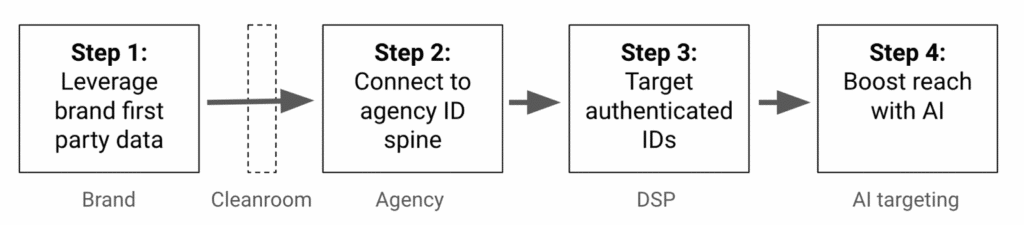
While there is definitely some complexity, a simple four-step approach will allow brands and agencies to clarify and unlock their post-cookie targeting strategy.
4 simple steps
1. Leverage brand first-party data. Building closer relationships with customers is always a good thing, and a strong first-party data set is a solid foundation for post-cookie success. But it is only a first step.
2. Connect to agency identity spine. Media agencies of all sizes have been building (or buying) identity spines that provide them with a broad understanding of mostly offline consumer behaviors, and deep demographic, psychographic, and behavioral profiles. Brands can connect their first-party data with these larger data sets via clean rooms to provide a privacy-safe path to activation.
3. Target authenticated IDs. There are a number of emerging alternative IDs that let advertisers find their customers, or lookalike customers, in the digital advertising ecosystem. Authenticated IDs like UID2 will drive performance that is superior to the less-precise third-party cookies, and will be a fundamental pillar of cookieless programmatic execution. Allocate the first budget dollars here for precision 1:1 targeting and measurement.
4. Boost reach with AI (this is where the magic happens!). Authenticated IDs are unlikely to deliver the scale of third-party cookies, so advertisers will need to spend more against impressions without IDs to drive reach and deliver brand KPIs. Some will default to classic contextual solutions, but new and emerging AI-driven targeting technologies offer a better way to fill the gap in reach left by cookie retirement. Delivering scale and performance that’s superior to contextual, they complement authenticated IDs by using the same behavioral signals and extend reach to the growing proportion of impressions without IDs. These innovative AI-driven technologies are the key to delivering reach, budget efficiency, and consumer privacy in a cookieless world.
Simplify your post-cookie targeting strategy
To simplify their approach to post-cookie targeting, brands should select best-in-class technology/partners at each step of this process. Choose your cleanroom partner, leverage your agency’s ID spine, work with your DSP in the authenticated space, and choose your AI reach boost partner.
Surely, there is a lot more complexity to work through than captured in this deliberate oversimplification. But by breaking the problem into just a handful of key decisions that fill the gaps left by cookie retirement, brands can create order from chaos, break the paralysis, and start executing an effective post-cookie programmatic targeting strategy.
Explore how Dstillery’s ID-free® targeting, an AI-powered technology that predicts ad impressions without user tracking, can enhance your programmatic campaigns in our frequently asked questions.
ID-free delivers performance and scale for advertisers’ programmatic campaigns. It also solves user privacy issues by not tracking users or creating user profiles. This makes ID-free a perfect solution for cookie deprecation and any privacy laws or regulations, including GDPR.
What are the use cases for ID-free?
ID-free is proven to drive both performance and scale. It can be modeled and optimized across the marketing funnel for most key performance indicators (KPIs), but it is most commonly used for upper-funnel campaigns driving qualified reach. By adding predictive bidding on The Trade Desk, it can also deliver up to 2.5x the performance of cookies for mid- and lower-funnel campaigns (more on this below).
What makes ID-free different from competitors’ solutions?
ID-free solves problems like performance, scale, and privacy for advertisers today. It’s not contextual nor an alternative ID; it’s patented technology in a category of its own.
ID-free uses AI to learn privacy-safe browsing patterns and applies these insights to inventory targeting. Think of it like this: ChatGPT understands words based on their use in a sentence. Similarly, ID-free understands website visits based on how they appear in browsing patterns. The result is privacy-safe behavioral targeting that reaches any display, in-app, or CTV ad impression with or without IDs.
How can I activate ID-free?
Partnering with Dstillery lets you choose the best ID-free activation method for your brand.
Activate via:
– PMP directly on your DSP.
– Predictive Bidding supported by The Trade Desk. Rather than making binary ‘buy’ or ‘don’t buy’ decisions, our AI predicts the precise value of each impression to your brand and exactly how much you should pay for it, maximizing every ad dollar.
– Contextual Integration found in The Trade Desk’s contextual marketplace.
How do I get started?
You can buy off-the-shelf ID-free audiences today on your DSP. If you’re looking for a custom, first-party data-powered ID-free audience, contact your Dstillery representative today or click here to get in touch.