As we all struggle with the growing personal and business disruptions associated with the COVID-19 pandemic, our focus at Dstillery is on our team and our clients.
For our own team members, our focus has been on their health and well-being. We are also conscious of our responsibilities as global citizens. Like many companies, we activated a business continuity plan in which we all are working from home starting last Monday. Our team is safe, and we are doing our part to slow community spread by avoiding commuting, crowded offices, in-person meetings, and travel.
As for our clients, though we are working from home, we are here to support whatever you need. We are fully operational and able to provide the same high level of service, excellent managed service campaign results, and strongly performing audience data that you know us for.
We are here to help you through your business challenges in whatever way we can.
Given our self-imposed isolation, it is important to stay connected through the channels that we have, to our partners, colleagues, and friends. The entire Dstillery team, from sales and client success to analytics and data science, are here to support you through this time. Reach out, and let’s stay connected.
Putting it succinctly, brands are spending more money than ever on sports sponsorships while acknowledging they have no trusted method to track their enormous investments. This presents a unique opening to apply the latest techniques in machine learning and AI to simplify what is an increasingly complex problem.
One potential solution is measuring fan behaviors for an individual sports property to see if fans’ digital interactions are aligning with sponsors’ activations and messaging. Dstillery used this exact approach by identifying fans of US Soccer and examining the changes in their digital behavior over a 22 month window encompassing the 2018 and 2019 World Cups. An analysis of the results reveals noticeable changes in US Soccer Fan’s behavioral composition from 2018 to 2019.
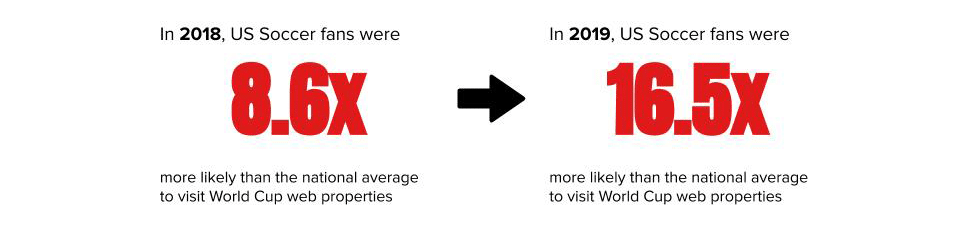
Overall, there was an increased attention to the World Cup in 2019 across the nation. Nielsen reported viewership of the Fox’s broadcast was up 22% from the men’s final last year. However, the interest in the World Cup grew even greater within the niche group of US soccer fans. In one year, US soccer fans’ interest in the World Cup doubled, compared to the national average. Likely driven by the success of the US Women’s National Team in France, the increase is a clear indicator of the digital attention the women’s team’s participation brought to the event. It’s also a reminder for brands that major events draw increased attention from target markets. The 2019 World Cup was an opportunity for sponsors to ride the wave of digital engagement organically generated by the conversations surrounding the women’s team.
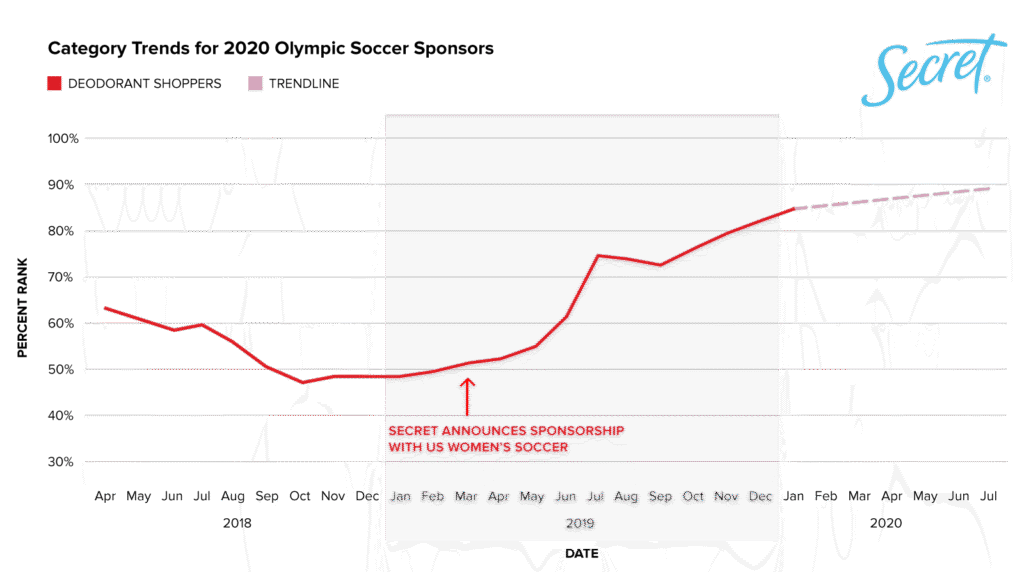
The sponsor who best capitalized on the wave was Secret, a deodorant brand from P&G. Last March, in the lead up to the 2019 World Cup, Secret launched a partnership with the US Women’s National Team. The timing of the announcement aligned perfectly with the increased digital consumption the US women’s team was attracting and propelled digital engagement with the brand’s category. As highlighted above, the US Soccer audience increased their engagement with deodorant shopping, including a massive jump at the start of the World Cup. However, Secret didn’t rely on the momentum of the World Cup to carry their partnership. The brand took it a step further and announced additional financial support amid the USWNT’s push for equal pay. These actions have seen Secret’s alignment with the women’s team become even stronger as deodorant shoppers continue to rank highly for US Soccer Fans.
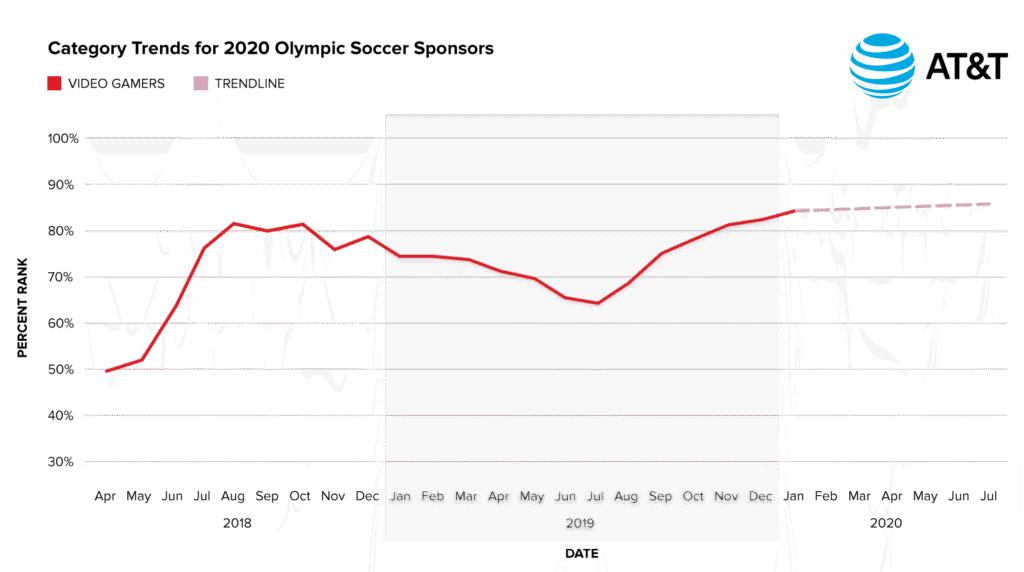
The deodorant brand is not alone. AT&T is another sponsor seeing success in its partnership. As the company rolls out its 5G offering, it has marketed heavily toward video gamers and esports fans. Fortunately for AT&T, US Soccer fans are increasingly interested in video games, which presents a unique opportunity. If the audience’s interest in video games continues, we’re likely to see Video Gamers get closer to the 90th percentile ranking of US Soccer Fans’ behaviors in 2020. The increased percentile ranking would indicate a high affinity of US Soccer Fans for video gaming (i.e. more people engaging with digital gaming content). This is great news for AT&T as it continues its rollout of 5G while maintaining a presence in esports.
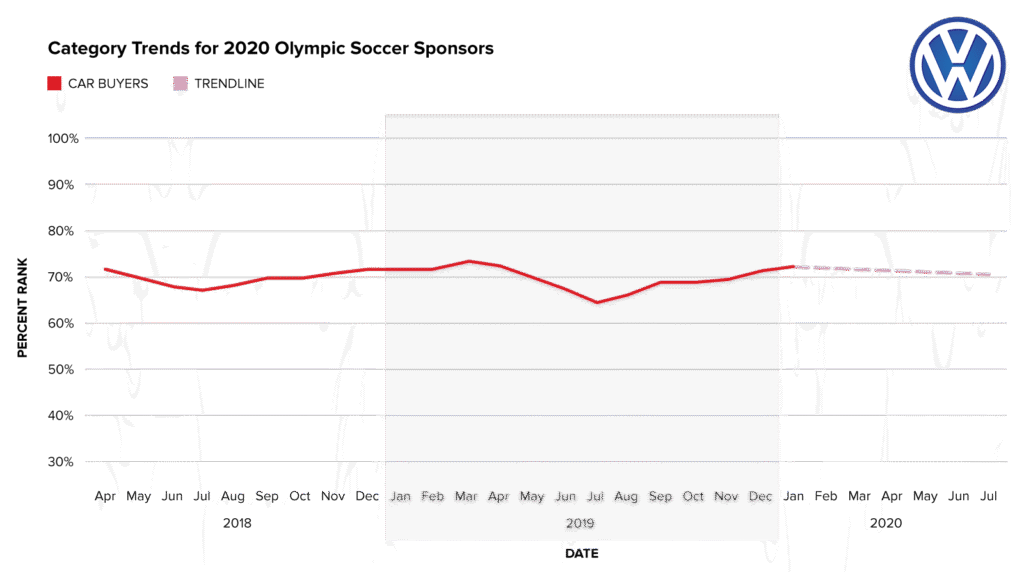
Meanwhile, car buying has remained a consistent behavior of soccer fans over the previous two years, providing steady value for sponsors like Volkswagen. Soccer fans have a strong affinity for buying a car but there are other behaviors that are more consistently characteristic of soccer fans. This could be explained by the lower frequency at which the audience is in-market for a car compared to say, daily or weekly purchases of groceries or video games. Car manufacturers can make an investment, starting with the Tokyo Olympics, in order to stand out to the next generation of car buyers by aligning the brand with a larger purpose. Prophet found that Gen Z, those individuals born between 1997 and 2012, is more committed to “changing the world than their millennial older brothers and sisters” and “expect companies to help, if not take the lead.”
Beyond measuring the success of the dollars they’ve already invested, these brands can use these same trends to predict if their future investments will pay off. Our research suggested a correlation between changes in behavioral composition and sponsorship success. We believe Secret will increase its sponsorship investment with the women’s team and continue to align its brand with the success of the team in Tokyo. AT&T sponsorship investments in soccer, esports, and 5G will present a unique crossover opportunity over the summer and we see AT&T taking advantage. Lastly, Volkswagen faces a challenge to stand out in a crowded automotive category. If the brand can align its messaging with a cause, similar to Secret, it will experience a similar jump in digital engagement and maximize the return on investment.
Going into the Tokyo Olympics, all three trends appear to be in unique positions to capitalize on the projected attention soccer fans will continue to have on the Olympic games. With the USWNT primed to be among the stars of Olympic coverage this summer, these sponsors can expect continued return for their investments.
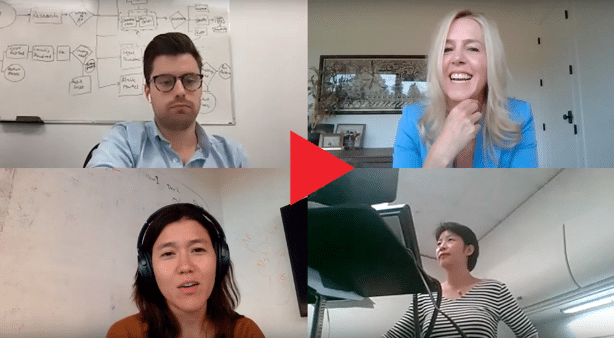
Melinda Han Williams shares her insights on how to address your clients’ concerns about audience targeting beyond cookies. You will learn about the current state of cookies, AI targeting strategies that work today with or without cookies, and how to best use AI to reach the people who matter most, regardless of cookies.
An in-depth discussion on one of the most controversial and innovative technologies shaping Market Research today: AI.
Artificial Intelligence and Machine Learning have the potential to revolutionize the market research industry but not all are convinced. Join us as we look at the impact of AI on Market Research as it currently stands, as well as its potential social reverberations on everything from hiring practices, diversity, unconscious bias and other unforeseen side effects of the digital age.
2019 marks the 50th anniversary of the Stonewall Riots, one of the most significant events that led to the LGBTQ liberation movement (read more here).
In celebrating equality and inclusion for the LGBTQ community and committing to ensuring that our LGBTQ colleagues, clients and partners feel supported as members of the Dstillery family, Director of Analytics Gilad Barash shares his perspective on what inclusion in the workplace means to him.
Roughly 53% of LGBTQ people are closeted in the workplace. They don’t feel comfortable to come out, and when you’re closeted in the workplace, as I was 15 years ago, it takes up a lot of energy and distracts you from your work. Here are a few things that go through your mind:
You have to think about changing pronouns or names of the significant others that you’re talking about.
You have to think about avoiding conversations.
You have to continually evaluate how much of yourself you are sharing..
The scariest part is that Monday morning water-cooler question, “Oh, what did you do this weekend?” The meme of the “calculating woman” is the best example of what goes through your head.
That’s what it feels like when you have to start answering questions about your personal life. You want to be included, you want to talk about yourself, you want to bond with your coworkers and you want to be a part of the company culture, but you can’t because you have that barrier. You end up feeling isolated in the workplace, you don’t really make friends, you feel depressed, you’re distracted from the work that you need to do.
Coming out is a decision that everybody has to make and we tend to think of coming out in two extremes. That on one hand if you’re in areas that they tend to be less accepting, there’s a more oppressing feeling, but then, those of us in places like New York and LA, there shouldn’t be a problem, because people are a lot more accepting. But that’s not necessarily the only part of the equation.
It’s a very, very personal journey and people even in New York, they live in gay neighborhoods in Chelsea and Hell’s Kitchen, don’t necessarily feel comfortable coming out at work. They’re dealing with baggage from their families who may live far away or they may live in the city, et cetera. And, not knowing your coworkers background, you don’t know if you can trust them to be accepting. So despite the fact that you could be living in a very nurturing and accepting environment, it’s a very, very personal choice that you may not be able to make those steps to get to the point where you come out.
I remember myself, the first time that I had to come out at work was very nerve-wracking. Like I said, about 15 years ago I was at a previous company in San Diego. There were a couple of other gay people that we had seen each out so we knew but it was a secret. First rule of fight club, you don’t talk about fight club, so we’d come into work and we would just kind of chat quietly about our real lives and weekends. Because I had a boyfriend at the time, I would change the pronouns in conversations and so I would only go so far in what I shared with my other coworkers.
It was very isolating but I managed to get away with it until the day that my boss asked me to add my emergency contact to a spreadsheet he was creating for the team. Being an immigrant, I didn’t have any family here, everybody knew that. The only person I had that I could possibly put on that sheet was my boyfriend. And I had to stand there and make the decision – “Am I ready to do this? Am I ready to name this person who nobody knows about, and I don’t know how people will feel about?” And I did it. He was very accepting. The team was very accepting and I haven’t looked back since. But it’s a dilemma that straight people never have to face.
Even when we come out – it’s a very conscious decision that we’re faced with every day. We don’t come out once. We come out continuously, every single day, in every new situation. Every new coworker that comes into the workplace that doesn’t know. Every new office that we go to work at. Every client, every new friend that we meet in a bar. Every day we have situations where we have to do the math. Should we come out, should we not come out? Does it make sense? Does it not? When they talk about their weekend, do we share information about ours honestly or go with the generic canned response?
“We don’t come out once. We come out continuously, every single day, in every new situation.”
For some people, that decision comes a lot easier. For me, today, after being out for 15 years, I don’t care. If you like it, you like it. If you don’t like it, you don’t like it. Your lack of acceptance is your problem, not mine. But some people still have that math that they do and it’s very difficult.
So in the workplace, despite it being inclusive, we also have to be careful about language and jokes that we make. Even though we can say the work’s “inclusive”, we have to make sure that people feel that as well.
I’m happy and blessed and pleased as a gay man to be working at a company that I know believes in those values and is inclusive. I hope that that continues and that we grow that inclusion and diversity in the company as we go forth.
For more information on the history of Pride Month and how you can support the LGBTQ Community, check out the resources below:
If you google “Women in Tech,” you’ll find countless articles, interviews, and conferences dedicated to the contributions of women in the fields of computer science. You’ll also find statistics highlighting the gender gap between professionals in these careers: women only occupy 25% of tech jobs. While the numbers are startling regardless of how often you hear them, perhaps we’ve created too limited a view on who belongs in this community.
As a woman at a data science company, I’ve seen how women from marketing to finance and engineering (and everything in between) impact the technology world. We may not be writing code, but we are teaching marketers and advertisers how to make sense of behavioral data and how to use technology to discover new audiences. We understand the pain points of digital advertising and market research, and work with product and development to create new ways for technology to solve these problems.
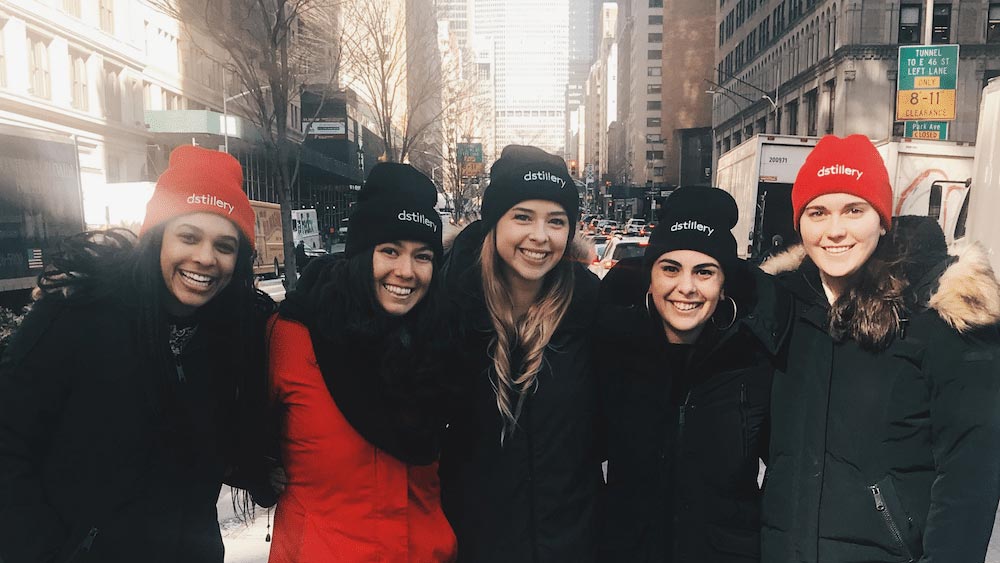
In celebration of Women’s History Month and an effort to redefine “Women in Tech”, I’ve asked the women of Dstillery — DstillHers — to share their unique perspectives as women in a technology company. What have been the keys to their success? What advice would they give to young women who are interested in tech? How has their mentor helped shape their career?
Being a woman in tech can be a lonely journey in a male dominated world, but it is a wonderful one. Believe in yourself, trust your voice, and know you can make a difference to the world of bits and bytes.
My advice is to embrace a winding career path. The job I have now wasn’t on my radar when I started my career. I changed directions by doubling down on work I found interesting and my willingness to learn something new opened doors. A computer science degree isn’t the only qualification for a career in tech. All work experience is relevant and unique to your growth as a professional.
The really exciting thing about working in the tech industry right now is that it is always evolving and changing. By nature, women tend to be very nimble and this presents us with a tremendous opportunity in our space. Be willing to roll up your sleeves, learn something new, ask questions and challenge the norm (even if it falls outside the scope of your day to day position, get curious!) and you will set yourself up for great success.
The one piece of advice I’d give to a woman looking to join a tech company is not to be afraid. Get involved in that project that’s piqued your interest, share your new idea with your teammates, or simply ask that question that’s been on your mind today. Speaking up and putting yourself out there will lead to success, not only for you as an individual, but for your entire company.
I believe that intuitive intelligence and thoroughness that a woman brings with her, has always helped my approach at work. I am also grateful to have mentors in my life who not only taught me to believe in myself, but also showed me how to be more assertive. I would urge all young women out there to believe that they have the power to achieve great heights and make a difference.
I encourage all women to explore the tech industry and all that it has to offer, even if you aren’t a “techie.” The tech industry is ever growing, jobs have nearly doubled in the last 20 years. As a woman, we need to be aware of the career opportunities from this leading growth industry.
My advice to young women who are interested in tech: ask questions. Allowing yourself to admit you don’t know something and being willing to learn will snowball into growth. I was previously our Technical Account Manager, writing queries and scripts. My team and department were male-dominated and I felt overwhelmed…until I didn’t. You’ll get there and you certainly don’t need me to tell you, the future is female!
One key to my success has been never accepting mediocrity and always pushing myself harder than the previous day. My mentor is Pat Summitt who was the coach of the Tennessee Women’s basketball team that I worked for during my time at UT. She inspired me through her hard work, dedication & leadership…all things I aspire to do every day in all parts of my life.
Some of the keys to my success at Dstillery have been raising my hand, reminding myself that if I’m comfortable, I’m not growing, and realizing that it is better to ask a million questions and get it right rather than being embarrassed that I’m asking a “stupid question”. And also remembering to never be intimidated – a girl can do ANYTHING a guy can do, so don’t let them always take the seats at the front of the room in a meeting!
Tech is always evolving and I lucked out early on in finding a mentor to always run any important decision by throughout my career. With any important decision I was faced with, I’ve always used her as my go-to and she’s helped lead me to where I am today. I’ve been forever grateful and try to give back as much as possible so other aspiring Women in Tech can feel like they have someone to act as their go to. Finding a mentor of your own can be a huge key to success, so ask questions to the people you meet and remember, we all started somewhere.
I grew up in the equestrian sport where men and women are on an equal competitive playing field. A skilled equestrian requires focus, physical and mental grit, dedication and the ability to guide their teammate (horse) to complete the required task with ease. These are traits that I bring to the table every single day. My advice to young women in tech is to speak up. Not everything you say has to be a profound statement, but say something. Ask questions. Show your interest with body language. Make your presence in the room known. You are listening and contributing in your own style.
The biggest key to my success lately has been embracing the unknown as an opportunity to raise my hand and put my name on something brand new. I like to think that we’re navigating uncharted territory at this company and in this industry. If you sit and wait until you have all the information you *think* you need before taking the next step forward, you’ll stand still forever.
In my career I’ve followed what’s called a “greedy algorithm”. A greedy algorithm means that at each step, you make the move that optimizes your objective function. The objective function I’ve chosen to maximize is learning. As a result, what I’ve learned has depended heavily on the opportunity that presented itself, whether that means low-dimensional electron transport, machine learning at scale, managing tech teams, or developing business strategies. Following a greedy algorithm does not guarantee that you’ll end up with a globally optimal result, but with the right objective function, it does guarantee that you’ll have fun along the way.