testCategory: Trends

Statement of support for Ukraine from our CEO

Dstillery strongly stands with the people of Ukraine amidst the ongoing Russian aggression and ensuing humanitarian and refugee crises. We condemn the senseless violence aimed at both Ukrainian military members and civilians alike, and we hope for a swift, peaceful resolution. 

This week, we donated to the GlobalGiving Ukraine Crisis Relief Fund and the International Rescue Committee’s Crisis in Ukraine Fund. For every Dstillery employee who chooses to donate to these organizations as well, we pledge to match 100%.

We will continue seeking the best ways to support Ukraine. We encourage everyone to do and give what they can, including our partners, clients, industry peers, as well as friends and family.

Michael Beebe
CEO
Dstillery

Outlook 2022: a year of rethinking, not simply predicting

“We live in a rapidly changing world where we need to spend as much time rethinking as we do thinking.”  – Adam Grant, Organizational psychologist at Wharton, #1 NYT Bestselling Author of THINK AGAIN

Never, in the span of most of our lifetimes, has this concept of rethinking held so much meaning.  Our Perfect Storm of Pandemic + Political Unrest + Educational Crisis is not simply a call-to-arms to embrace Resilience.  Rather, it’s a defining moment when the Winners will be those who rethink past assumptions and reimagine the future.

What does any of this have to do with Adtech in 2022?  Isn’t it enough to take the position of an Innovator, offering the best, newest, most exclusive solutions?  If we build it, will they come?

Within the digital marketing industry, we see no shortage of brilliant, thought-leading predictions, innovations, and new-to-the-world offerings.  A few weeks into this new year, we spotlight three defining forecasts:

Adweek Outlook 2022

Adweek Outlook 2022, featuring our Chief Data Scientist, Melinda Han Williams, offers a series of recent livecasts, capturing every angle of the adtech ecosystem.  Click here to watch Melinda’s presentation, sharing how marketers can engage with consumers on their terms, in a privacy-first digital landscape.

GroupM Forecast

This time last year, we were fortunate to have GroupM’s Global President of Business Intelligence, Brian Wieser, join Dstillery’s Chief Data Scientist, Melinda Han Williams, and our CEO, Michael Beebe, forecasting this past year’s trends.  His latest report looks ahead with predictions for the coming year.

Web Summit 2022 Marketing Trends Report

This November in Lisbon, at “Europe’s biggest tech conference” (Reuters), “The giants of the web assemble” (Wall St. Journal). Check out the Dstillery reference on p. 9, under “A world without Cookies” here.

With each of these, and so many others, the unique challenges that our world, our industry and our future brings have a common denominator: They’ve forced us to rethink our previous assumptions, to take nothing for Granted, and to view predicting [the future] as less Crystal Ball, more Science. All of which works to our advantage, since Science, and specifically Data Science, is at the heart of everything we do.

Reflecting on ’21, ringing in ’22

Vision. Innovation. Growth.

Terms like these get thrown around this time of year like midnight confetti on New Year’s Eve. 

As Dstillers, we also like to measure ourselves from another important perspective: Did we do what we set out to do, actively supporting the occasions and organizations we committed to from the start? 

As a company, we’re proud to say that we did accomplish what we set out to do, surpassing some of our greatest expectations. And not just for Growth, but for Good.

We’re proud to have supported several life-changing organizations, including St. Jude Children’s Research Hospital, ASPCA, Kids in Crisis, No Kid Hungry, World Central Kitchen, and the ALS Association. During Black History Month, we honored Black Girls Code, 100 Black Men of America, and The Fifteen Percent Pledge.

In honor of Pride month, Dstillery spotlighted the good work of New Alternatives NYC, Transgender Law Center, and Live Out Loud, supporting their missions.  Dstillery Walks Together exceeded our mileage goal of 1,969 (Year of the Stonewall Uprising), logging over 2,200 miles of solo and team treks.  Dstillery added to employee contributions, benefitting both The Trevor Project and Trans Lifeline.

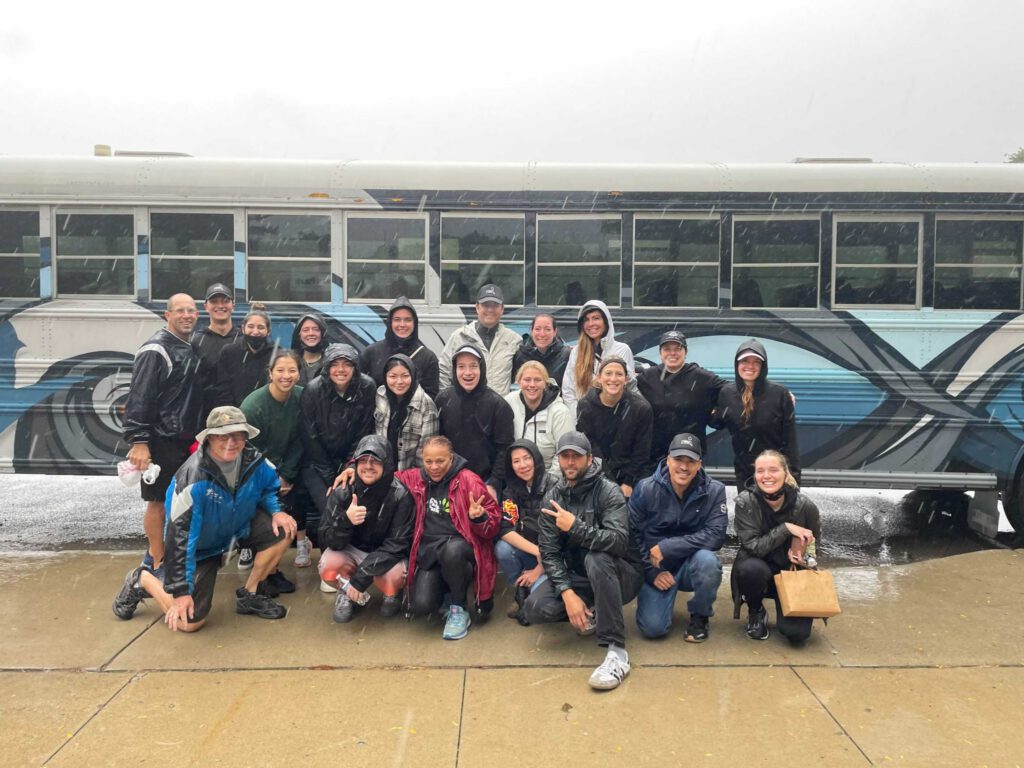
Our Go-to-Market team took over Motor City, volunteering with the non-profit People for Palmer Park, in a rain-soaked clean-up event to help sustain a portion of the 296-acre historic community.  

Our Client Services Leadership Team combed and cleaned over 2.5 miles of NY coastline, earning a matching commitment from Public Benefit Corp., 4Ocean.  

Our third-annual Cycle for Survival, benefitted rare cancer research at Memorial Sloan Kettering, as Dstillers raised pledges for cycling, running, walking and even doing yoga.

We wrapped our year with Secret Santa, as employees donated to one another’s charitable causes, extending the reach of our spirit of giving.

2022 is bound to bring both opportunities and challenges, as we embark upon a New Year filled with possibilities.  But one thing’s for sure. None of our successes, our learning, or our innovation can happen without you, our clients, partners, and industry supporters.  For that, we’re grateful, and most importantly, committed, to making 2022 even greater, brighter and bolder, for all in our community.  

How to do everything at once: digital advertising in 2021 & beyond

Data-driven digital advertising in 2021 means working in a world where everything is changing, always. The biggest recent change for advertisers is the extended timeframe for the planned retirement of third-party cookies. 

Even with this change, it’s clear that the industry’s future is based on opt-in identifiers, rather than default-on tracking. Lots of advertisers spent a year scrambling to get ready before Google provided an additional two years to prepare for losing cookies entirely. However, the addition of more time hasn’t changed advertisers’ goals. They must prepare for the future and optimize for today, all at the same time.

These two needs are at odds. How do you optimize actions for today and tomorrow simultaneously? How can you prepare for a cookieless future without giving up performance benefits prematurely?

The answer: Do everything.

Think like Zaila Avant-garde, the winner of the 2021 Scripps National Spelling Bee and a multiple Guinness World Record holder. Avant-garde can dribble six basketballs at once. Fortunately, marketers won’t have to do that. But they do need to think about a targeting strategy that uses multiple approaches to finding their best audience. The trick is to balance these approaches in an optimized digital advertising targeting portfolio.

Your Digital Advertising Targeting Portfolio

Digital advertisers generally run lots of tactics at once, and most have testing and scaling phases for new tactics. This is a great practice to maintain in order to explore new emerging approaches. But it’s not what we mean when we talk about an optimized digital targeting portfolio. We’re talking about a portfolio of tactics that gives you the best possible performance now. And the good news is this portfolio is likely to include approaches that also prepare you for tomorrow.

This is because some post-cookie solutions work well enough to improve ROI and performance right now if allocated correctly. As the landscape transitions away from cookies over the next two years, the optimal allocation of these post-cookie solutions will change. Right now, cookies drive the strongest performance. Somewhere between now and mid-2023, there will be a point where cookies aren’t gone yet but more post-cookie solutions are ready to use at a scale beyond what would make sense today.

The optimal portfolio will keep changing over time, and at every point, it will make sense to use both cookie-based and post-cookie solutions. Start by choosing what to include in your portfolio; Including today’s best solutions as well as the solutions you’ll want post-cookie keeps you prepared for the future. Then optimize for any scenario by turning those knobs to dial up the solutions you need.

The Dstillery post-cookie solution

One way to start strengthening your portfolio now is by adding Dstillery’s ID-free Custom AI cookie-less solution.

ID-free Custom AI is a privacy-first behavioral targeting solution that performs on par with cookies and reaches users without using an identifier. Because ID-free doesn’t use identifiers, it works on any browser, today and in the future.

Best of all, it works, at scale, and can (and should) be used to complement ID-based solutions.

ID-free Custom AI takes a similar approach to what we’ve been using for years to build our ID-based Custom AI audiences. We’ve just reapplied the technology to ID-free signals. Big picture: this is a privacy-friendly approach to targeting users, without any kind of ID, by identifying the impression opportunities that drive performance.

This solution works so well in a portfolio alongside ID-based solutions because it’s a true complement to those approaches. ID-free signals are based on the impression opportunity, rather than persistent information about the user. Since it uses separate signals to make decisions, the ID-free approach is able to take advantage of opportunities that ID-based solutions miss. It remains to be seen how much inventory will be sold without any IDs after cookies are fully retired, but one thing we know for sure is identifier-free inventory will exist in that world, because it already exists today. Running Dstillery ID-free Custom AI in a portfolio along with ID-based solutions is an easy way to improve your ROI today, and be prepared to turn the dial to stay optimized in the future.

To learn more about ID-free Custom AI, please contact Dstillery here.

To watch a previously recorded session on this topic during the ANA Masters of Data & Technology Conference, click here.

Statement of support for the AAPI community from our CEO

Last week’s mass shooting in Atlanta is the latest reported attack in a disturbing trend of increased violence against Asian Americans. Dstillery condemns all forms of xenophobia, bigotry, and racism and we stand in solidarity with our Asian American and Pacific Islander employees, families, and communities.

Over the past few weeks, many of our advertising industry colleagues have spoken out to raise awareness of these racially motivated acts, and we urge our partners to join us in amplifying their calls for action. While the murders in Atlanta are receiving the media attention required to drive meaningful change, we know there are many incidents that go unreported and unaccounted for.

We support the work non-profits like Stop AAPI Hate are doing to document anti-Asian hate incidents. If you see something, do what you can to record, report, and support the individuals being attacked. Additionally, we encourage our community to utilize the resources and information available through initiatives like Welcome to Chinatown, Send Chinatown Love, and Protect Oakland Chinatown.

This week is a painful reminder of the important work still ahead of us. Dstillery is committed to doing our part as a company and a community to build a more just society.

Michael Beebe
CEO
Dstillery

Who’s Your Data? Podcast

Who's Your Data Podcast

Want to hear fresh perspectives on Data Analytics and Data Science while staying on top of industry trends? Check out the Who’s Your Data Podcast, hosted by Gilad Barash, Dstillery’s VP of Analytics.

Listen as Gilad gets candid with interesting industry leaders – from thoughts on data science career paths to inclusivity and representation in tech – nothing is off-limits.

If you’re interested in data, analytics, or curious about how diversity and inclusiveness play a role in combating bias in data and tech, this podcast is for you! Listen on Apple Podcasts & Spotify today.

Visit whosyourdata.org to learn more.


Subscribe To Who’s Your Data Podcast:

Apple Podcasts
Spotify

What’s next for digital advertising trends In 2021?

This past year was unlike anything the advertising industry has ever experienced. While we’re still catching our collective breath from the year that passed, it’s time to look ahead to 2021. On Dec. 17, Dstillery hosted a webinar, 2021 Digital Advertising Forecast & Predictions, a three-way conversation between Dstillery CEO Michael Beebe and Chief Data Scientist Melinda Han Williams, along with Brian Wieser, Global President – Business Intelligence at GroupM, the world’s leading media investment company.

What follows are highlights from the session, focusing on what advertisers and agencies should expect for digital advertising in 2021 after a year of major disruption. You can also watch the video recording here.

2021 will feel a lot like 2020

That is, at least at the start of the year. Much of this year’s tumult will carry over into 2021 as we deal with the global Covid health crises and connected changes on consumer behavior. The year will be marked by disruption as we prepare for a post-cookie future, and the entire industry will ramp up its preparations for the demise of the third-party cookie, which is expected in 2022.

The new year will also carry some of 2020’s silver linings. “It’s bad, but it really could’ve been worse,” said Wieser, reflecting on 2020. Indeed, the disruption of 2020 inspired a great deal of business transformation across verticals, driven by e-commerce. Wieser pointed out that many categories that previously didn’t do much business online were suddenly seeing massive e-commerce growth, and that should continue into the new year.

Data-driven marketing is a must-have, even as cookies disappear

The past 12 months forced a lot of brands to get even better at using data in order to target their marketing and advertising dollars. “That goes hand in hand with the shift toward e-commerce,” said Beebe. “Even companies and brands that have been beholden to retail for their distribution, we saw a lot of activity from those types of brands in terms of developing a more data-driven consumer-direct strategy around how they spend their budgets and target their marketing dollars.”

These brands saw the real benefits of using more data to drive outcomes, and we should expect them to continue exploring data in 2021 and into the future. This is all the more important in the lead-up to 2022, and the end of the cookie era.

“Cookies could go away, and marketers will find something else to work with,” Wieser said. “They’ll find other approaches to buy the best audience relative to the next best alternative approach, to accomplishing whatever their goal is. There are other signals out there.”

Future growth for AI & analytics

As marketers look toward a cookie-less future, they’re wondering how best to use the available data to maximize efficiency and targeting. One method that’s garnered a lot of buzz is through AI. But AI isn’t necessarily a cure-all so much as it is a tool for accomplishing a goal.

“Every marketer should take a step back and know what’s possible with data and what’s possible with AI,” said Wieser. “What’s the business goal, marketing strategy, what could it be, how could we think about people differently? It might be lower fidelity data you’re going to work with, and it could be far more powerful. We should keep that in mind.”

Indeed, all three participants agreed that there’s no purpose in processing more data for its own sake. Dstillery has long held that marketers should be very deliberate about how they apply their data and analytics. “I can make a model that’s super good at predicting clicks, and your clicks will be off the chart and it’s so great. And so I win, right? But actually, the brand doesn’t win in the end if it’s not related to the real goals that the brand is trying to drive at a higher level,” said Williams.

The quality of data simply matters more than the quantity, and this will be especially important for digital marketers in 2021 and beyond. “You have to know what you’re looking for,” said Beebe.

Click here to watch the full discussion between Michael Beebe, Melinda Han Williams, and Brian Wieser on 2021 Digital Advertising Trends.

Commitment to diversity & inclusion, a letter from our CEO

Over the six months since George Floyd’s murder, Dstillery has redoubled our efforts to support social justice, equality, and diversity across all aspects of our business.  While discrimination and inequality are not new to our society, there has never been a more crucial time to act.  We stand in solidarity with the fight against systemic racism, and we believe that Black Lives Matter.

We have laid the foundations for our company and community to make enduring change.  The company has developed a formal Diversity & Inclusion program with multiple pillars dedicated to education, recruitment, training, community building, and mentorship.  We have seen inspired energy from our team members — our Dstillers — who have participated in protests, led discussion groups, and organized guest speakers. 

Our shared values related to diversity & inclusion, surfaced organically by Dstillers, include Equality, Respect, Empowerment, and Trust.  We are committed to taking actions that nurture these values, while offering equal opportunities for personal and professional growth in our internal and external communities.  

We are taking the long view, and together, we can and will do more.  Dstillery will invest the time, effort and resources to identify and dismantle any bias in our policies and procedures, enhancing our workforce diversity and fostering an inclusive workplace.  We will continue to provide a safe space for our team members to engage in difficult but necessary conversations, and to empower our community to drive change in our company and in the world for the betterment of all.

Michael Beebe
CEO
Dstillery

Forget intuition, let machines do the work in programmatic

Programmatic ad buying has become a critical part of the ad industry, accounting for more than $4 out of every $5 spent on digital display ads. Programmatic’s ascendance was the result of massive investment by brands, agencies and startups in software, hardware, and data science, all with the aim of optimizing campaign performance and bringing spending efficiency to an internet where audiences were increasingly spread out.

The technology took care of the efficiency piece, giving advertisers the scale they wanted without having to negotiate thousands of individual publisher-direct deals. True optimization has lagged though, due to one major hurdle: for all of the investment in technology and computing power, a human still steps in at the last mile to make critical decisions about targeting — decisions that dilute or possibly even negate the value of the technology-powered decision making that came before.

The issue stems from the primitive way that data segments are still bought and sold, more often than not by a human trader entering a keyword into a search box and choosing segments to target based on description alone. For programmatic to truly realize its potential — especially in a time of tightened budgets — now is the time to adopt tools which remove human intuition and let the machines do more of the thinking.

A last-mile issue

Today, the minority of programmatic buys are targeted, optimized and self-tuned in real-time via machine learning. The significant majority are targeted manually, with media traders logging into their platforms of choice, searching for their target audiences (surfers, soccer moms, auto intenders, etc.) and picking from 50 to 500 audiences that match the search.

They might pick an audience segment based on the data company’s brand name, or they may go with something that was effective for a past campaign from the same client. But in essence, they’re throwing darts to see if they can find the best audience for targeting the campaign because they don’t have access or insight into audience composition, or what’s truly going to work for their campaign.

Hundreds of millions of dollars have been invested in machine learning and state-of-the-art technology to execute targeted ad buys in a fraction of a second. Major advancements in processing power mean that billions of data points are collected and fed into the system to enhance future campaigns and find the best prospects. Once the first flight is up and running, machines should take over and continue executing the campaigns against the best audiences. Why then, are agencies turning everything over to a human being, who rely mostly on intuition?

The data optimization gap

The reason that so many programmatic buys are targeted by humans, rather than machines, is that the data purchasing process is still primitive, despite the sophistication of the technology used to buy and serve the ads.

Typing into a search bar and then clicking away is certainly easy, but the lack of sophistication makes this method feel like it’s a holdover from some 1.0 version of programmatic. There is very little visibility into the provenance, cleanliness or recency of the data selected. There’s merely a segment name, the company that built the segment, and the cost. The technology powering programmatic buying is ultra-sophisticated. Why then, does the audience selection at the last mile amount to an essentially random decision?

Most demand-side platforms provide tools that leverage machine learning to optimize audience targeting. These tools are constantly testing audience segments against campaign KPIs and shifting spends toward those that are delivering the best performance.  This is not an optimization that can be done at a human scale.

Trouble is, the data used for targeting is often an afterthought in the broader campaign planning process and is something left up to the media trader. Agencies work on tight time schedules, and their strategy and planning teams often hand their trading desks a very high-level demographic description of their target audience. Traders, then, attempt to find a fit for that targeting strategy within the sea of third-party segments in the data marketplace.

An optimized future

To be clear, nearly every player involved in programmatic advertising bears some of the blame here. Brands still think in terms of broad-based demos or personas, ignoring the technologies that allow them to optimize against the actual KPIs that drive business results. Media agencies propagate these legacy targeting strategies, which are the path of least resistance. And the buying platforms have focused primarily on driving usage of their technology, happy to integrate data partners but leaving the data sales component an afterthought.

The only path forward for brands and agencies is to advance the way data is bought and sold, evolving these primitive systems for the present and future. The IAB’s data transparency label effort is a major step toward understanding what goes into segments, but quality and accuracy remain outside the project’s scope. Many buying platforms realized in recent years that they had to clean up the inventory available, due to redundancy and low quality. This process improved experiences all around, and improved margins for the platforms and the agency trading desks. The same needs to be done for data. Data marketplaces are full of low-quality audience segments, with opaque methodology and questionable provenance, built using outdated observations. They need to be culled so that buyers aren’t spending money on stale junk.

Cleaner marketplaces and greater emphasis on data optimization would free traders up to apply that human judgment in a higher value way for their clients.  Rather than choosing audience segments from a search box, they should be deciding when to let computers optimize, what to optimize for, and how to know when that optimization is working. The best-case scenario is a human thoughtfully choosing KPIs that meet the brand’s objectives, then hitting the “optimize” button on their platform of choice.

This level of strategic thinking is harder than it sounds, and it’s much higher-value activity than the time spent combing through data segment search results. As the ecosystem changes amid the cookie phase-out, connecting objectives and KPIs to execution will only get harder. Letting machines perform the data selection will free traders to spend more time putting their minds toward critical matters of campaign strategy.

A personal story about inclusion in the workplace

Coming out at work. It’s Highschool all over again. 

Being ourselves at work and inclusion in the workplace is vitally important for being able to do the best job possible. Yet studies suggest that roughly 53% of LGBTQ people are closeted in the workplace and don’t feel comfortable to come out. When you’re closeted in the workplace, as I was 15 years ago, it takes up a lot of energy and distracts you from your work. You spend a lot of brain-cycles running through these potential scenarios: 

  • You have to think about avoiding conversations. Water-cooler exchanges and Monday morning catch-ups on the weekend become no-no’s since you don‘t want to navigate the choppy waters of editing your story to suit the people listening.
  • If you DO decide to share, you have to think about changing pronouns or names of the significant others that you’re talking about, as well as not give away any other incriminating information.
  • You have to continually evaluate how much of yourself you are sharing and whether it will come back to haunt you eventually. 

Every friendly conversation with colleagues becomes an exercise in the calculus of what to reveal and what to keep to yourself. 

You want to be included, you want to talk about yourself, you want to bond with your coworkers and you want to be a part of the company culture, but you can’t because you have that barrier. You end up feeling isolated in the workplace, you don’t really make friends, you feel depressed, you’re distracted from the work that you need to do. You might see other co-workers mingling and bonding over stories about their relationships, kids, etc… and you are excluded. 

It’s just like high school all over again. 

So just come out, right? 

Whether you’re in an environment that is more repressive or one that is seemingly more accepting, coming out is an extremely personal journey. 

Living in New York, in gay-friendly neighborhoods like Chelsea and Hell’s Kitchen, doesn’t necessarily mean that a person feels comfortable coming out at work. They’re dealing with baggage from years of repression, fear of abandonment by their families who may live far away or they may live in the city, etc. Without knowing your coworkers’ background, you don’t know if you can trust them to be accepting. So despite the fact that you could be living in a nurturing and accepting environment, it’s a personal choice that is not always easy to make.

The first time that I had to come out at work was nerve-wracking.

It was 20 years ago at my previous company in Southern California. I knew that there were a couple of other gay people in my office because we had seen each other out, though it was a secret. The first rule of fight club, you don’t talk about fight club. So we would come into work and we would chat quietly about our real lives and weekends. 

However, when speaking with my straight co-workers I would play the pronoun game and only refer to my boyfriend elusively so that they would not learn my secret. The game actually went smoothly, but at the same time, was isolating and emotionally exhausting. 

Things changed on the day that my boss asked me for my emergency contact. He was creating a spreadsheet for the team.   

As an immigrant, I didn’t have any family here, which everybody knew. The only person that I could possibly put on that sheet was my boyfriend. At that moment, standing in my boss’s office, I had a decision to make.  “Am I ready to do this? Am I ready to name this person who nobody knows about, and I don’t know how people will feel about?” 

After some quick calculus, I decided to just go for it and my boss was very accepting. Eventually, the team found out and they were accepting, as well, and I haven’t looked back since. 

The point of this story isn’t the big drama of coming out. There was none. The point of this story is the big internal drama that precedes coming out. And it’s a dilemma that straight people never have to face. 

Coming out every day.

Coming out is a conscious decision that the LGBT community is faced with every day. We don’t just come out once. We come out continuously, every single day, in every new situation. Every time a new coworker comes into the workplace. Every new office that we go to work. Every new client, every new friend that we meet in a bar. Every new barber we chat with while on their chair. Every day we have situations where we have to do the math. Should we come out, or should we not come out? Does it make sense? Does it not? When they talk about their weekend, do we share information about ours honestly or go with the generic canned response?

“We don’t come out once. We come out continuously, every single day, in every new situation.”

For some people, that decision becomes a lot easier over time. Personally, after being out for over 20 years, I don’t care. If you like it, you like it. If you don’t like it, you don’t like it. Your lack of acceptance in no way reflects on me. But it is a personal decision and some people still do the math, which is difficult.

Inclusion in the workplace.

Understanding these unique challenges is step one. Step two is finding ways to make your office more comfortable and accepting of diverse coworkers. Keep in mind that while this speaks to LGBT colleagues, it holds true for diversity of any kind – Coworkers of color, coworkers of a different gender, coworkers with disabilities, etc… 

So in the workplace, it behooves us to make our environment feel more inclusive. To me, this means that we acknowledge and see our diverse coworkers by using inclusive language, instead of non-inclusive language, and avoiding stereotypes that might make people feel left out. But it doesn’t end there. 

More importantly, it means creating a sense of community for our diverse colleagues. It is not enough to have one LGBT coworker or one coworker of color and tick off a diversity box, as if you’ve fulfilled some sort of quota. It is crucial to create a community that supports each of these diverse perspectives so that they feel a sense of belonging and being seen and heard by others like them. They should be made to feel like they are set up for success. There should be a critical mass of employees of Color, LGBT employees, etc. Only then can we achieve not only a workplace of diverse perspectives, but one where everyone feels safe to bring their full, authentic selves.

To learn more about Dstillery’s Commitment to Diversity & Inclusion, click here to read a message from our CEO, Michael Beebe.