
testTag: programmatic advertising

4 Simple Decisions to Unlock Your Post-Cookie Targeting Strategy

The rise of AI and the fall of the cookie together are creating profound change for the programmatic advertising industry. With Chrome’s deprecation of third-party cookies now just months away, nearly every part of the ecosystem needs a plan to adapt its programmatic execution to the new reality.

The result is a seemingly endless swirl of technologies – new and old – with an increasing number of AdTech companies claiming to have the solution. The cacophony of pitches and promises is dizzying, and many marketers are understandably paralyzed by the chaos of the marketplace.

While there is definitely some complexity, a simple four-step approach will allow brands and agencies to clarify and unlock their post-cookie targeting strategy.  
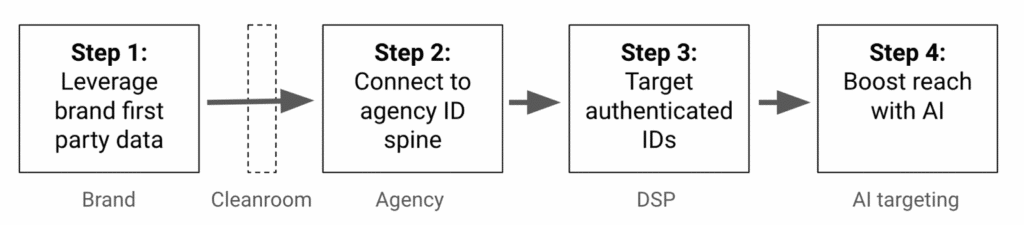
4 simple steps

1. Leverage brand first-party data.  Building closer relationships with customers is always a good thing, and a strong first-party data set is a solid foundation for post-cookie success. But it is only a first step.  

2. Connect to agency identity spine.  Media agencies of all sizes have been building (or buying) identity spines that provide them with a broad understanding of mostly offline consumer behaviors, and deep demographic, psychographic, and behavioral profiles. Brands can connect their first-party data with these larger data sets via clean rooms to provide a privacy-safe path to activation.

3. Target authenticated IDs. There are a number of emerging alternative IDs that let advertisers find their customers, or lookalike customers, in the digital advertising ecosystem.  Authenticated IDs like UID2 will drive performance that is superior to the less-precise third-party cookies, and will be a fundamental pillar of cookieless programmatic execution. Allocate the first budget dollars here for precision 1:1 targeting and measurement.

4. Boost reach with AI (this is where the magic happens!).  Authenticated IDs are unlikely to deliver the scale of third-party cookies, so advertisers will need to spend more against impressions without IDs to drive reach and deliver brand KPIs.  Some will default to classic contextual solutions, but new and emerging AI-driven targeting technologies offer a better way to fill the gap in reach left by cookie retirement.  Delivering scale and performance that’s superior to contextual, they complement authenticated IDs by using the same behavioral signals and extend reach to the growing proportion of impressions without IDs.  These innovative AI-driven technologies are the key to delivering reach, budget efficiency, and consumer privacy in a cookieless world.


Simplify your post-cookie targeting strategy

To simplify their approach to post-cookie targeting, brands should select best-in-class technology/partners at each step of this process.  Choose your cleanroom partner, leverage your agency’s ID spine, work with your DSP in the authenticated space, and choose your AI reach boost partner.  

Surely, there is a lot more complexity to work through than captured in this deliberate oversimplification.  But by breaking the problem into just a handful of key decisions that fill the gaps left by cookie retirement, brands can create order from chaos, break the paralysis, and start executing an effective post-cookie programmatic targeting strategy. 

Programmatic 101

What is Programmatic Buying?

Programmatic ad buying is the use of different pieces of software to buy digital advertising. Many are familiar with the traditional method, which is made up of requests for proposals and negotiation. Programmatic buying uses sophisticated advertising algorithms to buy and sell online advertising display space to buyers and traders across the globe.

Programmatic trading uses traffic data and online display targeting to drive impressions at scale, resulting in a better ROI for marketers. By leveraging machine learning and AI, programmatic ad buying is more efficient, automating many menial and mundane tasks. Programmatic advertising also offers simple ways to reach a desired segment. You can reach your target audience and maximize any ad budget through behavioral, contextual, or geotargeting. Overall, programmatic advertising can yield excellent results for brands of any size, from small to global, so it has quickly become a fundamental part of many brand’s marketing stack.

Programmatic Advertising Terminology

SSP: Supply-side platforms (SSPs) are used by website publishers to manage, sell, and optimize available ad space on their websites or apps. Some popular SSPs are Google Ad Manager, OpenX, Pubmatic, and Magnite.

DSP: Demand-side platforms (DSPs) enable media buyers to automate the purchase of digital ad space from a marketplace. Programmatic DSPs include Google DV 360, The Trade Desk, and Amazon.

Ad Exchanges: Ad exchanges are digital marketplaces where marketers and publishers can buy and sell ad space. These marketplaces allow SSPs to sell ad inventory on behalf of website publishers and DSPs to bid on it.

RTB: Real-time bidding (RTB) is an automated digital auction process of buying and selling ad space on an impression basis through real-time auctions or at a fixed price.

Programmatic vs. Display: In the context of programmatic advertising, programmatic is a method of purchasing and placing ads via automation. Display is the form of the ad itself (video, image, text, etc.) and where the ad appears.

Using DSPs

Before seeking a DSP, it’s best to take a moment to understand your brand goals, KPIs, and your creative approach. After your marketing team has figured out the formula and metrics for success, it’s time to find a DSP. DSP selection should be based on several factors like budget, ease of use, targeting capabilities, and reach. Once you match your KPIs to a DSP, you can begin bidding in real-time. 

After you select your target audience segment, you define your budget and upload your ad / creative onto the platform. Once bidding begins, you will have the option to buy impressions based on segment criteria. The auction happens in real-time once a bid is selected. The winning bid will purchase the space, and the ad will move to the publisher’s website. This all happens within milliseconds from click to placement.

Once your campaign is live, your DSP has various optimization tools. Keeping a close eye on your campaign data is key to helping you and your team make adjustments to enhance your ad performance. 

Why Start Using Programmatic Advertising?

While you can’t automate your way to success, you can strategically optimize your ad dollars to reach your campaign goals. If you want to be a successful trader, you have to understand your audience and prospects. There’s a big human component to trading that requires buyers of digital ad space to have their finger on the pulse of who they are as a brand, product, or service. 

Through programmatic trading, digital advertisers know where their ads are placed, who views them, and how the ads are performing — all on one platform. That said, it’s on the marketing wizards of today, tomorrow, and the future to use their instincts and data to become the marketing master that their brand needs.

Questions? Contact us.