
testTag: digital advertising

4 Simple Decisions to Unlock Your Post-Cookie Targeting Strategy

The rise of AI and the fall of the cookie together are creating profound change for the programmatic advertising industry. With Chrome’s deprecation of third-party cookies now just months away, nearly every part of the ecosystem needs a plan to adapt its programmatic execution to the new reality.

The result is a seemingly endless swirl of technologies – new and old – with an increasing number of AdTech companies claiming to have the solution. The cacophony of pitches and promises is dizzying, and many marketers are understandably paralyzed by the chaos of the marketplace.

While there is definitely some complexity, a simple four-step approach will allow brands and agencies to clarify and unlock their post-cookie targeting strategy.  
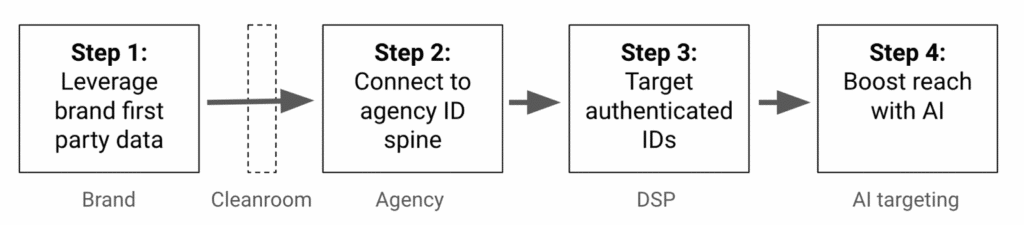
4 simple steps

1. Leverage brand first-party data.  Building closer relationships with customers is always a good thing, and a strong first-party data set is a solid foundation for post-cookie success. But it is only a first step.  

2. Connect to agency identity spine.  Media agencies of all sizes have been building (or buying) identity spines that provide them with a broad understanding of mostly offline consumer behaviors, and deep demographic, psychographic, and behavioral profiles. Brands can connect their first-party data with these larger data sets via clean rooms to provide a privacy-safe path to activation.

3. Target authenticated IDs. There are a number of emerging alternative IDs that let advertisers find their customers, or lookalike customers, in the digital advertising ecosystem.  Authenticated IDs like UID2 will drive performance that is superior to the less-precise third-party cookies, and will be a fundamental pillar of cookieless programmatic execution. Allocate the first budget dollars here for precision 1:1 targeting and measurement.

4. Boost reach with AI (this is where the magic happens!).  Authenticated IDs are unlikely to deliver the scale of third-party cookies, so advertisers will need to spend more against impressions without IDs to drive reach and deliver brand KPIs.  Some will default to classic contextual solutions, but new and emerging AI-driven targeting technologies offer a better way to fill the gap in reach left by cookie retirement.  Delivering scale and performance that’s superior to contextual, they complement authenticated IDs by using the same behavioral signals and extend reach to the growing proportion of impressions without IDs.  These innovative AI-driven technologies are the key to delivering reach, budget efficiency, and consumer privacy in a cookieless world.


Simplify your post-cookie targeting strategy

To simplify their approach to post-cookie targeting, brands should select best-in-class technology/partners at each step of this process.  Choose your cleanroom partner, leverage your agency’s ID spine, work with your DSP in the authenticated space, and choose your AI reach boost partner.  

Surely, there is a lot more complexity to work through than captured in this deliberate oversimplification.  But by breaking the problem into just a handful of key decisions that fill the gaps left by cookie retirement, brands can create order from chaos, break the paralysis, and start executing an effective post-cookie programmatic targeting strategy. 

How To Do Everything At Once: Digital Advertising in 2021 & Beyond

Data-driven digital advertising in 2021 means working in a world where everything is changing, always. The biggest recent change for advertisers is the extended timeframe for the planned retirement of third-party cookies. 

Even with this change, it’s clear that the industry’s future is based on opt-in identifiers, rather than default-on tracking. Lots of advertisers spent a year scrambling to get ready before Google provided an additional two years to prepare for losing cookies entirely. However, the addition of more time hasn’t changed advertisers’ goals. They must prepare for the future and optimize for today, all at the same time.

These two needs are at odds. How do you optimize actions for today and tomorrow simultaneously? How can you prepare for a cookieless future without giving up performance benefits prematurely?

The answer: Do everything.

Think like Zaila Avant-garde, the winner of the 2021 Scripps National Spelling Bee and a multiple Guinness World Record holder. Avant-garde can dribble six basketballs at once. Fortunately, marketers won’t have to do that. But they do need to think about a targeting strategy that uses multiple approaches to finding their best audience. The trick is to balance these approaches in an optimized digital advertising targeting portfolio.

Your Digital Advertising Targeting Portfolio

Digital advertisers generally run lots of tactics at once, and most have testing and scaling phases for new tactics. This is a great practice to maintain in order to explore new emerging approaches. But it’s not what we mean when we talk about an optimized digital targeting portfolio. We’re talking about a portfolio of tactics that gives you the best possible performance now. And the good news is this portfolio is likely to include approaches that also prepare you for tomorrow.

This is because some post-cookie solutions work well enough to improve ROI and performance right now if allocated correctly. As the landscape transitions away from cookies over the next two years, the optimal allocation of these post-cookie solutions will change. Right now, cookies drive the strongest performance. Somewhere between now and mid-2023, there will be a point where cookies aren’t gone yet but more post-cookie solutions are ready to use at a scale beyond what would make sense today.

The optimal portfolio will keep changing over time, and at every point, it will make sense to use both cookie-based and post-cookie solutions. Start by choosing what to include in your portfolio; Including today’s best solutions as well as the solutions you’ll want post-cookie keeps you prepared for the future. Then optimize for any scenario by turning those knobs to dial up the solutions you need.

The Dstillery post-cookie solution

One way to start strengthening your portfolio now is by adding Dstillery’s ID-free Custom AI cookie-less solution.

ID-free Custom AI is a privacy-first behavioral targeting solution that performs on par with cookies and reaches users without using an identifier. Because ID-free doesn’t use identifiers, it works on any browser, today and in the future.

Best of all, it works, at scale, and can (and should) be used to complement ID-based solutions.

ID-free Custom AI takes a similar approach to what we’ve been using for years to build our ID-based Custom AI audiences. We’ve just reapplied the technology to ID-free signals. Big picture: this is a privacy-friendly approach to targeting users, without any kind of ID, by identifying the impression opportunities that drive performance.

This solution works so well in a portfolio alongside ID-based solutions because it’s a true complement to those approaches. ID-free signals are based on the impression opportunity, rather than persistent information about the user. Since it uses separate signals to make decisions, the ID-free approach is able to take advantage of opportunities that ID-based solutions miss. It remains to be seen how much inventory will be sold without any IDs after cookies are fully retired, but one thing we know for sure is identifier-free inventory will exist in that world, because it already exists today. Running Dstillery ID-free Custom AI in a portfolio along with ID-based solutions is an easy way to improve your ROI today, and be prepared to turn the dial to stay optimized in the future.

To learn more about ID-free Custom AI, please contact Dstillery here.

To watch a previously recorded session on this topic during the ANA Masters of Data & Technology Conference, click here.

What’s Next For Digital Advertising Trends In 2021?

This past year was unlike anything the advertising industry has ever experienced. While we’re still catching our collective breath from the year that passed, it’s time to look ahead to 2021. On Dec. 17, Dstillery hosted a webinar, 2021 Digital Advertising Forecast & Predictions, a three-way conversation between Dstillery CEO Michael Beebe and Chief Data Scientist Melinda Han Williams, along with Brian Wieser, Global President – Business Intelligence at GroupM, the world’s leading media investment company.

What follows are highlights from the session, focusing on what advertisers and agencies should expect for digital advertising in 2021 after a year of major disruption. You can also watch the video recording here.

2021 will feel a lot like 2020

That is, at least at the start of the year. Much of this year’s tumult will carry over into 2021 as we deal with the global Covid health crises and connected changes on consumer behavior. The year will be marked by disruption as we prepare for a post-cookie future, and the entire industry will ramp up its preparations for the demise of the third-party cookie, which is expected in 2022.

The new year will also carry some of 2020’s silver linings. “It’s bad, but it really could’ve been worse,” said Wieser, reflecting on 2020. Indeed, the disruption of 2020 inspired a great deal of business transformation across verticals, driven by e-commerce. Wieser pointed out that many categories that previously didn’t do much business online were suddenly seeing massive e-commerce growth, and that should continue into the new year.

Data-driven marketing is a must-have, even as cookies disappear

The past 12 months forced a lot of brands to get even better at using data in order to target their marketing and advertising dollars. “That goes hand in hand with the shift toward e-commerce,” said Beebe. “Even companies and brands that have been beholden to retail for their distribution, we saw a lot of activity from those types of brands in terms of developing a more data-driven consumer-direct strategy around how they spend their budgets and target their marketing dollars.”

These brands saw the real benefits of using more data to drive outcomes, and we should expect them to continue exploring data in 2021 and into the future. This is all the more important in the lead-up to 2022, and the end of the cookie era.

“Cookies could go away, and marketers will find something else to work with,” Wieser said. “They’ll find other approaches to buy the best audience relative to the next best alternative approach, to accomplishing whatever their goal is. There are other signals out there.”

Future growth for AI & analytics

As marketers look toward a cookie-less future, they’re wondering how best to use the available data to maximize efficiency and targeting. One method that’s garnered a lot of buzz is through AI. But AI isn’t necessarily a cure-all so much as it is a tool for accomplishing a goal.

“Every marketer should take a step back and know what’s possible with data and what’s possible with AI,” said Wieser. “What’s the business goal, marketing strategy, what could it be, how could we think about people differently? It might be lower fidelity data you’re going to work with, and it could be far more powerful. We should keep that in mind.”

Indeed, all three participants agreed that there’s no purpose in processing more data for its own sake. Dstillery has long held that marketers should be very deliberate about how they apply their data and analytics. “I can make a model that’s super good at predicting clicks, and your clicks will be off the chart and it’s so great. And so I win, right? But actually, the brand doesn’t win in the end if it’s not related to the real goals that the brand is trying to drive at a higher level,” said Williams.

The quality of data simply matters more than the quantity, and this will be especially important for digital marketers in 2021 and beyond. “You have to know what you’re looking for,” said Beebe.

Click here to watch the full discussion between Michael Beebe, Melinda Han Williams, and Brian Wieser on 2021 Digital Advertising Trends.