In the ever-evolving world of digital advertising, staying ahead of the curve is essential to reaching your target audience effectively. However, with the impending demise of third-party cookies, advertisers face a paradigm shift in how they target their audience. This is where Dstillery comes into play as a game-changing solution for your programmatic ad targeting needs. Keep reading to explore the challenges the disappearing cookie brings and how we can help.
Cookies are Going Away
Third-party cookies have been a staple in the digital advertising world for years. They have enabled marketers to track user behavior, gather insights, and serve personalized ads to the right audience. However, growing concerns over privacy and the ever-evolving regulatory landscape have put cookies on the chopping block. Major web browsers, including Google Chrome and Safari, are phasing out support for third-party cookies, leaving advertisers with a looming void in their arsenal.
The Rise of First-Party Data
First-party data has become increasingly valuable, with third-party cookies on the way out. First-party data is information collected directly from your users, such as website behavior or interactions with your brand. This data is not subject to the same privacy concerns and regulations as third-party data, making it a crucial asset for advertisers.
Dstillery’s Cookie-Free Solution
Dstillery is the leading AI ad targeting company. We’re uniquely positioned to help you address the challenges created by the cookie’s departure and thrive without them.
That’s why we created ID-free®. ID-free is a first-of-its-kind targeting technology that delivers scale and privacy for advertisers’ programmatic ad campaigns. Our technology predicts the value of an impression to a brand without knowing anything about the user. The technology also uses AI to learn from browsing patterns detected in de-identified opt-in panel data. Just like how ChatGPT learns by predicting the next word in a sentence, ID-free learns by predicting the next website visit in an anonymous site visitor’s journey.
Neural network technology called the Map of the Internet (MOTI) powers ID-free. Using MOTI, we create a model that identifies the best impression opportunities. ID-free is the future of ad targeting without cookies. It’s an innovative one-of-a-kind targeting technology that delivers scale and privacy for advertisers’ programmatic ad campaigns.
Advertisers must reimagine their targeting strategies as the era of third-party cookies draws to a close. Don’t let the cookie crumble your advertising efforts; turn to Dstillery for a brighter, data-driven future in digital advertising.
Google’s timeline shift for its retirement of support for third-party cookies in Chrome, announced June 24, 2021, was met by the programmatic advertising industry with relief. And with good reason: Most of the industry was simply not ready for the transition to happen in the first quarter of 2022.
Under the new timeline, Chrome’s phase-out of support for third-party cookies will begin in the middle of 2023, exactly two years from now. With that longer horizon, it might be tempting to power down efforts to develop alternative targeting and measurement technologies, and address it in the future, maybe in mid-2022.
To do so, though, would be to waste a powerful opportunity.
Over the last six months, the industry has seen an explosion in innovation in preparation for the change and has developed tremendous momentum. The new class of emerging solutions has been inspired by the threatened imminent demise of cookie-based targeting, but their value propositions are aligned with the more macro trend of rising consumer privacy standards.
Indeed, Chrome’s third-party cookie retirement is less of a one-off catalyst for more privacy-friendly targeting than it is a punctuation of a multi-year trend. Regulations like GDPR and CCPA and commercial moves by Apple and Mozilla have all set the stage for Google Chrome’s final act in support of third-party cookies.
The previous short-term timeline was a wake-up call for the programmatic advertising ecosystem.
Advertisers faced a probable disruption to their programmatic campaigns & ROI. Agencies faced a discontinuity in their digital services and revenue streams. Publishers faced a precipitous decline in the value of their ad inventory. And advertising technology companies faced what for many would be an existential reckoning.
Faced with this imminent disruption, the whole programmatic ecosystem has been investing behind a wave of innovation that includes a host of new opt-in identity solutions, publisher-led targeting solutions, and new privacy-compliant targeting techniques built around signals that are not user-based. That momentum has been breathtaking to behold and has inspired a renaissance for the advertising technology industry that has included renewed investor interest, appreciating valuations, IPOs, and strategic M&A.
In 2020, Dstillery introduced a cookie-less solution that we call ID-free Custom AI ™*.
It is ID-free™ because it enables targeting without knowing anything at all about the user seeing the ad. Custom AI, because it uses a bespoke AI model, powered by a brand’s own first-party customer data.
Best of all, our ID-free Custom AI performs on-par with our best cookie-based targeting solutions, and outperforms contextual, the next-best alternative to cookie-based targeting.
Our ID-free targeting is creating a new category of ad targeting — a third way. It starts with an understanding of the common digital journeys that an individual brand’s customers take to conversion, and targets moments in that journey, without tracking or relying on cookies.
While the imperative to replace third-party cookies has become less immediate, we as an industry should ride the cresting wave of innovation to address the macro condition of rising consumer privacy standards and capitalize on the powerful momentum we have built. We now have more time to test new technologies, to learn and adapt them, and to deploy them well ahead of the catalyst.
Adopting new and innovative solutions now, including Dstillery’s ID-free®, can provide real value-add today, demonstrate the industry’s respect for consumer privacy, and de-risk the retirement of third-party cookies, whenever it occurs.
It has been more than a year since Google announced that it would stop supporting third-party cookies in its Chrome browser in early 2022. In that time, the advertising technology industry has been developing post-cookie plans and products to fill the white space in targeting that cookie retirement will expose.
The trouble is that many of the proposed solutions are really simple retreads of old ideas. This is not a moment for retrograde thinking — it is a moment for the industry to innovate.
Path of Least Resistance
For advertisers, the path of least resistance may be to fall back on targeting technologies available today that are not dependent upon cookies, or to rely on one or more yet-to-emerge ID spaces to replace cookies.
As far as currently available solutions, proposals usually involve one or more of the following strategies:
Double down on first-party data to target existing customers who have opted in to receiving an advertiser’s messages
Return to classic contextual targeting, using words, images, audio and video on page to show ads in environments that are brand-safe and relevant
Dedicate even more budget to the walled gardens that benefit from a large base of opted-in users with consent
Surely, brands and their agencies will employ all of these strategies to some degree, but they come at a cost. Plainly stated, this is why advertisers do not concentrate their budgets against them today.
First-party Data
When brands focus messaging against first-party data, they sacrifice new customer growth opportunities. Needless to say, abandoning any method of new customer acquisition in a crowded advertising market is not a sound business strategy. Yes, brands can try to find new prospects who look exactly like current customers, but without cookies and retargeting, that will become more difficult.
Contextual Targeting
By allocating more budget to classic contextual, brand marketers give up precision, which deteriorates return on ad spend. Most advertisers are aware that contextual goes beyond basic keyword targeting. But, it’s harder to create a perfect match between the ad and customer interest when using page signals alone.
Walled Gardens
If brands increase reliance on walled gardens, they cede control of customer relationships to these massive platforms. These behemoths share woefully little data or insight with the brand and agency, forcing marketers to rely on a black box of reporting. It is sort of the opposite of relying on first-party data — the brand might get scale and new customer opportunities but at a loss of any insight into their best customers or prospects
Emerging Multi-ID Options
Those are the options available now. As for what will be available in the future, there are a number of strong proposals across the industry for IDs that are functionally equivalent to third-party cookies, yet respectful of consumer privacy.
The Trade Desk’s UID2, LiveRamp’s ATS, LiveIntent’s nonID, ID5’s Universal ID, and Britepool’s ID have all emerged as independent options. While Google is developing a one-to-several solution called FLoCs, or Federated Learning of Cohorts. FLoCs propose to protect consumer privacy by grouping users into cohorts with similar behaviors – allowing one-to-several, rather than one-to-one tracking and targeting.
This emerging multi-ID space will definitely occupy a valuable place in the post-cookie targeting landscape. These solutions do not suffer the same drawbacks as the options described above, but they do have their own.
Most notably, the opt-in paradigm of the one-to-one proposals means these new identifiers will have much less scale than cookies. Given the number of competing proposals, the multi-ID space will be fragmented, introducing tremendous complexity.
Embrace the post-cookie transition
The transition away from cookies gives advertising organizations choices. Anchor to the familiar, such as first-party data, contextual advertising, walled gardens, or a raft of cookie-like IDs. Or, brands and agencies can embrace the transition.
The readily available cookie-free options come with clear limitations. Simply substituting an emerging identifier for cookies carries lots of uncertainty. Settling for a substitute is not going to give advertisers what they are looking for, and they will undoubtedly express disappointment.
But resting on one’s laurels, waiting for the ideal future path to emerge is not exactly innovative — it is passive. Brands and agencies can proactively develop new solutions to the issues of targeting and privacy. This requires these organizations to embrace some of the new limitations, rather than finding new ways around the resistance. If brand marketers only have access to certain signals, how can they combine them to deliver the best ad experiences? How much are brands willing to invest in testing right now? How willing are they to accelerate the percentage of budget they devote to cookieless solutions?
If the current post-cookie options on the table make one thing clear, it is that marketers cannot wait. If none of the options seem palatable, each individual brand has time to create the formulas that will work for them. Digital advertising is not going anywhere. But those that opt for the path of least resistance are going to be left behind.
If you want to learn more about how Dstillery can help you prepare for a post-cookie future, contact us.
There’s been a great deal of hand-wringing over the future of identity in digital advertising. Google Chrome’s plan to retire third-party cookies and Apple’s move to make IDFAs opt-in have kicked off what, to many, feels like a crisis for digital advertising.
Google’s recent announcement that it won’t provide alternate user-level identifiers is just the latest indication that we are well within an inexorable shift towards an opt-in world. This world is one where the only industry-accepted (and, in increasingly many jurisdictions, legally-accepted) means of addressable digital targeting is through an ID which the user has explicitly opted-in to using.
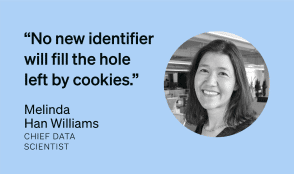
To be clear, there will be alternate user-level identifiers, just not built or used by Google. That horse race is well underway and will continue, unaffected by this news from Google. But new identifiers are not going to solve the ad world’s problems. Google’s announcement confirms that we won’t see one built into Chrome, and without the penetration provided by being default-on in a major browser, no new identifier will fill the hole left by cookies.
With the looming Chrome change in 2022, the frogs felt the water warming. Targeting remains possible, so there hasn’t been much urgency. But now that the identifiable internet is about to be reduced to a fraction of its size, the water is boiling. Advertisers need an escape, and switching to another identifier is the same as jumping to another pot. The only way off the hot stove is for advertisers to break free of identifiers as much as possible.
Insufficient replacements for third-party cookies
“Replacement” identifiers are jockeying for position, and are expected to provide precise targeting and granular measurement. The key improvement in these solutions is that the user consent is clear and explicit.
These replacement identifiers are built by companies other than the browser vendors and were never expected to be a Chrome-built browser feature, so to the extent that they are adopted by publishers and users, they will work regardless of whether Google buys into this philosophy.
Still, even before Google’s move this week, it would have been a mistake to think of these new opt-in identifiers as full replacement solutions. Any advertiser who plans on relying on these new identifiers to solve their problems needs to ask themselves, just how many of these impressions will be available? And am I willing to tie my campaign’s success to that number?
The availability, penetration, and number of impressions available with those solutions will depend on a number of factors, including publisher adoption and user behavior around opt-ins.
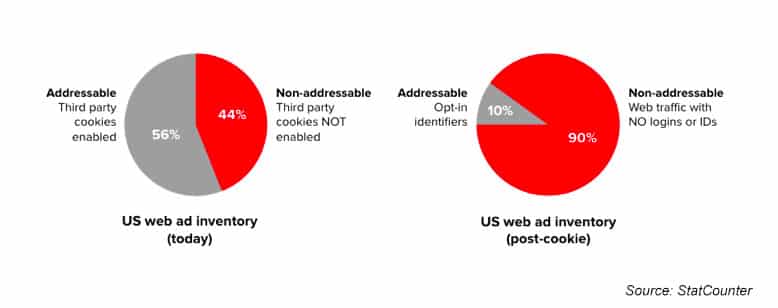
Certainly, the number of display impressions that can be targeted based on an addressable ID will be far less than today’s 56%. (Currently, about 44% of US internet users are already using web browsers without third-party cookies enabled.) The most ambitious estimates put the number of addressable impressions at around 30%, while many publishers believe 10% is optimistic. Whatever the end state, it will require a long adoption ramp-up, not a flip of a switch.
Think about that: Up to 90% of all display impressions will have no ID attached to them. Though the details remain uncertain, it’s clear that the replacement identifiers will not be enough. In order to effectively target at scale in the post-cookie world, advertisers need to adopt a portfolio of approaches that includes solutions to intelligently target ads where no identifiers are available.
Getting used to a non-identifiable world
The time to reach beyond addressable impressions is right now, before third-party cookies are retired from Chrome in 2022. Since 44% of US web impressions don’t have any IDs, smart, identifier-free targeting solutions could improve scaled performance immediately. Consider Safari users, who already exist outside the cookied universe. These consumers are on Apple products, which makes them highly-desirable, and it’s possible to reach them through a diversified approach.
Why is most of the industry still waiting to adopt identifier-free targeting solutions? The answer is measurement. It remains one of digital advertising’s key promises, which is why the industry has remained hooked on identifiers up to this point.
Google’s Chrome team has promised that a new measurement method will be in place before cookies are retired. But remember, Google can’t control what Apple, Mozilla, or others do with their browsers. After cookies are gone, targeting on the web without user IDs requires buying inventory that lacks a precise measurement mechanism.
But the other option, the choice most advertisers are already making, is sacrificing scale. Today, dedication to device-level measurement means ignoring more than 40% of online consumers on the web. In the very near future, they’ll have to decide whether they’d rather ignore 70-90% of online consumers, or have fuzzier measurement across 100% of potential customers.
A “fuzzier” measurement solution might mean extrapolating performance into the non-addressable web, or using a more traditional measurement framework like media mix modeling. Yes, this feels counter to everything we’ve gained in the last decade of hyper-granular data collection and analytics. But most brands will actually see a better ROI when they expand their views and target across the entire internet at its full scale. Even better, adopting an identifier-agnostic strategy now will leave advertisers well positioned to deal with the continued shift towards opt-in identification across all digital environments, not just the web.
While looking ahead is frightening, remember that we’re starting at a point where roughly half of the online audience can’t be identified, right now. Waiting around for new identifiers only limits advertisers even more.
The lost opportunities have already arrived, via browsers like Safari. Why are advertisers abandoning huge segments simply to maintain the status quo, and why continue doing so? The water is about to boil, and advertisers need to decide whether to stick around, jump to a new pot, or get off the stove altogether.