

testCategory: Agentic AI

How multimodal AI is redefining ad targeting

Editor’s note: This blog was featured in the U of Digital AI Literacy Alliance series, where we explained how multimodal AI can help advertisers move beyond the constraints of silos, toward more adaptive, cross‑channel targeting.

Why following clicks has never been enough 

For years, digital advertising relied on channel-specific tools to find audiences and buy media to effectively reach them. Early AI followed the same pattern, with separate models for search, display, social, or CTV, each trained on a single data stream in isolation rather than the full multimodal customer journey. But real-world consumer behavioral journeys don’t occur in silos. As people move across sites of interest, they encounter and generate many different modalities at once — text, images, audio, video, and behavioral signals — that do not fit neatly into single-channel patterns. The industry has shifted from “following user clicks” to “understanding the user journey and the moment.” Just as we are all multi-faceted individuals, user behaviors are best predicted not as single-modality models but instead, with multimodal AI, connecting those signals in one unified system.

When more data creates fragmentation, not better targeting

Advertisers and their agencies now have access to more heterogeneous data than ever: site tags, search terms, product feeds, campaign and ad exposure logs, CTV viewership, and signals from podcasts or streaming services. 

And while advertiser data volume may seem advantageous, the key is quality over quantity. A small but accurate seed of a brand’s best customers often outperforms a large, disconnected dataset. Yet, all too often, these inputs are still modeled and activated in silos, making it hard to turn them into coherent targeting signals for top-performing campaigns.  The resulting fragmentation, latency, and guesswork mean brands and their agencies lose out on precision, ultimately compromising results. Bigger datasets or faster models won’t solve these problems; brands and agencies need targeting that can adapt to more predictive, cross‑channel environments.

Omnichannel targeting strategies have been around for years; how is this different?

Marketers often define their target audiences, perhaps through a set of descriptive attributes, and then reach those audiences across channels in one of two ways – qualitative matching or device graphs. 

Dstillery Chief Data Scientist, Melinda Han Williams, explains: “Multimodal AI goes a level deeper, bringing cross-context connections directly into the model’s training space. Beyond gaining a more precise view of a brand’s best customers across data types, learning in a multimodal space unlocks flexibility for model inputs and outputs that otherwise wouldn’t be possible.”

How multimodal AI works (simplified)

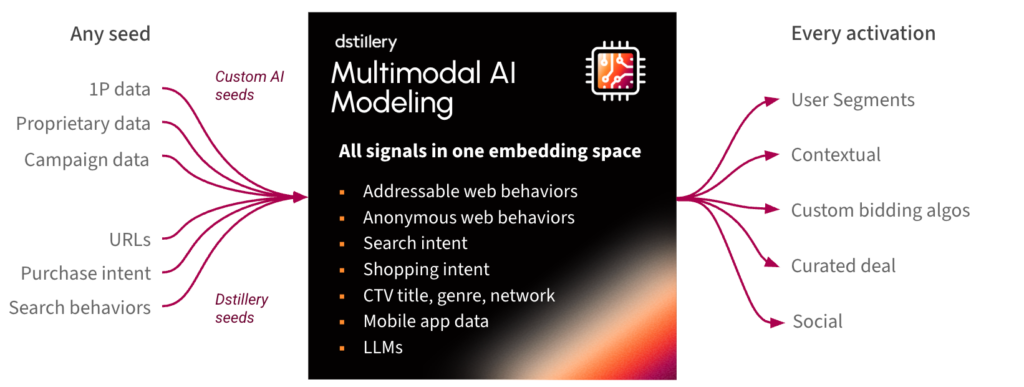
At its core, multimodal AI represents digital behaviors, or data points, from different contexts, or modalities, in one common space to use as the foundation for modeling. Instead of treating a search term, a URL, or a CTV show as separate objects, the system converts each into a point in a shared mathematical space, or embedding, where similar behaviors and interests sit close together. The model learns that space across many signals at once, so behaviors tied to similar outcomes cluster together even without a common ID. Those points in the shared embedding space then become a common behavioral map to reach users regardless of modality or silo, ensuring the highest value for a brand’s campaigns.   
Multimodal AI is powerful, but not magic

Multimodal AI does not, by itself, solve today’s targeting challenges; it provides the connective tissue advanced agentic systems will rely on to understand and operate across modalities. For that foundation to work, agencies and brands need to test multiple tactics, share learnings with their partners, iterate on models, and align around clear KPIs. Success depends on strong inputs, transparency, and an ongoing willingness to learn what delivers results.

Rebuilding loyalty in the age of agentic AI

Editor’s Note: This blog is inspired by Dstillery Board Director Julie Lyles’ presentation at the Food Industry Summit, 4/17/26, St. Joseph’s University.

For decades, loyalty has been won at the moment of choice, from the shelf to the feed to checkout. Today, that paradigm is breaking down.

A new model called agentic commerce is emerging, where AI systems increasingly act on behalf of consumers, researching, evaluating, and completing purchases. Gartner reports that a growing share of digital commerce interactions will soon be influenced or executed by AI agents. At the same time, research from McKinsey & Company finds that over 70% of consumers already expect brands to anticipate their needs, accelerating the shift toward automated decision-making.

This fundamentally changes the role of marketing.

Dstillery POV:
The most important decisions are no longer happening in the moment; they are being modeled in advance. Brands are no longer just competing to be chosen by consumers; rather, they are competing to be pre-selected by the systems that decide. 

The Collapse of the Decision Moment

Historically, marketing strategy has focused on influencing behavior within the consumer journey. This has largely been done through promotions, channel retargeting, and checkout conversion optimization. 

It is essential to note that this model assumes a human actively navigating options. Agentic AI removes that assumption, is apt to learn from behavioral signals, evaluate options, and execute purchases autonomously. Research from Deloitte projects that customers will increasingly hand over not just recommendations, but also purchasing authority to autonomous agents, prompting brands to consider how they earn influence and embed into automated workflows. 

Dstillery POV:
The “moment of decision” is no longer a moment; it’s a model. What used to be a discrete interaction is now the output of continuous prediction. The implication is that brands that rely on actively intercepting consumer decisions will lose ground to those shaping the model upstream. 

From Influence to Prediction

We are moving beyond influence into something more powerful: predictive preference modeling. Traditional commerce has historically focused on influencing decisions, optimizing conversions, and reacting to consumer behavior. In the age of agentic commerce, AI systems can effectively predict consumer decisions, optimize the likelihood of selection, and model behavior before it occurs. 

Dstillery POV:
The next stage in the evolution of marketing is prediction, not persuasion.

At Dstillery, this is the foundation of how modern audience targeting should work. AI is not just identifying who a consumer is: it is identifying and predicting who they are likely to become in a given context. This distinction matters.

In an agentic marketplace, the brand that wins is not the one that always reacts the quickest. Instead, it’s the one already aligned with the anticipated outcome. 

The Commoditization Trap

As AI intermediates transactions, traditional levers of differentiation erode. Price, convenience, and availability become instantly comparable, continuously optimized, and algorithmically interchangeable. 

According to NielsenIQ, in categories like grocery, purchasing is largely driven by habitual, repetitive behaviors, with returning buyers accounting for a significant share of brand revenue. When those habits are handed to AI, the system defaults to efficiency unless directed otherwise.

Dstillery POV:
If your brand is only winning on efficiency, you are training the system to replace you. Without strong preference signals, brands become indiscernible and substitutable. 

What AI Can’t Optimize (Yet)

AI excels at optimizing functional outcomes, such as finding the lowest price, the fastest delivery, and the highest-rated option. However, loyalty is not built purely on functionality.

Research from Accenture indicates 63% of consumers show increased loyalty to brands that align with their values.

Dstillery POV:
The most valuable signals are the hardest to quantify and the hardest to displace. These signals include emotional connection, brand trust, cultural relevance, and perceived identity fit. Preferential signals don’t disappear to agentic systems; instead, they become inputs. The question is whether your brand is generating them strongly enough to be recognized.

The New Loyalty Equation

In an agentic world, loyalty is no longer built at the point of purchase. It is built before the system begins evaluating options. 

Dstillery POV: The Pre-Decision Advantage

The brands that win will: 

  • Model intent early, moving upstream from conversion to intent formation
  • Create durable signals that AI systems can learn from, such as behavioral patterns and contextual relevance
  • Reinforce preference continuously, ensuring signals are not episodic, but instead, persistent
  • Align with machine logic, structuring brand signals in ways legible to AI systems

The Role of AI-Powered Advertising

In an agentic landscape, fragmented signals create blind spots, causing identity-based approaches to struggle as signal loss increases. What’s needed is a system that can operate without dependency on identifiers, while still modeling high-intent behavior. This is where our approach at Dstillery becomes critical.

Dstillery POV:
Identity is not required to understand intent: prediction is. 

Dstillery’s AI-driven approach synthesizes behavioral and contextual signals across environments to identify patterns of emerging intent and build custom AI audiences based on likelihood to act. This enables brands to engage consumers earlier in the decision cycle, influence both human- and AI-mediated outcomes, and shape preferences before they are formalized into action. 

From Targeting to Training

As AI reshapes advertising, the role of targeting is evolving. Finding demand is no longer enough – brands must also train the systems that ultimately determine who wins it.

Dstillery POV:
Impressions now serve a dual purpose: driving immediate conversion while simultaneously informing future decision systems. This shift reframes campaigns as both performance engines and signal generators. In turn, media evolves from a distribution channel into a persistent data ecosystem—one where every outcome contributes to cumulative impact.

Brands that understand this will think beyond short-term ROI, invest in long-term signal strength, and build compounding advantage gradually. 

An Opportunity to Lead

What feels experimental today will quickly become standard. The shift into the agentic commerce era creates a clear divide between brands that optimize for today’s decisions and brands that shape the decisions of tomorrow. According to Deloitte, over half of leading retailers believe AI agents will handle most customer interactions within five years. McKinsey reports that agentic AI commerce will likely generate up to one trillion dollars in the United States alone by 2030, with global projections as high as five trillion. Ultimately, agentic AI isn’t the add-on in commerce: it’s the infrastructure. 

Dstillery POV:
The brands that win in an agentic world won’t just participate in the ecosystem; they will influence how it thinks.

Preference Is the New Currency

Loyalty has always been rooted in economics. In an era where convenience is assumed, comparison is automated, and decisions are delegated, preference becomes the most valuable currency of all.

Dstillery POV:
If you are not shaping preference, you are competing on leftovers. The question isn’t if your brand wins at the moment of choice; it’s whether it has already been chosen before that moment arrives.