testCategory: Learning

Mutual mentoring is a perfect fit for the age of AI

The rise of AI has created uncertainty about the future of employment across several industries, and advertising is no exception. In an era where new tools are emerging almost daily and changing the very nature of work, mentorship has never been more important. It’s within this era of change that the practice of mutual mentoring becomes so important.

The concept of mutual mentoring began in academia as universities like UMass and Cornell developed an approach that tied tenured faculty and early career professors together. The idea was that the tenured group could teach leadership, while the other, less-experienced group could teach newer, more digitally-native techniques. The concept was quickly adopted by corporate America, and today, in this age of AI, rapid technological evolution, and shifting skill sets, it’s fresher than ever.

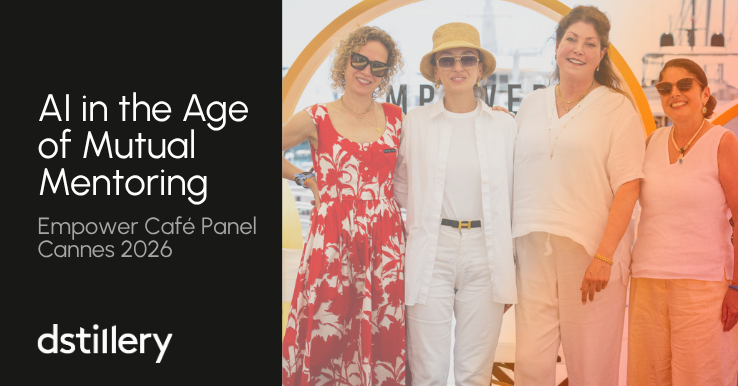
I recently had the privilege to lead a panel on this topic at Cannes, as part of the Empower Cafe. Joining me were Julie Lyle, Board Director of Dstillery; Rebecca Dykema, Founder of the Future Works Initiative, and Anna Koicheva, Head of Business Development & Strategic Growth at Tatari.

How AI innovation changes mentoring possibilities 

While the arrival of AI has shifted how many people perform their day-to-day work, the AI tools are so new to nearly everyone that this moment creates the perfect opportunity for mentorship, skill sharing, and ongoing conversations. 

“As much as times have changed, they haven’t,” said Dykema. She shared a conversation with a CMO who was encouraging mutual mentorship across his group by connecting colleagues and peers to teach each other about what they were doing with AI. If the organization is committed to supporting mentorship, then the innovation and opportunity are greater for that organization. 

Of course, this isn’t the only way that mentorship can happen. Learning opportunities can happen impromptu, but are more likely to happen when structure is in place, according to Lyle. She shared how early in her marketing career she found a mentor and asked for one hour a month to talk about her career goals and learn about her mentor’s career trajectory. 

“When you create a structured program like that and you say, ‘I really only need an hour a month and the opportunity to travel with you and I’ll also complete a project for you,’ even the busiest leaders can find time to support your growth and development,” Lyle said. 

When it comes to the actual mentoring practice, AI creates a new way for mentors and mentees to interact. Good mentorship is all about providing feedback where employees want to access it. This is the case at Tatari, which uses Claude to deliver certain kinds of feedback to employees in a neutral manner. 

“You have to have a human being involved with you to support you, give you soft feedback, etc.,” Koicheva said. “But when it comes to particular KPIs and metrics in terms of how you achieve, how you improve your productivity, emotional intelligence or intellectual intelligence, it is important to actually have these neutral tools support that as well and provide that feedback.”

Continued mentorship across a career

Mentorship so often conjures images of more experienced employees guiding those just entering the workforce. While that’s a critical component, no one should ever consider themselves “too experienced” to be a mentee. The real benefit of mutual mentorship is that both sides get something out of the exchange. 

As Dykema explained, some of her most beneficial relationships were when those mentors used the relationship “to see what the next generation is thinking about, to see what they’re wrestling with, to understand the complexities of their business from a totally different perspective.”

Mentorship programs are also critical for developing interpersonal and cross-generational

communication skills. “If you have the technical skills and you don’t have those skills, you will reach a cap fairly quickly in your career,” said Lyle. 

Seize the moment.

Overall, every panelist agreed that this is a perfect opportunity for organizations and employees themselves to engage in mutual mentoring. While not everyone finds the perfect mentor or opportunity with their very first try, this age of AI requires us all to be curious and open to the possibilities of learning from each other.

As Lyle put it, “Luck always plays a part in everybody’s career, but luck often happens when you’re prepared and you’re ready for it and you seize the opportunities.”
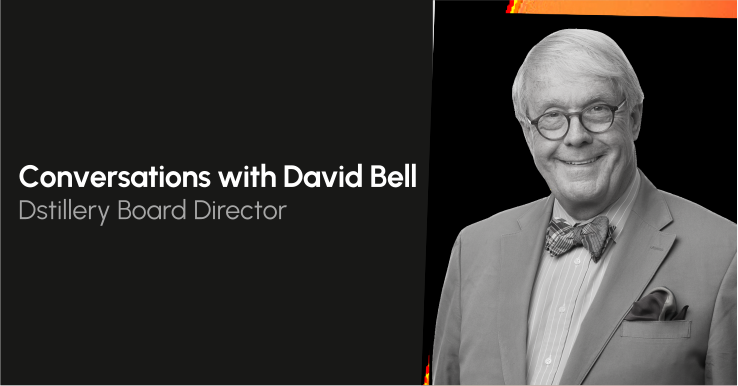
Conversations with David Bell: Adtech leaders on AI, innovation, and the future of advertising

Few people have influenced the advertising industry as profoundly as David Bell.

Over the course of his distinguished career, David has helped shape the evolution of modern marketing – from building one of the world’s leading media agencies to advising and investing in the next generation of advertising technology companies. Today, as a member of Dstillery’s Board of Directors, he continues to bring a unique perspective on the trends, technologies, and ideas transforming our industry.

At the 2026 Cannes Lions International Festival of Creativity, David sat down with some of advertising’s most respected executives for a series of candid conversations exploring the forces reshaping media, marketing, and technology. Rather than formal interviews, these are thoughtful discussions between industry peers, covering everything from AI and data innovation to entrepreneurship, creativity, client transformation, and the future of agency leadership.

The result is Conversations with David Bell: a collection of insightful interviews with the people helping define what’s next for advertising.

Each conversation offers a different perspective, but together they tell a compelling story. AI is accelerating change across every corner of the industry. Trust and transparency are becoming increasingly important. And while technology continues to evolve, success still comes down to people – their curiosity, creativity, and willingness to adapt.

Featured conversations: leaders shaping what’s next

The inaugural Conversations with David Bell series features interviews with:

Together, these interviews paint a compelling picture of an industry in transition. Spanning topics from agency leadership and mentorship to AI, data strategy, and measurement, the conversations reveal both diverse viewpoints and a shared vision for the future of marketing.

AI is changing everything, but people remain the differentiator

Across nearly every interview, executives agreed that AI is fundamentally reshaping advertising. Yet the consensus was equally clear: technology is most powerful when it amplifies human creativity, strategic thinking, and collaboration rather than replacing them.

Trust and transparency matter now more than ever

As AI becomes increasingly embedded across organizations and teams, leaders emphasize the importance of transparency, responsible data practices, and trusted partnerships. Success won’t come from technology alone; it will come from organizations that earn and maintain client confidence.

Innovation thrives through collaboration

Whether discussing agency partnerships, open technology ecosystems, or client relationships, guests repeatedly highlighted collaboration as a competitive advantage. The future belongs to organizations willing to learn, adapt, and innovate together.

Leadership requires curiosity

Many conversations turned to leadership itself and how to guide teams through rapid change, encourage experimentation, embrace failure as part of growth, and remain relentlessly curious in an industry that never stops evolving.

Conversations with David Bell are more than interviews

These aren’t traditional executive interviews. They’re candid conversations between industry peers, exploring the challenges and opportunities shaping advertising today and the decisions leaders are making to prepare for tomorrow.

Whether you’re interested in AI, media strategy, entrepreneurship, data-driven marketing, or agency leadership, you’ll find valuable insights throughout the series. We’re grateful to each executive who joined David during a busy week in Cannes to share their perspectives, experiences, and vision for the future.

Watch all the Conversations with David Bell on our videos page to hear directly from the leaders helping define the next era of advertising.

How multimodal AI is redefining ad targeting

Editor’s note: This blog was featured in the U of Digital AI Literacy Alliance series, where we explained how multimodal AI can help advertisers move beyond the constraints of silos, toward more adaptive, cross‑channel targeting.

Why following clicks has never been enough 

For years, digital advertising relied on channel-specific tools to find audiences and buy media to effectively reach them. Early AI followed the same pattern, with separate models for search, display, social, or CTV, each trained on a single data stream in isolation rather than the full multimodal customer journey. But real-world consumer behavioral journeys don’t occur in silos. As people move across sites of interest, they encounter and generate many different modalities at once — text, images, audio, video, and behavioral signals — that do not fit neatly into single-channel patterns. The industry has shifted from “following user clicks” to “understanding the user journey and the moment.” Just as we are all multi-faceted individuals, user behaviors are best predicted not as single-modality models but instead, with multimodal AI, connecting those signals in one unified system.

When more data creates fragmentation, not better targeting

Advertisers and their agencies now have access to more heterogeneous data than ever: site tags, search terms, product feeds, campaign and ad exposure logs, CTV viewership, and signals from podcasts or streaming services. 

And while advertiser data volume may seem advantageous, the key is quality over quantity. A small but accurate seed of a brand’s best customers often outperforms a large, disconnected dataset. Yet, all too often, these inputs are still modeled and activated in silos, making it hard to turn them into coherent targeting signals for top-performing campaigns.  The resulting fragmentation, latency, and guesswork mean brands and their agencies lose out on precision, ultimately compromising results. Bigger datasets or faster models won’t solve these problems; brands and agencies need targeting that can adapt to more predictive, cross‑channel environments.

Omnichannel targeting strategies have been around for years; how is this different?

Marketers often define their target audiences, perhaps through a set of descriptive attributes, and then reach those audiences across channels in one of two ways – qualitative matching or device graphs. 

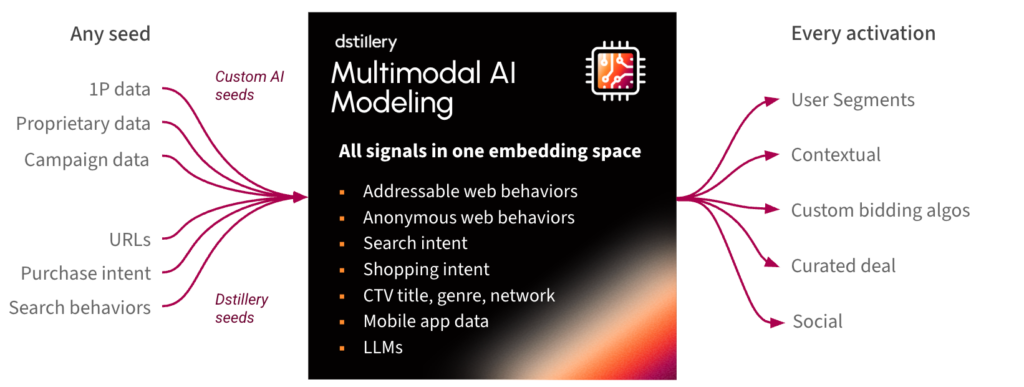
Dstillery Chief Data Scientist, Melinda Han Williams, explains: “Multimodal AI goes a level deeper, bringing cross-context connections directly into the model’s training space. Beyond gaining a more precise view of a brand’s best customers across data types, learning in a multimodal space unlocks flexibility for model inputs and outputs that otherwise wouldn’t be possible.”

How multimodal AI works (simplified)

At its core, multimodal AI represents digital behaviors, or data points, from different contexts, or modalities, in one common space to use as the foundation for modeling. Instead of treating a search term, a URL, or a CTV show as separate objects, the system converts each into a point in a shared mathematical space, or embedding, where similar behaviors and interests sit close together. The model learns that space across many signals at once, so behaviors tied to similar outcomes cluster together even without a common ID. Those points in the shared embedding space then become a common behavioral map to reach users regardless of modality or silo, ensuring the highest value for a brand’s campaigns.   

Multimodal AI is powerful, but not magic

Multimodal AI does not, by itself, solve today’s targeting challenges; it provides the connective tissue advanced agentic systems will rely on to understand and operate across modalities. For that foundation to work, agencies and brands need to test multiple tactics, share learnings with their partners, iterate on models, and align around clear KPIs. Success depends on strong inputs, transparency, and an ongoing willingness to learn what delivers results.

From Walmart to the boardroom: Julie Lyle’s lessons on leadership and growth

Editor’s Note: This interview was originally featured in The Female Quotient’s Leaders Spotlight from their newsletter on June 2, 2026.

Julie Lyle is a Board Director at Dstillery, the leading predictive AI audience targeting company. She is also President and Board member of TCC Global, where she leads efforts to help retailers worldwide drive customer loyalty, develop data strategies, and implement marketing programs at scale. Julie began her career as an entrepreneur before moving into executive roles at Walmart, Prudential plc, and Barnes & Noble, building deep expertise at the intersection of commerce and consumer behavior. In addition to her operating roles, she is a seasoned investor and advisor, serving on the board of meetsynthia.ai. Julie is widely recognized for her perspective on how brands can build lasting customer relationships through data and personalization.

What’s the most unexpected opportunity you’ve gotten in your career?

Early in my career, Mitch Hart, who is a venture capitalist and Founder of The Hart Group, recognized my potential and gave me the role of functionally reporting to 5 portfolio company CEOs, while administratively reporting to Mitch as Chairman. Through that job, I learned to successfully navigate internal politics, build trust among competing executives, and master conflict among big personalities. It was challenging, and the skills I gained were invaluable.

What’s the worst career advice you’ve gotten?

“If people allow you to take advantage of them, they deserve what they get.” I categorically disagree with that. I believe we all have a moral imperative to do well by doing good, as companies and as people. At the end of the day, your integrity is all that matters.

What was a heartbeat moment for you in your career?

It was when my mother was diagnosed with cancer. While she fought valiantly, she eventually had to be transitioned to hospice care. I was CMO of Walmart at the time, and I immediately resigned so that I could go and take care of her. It was a heartbeat moment for me because I loved my job. It was difficult to go from managing multi-billion-dollar profit and loss statements to changing bedpans and IVs, but I wouldn’t change that decision for the world. Those last months I had with my mom will always be precious to me.

Who is one person you’d love to give flowers to from your career that influenced your journey? What advice or lesson did you learn from them?

I would give flowers to Dan Burnham, who, when he was CEO at Raytheon, gave me a “tough love” challenge to be more intentional about how I managed my career. I took his advice to heart and developed a 7-part marketing plan with time and action schedules that I implemented and followed for the next 25 years. It had an incredible impact on my career growth and income. I eventually turned it into a curriculum and convinced Walmart to offer the program to 2,500 female managers in an effort to empower them with a clear path for growth and development. Even though it was 18 years ago, I still receive notes from women who used those growth insights to achieve success. I’m grateful to Dan for challenging me, bringing out my best, and allowing me to pay it forward.

Where have you caused some good trouble in your career?

During the 2008 global financial crisis, I was leading a team charged with accelerating growth in Prudential’s Asian insurance business. Market confidence was at an all-time low, and we had very little brand awareness in Asia. After careful research, we went against industry standards and took a big risk. We shifted our entire marketing strategy from typical financial services messaging to focus on families with children under the age of 12. We developed music videos, apps, games, and characters around a financial learning program for kids. We shifted our advertising dollars from the major news and financial media outlets to Nickelodeon. It was a huge success, and our sales, recruitment, and brand recognition soared.

Want to nominate a Female Quotient “Troublemaker” you admire? You can do so here.