testCategory: Multimodal AI

AI audience targeting: how Dstillery drives precision at scale

AI has already changed how advertisers identify, reach, and engage their most valuable prospects. But not all AI-powered audience targeting solutions work the same way.

Traditional audience segments and platform lookalikes can limit targeting to predefined categories, existing customer characteristics, or platform-specific signals. Dstillery takes a different approach, using multimodal AI and behavioral data to predict intent, rank devices, and help advertisers reach relevant audiences across digital channels.

By combining flexible data inputs, daily audience rescoring, and scalable activation, Dstillery helps advertisers and marketers move beyond static segments toward more precise, predictive audience targeting.

Here’s what makes Dstillery different.

1. Multimodal AI for precise audience targeting

Effective audience targeting starts with understanding which signals indicate a consumer’s likelihood of taking action.

Dstillery’s custom, patented AI models learn from multiple types of data to identify patterns associated with consumer intent. Rather than relying solely on predefined audience segments or demographic categories, our multimodal AI can use diverse inputs to build audiences aligned with specific campaign objectives.

Advertisers can start with CRM data, keywords, website signals, CTV exposure, or a written campaign brief. Our models use these inputs to identify relevant behavioral patterns and rank devices by modeled intent.

Dstillery brings three key capabilities together:

  • Multimodal AI: Learn from diverse data types to uncover relevant audience signals.
  • Device-level intent ranking: Prioritize devices based on modeled likelihood of taking action.
  • Daily audience rescoring: Reassess audience relevance every 24 hours as signals evolve.

This combination creates a flexible approach to predictive audience targeting, helping advertisers identify prospects based on behavioral insights rather than relying exclusively on static segments.

2. Flexible audience building, with or without first-party data

First-party data can be a valuable starting point for digital advertising, but it isn’t always available in sufficient volume or detailed enough to define an entire target audience.

Dstillery supports audience building with or without an existing seed audience, giving advertisers greater flexibility in their targeting approach.

Campaign inputs can include:

  • CRM lists and first-party customer data
  • Keywords and search-related signals
  • Websites and behavioral data
  • CTV exposure
  • Existing campaign audiences
  • Written briefs describing campaign goals and desired audiences

When advertisers have an established audience, Dstillery can use it as a starting point. When they don’t, our AI can identify relevant prospects from other available signals. This flexibility is especially useful for reaching hard-to-define audiences that may not fit neatly into standard taxonomies. 

3. Predictive targeting that balances precision and scale

A common challenge in programmatic advertising is balancing audience precision with reach. Narrow segments can constrain scale, while broadening an audience doesn’t necessarily improve the quality of the match.

Dstillery uses AI-driven device-level ranking to help advertisers identify relevant prospects at scale.

Instead of relying exclusively on fixed segment sizes, our models evaluate devices according to their predicted relevance to a campaign. This enables advertisers to build audiences around campaign-specific goals and scale activation according to their needs.

The objective is simple: help advertisers reach more of the people most likely to matter to their business, rather than maximizing audience size alone.

4. Cross-channel audience targeting without platform silos

Consumers move between websites, mobile apps, streaming environments, and other digital touchpoints. Advertisers need audience strategies that can support this fragmented media landscape. Yet many targeting solutions are tied to individual platforms, each with its own audience definitions, identifiers, and activation capabilities.

Dstillery helps marketers take a more unified approach to audience development. Our models can support activation across available DSP and partner channels, allowing advertisers to apply a consistent targeting strategy across eligible environments.

Depending on campaign requirements and activation capabilities, Dstillery also supports both ID-based and ID-free® targeting approaches. The result is greater flexibility in how advertisers develop and activate audiences across digital media and their campaigns.

5. Fresh audiences every 24 hours

Consumer interests and purchase intent change over time. An audience identified several weeks ago may not represent the same opportunity today.

That’s why audience freshness matters.

Dstillery rescores audiences every 24 hours, continually reassessing device-level relevance based on evolving behavioral signals. Rather than treating audience selection as a one-time exercise, our approach makes predictive targeting an ongoing process.

Daily rescoring helps advertisers work with fresher audience assessments and adapt to changing signals throughout their campaigns.

For marketers focused on improving targeting precision, this is a meaningful distinction from audience solutions that update less frequently or on varying schedules.

6. The data and technology behind Dstillery’s AI

Dstillery combines insights from observed consumer behavior with the scale of the open web to power predictive audience targeting.

Our patented models learn from an opt-in panel of approximately 2 million panelists, helping identify patterns across real-world consumer journeys. We apply those learnings across more than 400 million web and mobile devices to help advertisers find relevant prospects at scale.

The foundation of our approach includes:

  • Approximately 2 million opted-in panelists provide insights into real-world consumer journeys.
  • More than 400 million web and mobile devices offer opportunities to identify and reach relevant audiences.
  • 24-hour audience rescoring to continually reassess device-level relevance.
  • 25 U.S. patents protecting proprietary methods behind Dstillery’s AI technology.

7. AI advertising technology backed by proven results and real campaign metrics

The value of predictive AI audience targeting ultimately comes down to business outcomes. Dstillery has helped countless agencies and brands across different verticals improve campaign performance, from lowering acquisition costs to increasing engagement and conversion rates.

Examples of reported campaign results include:

  • DIRECTV: 3.75x improvement in the reported performance metric and a 200% improvement in cost per subscriber.
  • Tropical Smoothie Cafe: 70% lower display CPA and 75% lower video CPA.
  • Southwest Airlines: 92% improvement in cost per booking.

These results illustrate the potential impact of more effective audience targeting when the strategy, campaign objectives, and activation approach are aligned. Actual outcomes vary by campaign.

Dstillery’s innovation has also been recognized by industry organizations, including Digiday’s Best Ad Tech Platform (2025), the Business Intelligence Group’s AI Excellence Award (2025 and 2026), and Adweek AI Power 50 (2026).

8. Flexible activation through DS-1 and managed services

AI audience targeting should fit the way media buying teams work. Dstillery offers different approaches to support you and your team’s unique needs.

Self-serve with DS-1

DS-1 is Dstillery’s agentic AI advertising platform. It helps media planning teams work through audience discovery and activation using a conversational interface, simplifying workflows that traditionally require multiple manual steps. No more juggling multiple tools or waiting days for your audiences. DS-1 is the best tool for media teams to use to collaborate, research, build, optimize, and activate audiences – all in one place.

Managed services

Advertisers can also partner with Dstillery’s team to develop and execute audience strategies tailored to their campaign objectives. Our experts help translate business goals into strategic audience solutions and support activation across available channels.

Whether teams prefer a self-serve platform or hands-on expertise, Dstillery offers flexible options to put predictive audience targeting into practice.

What to look for in an AI audience targeting solution

When evaluating AI-powered audience targeting solutions and platforms, marketers should look beyond claims of scale or automation alone. Consider whether a solution can:

  • Learn from multiple types of data, rather than relying only on predefined audience categories.
  • Use behavioral signals to prioritize audience relevance.
  • Refresh audience assessments frequently as signals change.
  • Support activation across relevant digital channels.
  • Work with first-party data while offering alternatives when seed audiences are limited.
  • Demonstrate measurable campaign outcomes.

These capabilities can help marketers distinguish between solutions that simply automate existing targeting approaches and those that use AI to fundamentally change how audiences are identified and prioritized.

A better approach to audience targeting

The future of programmatic advertising isn’t just about accessing more data. It’s about using data more intelligently to predict intent, identify relevant prospects, and support better campaign outcomes.

Dstillery combines multimodal AI, behavioral insights, daily audience rescoring, and flexible activation to help advertisers move beyond static audience segments and toward more predictive, intent-driven targeting.

See how Dstillery compares with your current audience targeting strategy. Run a head-to-head test to evaluate performance against your existing approach. Visit dstillery.com/contact to get started today.
How multimodal AI is redefining ad targeting

Editor’s note: This blog was featured in the U of Digital AI Literacy Alliance series, where we explained how multimodal AI can help advertisers move beyond the constraints of silos, toward more adaptive, cross‑channel targeting.

Why following clicks has never been enough 

For years, digital advertising relied on channel-specific tools to find audiences and buy media to effectively reach them. Early AI followed the same pattern, with separate models for search, display, social, or CTV, each trained on a single data stream in isolation rather than the full multimodal customer journey. But real-world consumer behavioral journeys don’t occur in silos. As people move across sites of interest, they encounter and generate many different modalities at once — text, images, audio, video, and behavioral signals — that do not fit neatly into single-channel patterns. The industry has shifted from “following user clicks” to “understanding the user journey and the moment.” Just as we are all multi-faceted individuals, user behaviors are best predicted not as single-modality models but instead, with multimodal AI, connecting those signals in one unified system.

When more data creates fragmentation, not better targeting

Advertisers and their agencies now have access to more heterogeneous data than ever: site tags, search terms, product feeds, campaign and ad exposure logs, CTV viewership, and signals from podcasts or streaming services. 

And while advertiser data volume may seem advantageous, the key is quality over quantity. A small but accurate seed of a brand’s best customers often outperforms a large, disconnected dataset. Yet, all too often, these inputs are still modeled and activated in silos, making it hard to turn them into coherent targeting signals for top-performing campaigns.  The resulting fragmentation, latency, and guesswork mean brands and their agencies lose out on precision, ultimately compromising results. Bigger datasets or faster models won’t solve these problems; brands and agencies need targeting that can adapt to more predictive, cross‑channel environments.

Omnichannel targeting strategies have been around for years; how is this different?

Marketers often define their target audiences, perhaps through a set of descriptive attributes, and then reach those audiences across channels in one of two ways – qualitative matching or device graphs. 

Dstillery Chief Data Scientist, Melinda Han Williams, explains: “Multimodal AI goes a level deeper, bringing cross-context connections directly into the model’s training space. Beyond gaining a more precise view of a brand’s best customers across data types, learning in a multimodal space unlocks flexibility for model inputs and outputs that otherwise wouldn’t be possible.”

How multimodal AI works (simplified)

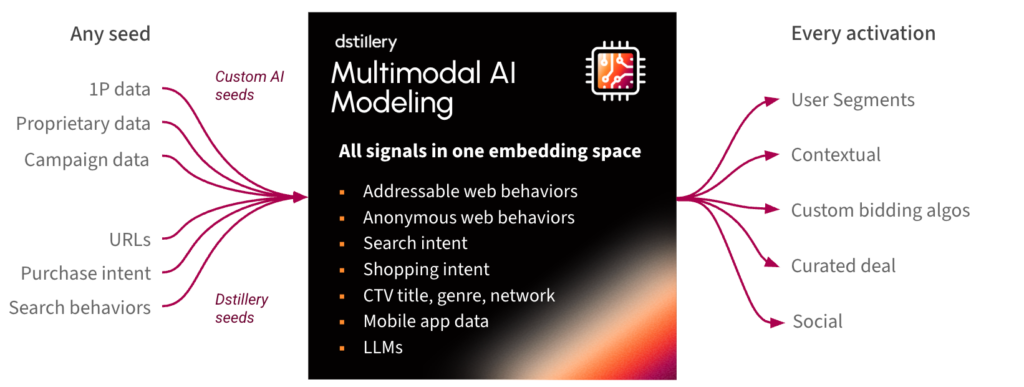
At its core, multimodal AI represents digital behaviors, or data points, from different contexts, or modalities, in one common space to use as the foundation for modeling. Instead of treating a search term, a URL, or a CTV show as separate objects, the system converts each into a point in a shared mathematical space, or embedding, where similar behaviors and interests sit close together. The model learns that space across many signals at once, so behaviors tied to similar outcomes cluster together even without a common ID. Those points in the shared embedding space then become a common behavioral map to reach users regardless of modality or silo, ensuring the highest value for a brand’s campaigns.   

Multimodal AI is powerful, but not magic

Multimodal AI does not, by itself, solve today’s targeting challenges; it provides the connective tissue advanced agentic systems will rely on to understand and operate across modalities. For that foundation to work, agencies and brands need to test multiple tactics, share learnings with their partners, iterate on models, and align around clear KPIs. Success depends on strong inputs, transparency, and an ongoing willingness to learn what delivers results.

AdExchanger’s Programmatic AI 2026: Dstillery’s key takeaways

Las Vegas hosted AdExchanger’s Programmatic AI event, and after two days of sessions and conversations, we left with a clearer picture of where the industry’s head is at and where the real work is happening.

The conversation has shifted

The most noticeable change from years past: nobody needed to be convinced that AI matters. The interesting debates were happening further upstream, around execution, differentiation, and what “useful AI” actually looks like in practice.

One phrase that kept surfacing was the shift from “human in the loop” to “human in the lead.” It reflects something we think about a lot at Dstillery: automation that accelerates doesn’t mean automation that replaces judgment. The organizations moving fastest aren’t chasing autonomy for its own sake. They’re embedding AI into the places where manual work creates the most drag.

There was also a lot of honest conversation about “pilot purgatory,” the gap between experimenting with AI tools and actually integrating them into scalable workflows. That gap is where many companies are still stuck, and it came up repeatedly as a more urgent challenge than any technological limitation.

Mark Jung on agents actually used in the wild

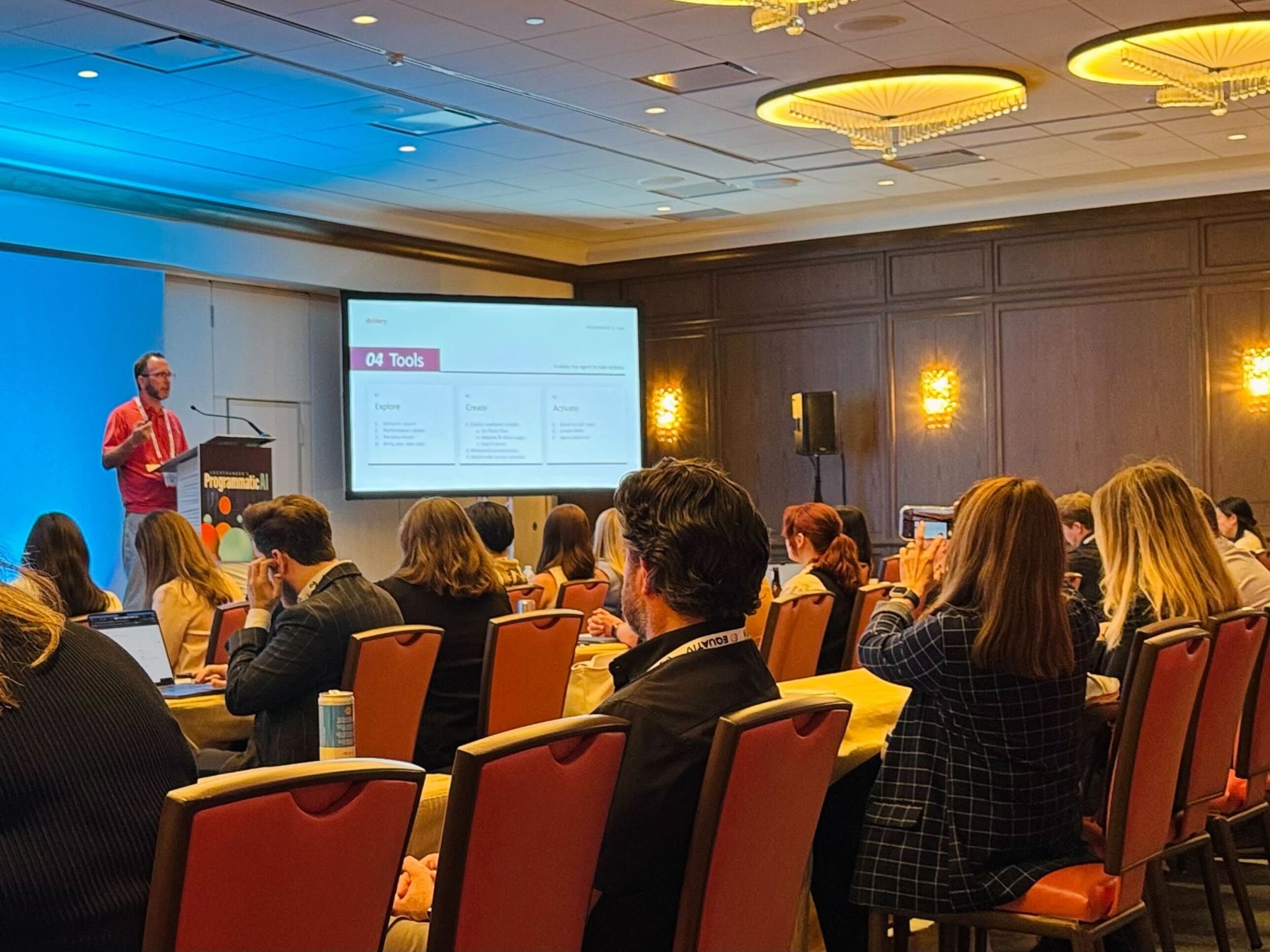
A highlight for us was Dstillery’s VP, Head of Product & AI, Mark Jung’s session, “Agents Built For Audience Buying Workflows… Actually Used In The Wild.” The framing was intentional: not a roadmap, not a demo of what’s coming, but a look at how agentic AI and Dstillery’s DS-1 platform are already running inside real audience-buying workflows today.

Mark walked through how Dstillery’s agentic AI advertising platform, DS-1, helps teams move faster on audience discovery, reduce activation timelines, and cut down on the manual operational work that tends to slow campaign execution. From audience creation to activation, the session showed how agentic AI can streamline workflows that traditionally take days into processes completed in minutes. The core argument: you don’t need fully autonomous systems or perfect industry standards to start generating real operational value. The work is happening now.

That landed well in the room, and it matched the tone of the broader conference. Less interest in flashy demos, more interest in what’s actually solving problems.

What we’re thinking about next

Consumer intent signals are getting more fragmented as AI assistants become a bigger part of how people discover and decide. That makes downstream behavioral modeling more important, specifically the kind that can work across fragmented signals. It’s a dynamic we’re watching closely.

There was also consistent emphasis on data quality and governance as AI takes on a larger operational role. The reality is that AI is only as strong as the data and systems behind it, and as automation scales, those foundations become even more important. For us at Dstillery, that’s where the real opportunity lies: building AI that’s not just fast, but reliable, scalable, and grounded in high-quality data.

WTF is multimodal AI in advertising?

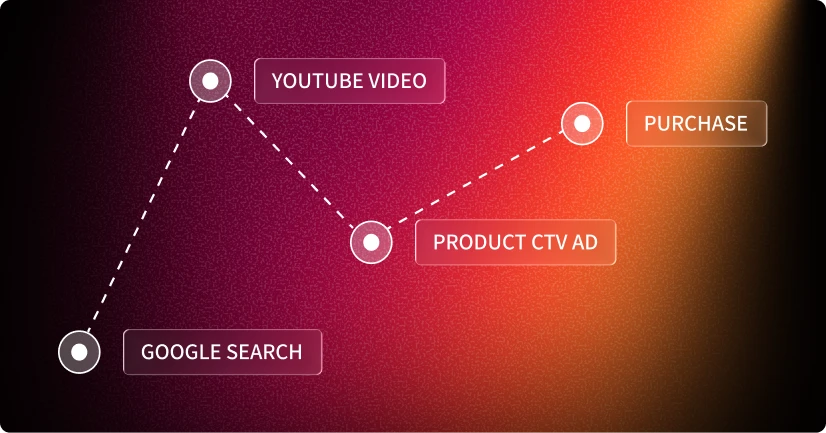
Picture this: You’re researching a new coffee maker. You Google “best espresso machines,” browse Williams-Sonoma’s website, watch a YouTube review, then see a CTV ad for Breville machines before finally making a purchase. Traditional ad targeting treats each of these touchpoints as isolated events. Multimodal AI sees them as one connected journey — and that’s revolutionizing how advertisers find and reach audiences.

The multimodal difference

While everyone’s been obsessed with Sora 2 putting their faces into videos, the advertising world has quietly been building something more practical: AI that can understand any type of data and apply those insights across any advertising channel.

“What you need is prediction based on behavioral data, and that’s why we wanted to use multimodal AI for prediction in digital ad targeting,” explains Melinda Han Williams, Chief Data Scientist at Dstillery. “By multimodal, we mean you can use different modalities of data — not just different sources. The difference between looking at words and what they mean and looking at behaviors and how you’ve seen them strung together as sequences in the past.”

Think of it like how humans naturally combine visual cues, sounds, text and context to understand a situation. When you see a waiter slip on a wet floor near a caution sign, your brain instantly processes multiple inputs to grasp the full story. Multimodal AI aims for that same fusion of understanding.

From brief to campaign in one model

Here’s where it gets interesting for advertisers. Instead of building separate models for search, display, CTV and everything else, multimodal AI creates one unified understanding that works everywhere.

“What sets multimodal AI apart is in its flexibility,” said Taejin In, Chief Product Officer at Dstillery. “Whether you have rich first-party data or just a basic campaign brief, multimodal AI can transform virtually any starting point into precise, actionable audiences.”

The system can take first-party data, CRM lists, search keywords, website URLs, or even just a paragraph describing your target audience. It then builds a model that can activate across user segments, contextual targeting, private marketplace deals and custom bidding algorithms — all from that single input.

This new way to approach targeting doesn’t just simplify workflows for overworked advertising professionals, but it also delivers superior outcomes. For example, an automotive brand using a curated CTV deal created by multimodal AI saw a much higher 98% video completion rate compared to traditional ID-based targeting, while an auto insurance company with direct response goals surprisingly discovered that contextual targeting outperformed 12 other tactics in their campaign, including traditional id-based lookalikes.

Why this matters now and in the future

Multimodal capabilities in digital ad targeting clearly provide a lot of value today – the application of more data to build more precise targeting, the ability to understand and reach audiences without relying solely on identifiers, and the ability to reduce vendor sprawl and simplify workflows.

However, something that might not be obvious is how multimodal AI is foundational for tomorrow’s AI agents and agentic advertising systems. “For agentic AI and advanced AI agents to truly deliver superior value, they need to understand all modes of data; you can’t do that without multimodality,” In explains, “Imagine if an AI agent can only reason from contextual signals. It would be missing behavioral signals which we all know are a much better predictor of intent”

With a multimodal foundation, these agentic AI systems and protocols will be able to understand multiple modes of data (web behavioral, CTV, in-app, search, user segment, evaluate and make decisions in a shared space, and interact with external systems all with different modalities.

The reality check

Multimodal AI isn’t magic. Success depends on having the right seed data and being willing to test and optimize. The most successful implementations happen when brands view it as a partnership, not a set-it-and-forget-it solution.

But for advertisers tired of managing dozens of disconnected models and tactics, multimodal AI offers a compelling alternative: one model that understands your audience across every signal and can activate that understanding anywhere in the programmatic ecosystem. In a world where consumer journeys zigzag across channels, that unified view isn’t just convenient — it’s essential.

Data Science Deep Dive: modular multimodal system for CTV ad targeting

Why Multimodal Learning Matters

Multimodal learning is the next frontier in machine learning. It allows machines to combine different types of data to understand more than is possible from any one source.

Think of the example of understanding a scene in a play. As humans, our brains seamlessly integrate visual cues, auditory input, text, and prior knowledge.  In a scene, we may see a waiter fall and drop a tray of drinks, we hear the crash of objects falling, we hear language spoken as someone reacts to the accident, and we read a caution sign saying the floor is wet. From this input, we easily conclude that the waiter slipped on the wet floor and dropped the drinks. This is due to our brains combining visual cues, auditory input, text, and prior knowledge.  Without the combination of all of these inputs, we risk drawing the wrong conclusion about the scene. Auditory input alone might tell us an accident occurred, while visual cues may show a waiter slipping and drinks falling – but without reading the sign that says the floor is wet, we can’t fully understand why it happened.

Multimodal machine learning allows machines to perform a similar fusion of different data modalities, giving machines the ability to understand context, respond naturally, and make smart decisions in complex environments. 

At Dstillery, we are experts at using AI to perform ad targeting. A powerful data modality in this space is user browsing behavior. The success of ad targeting campaigns is often measured by a conversion event performed online, such as purchasing a product or visiting a homepage. The journeys a user takes across the internet can be very predictive of whether they are likely to perform a particular online conversion or not.  

For example, online retail sites visited by a consumer tells us the user’s style and the amount they may be willing to pay, and gives clues to demographic attributes such as gender and age.  It is intuitive to see how this leads to useful features in an ad targeting campaign for a clothing brand. With the recent development in LLMs and generative AI, highly accurate text features can be generated for almost anything. This gives a second highly performing data modality we can use in our ad targeting campaigns.

We have built a modular, scalable multimodal architecture to integrate these data modalities and produce high-performing CTV ad targeting. Our patent-pending approach combines web behavioral features and text features to generate richer predictions, better personalization, and smarter automation of CTV ad targeting. 

Our Approach: A Modular Multimodal Architecture for CTV Ad Targeting

Our CTV ad targeting system is built on a modular multimodal architecture that combines a foundation model with a lightweight mapping model. The foundation model is trained on large-scale web browsing behavior, while the mapping model enables us to extend that model’s capabilities to other data types — such as text — by projecting them into the same embedding space.

Foundation Model: Learning Behavioral Embeddings from Web Journeys

At the core of our system is a foundation model trained on web visitation sequences, producing what we call MOTI embeddings — short for Map Of The Internet. These embeddings are learned using self-supervised learning on billions of sequential website visits. The model is trained to predict the next website in a user’s browsing journey, allowing it to learn the behavioral patterns and intent behind web visits.

This results in a rich embedding space that captures user behavior across the open web — not just what sites users visit, but why and in what context. MOTI embeddings provide a strong signal for predicting future behavior, especially web-based conversions.

Mapping Model: Extending MOTI Embeddings to New Modalities

To enable multimodal learning, we train a mapping model that projects from text space into the MOTI embedding space. This allows us to represent any domain described by text — such as CTV content metadata — using the behavioral signal embedded in our foundation model.

We train this mapping model by aligning two modalities:

  • MOTI embeddings for a large set of websites.
  • LLM-generated keyword embeddings extracted from the same websites using generative AI.

By training a model to predict MOTI embeddings from LLM embeddings, we learn a cross-modal projection that allows us to map new text inputs (e.g., CTV parameters) into our MOTI space — effectively teaching the text modality to “speak the language” of web behavior.

Brand-Specific Models: Optimizing for Conversions

Clients often wish to drive outcomes measurable by web conversions — such as site visits, keyword searches, or product views. Since MOTI embeddings capture real behavioral intent, they serve as high-performing features for building client-specific models trained on conversion outcomes.

These models learn what types of behavior (in MOTI space) are most predictive of desired outcomes for each brand — allowing us to personalize targeting at scale.

CTV Targeting: Scoring Content Using Behavioral Signals

Once we’ve trained a brand-specific model in MOTI space, we can use it to score any other domain that can be described in text. For CTV ad targeting, we use generative AI to extract semantic features from content metadata — such as series, title, genre, language, rating, and channel.

These features are embedded using an LLM, then mapped into MOTI space via our mapping model. This allows us to use the brand’s web conversion model to score and rank CTV inventory based on how closely it aligns with high-performing web behaviors — creating a seamless link between behavioral intent and CTV content.

This architecture enables us to fuse two distinct data modalities — behavioral browsing data and structured text — through a shared representation space. It’s a powerful, scalable approach to multimodal learning: one that leverages foundation models, bridges across modalities, and delivers measurable performance in production systems. You can think of it as teaching the text modality to speak the behavioral language of MOTI embeddings, allowing both modalities to contribute meaningfully to targeting decisions.

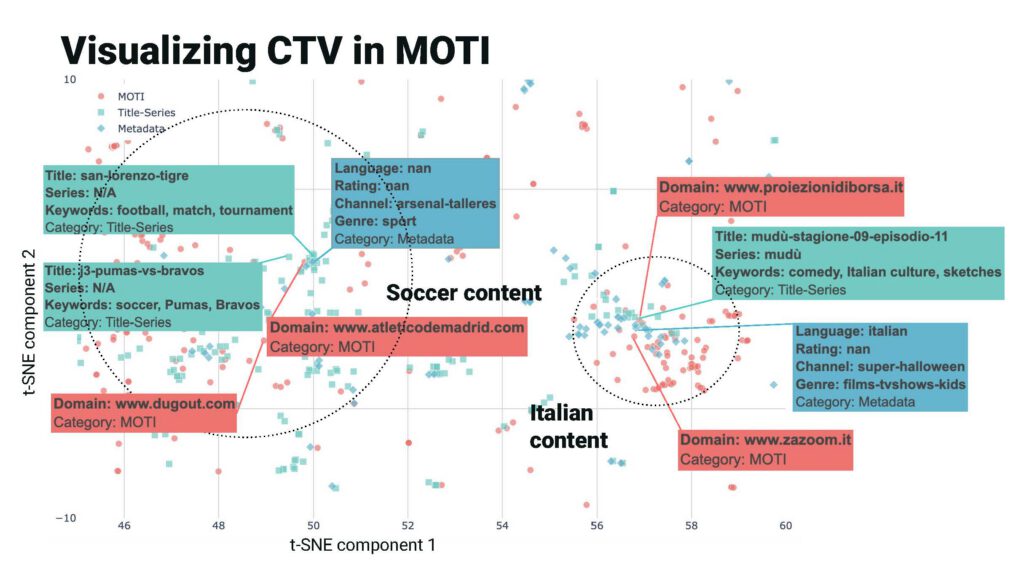
FIGURE: TSNE visualization of CTV attributes (series, title, language, rating, channel, genre) in the same space as websites in MOTI. As indicated by the left dotted circle, CTV attributes related to soccer, as well as soccer related domains are close by in the MOTI space.  Another example indicated by the right dotted circle shows CTV attributes and nearby domains are related to Italian content.

FIGURE: TSNE visualization of CTV attributes (series, title, language, rating, channel, genre) in the same space as websites in MOTI. As indicated by the left dotted circle, CTV attributes related to soccer, as well as soccer related domains are close by in the MOTI space.  Another example indicated by the right dotted circle shows CTV attributes and nearby domains are related to Italian content. 

A powerful, flexible approach to multimodal learning

Our CTV ad targeting solution is an effective and product-ready form of multimodal learning. 

Scalable: Leveraging an existing foundation model trained on large amounts of streaming data allows the training of CTV models at scale. Training a model for each of our clients is fast and efficient.  

Flexible: As text features from LLMs improve, or new CTV shows are aired, we can represent this new data in our multimodal model without retraining our large and computationally expensive foundation model.

Composable: As text features have emerged over the past couple of years, if there is a new data modality that is useful for ad targeting we can simply train a new mapping model and produce a multimodal solution with a new modality

Interpretable: Our solution is highly interpretable because we can query the joint representation space easily, giving us a clear understanding of the relationship between modalities

Results in the real world

Our modular multimodal targeting system has delivered strong, measurable performance across verticals, proving its value in real-world, ID-free environments.

Automotive Brand: Outperforming ID-Based Targeting

An automotive client sought to reach high-intent car shoppers using an ID-free CTV strategy. Using our modular multimodal architecture, we built a custom brand model for the campaign.

– The ID-free CTV model outperformed the client’s ID-based audience from day one, ultimately achieving a 98% higher video completion rate (VCR) by the end of the campaign.
– The model also delivered better cost efficiency, producing more CTV conversions at a lower cost per conversion (CPC), obtaining a CPC of $9.13.
– The client’s agency concluded that adding ID-free targeting alongside traditional ID-based models significantly expanded reach without sacrificing performance.

Kitchen Appliance Brand: Sustained Success Across CTV and Display

A kitchen appliance brand partnered with Dstillery to raise awareness for their new products using CTV and display media. They measured success using VCR and clickthrough rate (CTR) as KPIs.

– The campaign achieved a 94% average VCR on CTV beating the client benchmark of 70%.
– Display ads delivered a 0.14% CTR beating the 0.10% benchmark.
– Top-performing CTV channels included AT&T TV, Discovery Channel, and Food Network Kitchen — all aligned with high behavioral intent signals captured in our MOTI embeddings.

Multimodal AI for CTV: A Real-World Blueprint for Smarter Ad Targeting

Our solution is a framework for practical multimodal AI.  When there are two complementary data sources and a unimodal foundation model exists for at least one of the modalities, a fast and efficient solution to multimodal machine learning is to train a model to learn a mapping from one modality to another.  This produces an efficient multimodal solution that is interpretable and adaptable. You don’t need to train all modalities together from day one. Multimodal learning can be layered, modular, and immediately impactful. Multimodal learning isn’t just about giant models – It’s about combining signals to see more clearly and building systems that grow with your product.