testTag: contextual targeting

How Does ID-free® Differ from Contextual Targeting?

Back in January 2020, when Google first announced its intention to deprecate third-party cookies, marketers and advertisers started exploring alternative strategies to reach audiences effectively. And while third-party cookies are technically still here, the need for new privacy-safe targeting solutions remains.  

Two popular approaches are ID-free® targeting and contextual targeting. While both methods help deliver privacy-friendly advertising, they are distinct in how they operate and how they identify the best audiences.

Understanding ID-free Targeting

Dstillery’s patented ID-free targeting is a revolutionary technology that employs a totally different approach than basic content analysis. ID-free targeting is rooted in data science and machine learning, leveraging sophisticated algorithms to find the right audiences without relying on any form of personal identification, cookies, or device IDs. By analyzing the aggregated behaviors of an anonymous consumer panel, such as browsing behavior, content consumption, and time of day, ID-free targeting finds your best audiences based on behavioral inventory signals. What’s more? ID-free predicts which sites are likely to convert for your brand without any user profiles or tracking.

The power of our ID-free technology lies in its ability to be adaptive and intuitive. It allows advertisers to reach users who are most likely to engage with their messages, based on patterns of behavior that indicate interest, rather than matching specific topics or keywords. This level of precision not only enhances campaign performance but also meets the growing need for privacy-safe solutions.

What is Contextual Targeting?

Contextual targeting is an advertising method that involves placing ads based on the content of the webpage, or the context in which the ad is served. For example, an ad for gym clothes might appear in a blog article about workout routines. This approach uses keywords, page topics, and sentiment analysis to ensure that ads align with the content that users are currently viewing.

While contextual targeting can effectively place ads in relevant environments, it is limited by its reliance on immediate content. It does not account for user behavior beyond the current page the way ID-free does which will cause advertisers to miss out on reaching pertinent audiences.

Contextual targeting is a good way to understand the keyword clusters an audience member might search for along their digital journey. However, if you craft a deep profile of understanding around your audience, only a tiny fraction of that audience will be targeted by contextual solutions. 

Key Differences Between ID-free and Contextual Targeting

ID-free technologyContextual Targeting
Audience PrecisionLeverages complex data science techniques to identify ideal audiences based on anonymous behavioral signalsMatches ads to specific content, ignoring interest patterns or user journeys 
Privacy StandardsPrivacy-safe, does not rely on any personal dataPrivacy-safe 
AdaptabilityDynamically adjusts to shifting behaviors and trends in real-time, enabling brands to stay relevantTied to specific page content and may not capture broader audience interest shifts

Choosing the Right Solution for Your Brand

As more and more people opt out of cookies, it’s crucial to understand the differences between ID-free and contextual targeting. While contextual targeting is effective in aligning ads with relevant content, ID-free offers a powerful alternative for brands and their agencies aiming for audience precision without sacrificing privacy. 

If you’d like to test ID-free targeting in your next campaign, reach out to get started.

Contextual Targeting vs. Behavioral Targeting

Updated: November 7, 2024

In the noisy digital world, ad relevance is crucial to reaching your target audience. Digital ads need to be approached carefully so as not to disrupt your potential customers’ online experiences. And with third-party cookie retirement on the horizon, digital marketers should evaluate new cookieless advertising strategies to ensure their ads are being seen by the right people, at the right time.

Contextual and behavioral targeting are two techniques that you should be testing now. Neither requires cookies, both are privacy-safe, and when implemented correctly, these can be highly effective for reaching your target audiences.

What is contextual targeting? 

Contextual targeting is a form of digital advertising that places display ads based on a website’s content. We’ve all seen them. It’s the reason why you’re served a meal kit delivery ad while browsing a recipe website, or a bridal gown ad on a wedding planning blog. Contextual targeting is the digital form of running a printed ASICS ad in Runner’s World magazine. The process matches display ads to relevant websites based on keywords, topics, and context.

What is behavioral targeting?

While contextual targeting relies on keywords and topics, behavioral targeting is based on a user’s online behaviors. By analyzing online browsing habits – i.e. sites visited, search queries, purchase behavior – behavioral targeting leverages user data to create a more personalized experience. 

Timely and effective advertising requires a deep understanding of your audience. Behavioral targeting does just that by going deeper than website content.

Dstillery’s cookieless behavioral targeting solution

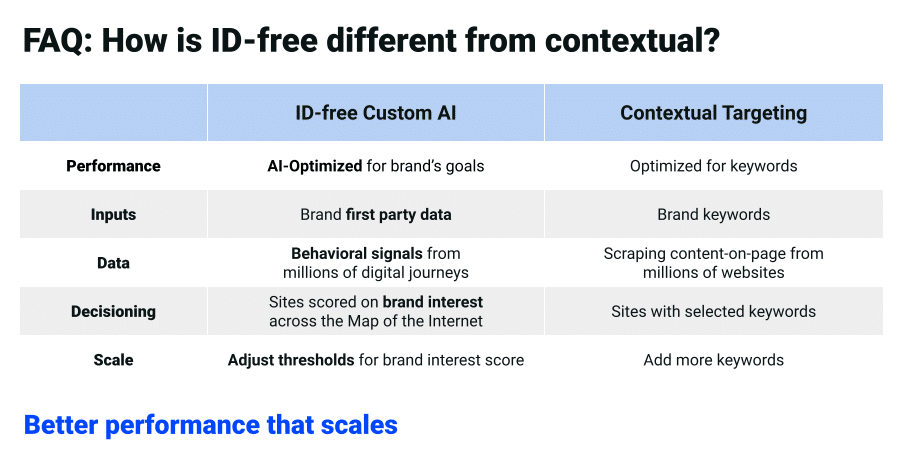
To get ahead of the retirement of third-party cookies, we created a privacy-by-design, behavioral targeting solution called ID-free®. Instead of reading the words on a page or scraping content, our behavioral solution picks up on other signals that reflect brand interest by using AI optimization toward a client’s first-party data. Unlike standard behavioral targeting, ID-free takes advantage of predictive behavioral signals without tracking your audience. ID-free evaluates individual impression opportunities to provide intelligent decisioning without compromising anonymity, resulting in better performance that scales.

ID-free Custom AI behavioral targeting solution compared to contextual targeting.

As long as first-party data is available, ID-free audiences can be implemented in your next campaign. Whether you’re looking for a behavioral targeting solution or want to future-proof your ad campaigns, now’s the time to test. Contact us today to learn more.

Contextual Targeting 101

With Google planning to retire third-party cookie tracking in 2023, marketers everywhere are searching for the next best way to show the most relevant ads to users. How do they reach specific people at the right time? Between behavioral and contextual targeting, marketers need a more flexible way to think about “the right time.”

What Is Contextual Targeting?

Contextual targeting is defined as showing an advertisement directly related to the website content being viewed. For example, if a user reads an article titled “10 Best Electric Vehicles,” a Tesla display ad might show on the page. Another example might be if a user reads about ways to save time, and meal delivery subscription ads are shown. Contextual targeting uses data from website analysis to determine the topics, keywords, and image information (among other details) to determine what a web page is about. Based on the data, the ad servers know what ads to place on that individual page.

What is Context Switching and Why Does it Matter?

As attention spans decrease and the average consumer engages with multiple pieces of content at a time, context switching is essential for marketers to consider. Context switching is moving from one task to another, and it comes with some serious negative side effects. Thanks to cognitive flexibility, humans are able to easily and quickly move from topic to topic. While it seems great to multi-task, context switching eats into focused time.

This movement from one state to another used to be powered by third-party cookie tracking. But with the depreciation of cookies, there is still the question of showing the right ad at the right time. Does this moment of a shifted context matter? Should ad servers still show a relevant ad? For example, attention residue shows that even as a user has moved on, their brain is still thinking about the top 10 best electric vehicles — even if they’re now reading an article on SportsCenter.

The Right Ad at the Right Time

Finding the optimal moment is critical. And as movement and behavior online continually change, the right moment for the right ad might continue to shift. We’re primed at all different times to get a nudge about a topic we were previously researching thanks to the flexible human brain.

At Dstillery, we help clients maximize the value of customer data and transform the way they connect with their audiences. To help prepare for the retirement of third-party cookies, we’ve launched a new cookieless targeting solution that isn’t contextual.

If you’re interested in learning more, visit dstillery.com/go-cookieless.