testTag: cookieless future

Ready for a Cookieless Future? Check Out Our ID-free® Testing Guide

With cookie deprecation and cookieless testing top-of-mind for many media buyers, here is a quick overview of the best ways to set up and test Dstillery’s ID-free®, the only behavioral targeting solution without IDs. 

ID-free is a first-of-its-kind targeting technology that delivers performance, privacy, and scale by predicting the value of an impression to a brand without knowing anything about the user. This patented technology uses AI to learn from browsing patterns detected in de-identified opt-in panel data, ultimately answering the question: When someone visits a site, how likely will they be interested in your brand’s message?

Audience Definition

The first step is defining your target audience in your display, search, or CTV campaign. If you have used an ID-based Dstillery audience in the past and found it successful, you can simply request an ID-free version of the audience. If you haven’t, you can use a variety of signals such as first-party data, search terms, URL lists, or our catalog of thousands of pre-built audiences to seed your ID-free model.  

Campaign Setup

One of the most common pitfalls we see with testing is not allocating enough budget and time to allow the model to perform and optimize. We recommend three months for a proper cookieless test to truly understand how the audience performs against your KPIs. Beyond awareness metrics, ID-free excels in cost-per metrics such as:

  • Cost per action (CPA)
  • Cost per click (CPC)
  • Cost per complete view (CPCV)
  • Cost per site visit (CPSV)
  • Return on ad spend (ROAS)

In terms of budget, we recommend a $30,000 monthly budget in media – split out evenly between ID-free and ID-based versions of your audience – without highly restrictive inclusion lists and operating all hours of the day. These campaign parameters will allow you to truly understand and optimize your ID-free campaign with the most information available throughout the testing period.

Make the Most of Your ID-free Test

Our experienced Client Success teams can help you through all the details of creating a proper A/B testing framework. Beyond campaign parameters, to properly assess ID-free performance, efficiency, and scale, we recommend an A/B testing approach by running both ID-based and ID-free audiences in parallel. We recommend creating one line item for your ID-based audience and one for your ID-free audience. When creating these line items, try duplicating them rather than creating them from scratch. This ensures that various settings in your line items are identical, except for the singular variable (ID-based vs ID-free audience) you are testing. Also, since our industry still uses third-party cookies for attribution KPIs, we recommend targeting trackable Chrome inventory for both line items. 

Bonus Test to Assess Performance Outside of 3rd Party Cookies

Using conversions measured on trackable inventory, Dstillery can model the conversion rate per site across all domains specific to the campaign. Using this data, we can understand the performance of impressions delivered on inventory with no trackable identifiers. To learn more about this measurement, read our case study with Tombras, where we drove 2.5x more conversions than traditional cookie-based targeting.

Ready to test ID-free? Amazing. It’s available on every DSP. Contact one of our representatives to get started today.

Does Google’s Cookie Retirement Timeline matter anymore? 

Google delays cookie retirement… again.

This week, Google announced that it would once again delay its retirement of third-party cookies from the Chrome browser. Originally planned for 1Q 2022, Google had shifted the timeline to 4Q 2023 last June. Now, it is targeting
2H 2024.

Why the delay?

The reason Google gave is that its own post-cookie solutions, known as the Privacy Sandbox, will not be ready in time to provide the industry with a viable alternative to cookies by 4Q 2023 – a requirement for regulators focused on Google’s market power.

A further delay is not wholly unexpected. In fact, it has been consensus for some time in the programmatic ad industry that Google would not meet its timeline, and many believe that cookies will live on indefinitely.

But the industry momentum behind new targeting technologies is not exclusively about Google’s plans for cookies. Indeed, that is only the most visible element of a bigger, more fundamental industry movement towards privacy-safe digital advertising technologies, a movement that is unlikely to abate.

What does this mean for advertisers today?

That does not mean that we think advertisers ought to stop using cookies. Indeed, our point of view has been that advertisers should use that technology for as long as it is available, if it is delivering value for them.

It does mean, though, that we believe that advertisers should also be leveraging — or at a minimum, testing —the new technologies that the privacy wave has inspired. Among those technologies, there may be something better than cookie-based solutions that brands should be using today instead of or in addition to them.

Cookieless targeting is available now.

At Dstillery, we are super-proud of our cookieless targeting solution, which we call ID-free Custom AI™. The patented technology uses aggregate behaviors of consented users (from, say, a panel) to make predictions about what ad inventory is likely to convert for a specific brand. The accuracy of those predictions is on par with the accuracy of our high-performing user-based audiences, despite having no user histories and no ID in the bid request. And all of this at the scale that advertisers need.

ID-free has had a strong reception from the market and has unlocked a wave of innovation and growth at Dstillery. We have developed an ID-free targeting solution for the healthcare industry, which we call Custom Patient Targeting, that delivers privacy-compliant but highly accurate, scaled digital targeting to healthcare brands. We have launched targeting in new forms beyond user-based audiences, including custom bidding algos and Deal-IDs. And we have seen intense initial interest in ID-free from advertisers in Europe, where user targeting is constrained by GDPR.

Whatever Google’s timeline, Dstillery is well positioned today with the combination of best-in-class ID-based audience targeting products and easy-to-activate ID-free solutions that provide scale, performance, and precision in a privacy-safe way. Those solutions are available for activation here and now, and drive better performance than the most widely used cookie-based audiences.

The wave of privacy-inspired innovation that is underway will keep on rolling, regardless of whether cookie retirement happens or not. Advertisers would do well to ride that wave.

Contextual Targeting vs. Behavioral Targeting

Updated: November 7, 2024

In the noisy digital world, ad relevance is crucial to reaching your target audience. Digital ads need to be approached carefully so as not to disrupt your potential customers’ online experiences. And with third-party cookie retirement on the horizon, digital marketers should evaluate new cookieless advertising strategies to ensure their ads are being seen by the right people, at the right time.

Contextual and behavioral targeting are two techniques that you should be testing now. Neither requires cookies, both are privacy-safe, and when implemented correctly, these can be highly effective for reaching your target audiences.

What is contextual targeting? 

Contextual targeting is a form of digital advertising that places display ads based on a website’s content. We’ve all seen them. It’s the reason why you’re served a meal kit delivery ad while browsing a recipe website, or a bridal gown ad on a wedding planning blog. Contextual targeting is the digital form of running a printed ASICS ad in Runner’s World magazine. The process matches display ads to relevant websites based on keywords, topics, and context.

What is behavioral targeting?

While contextual targeting relies on keywords and topics, behavioral targeting is based on a user’s online behaviors. By analyzing online browsing habits – i.e. sites visited, search queries, purchase behavior – behavioral targeting leverages user data to create a more personalized experience. 

Timely and effective advertising requires a deep understanding of your audience. Behavioral targeting does just that by going deeper than website content.

Dstillery’s cookieless behavioral targeting solution

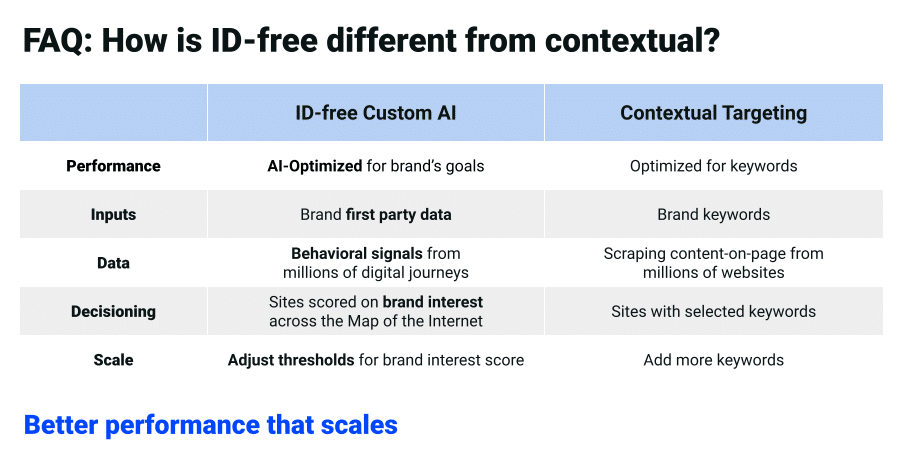
To get ahead of the retirement of third-party cookies, we created a privacy-by-design, behavioral targeting solution called ID-free®. Instead of reading the words on a page or scraping content, our behavioral solution picks up on other signals that reflect brand interest by using AI optimization toward a client’s first-party data. Unlike standard behavioral targeting, ID-free takes advantage of predictive behavioral signals without tracking your audience. ID-free evaluates individual impression opportunities to provide intelligent decisioning without compromising anonymity, resulting in better performance that scales.

ID-free Custom AI behavioral targeting solution compared to contextual targeting.

As long as first-party data is available, ID-free audiences can be implemented in your next campaign. Whether you’re looking for a behavioral targeting solution or want to future-proof your ad campaigns, now’s the time to test. Contact us today to learn more.

How Brand Identity Is Measured in a Cookieless Future

As marketers everywhere heard the news that Google was sunsetting third-party cookies in late 2023, we asked ourselves, “How will we measure attribution in a cookieless future?”

Historically, marketing value has been tough to track. The advent of cookies and behavioral signals finally gave the industry a firm way to measure message impact and attributed success across multiple channels. Cookies have allowed marketers to personalize user experiences, recommend products, and increase sales, but a global emphasis on privacy and security means behavioral tracking as we know it is changing.

Removing Cookies Affects a Majority of Internet Users

The majority of internet users are on Chrome — 68.1% on desktop and 61.5% on mobile. This is why Google’s decision to double down on user privacy was met with panic across ad tech. However, Tech giants like Apple and Facebook (or Meta) are also strengthening the walls around their user data. This offers marketers a true glimpse into a very private future internet landscape. Meta even provides a specific glimpse into its privacy progress report in a constantly updated platform.

Cookies allow brands to track at scale, while historical measurement tools inherently offer smaller, user-based audiences. The end of widespread, third-party tracking lets brands realign with their traditional positioning and value.

Establishing Brand Positioning and Value in a Cookieless Future

For years, marketers have relied on third-party cookie data to tell them who their audience is — from ages to locations. Gone were the days of focus groups, one on one interviews, and benchmark studies. Suddenly, we had more data at our fingertips than we ever could have dreamed of.

As Al Ries and Jack Trout’s classic marketing text Positioning, the Battle for your Mind explains, brand positioning is the place it occupies in the prospect’s mind. With the retirement of cookies, it begs the question: Did we ever need all of this data to tell us who our customers are? Is it sufficient and even more authentic to simply know audience size and that the product is loved? Can we not simply build brand positioning as we once did?

The Future of Attribution in a More Private World

Looking to a cookieless future, experts encourage a shift to a wider range of data sources and technology to discover consumer interests and maintain cost-effectiveness, according to Marketing Week.

Dstillery’s ID-free Custom AI™️ solution is designed to do just that. With our privacy-by-design behavioral targeting solution, the sunset of cookies becomes less frightening and more of an opportunity to innovate.

As marketers are challenged over the next few years to shift their attribution models, we’ll all be challenged to polish up KPIs and brand measurement standards. We must continue revamping our strategies for a privacy-centric world.

5 Steps To Prepare Now for the Cookieless Future

The 5 steps are each preceded by a question.

“Great results begin with great questions.”*

In a recent Gartner article, How the CMO Role Has Evolved – and What’s Next, VP Analyst Chris Ross refers to the role as having “undergone a head-spinning transformation over the last decade.”  In the next 5 years, Ross contends, the CMO role will become even more challenging with expectations for supporting the scope, speed, and complexity the business requires… with the need to “measure and optimize everything they do.”  

Add a global pandemic to the equation and the stakes get even higher. In the 2021 Forbes article, 4 Ways the Role of the CMO Has Changed As a Result of the Pandemic, author Greg Salmon contends that CMOs need to “address the fact that we face uncertainties and volatilities as never before.” So where do CMOs turn for advice, future planning insights, and flat-out answers? If there’s one thing that hasn’t changed, it’s where an agency can add its greatest value: Solving problems beyond a brand’s in-house capabilities or expertise.

Enter the Challenge of The Cookieless Future.

Few agencies would offer that they have “the answer.” Meanwhile, marketers, at all levels, readily admit that they need those answers to run successful campaigns in the future.  A future that’s rapidly approaching.  It’s not an overstatement to suggest that addressing the cookieless future, ahead of third-party cookie deprecation, is essential to capturing growth.

IAB’s Internet Advertising Revenue Report, issued earlier this week, shows programmatic advertising growing at 39% YoY, with its share of total digital revenue increasing 52.3%.  Outside of media, the ad agency business would be hard-pressed to identify another direct-path-to-growth that exceeds that trajectory. But what happens when data-driven digital advertising faces a dearth of the very data it has come to rely upon for decades?

The 5 questions CMOs should be asking their agency partners.

CMOs, Heads of Marketing, and any marketer responsible for their brand’s growth should be asking these 5 questions, to prepare for the cookieless future:

  1. To understand changes in data privacy: What’s happening, when, and how will it affect my campaigns?
  2. Data Partners offer options: Are we confident we have the right partners to deliver optimal audiences?
  3. Planning Strategy: What near- and long-term media strategies do you recommend?
  4. Testing Now: What plans are in place to test cookieless solutions now?
  5. Measurement: How are we monitoring performance and measuring successful results, comparing to cookie-based campaigns?

In our own Dstillery ID-free research**, the findings suggest a not-so-surprising range of concerns. What IS surprising is that for every concern that marketing leaders and agency media professionals cite, the solution is merely to develop a preliminary plan and begin testing. Consider how a team approach, where CMOs and their marketing teams work with their programmatic agency partners to plan and run cookieless tests, would address our clients’ key issues:

A. “I don’t have a plan”
B. “Unsure how cookieless works”
C. “Worried about measurement”

CMOs and any marketer embracing their role in driving growth, have not only the right, but arguably, the responsibility to test and share learning with their organizations.  

If you’d like to learn more, visit: dstillery.com/go-cookieless

*Marilee Adams Ph.D., President and CEO of the Inquiry Institute, Originator of the QUESTION THINKING™ methodologies
**Source: Research conducted by Dstillery via Linkedin Polls, Dstillery Digest and 1:1 customer interviews, October 2021- April 2022