Why the 2026 Big Game was more than halftime entertainment—it marked a turning point for AI in digital advertising.
For the first time since AI entered the mainstream with tools like ChatGPT in 2022, it wasn’t a sidebar in advertising — it was central to how brands approached the Super Bowl itself. Super Bowl LX reflected a broader shift in how agencies and brands are using AI to inform strategy, shape investment decisions, and decide when they’re ready to compete on marketing’s biggest stage.
1) AI Is No Longer About Tools—It’s a Defining Position
AI-driven decisioning wasn’t just influencing how ads were created, but which brands chose to show up at all.
That shift was especially evident in the rise of first-time Super Bowl advertisers. Performance-minded, growth-focused brands were willing to make high-stakes investments in live TV, using AI-backed insights to validate reach, relevance, and scale before committing to the biggest media buy of the year.
We want to give a shout-out to our TV advertising platform partner, Tatari, on securing and managing the ultimate in premium media placements for four first-time Super Bowl brand advertisers—Life360, Manscaped, Ro, and Tecovas—each making a deliberate bet on relevance, reach, and measurable outcomes. These brands didn’t simply “jump in” to the Super Bowl; they’ve been expanding beyond their original target markets and hero products. While AI may have played a role in their media strategies and ad targeting decisions, what’s clear is that the legacy brand-building playbook still has a valuable role, with agency partnerships and relationship currency more important than ever.
This theme of blending top performance and playing to win extended beyond the game itself. At Adweek House, these brands joined a panel led by Tatari’s SVP of Marketing, Amit Sharan. See the full story here: First-Time Playbooks for the Big Game
2) AI-Powered Targeting Is Now the Confidence Engine Behind Media Decisions
Super Bowl advertising has always been a media decision as much as a creative one. What changed this year was the confidence behind those decisions.
Rather than relying on broad demographics or legacy assumptions, advertisers leaned on AI-powered audience prediction and targeting to reduce risk and increase certainty. AI is no longer optimizing campaigns after launch—it’s shaping upfront investment decisions, giving brands the confidence to take bigger bets with expectations.
3) AI Is Embedded in Prediction and Engagement (Not Just Creation)
Every Super Bowl ad is ultimately a prediction: a bet on what audiences will remember, share, or act on. AI is accelerating that predictive capability across both media and messaging.
This year, that showed up through AI-forward brand narratives and competitive positioning that used AI as both a capability and a differentiator. The most effective advertisers weren’t chasing novelty—they were using AI to align insight, timing, and engagement to drive impact.
The Bigger Signal
Super Bowl LX made one thing clear: AI in advertising has moved beyond experimentation. It’s shaping confidence, precision, and prediction—helping marketers ensure the right messages reach the right audiences at the right moment.
Multimodal learning is the next frontier in machine learning. It allows machines to combine different types of data to understand more than is possible from any one source.
Think of the example of understanding a scene in a play. As humans, our brains seamlessly integrate visual cues, auditory input, text, and prior knowledge. In a scene, we may see a waiter fall and drop a tray of drinks, we hear the crash of objects falling, we hear language spoken as someone reacts to the accident, and we read a caution sign saying the floor is wet. From this input, we easily conclude that the waiter slipped on the wet floor and dropped the drinks. This is due to our brains combining visual cues, auditory input, text, and prior knowledge. Without the combination of all of these inputs, we risk drawing the wrong conclusion about the scene. Auditory input alone might tell us an accident occurred, while visual cues may show a waiter slipping and drinks falling – but without reading the sign that says the floor is wet, we can’t fully understand why it happened.
Multimodal machine learning allows machines to perform a similar fusion of different data modalities, giving machines the ability to understand context, respond naturally, and make smart decisions in complex environments.
At Dstillery, we are experts at using AI to perform ad targeting. A powerful data modality in this space is user browsing behavior. The success of ad targeting campaigns is often measured by a conversion event performed online, such as purchasing a product or visiting a homepage. The journeys a user takes across the internet can be very predictive of whether they are likely to perform a particular online conversion or not.
For example, online retail sites visited by a consumer tells us the user’s style and the amount they may be willing to pay, and gives clues to demographic attributes such as gender and age. It is intuitive to see how this leads to useful features in an ad targeting campaign for a clothing brand. With the recent development in LLMs and generative AI, highly accurate text features can be generated for almost anything. This gives a second highly performing data modality we can use in our ad targeting campaigns.
We have built a modular, scalable multimodal architecture to integrate these data modalities and produce high-performing CTV ad targeting. Our patent-pending approach combines web behavioral features and text features to generate richer predictions, better personalization, and smarter automation of CTV ad targeting.
Our Approach: A Modular Multimodal Architecture for CTV Ad Targeting
Our CTV ad targeting system is built on a modular multimodal architecture that combines a foundation model with a lightweight mapping model. The foundation model is trained on large-scale web browsing behavior, while the mapping model enables us to extend that model’s capabilities to other data types — such as text — by projecting them into the same embedding space.
Foundation Model: Learning Behavioral Embeddings from Web Journeys
At the core of our system is a foundation model trained on web visitation sequences, producing what we call MOTI embeddings — short forMap Of The Internet. These embeddings are learned using self-supervised learning on billions of sequential website visits. The model is trained to predict the next website in a user’s browsing journey, allowing it to learn the behavioral patterns and intent behind web visits.
This results in a rich embedding space that captures user behavior across the open web — not just what sites users visit, but why and in what context. MOTI embeddings provide a strong signal for predicting future behavior, especially web-based conversions.
Mapping Model: Extending MOTI Embeddings to New Modalities
To enable multimodal learning, we train a mapping model that projects from text space into the MOTI embedding space. This allows us to represent any domain described by text — such as CTV content metadata — using the behavioral signal embedded in our foundation model.
We train this mapping model by aligning two modalities:
MOTI embeddings for a large set of websites.
LLM-generated keyword embeddings extracted from the same websites using generative AI.
By training a model to predict MOTI embeddings from LLM embeddings, we learn a cross-modal projection that allows us to map new text inputs (e.g., CTV parameters) into our MOTI space — effectively teaching the text modality to “speak the language” of web behavior.
Brand-Specific Models: Optimizing for Conversions
Clients often wish to drive outcomes measurable by web conversions — such as site visits, keyword searches, or product views. Since MOTI embeddings capture real behavioral intent, they serve as high-performing features for building client-specific models trained on conversion outcomes.
These models learn what types of behavior (in MOTI space) are most predictive of desired outcomes for each brand — allowing us to personalize targeting at scale.
CTV Targeting: Scoring Content Using Behavioral Signals
Once we’ve trained a brand-specific model in MOTI space, we can use it to score any other domain that can be described in text. For CTV ad targeting, we use generative AI to extract semantic features from content metadata — such as series, title, genre, language, rating, and channel.
These features are embedded using an LLM, then mapped into MOTI space via our mapping model. This allows us to use the brand’s web conversion model to score and rank CTV inventory based on how closely it aligns with high-performing web behaviors — creating a seamless link between behavioral intent and CTV content.
This architecture enables us to fuse two distinct data modalities — behavioral browsing data and structured text — through a shared representation space. It’s a powerful, scalable approach to multimodal learning: one that leverages foundation models, bridges across modalities, and delivers measurable performance in production systems. You can think of it as teaching the text modality to speak the behavioral language of MOTI embeddings, allowing both modalities to contribute meaningfully to targeting decisions.
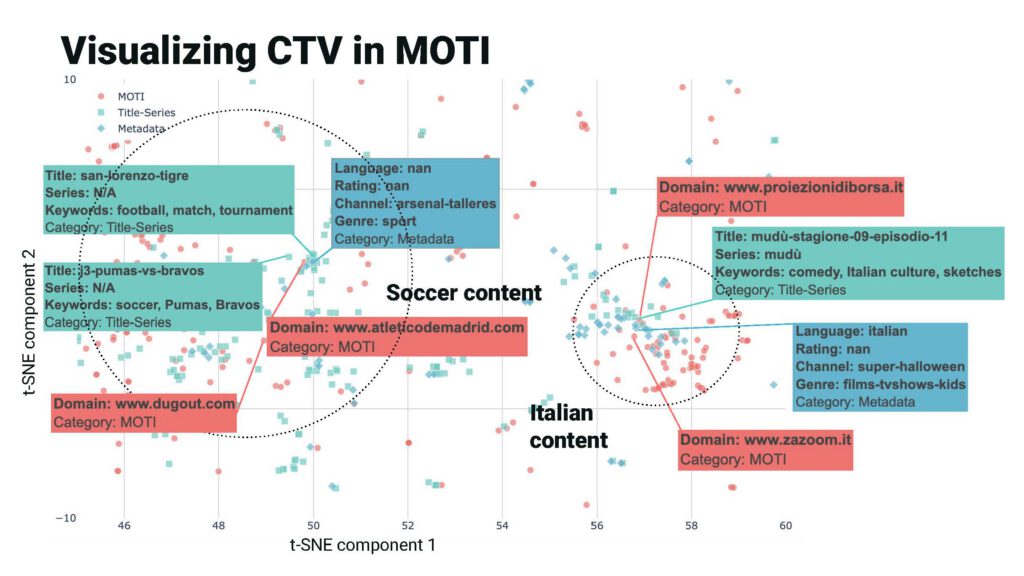
FIGURE: TSNE visualization of CTV attributes (series, title, language, rating, channel, genre) in the same space as websites in MOTI. As indicated by the left dotted circle, CTV attributes related to soccer, as well as soccer related domains are close by in the MOTI space. Another example indicated by the right dotted circle shows CTV attributes and nearby domains are related to Italian content.
A powerful, flexible approach to multimodal learning
Scalable: Leveraging an existing foundation model trained on large amounts of streaming data allows the training of CTV models at scale. Training a model for each of our clients is fast and efficient.
Flexible: As text features from LLMs improve, or new CTV shows are aired, we can represent this new data in our multimodal model without retraining our large and computationally expensive foundation model.
Composable: As text features have emerged over the past couple of years, if there is a new data modality that is useful for ad targeting we can simply train a new mapping model and produce a multimodal solution with a new modality
Interpretable: Our solution is highly interpretable because we can query the joint representation space easily, giving us a clear understanding of the relationship between modalities
Results in the real world
Our modular multimodal targeting system has delivered strong, measurable performance across verticals, proving its value in real-world, ID-free environments.
An automotive client sought to reach high-intent car shoppers using an ID-free CTV strategy. Using our modular multimodal architecture, we built a custom brand model for the campaign.
– The ID-free CTV model outperformed the client’s ID-based audience from day one, ultimately achieving a 98% higher video completion rate (VCR) by the end of the campaign. – The model also delivered better cost efficiency, producing more CTV conversions at a lower cost per conversion (CPC), obtaining a CPC of $9.13. – The client’s agency concluded that adding ID-free targeting alongside traditional ID-based models significantly expanded reach without sacrificing performance.
Kitchen Appliance Brand: Sustained Success Across CTV and Display
A kitchen appliance brand partnered with Dstillery to raise awareness for their new products using CTV and display media. They measured success using VCR and clickthrough rate (CTR) as KPIs.
– The campaign achieved a 94% average VCR on CTV beating the client benchmark of 70%. – Display ads delivered a 0.14% CTR beating the 0.10% benchmark. – Top-performing CTV channels included AT&T TV, Discovery Channel, and Food Network Kitchen — all aligned with high behavioral intent signals captured in our MOTI embeddings.
Multimodal AI for CTV: A Real-World Blueprint for Smarter Ad Targeting
Our solution is a framework for practical multimodal AI. When there are two complementary data sources and a unimodal foundation model exists for at least one of the modalities, a fast and efficient solution to multimodal machine learning is to train a model to learn a mapping from one modality to another. This produces an efficient multimodal solution that is interpretable and adaptable. You don’t need to train all modalities together from day one. Multimodal learning can be layered, modular, and immediately impactful. Multimodal learning isn’t just about giant models – It’s about combining signals to see more clearly and building systems that grow with your product.
Connected TV advertising reaches viewers that traditional TV advertising simply cannot access anymore. Last year, CTV streaming represented a record-breaking 34.8% share of total television consumption in the U.S., a 22% year-over-year rise in streaming volume. As more viewers have shifted from traditional cable to streaming services, advertisers understand how important CTV ads are to reach their target audiences.
We’ve taken the Dstillery display audiences used by 85% of the Fortune 100 brands and brought them into the world of CTV. Whether you’re looking for more relevance, scale or ease-of-use, our CTV solution is meticulously crafted with your needs in mind.
What makes our CTV solution different?
By combining the prowess of our patented AI technology with a deep understanding of your audience’s online content consumption habits, Dstillery’s CTV solution allows you to match your audience to the most relevant genres and networks for them. This simplified yet AI-powered process eliminates the time-consuming hassles of manual PMP setup and breaks through cross-device scale limitations.
Here’s how we do it.
1. We work closely with you to understand your campaign objectives and the audience you want to reach. With this in mind, we determine the best seed and build your model.
2. We run your model against our patented AI to identify your audience’s most relevant web content. Then, the AI bridges the gap between web content and CTV genres and networks to find the most relevant inventory for your audience.
3. In the final step, we craft your PMP(s) by working in tandem with our SSP partners. This activation method streamlines the targeting of your brand’s most relevant CTV bid opportunities.
Embrace the power of AI
By creating a new approach to CTV, Dstillery is helping advertisers build thoughtful, data-driven audiences. With Dstillery, navigating the CTV advertising landscape has never been easier.
What is Connected TV advertising, or CTV? Chances are, you’re already using it in your home and office. Any smart TV, video game console, or TV connected to a device, like an Apple TV or an Amazon Firestick, is Connected TV. With CTV, audiences are encouraged to do the same operations as a smartphone but on a television, like watching YouTube videos, listening to music on Spotify, and surfing the web. You’re probably starting to connect the dots if you’re programmatically minded – those websites have ads, surely the CTV versions must as well, right? Yes, they do!
Benefits of Connected TV Advertising
While we already made the TV-as-a-smartphone reference earlier, it’s important to note that approach is precisely how marketers should look at CTV with the added benefits of television marketing. Programmatic buying for CTV is based on purchasing advertising inventory that is placed on media companies’ platforms (streaming services and ad inventory). Compared to direct media buying, programmatic CTV is time-saving, which is its primary benefit.
Precise Targeting: Brands can reach highly targeted, active audiences based on various interests, personality traits, and intentions.
Measurement: Clicks are not great indicators of success for CTV campaign effectiveness. That said, CTV’s primary focus is cost per completed view (CPCV), video click rate (VCR), or CPM. By optimizing for these metrics, advertisers are able to keep costs down while reaching as many viewers as possible. For this reason, CTV shines in awareness campaigns but is equally actionable elsewhere in the sales funnel.
Multi-Device Targeting: Due to the large variety of connected devices in homes, CTV campaigns hugely benefit advertisers who want to push ads across multiple device formats. 90% of people who are watching TV are also using their phones. Imagine being able to target one person with two devices? You can effectively doubly target them with the same ad to reinforce your message.
The Rise of CTV
Last year, 76% of video marketers across all industry verticals considered CTV advertising to be a requirement for their media plans. CTV allows marketers to take advantage of a premium advertising environment while remaining highly cost-effective.
Just how premium is CTV inventory? CTV viewers have an 88% video completion rate and a 3.4% engagement rate, which are 1.1 and 10.3 times higher than non-interactive formats. CTV users are highly interested individuals who are ready, willing, and able to engage with your content from the comfort of their homes.
Connected TV has become a hugely popular marketing tool for CPG, QSR, automotive, and independent agency clients. Products that have, or need, an omnichannel approach are poised to benefit the most from CTV as it connects viewers to products across ages, demographics, and interests.
Challenges and Considerations for Advertisers
CTV is a wonderful tool for marketers but it’s important to acknowledge some of the current challenges facing the channel as well. As CTV popularity grows, expert marketers seek better ways to measure their CTV investments across marketing platforms and publishers. Other marketers have called out that managing CTV ads, their frequency, and inventory is another challenge. However, the outlook toward both of these concerns is largely optimistic as CTV programmatic investments gain more traction, as will the tools to support, measure, and optimize them.
Looking to the future, as CTV ad spend increases, there will likely be a more competitive inventory landscape for advertisers. Nearly 40,000 people continue to cut their cable in favor of more cost-effective ways to access media and it’s more important than ever for brands to be able to spring forward against competitors to get their message across. It’s important to be aware of the challenges facing advertisers with CTV but it’s a great time to be optimistic about the channel’s future since it provides another powerful and innocuous opportunity to reach customers.