testTag: healthcare

3 Key Takeaways from MediaPost’s Pharma & Health Summit

The event, not surprisingly, focused on the intersection of new product innovations, data privacy, and strategic digital marketing within the pharmaceutical and healthcare industries. Event sponsors and speakers shared a common zeal for promoting advanced strategies for enhancing engagement and preserving precision targeting in a privacy-first digital ad landscape.

Our Dstillery involvement, as sponsors, centered on our interest in generating increased awareness and trial for Custom Patient Targeting (CPT), the programmatic ad industry’s only truly ID-free offering, exclusively dedicated to Healthcare. Dstillery’s VP of Healthcare Sales, Michelle Lenzo, presented a session on reaching and exceeding campaign goals using CPT to effectively target a healthcare brand’s best audiences. While the session itself clearly fulfilled its purpose of generating interest, engagement, and requests for follow-up, what has truly made the difference is the continuous flow of meeting requests, as prospects and clients have reached out to learn more. In fact, the event inspired our Healthcare-focused White Paper, Seeking Treatment for Cookie Dependency, which you can download here.

Overall, the event itself exceeded expectations, in terms of participating agencies, brand leaders, and partner organizations, against the backdrop of an ideal retreat-style southern Florida venue. While every event organizer, whether publisher, industry association, or tech player, has its own unique style, MediaPost’s combination of a low-key, relaxed environment combined with cutting-edge educational content struck an ideal balance for discovering and enhancing professional relationships. Further, following the event, the results are speaking for themselves, as interest in CPT, and our many other ID-free® solutions is growing.

Below are our top 3 Takeaways:

  1. Innovations in Pharma & Healthcare Marketing:
    Summit hosts kicked off and maintained discussions throughout the event on the increasing impact of AI on the advertising industry, the accelerating value of first-party data, and the challenges of achieving campaign results as new industry measurement standards are explored. Under this umbrella, many speakers highlighted the importance of understanding and predicting consumer behavior in real-timereal time without compromising privacy. Other notable innovations focused on cookieless tracking, the role of content relevance, brand suitability, and continuing pursuits to ensure diversity & inclusivity.
  2. Digital Marketing Excellence:
    Case studies and award-winning campaign successes demonstrated innovative creative and media applications of digital marketing within pharma companies, stressing the need for more omnichannel programs to provide holistic, seamless customer experiences. Presenters also addressed the importance of transparent, fresh, reliable data sources, focused on multi-dimensional personas, next-gen CRM capabilities, and the need for agency-client relationships to be open, collaborative, agile, and adaptable.
  3. Strategic Marketing Planning:
    In this area, it’s as if, what’s old is new again – or that the O.G. principles are getting a new life, in the era of Generative AI. Brands with in-house programmatic agencies emphasized continuous improvement through experimentation, powerhouse Holdco agencies debated the merits and challenges of AI-enabled global brand campaigns, and predictabiy, the spotlight on delivering ROI continued to glare, especially with so many privacy-focused questions around measurement.

The good news for Dstillery is that this event, and every industry gathering since, has underscored the value of our multi-patented and trademarked ID-free technology. Whether as part of our Healthcare-focused Custom Patient Targeting, our Custom Search Lookalikes, or Audience Brief Genius, we continue to believe 2024 is our year, with a bright, growth-focused future beyond.

A Healthcare Advertising Solution Unlike Any Other

healthcare advertising

When approaching healthcare advertising, there are many considerations an advertiser must navigate regarding data cleanliness and privacy. Advertisers face strict guidelines when targeting potential and current patients. The future is becoming more consumer privacy-focused as we march toward advertising in a cookieless world. At Dstillery, we find these changes exciting and fundamental to our core values as thinkers. So we approached the creation of our healthcare targeting solution, Custom Patient Targeting, with the current and future state of ad targeting in mind.

Custom Patient Targeting is fundamentally a product that satisfies two needs in the healthcare space – consumer privacy and intuitive, cookieless targeting that is based in AI learning, not contextual or behavioral targeting methods. Let’s dive into how Custom Patient Targeting utilizes data and how we build seed sets for clients that help them meet and exceed their campaign goals.

Dstillery’s Privacy-Forward Data 

When building Custom Patient Targeting, we focused on perfecting what we knew to be a meaningful industry-standard – data privacy. After vetting various partners, Dstillery exclusively partnered with PurpleLab, a leading real-world data (RWD) provider in the healthcare industry. PurpleLab has access to 40 billion medical and pharmacy claims capturing 350m+ patient lives and 98% of payer data. PurpleLab’s sources for claims data are derived from a network of 11 “Open Claims” sources. These are organizations involved in the generation, transmission, or processing of medical and pharmacy claims from providers to insurers. 

Dstillery has found that using search data from our opted-in panel has been truly predictive of patient definition. Using anonymous patients searching for specific drug names, symptoms, and co-morbidities in the largest search engines as seeds have been proven to provide strong performance. Combining this data with ICD-10 codes provides the most accurate definition of a patient for a majority of our customers. In parallel, we identify the anonymous devices that have searched for desired search terms and extract the top targeting features from the Search-only model. As a final step, we combine the best targeting feature from both models to create a single model.

A New Era of Healthcare Advertising & Targeting

The result is a privacy-safe, waste-reducing, cookieless healthcare targeting solution that can scale and transform to adapt to any campaign KPI. This blended data for your model ranks high in AQ, or audience quality, a key measurement in the healthcare targeting space. Dstillery uses the best possible data to guarantee the best possible results. Custom Patient Targeting is a breakthrough method for healthcare brands to reach the right patients. It provides a level of precision targeting that is unheard of in the industry, reducing campaign waste drastically. If you’re thinking about using Custom Patient Targeting, don’t think — do

Thanks to our unique approach that allows us to be more precise compared to modeled condition segments, Custom Patient Targeting is more effective at finding net new patients at a lower cost of media than all other healthcare targeting products today.

An Introduction to ICD-10 Codes

icd-10 codes

If you’re familiar with our cookieless healthcare targeting solution, Custom Patient Targeting, you may have noticed a recurring term – ICD-10 codes. Specifically used when we talk about building custom seed sets for healthcare advertisers. So what exactly are these codes? They’re the primary standard for classifying standard medical diagnoses and are utilized by Dstillery to build condition-specific targeting models. Dispelling the ICD-10 code is the fastest way to get your campaign up and running at Dstillery.

The Anatomy of an ICD-10 Code

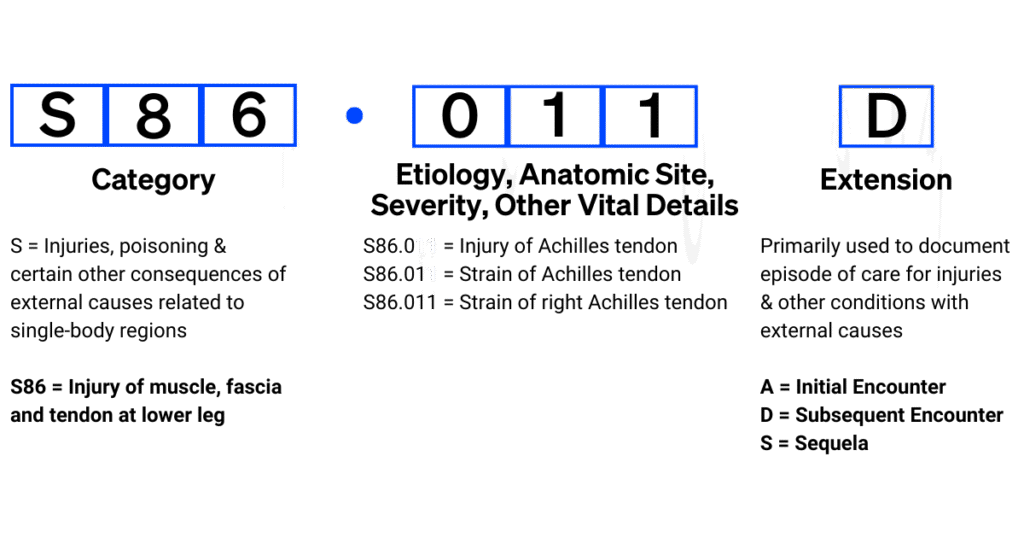
ICD-10 codes range from three to seven characters. The longer the code, the more specific the diagnosis. The first character is always a letter, and the following two codes are either letters or numbers.

The first three characters of an ICD-10 code designate the category of the condition. In this example, the letter S denotes a “poisoning injury and other consequences of external single body regions.” Paired with the 8 and 6, the diagnosis falls into the category of “muscle injury, fascia, and tendon of the lower leg.” A three-character code that lacks further subdivision can stand alone as a code, but when greater specificity is available, it is best to choose the more specific code. We encourage the use of both wide umbrella codes and granular codes to ensure targeting goals are as specific and broad as possible. 

Characters three through six indicated related etiology which is to say that they focus on the cause of the condition, set of causes, manner of causation, anatomic site, severity, and other clinical details. In the example above it helps us understand that the code is specifying the strain of the right Achilles tendon. The final character is usually referred to as the extension. It can provide information about the characteristics of the encounter or moment of injury. Not every ICD-10 code is allowed to use a seventh character. The extension must always be in the seventh position, and any characters in between should be filled by an X. 

Choosing ICD-10 Codes For Your Model

In many cases, you will need to choose multiple ICD-10 codes for a single condition. The more codes and symptoms your targeting model focuses on, the higher the accuracy which will help reduce campaign spend waste and ensure that your patients are being targeted. Oftentimes there are many ICD-10 codes that target or explain similar conditions and ailments. We encourage you to choose as many that seem applicable to your model since many times one condition can occur with another or lead to another. 

With injury-centric codes you can find multiple ICD-10 codes that further describe the scenario that resulted in the injury. These codes are often considered “secondary codes” since they describe the cause of injury rather than a chronic condition and capture the cause, the intent, the place or event, or the activity the patient was engaged in at the time of injury. These are particularly helpful for over-the-counter bandages, splints, crutches, and other medical assistance devices and items. You can use as many external cause codes as necessary to help fuel the model. Furthermore, these ICD-10 codes blended with search keyword data help us build your brand a campaign that targets patients throughout each part of their patient journey from the top to the bottom of the funnel. This blend of search terms and ICD-10 codes create an audience that prioritizes audience quality ensuring that vendors have accurate points of measurement.

Bringing It All Together

Understanding the ICD-10 code structure will help streamline and strengthen your Custom Patient Targeting campaign and ensure that your model is powered by the most precise and widely utilized data signals in the healthcare space. 

FAQ: Custom Patient Targeting

A new cookieless way to reach your patients, powered by Dstillery’s ID-free technology.

1. What is Custom Patient Targeting?

Custom Patient Targeting is a new privacy-safe patient targeting solution designed for healthcare brands. It offers the precision and customization you need to drive your best patient outcomes. It doesn’t rely on user-based targeting, ensuring compliance with all laws, policies, and guidelines from HIPAA, NAI and DSPs. Using AI-powered predictive modeling, we build a just-for-your-condition targeting model that bids on individual impressions based on aggregated patient behavior.

2. How is it precise?

Every single potential impression ad-supported internet is scored and ranked based on its likelihood of targeting your desired patient. This level of granular targeting is unheard of in healthcare.

3. How is it custom?

Custom Patient Targeting starts with your desired seed dataset, enriches it with our AI-powered understanding of every website on the internet, and creates a model tailored to your specific condition and your patient outcome goals.

4. How is it compliant?

Because Custom Patient Targeting doesn’t rely on user-based targeting, we can ensure compliance with all laws, policies, and guidelines.

5. What seed data can I use?

We recommend seeding with your brand’s first-party data for the most precise results. This can be data from your brand’s web pages or segments from a data management platform. If that’s unavailable, we recommend using your brand’s keywords, including product names, symptoms, and co-morbidities. We are in active discussions with leading healthcare data providers to use their real-world evidence (RWE) datasets, allowing brands to use ICD-10 codes to seed models.

6. How do you collect health data?

Our core dataset consists of healthcare-specific websites and keywords from opted-in devices. When combined with non-healthcare-specific event-level data, we find that these signals allow us to more fully see patients’ journeys, resulting in more accurate and robust models. We are in active discussions with leading RWE data providers rooted in payer and claims data to enhance the models. We will work with beta partners to test these incremental datasets in Q2-Q3 2022.

7. How do you target in a HIPPA-compliant way?

Dstillery’s healthcare targeting methodology doesn’t involve the creation of any health-related profiles. It uses a built-in de-identification to ensure that the data isn’t considered Protected Health Information under HIPAA. It also meets the requirements of the NAI sensitive data guidance by utilizing data minimization techniques that minimize the risk of inadvertently identifying a data subject.

8. How are you able to understand the patient journey without user tracking?

Custom Patient Targeting is powered by AI that identifies and learns the patterns of how, when, and from where anonymous opt-in devices browse the web. These behavioral patterns help the AI predict how anonymous patients browse the web.

9. What is the Map of the Internet?

The Map of the Internet (MOTI) is built by a type of AI called a neural network. It constantly analyzes hundreds of millions of anonymous digital journey patterns and learns the behavioral signals underlying any web visit to build the map. It then takes your seed and extends the patterns detected to all websites. The output is a model that scores and ranks every potential impression on the ad-supported internet and predicts the best patient impressions for your condition.

10. How is it different from contextual, condition, endemic, and traditional behavioral targeting?

Custom Patient Targeting is categorized as predictive behavioral targeting, not any of the following.

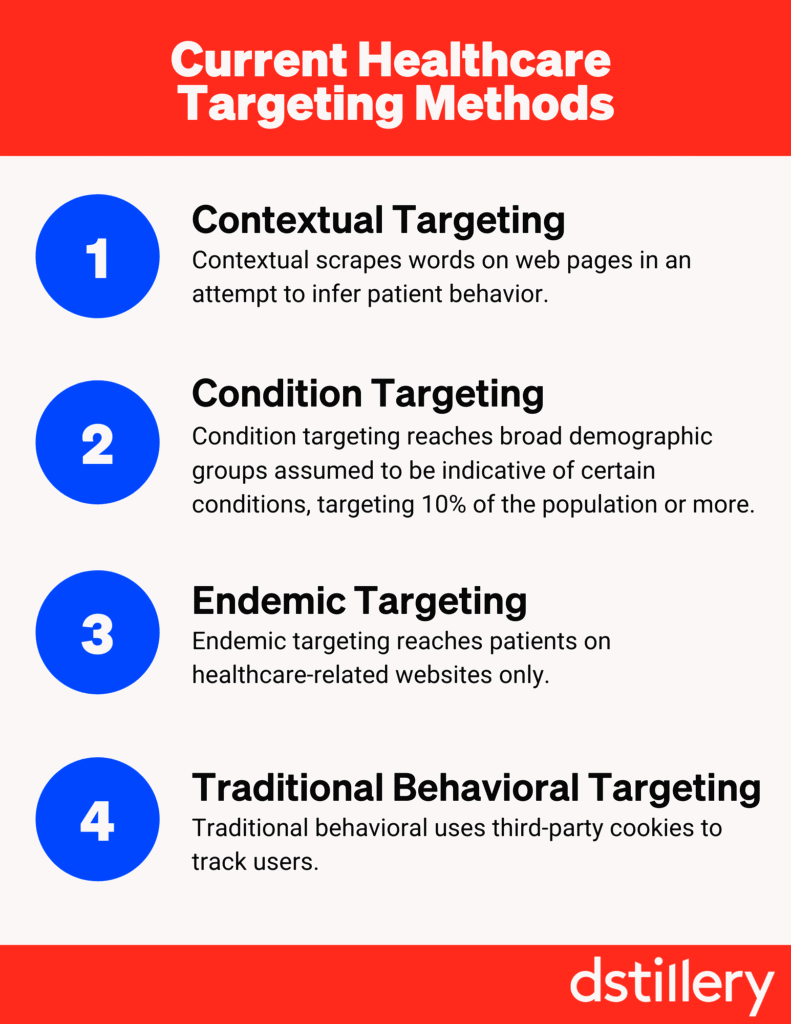
  • Contextual: Contextual scrapes words on web pages in an attempt to infer patient behavior. Custom Patient Targeting doesn’t rely solely on keywords (although they can be a helpful dataset). Instead, it predicts patient behavior with AI.
  • Condition: Condition targeting reaches broad demographic groups assumed to be indicative of certain conditions, targeting 10% of the population or more. Custom Patient Targeting can be seeded with demographics, but precisely targets patients based on behavior, not demographics.
  • Endemic: Endemic targeting reaches patients on healthcare-related websites only, while Custom Patient Targeting reaches patients at scale across the entire ad-supported internet.
  • Traditional Behavioral: Traditional behavioral uses third-party cookies to track users. In contrast, Custom Patient Targeting analyzes behavioral signals from millions of anonymous digital journeys to predict the impressions most likely to be your patient without user tracking.

11. Is this affected by cookie deprecation?

Because Custom Patient Targeting doesn’t rely on user tracking, like third-party cookies, it isn’t affected by cookie deprecation.

12. How is it priced?

We’ve priced Custom Patient Targeting to be on par with or less than traditional cookie-based behavioral targeting products. It’s priced at 20% of media, so if you’re clearing $2.00 inventory, it will be about a $0.40 eCPM.

13. How do I get started?

  • Sign targeting agreements
  • Provide targeting API access
  • Select seeds and outcomes
  • Dstillery builds and deploys custom model to campaign

To learn more, please reach out to contact@dstillery.com.

Doctor Dstillery, Prescribe Us a Patient Targeting Solution!

Challenges of Healthcare Targeting

The healthcare advertising space is a dynamic world of its own in terms of marketing. A whopping 66% of internet users look online for information about a specific disease or medical problem. It has more rules and regulations to protect consumer privacy and rightfully so!

We at Dstillery see these rules not as barriers to sidestep and scheme against, but rather as conversation topics to discuss and analyze and then turn into new doors to open that are filled with possibility. Healthcare targeting is currently heavily regulated by HIPAA, NAI, and DSP rules. These guidelines prevent advertisers from focusing too heavily on demographic data and patient condition data. In the healthcare space, it is crucial to protect the patient both physically and informational. That said, naturally, Dstillery wanted to explore how best to serve advertisers and protect patient data at the same time. Like all things, it’s best to start with what we know and then set our sights on the future.

How Are Patients Being Targeted Now?

Healthcare companies’ global advertising expenditure is projected to increase by 4.3% in 2022. As it stands, patients are being targeted in a variety of ways across the healthcare space. Below are some of the current targeting solutions being deployed:

current healthcare targeting methods

There are at least 100 billion searches for healthcare on Google alone each year. That’s 273 million healthcare searches a day. While these targeting solutions are effective in their own individual ways, we wanted to develop something more effective. Born from our existing, trusted technology that best serves the patient and the advertiser. 

Enter Custom Patient Targeting. 

What Is Custom Patient Targeting?

Custom Patient Targeting is Dstillery’s solution to healthcare compliance and digital targeting solutions. Our targeting solution is categorized as predictive behavioral targeting. It’s built from the same technology as our patented ID-free targeting technology called MOTI, or the Map of the Internet. MOTI is built by a type of AI called a neural network. It constantly analyzes hundreds of millions of anonymous digital journey patterns and learns the behavioral signals underlying any web visit to build the map. It then takes your seed set and extends the patterns detected to all websites. The output is a model that scores and ranks every potential impression on the ad-supported internet and predicts the best patient impressions for your condition. Another important trait of Custom Patient Targeting is that it isn’t affected by cookie deprecation. Custom Patient Targeting is built on our ID-free targeting technology, meaning your patient targeting solution is future-proof.

Can You Tell Us More About How Custom Patient Targeting is Compliant?

Great question! Doctor Dstillery has the answer. Our core dataset consists of healthcare-specific websites and keywords from opted-in devices. When combined with non-healthcare-specific event-level data, we find that these signals allow us to more fully see patients’ journeys, resulting in more accurate and robust models.  Additionally, our healthcare targeting methodology doesn’t involve the creation of any health-related profiles. It uses a built-in de-identification to ensure that the data isn’t considered Protected Health Information under HIPAA. It also meets the requirements of the NAI sensitive data guidance by utilizing data minimization techniques that minimize the risk of inadvertently identifying a data subject.

Getting the Script

If you’re curious about our healthcare targeting treatment option, or rather, our healthcare targeting solution reach out to us and one of our data doctors will assess your condition and see what we can do for you. New health-related conditions will begin to flare from allergies to achy bones as we shed our winter bodies and move into an activity-filled summer. Dstillery is here to help you prepare.

Weaving Dstillery’s Data Fabric for the World of Healthcare

If there’s one thing we know about a new year it is that people have a renewed focus on their health and personal fitness. After dealing with the past two and a half years of the pandemic, healthcare has become an even greater if not the most important focus in our lives. From personal fitness goals to chronic illness, the world of healthcare is vast and frankly, dense, for marketers on internal and agency teams to crack.

The trick, however, is to understand who you want to reach and how to get them. Doing so requires key data insights around behavior, consumer spending habits, and demographics and the way that they all coalesce into your target demographic. What’s fascinating from the Dstillery side is how much our healthcare audiences have grown and changed over the course of the pandemic and how new pockets of overlaps and intenders have emerged.

In addition to making pre-pandemic healthcare assumptions, marketers must open their minds to healthcare’s newer audiences and the ways they overlap with other consumer segments such as fitness and mental health, along with industry mainstays such as chronic illness and medical procedure research. This means looking at more data over a wider array of topics and data points to drive interest and return on investment. Luckily for those in healthcare, the data is out there and it is plentiful.

Choosing Your Targets

If one industry is tried and true with its audiences, it’s healthcare. People all follow the same arc, they’re little, they grow, and they grow, and they grow, and suddenly they’re old. Within all of that growth, they’re getting sick, recovering, developing new health conditions, and making lifestyle changes to increase the longevity of their lives. The life story has a ton of component pieces that Dstillery has taken and parsed out into tons of pre-built audiences that can be utilized for marketing campaigns. Considering the three main stages of human life, let’s look at three segments of healthcare consumers:

  • Children and Teenagers
  • Middle Aged People
  • Elderly People

Understanding the Influence of Healthcare Trends

Sure, it’s easy to identify the three most obvious groups of consumers in healthcare but let’s bring it down into a more approachable level. Looking back on 2021 it seems like everyone was wrapped up with COVID in mind regarding their personal health. 

However, many personal healthcare motivations remained the same. For example, many people renewed their interest in personal fitness early in the year. Kids are outdoors more than ever, but also more digitally connected with devices and screens for schooling and leisure activity. Over the summer, we began to see a renewed interest in action sports and physical activity that required consumers to be outside and engaged with their bodies. For older consumers, there was a blanket uptick in regular check-ups, with an emphasis on heart and lung health as well as increased interest in exploring regular exercise activity. 

What this tells us is that the average healthcare consumer within our classic targeting groups is much more dynamic and sophisticated than being summarized as simply a “fitness intender” or a “medical procedure researcher.” The three demographics we looked at before suddenly become more interesting when you view them like this:

Children and Teenagers 

  • Eyeglasses Shoppers
  • Eyeglasses and Contact Lens Buyers
  • Dermatology / Dermatologists
  • Pediatricians
  • Asthma Sufferers
  • Dentists

Middle Aged People

  • Cardio Health Researchers
  • Vegans / Vegetarians
  • Oncologists
  • Endocrinology
  • Fertility Treatment Researchers
  • Gastroenterologists 
  • Reproductive Health

Late Aged and Elderly People

  • Joint Pain Sufferers
  • Generic Prescription Pill Shoppers
  • Arthritis Sufferers
  • Neurologists
  • Heart Surgery Researchers
  • Orthopedic Health Researchers

Observing and Predicting Healthcare Trends

Now that you can begin to see how complex the average healthcare consumer is and how their needs are determined by lifestyle or seasonal activities, you can begin to needle in on new ways to leverage their motivations. 

Healthcare marketers must understand that one-size-fits-all audiences may be useful in gaining large swaths of consumer segments, but needling in and understanding their behaviors seasonally or habitually will provide the most return on investment. These audiences can come from our recommendations based on pre-built data segments and seed sets, or via first-party data. 

With an ever-changing and evolving customer base, our audiences can be as fluid as your campaign demands. 

Consumer Trends and Data Privacy

One approach to reaching new healthcare-based audiences is to leverage our ID-free Custom AI solution to provide a more privacy-forward and behavior-forward audience solution. ID-free is built differently than our cookie-based audiences. The product is a new privacy-by-design patient targeting solution that reaches your healthcare brand’s best patients while protecting their privacy. Unlike wasteful and stagnant audience segmentation, ID-free is a dynamic model that targets individual impressions based on patients’ behavior. This is all done without any user tracking ensuring 100% compliance with all laws, policies, and guidelines.

Powered by patented neural network technology, the product constantly analyzes hundreds of millions of anonymous patient journey patterns and learns the health condition and behavioral signals underlying any web visit. Using a healthcare brand’s first-party data, the product creates a just-for-your-brand model that evaluates anonymous impressions individually to select the ones most likely to convert.

We do this all without the use of cookies, but rather behaviors that we see trend across websites, seed sets, and other data points to build privacy-forward audiences to help future-proof digital marketing campaigns.

Leveraging the Signals

The segmentation and trend analysis we just walked through is commonplace within all Dstillery campaigns. Consumers broadcast tons of signals out into the ether of the internet and it’s our job to understand and distill that information into useful, tangible results for digital marketers. There’s a huge chance that your brand has useful seed set data for us to utilize and build custom AI audiences for your next marketing campaign. 

It’s not worth the time or money to throw marketing dollars into the hands of audience solutions companies that won’t explain, research, or optimize your campaigns for you. Our audience solutions are dynamic, cutting edge, and built on seizing opportunities as they are and as they arise.