testAuthor: Dstillery

Commitment to diversity & inclusion, a letter from our CEO

Over the six months since George Floyd’s murder, Dstillery has redoubled our efforts to support social justice, equality, and diversity across all aspects of our business.  While discrimination and inequality are not new to our society, there has never been a more crucial time to act.  We stand in solidarity with the fight against systemic racism, and we believe that Black Lives Matter.

We have laid the foundations for our company and community to make enduring change.  The company has developed a formal Diversity & Inclusion program with multiple pillars dedicated to education, recruitment, training, community building, and mentorship.  We have seen inspired energy from our team members — our Dstillers — who have participated in protests, led discussion groups, and organized guest speakers. 

Our shared values related to diversity & inclusion, surfaced organically by Dstillers, include Equality, Respect, Empowerment, and Trust.  We are committed to taking actions that nurture these values, while offering equal opportunities for personal and professional growth in our internal and external communities.  

We are taking the long view, and together, we can and will do more.  Dstillery will invest the time, effort and resources to identify and dismantle any bias in our policies and procedures, enhancing our workforce diversity and fostering an inclusive workplace.  We will continue to provide a safe space for our team members to engage in difficult but necessary conversations, and to empower our community to drive change in our company and in the world for the betterment of all.

Michael Beebe
CEO
Dstillery

Forget intuition, let machines do the work in programmatic

Programmatic ad buying has become a critical part of the ad industry, accounting for more than $4 out of every $5 spent on digital display ads. Programmatic’s ascendance was the result of massive investment by brands, agencies and startups in software, hardware, and data science, all with the aim of optimizing campaign performance and bringing spending efficiency to an internet where audiences were increasingly spread out.

The technology took care of the efficiency piece, giving advertisers the scale they wanted without having to negotiate thousands of individual publisher-direct deals. True optimization has lagged though, due to one major hurdle: for all of the investment in technology and computing power, a human still steps in at the last mile to make critical decisions about targeting — decisions that dilute or possibly even negate the value of the technology-powered decision making that came before.

The issue stems from the primitive way that data segments are still bought and sold, more often than not by a human trader entering a keyword into a search box and choosing segments to target based on description alone. For programmatic to truly realize its potential — especially in a time of tightened budgets — now is the time to adopt tools which remove human intuition and let the machines do more of the thinking.

A last-mile issue

Today, the minority of programmatic buys are targeted, optimized and self-tuned in real-time via machine learning. The significant majority are targeted manually, with media traders logging into their platforms of choice, searching for their target audiences (surfers, soccer moms, auto intenders, etc.) and picking from 50 to 500 audiences that match the search.

They might pick an audience segment based on the data company’s brand name, or they may go with something that was effective for a past campaign from the same client. But in essence, they’re throwing darts to see if they can find the best audience for targeting the campaign because they don’t have access or insight into audience composition, or what’s truly going to work for their campaign.

Hundreds of millions of dollars have been invested in machine learning and state-of-the-art technology to execute targeted ad buys in a fraction of a second. Major advancements in processing power mean that billions of data points are collected and fed into the system to enhance future campaigns and find the best prospects. Once the first flight is up and running, machines should take over and continue executing the campaigns against the best audiences. Why then, are agencies turning everything over to a human being, who rely mostly on intuition?

The data optimization gap

The reason that so many programmatic buys are targeted by humans, rather than machines, is that the data purchasing process is still primitive, despite the sophistication of the technology used to buy and serve the ads.

Typing into a search bar and then clicking away is certainly easy, but the lack of sophistication makes this method feel like it’s a holdover from some 1.0 version of programmatic. There is very little visibility into the provenance, cleanliness or recency of the data selected. There’s merely a segment name, the company that built the segment, and the cost. The technology powering programmatic buying is ultra-sophisticated. Why then, does the audience selection at the last mile amount to an essentially random decision?

Most demand-side platforms provide tools that leverage machine learning to optimize audience targeting. These tools are constantly testing audience segments against campaign KPIs and shifting spends toward those that are delivering the best performance.  This is not an optimization that can be done at a human scale.

Trouble is, the data used for targeting is often an afterthought in the broader campaign planning process and is something left up to the media trader. Agencies work on tight time schedules, and their strategy and planning teams often hand their trading desks a very high-level demographic description of their target audience. Traders, then, attempt to find a fit for that targeting strategy within the sea of third-party segments in the data marketplace.

An optimized future

To be clear, nearly every player involved in programmatic advertising bears some of the blame here. Brands still think in terms of broad-based demos or personas, ignoring the technologies that allow them to optimize against the actual KPIs that drive business results. Media agencies propagate these legacy targeting strategies, which are the path of least resistance. And the buying platforms have focused primarily on driving usage of their technology, happy to integrate data partners but leaving the data sales component an afterthought.

The only path forward for brands and agencies is to advance the way data is bought and sold, evolving these primitive systems for the present and future. The IAB’s data transparency label effort is a major step toward understanding what goes into segments, but quality and accuracy remain outside the project’s scope. Many buying platforms realized in recent years that they had to clean up the inventory available, due to redundancy and low quality. This process improved experiences all around, and improved margins for the platforms and the agency trading desks. The same needs to be done for data. Data marketplaces are full of low-quality audience segments, with opaque methodology and questionable provenance, built using outdated observations. They need to be culled so that buyers aren’t spending money on stale junk.

Cleaner marketplaces and greater emphasis on data optimization would free traders up to apply that human judgment in a higher value way for their clients.  Rather than choosing audience segments from a search box, they should be deciding when to let computers optimize, what to optimize for, and how to know when that optimization is working. The best-case scenario is a human thoughtfully choosing KPIs that meet the brand’s objectives, then hitting the “optimize” button on their platform of choice.

This level of strategic thinking is harder than it sounds, and it’s much higher-value activity than the time spent combing through data segment search results. As the ecosystem changes amid the cookie phase-out, connecting objectives and KPIs to execution will only get harder. Letting machines perform the data selection will free traders to spend more time putting their minds toward critical matters of campaign strategy.

A personal story about inclusion in the workplace

Coming out at work. It’s Highschool all over again. 

Being ourselves at work and inclusion in the workplace is vitally important for being able to do the best job possible. Yet studies suggest that roughly 53% of LGBTQ people are closeted in the workplace and don’t feel comfortable to come out. When you’re closeted in the workplace, as I was 15 years ago, it takes up a lot of energy and distracts you from your work. You spend a lot of brain-cycles running through these potential scenarios: 

  • You have to think about avoiding conversations. Water-cooler exchanges and Monday morning catch-ups on the weekend become no-no’s since you don‘t want to navigate the choppy waters of editing your story to suit the people listening.
  • If you DO decide to share, you have to think about changing pronouns or names of the significant others that you’re talking about, as well as not give away any other incriminating information.
  • You have to continually evaluate how much of yourself you are sharing and whether it will come back to haunt you eventually. 

Every friendly conversation with colleagues becomes an exercise in the calculus of what to reveal and what to keep to yourself. 

You want to be included, you want to talk about yourself, you want to bond with your coworkers and you want to be a part of the company culture, but you can’t because you have that barrier. You end up feeling isolated in the workplace, you don’t really make friends, you feel depressed, you’re distracted from the work that you need to do. You might see other co-workers mingling and bonding over stories about their relationships, kids, etc… and you are excluded. 

It’s just like high school all over again. 

So just come out, right? 

Whether you’re in an environment that is more repressive or one that is seemingly more accepting, coming out is an extremely personal journey. 

Living in New York, in gay-friendly neighborhoods like Chelsea and Hell’s Kitchen, doesn’t necessarily mean that a person feels comfortable coming out at work. They’re dealing with baggage from years of repression, fear of abandonment by their families who may live far away or they may live in the city, etc. Without knowing your coworkers’ background, you don’t know if you can trust them to be accepting. So despite the fact that you could be living in a nurturing and accepting environment, it’s a personal choice that is not always easy to make.

The first time that I had to come out at work was nerve-wracking.

It was 20 years ago at my previous company in Southern California. I knew that there were a couple of other gay people in my office because we had seen each other out, though it was a secret. The first rule of fight club, you don’t talk about fight club. So we would come into work and we would chat quietly about our real lives and weekends. 

However, when speaking with my straight co-workers I would play the pronoun game and only refer to my boyfriend elusively so that they would not learn my secret. The game actually went smoothly, but at the same time, was isolating and emotionally exhausting. 

Things changed on the day that my boss asked me for my emergency contact. He was creating a spreadsheet for the team.   

As an immigrant, I didn’t have any family here, which everybody knew. The only person that I could possibly put on that sheet was my boyfriend. At that moment, standing in my boss’s office, I had a decision to make.  “Am I ready to do this? Am I ready to name this person who nobody knows about, and I don’t know how people will feel about?” 

After some quick calculus, I decided to just go for it and my boss was very accepting. Eventually, the team found out and they were accepting, as well, and I haven’t looked back since. 

The point of this story isn’t the big drama of coming out. There was none. The point of this story is the big internal drama that precedes coming out. And it’s a dilemma that straight people never have to face. 

Coming out every day.

Coming out is a conscious decision that the LGBT community is faced with every day. We don’t just come out once. We come out continuously, every single day, in every new situation. Every time a new coworker comes into the workplace. Every new office that we go to work. Every new client, every new friend that we meet in a bar. Every new barber we chat with while on their chair. Every day we have situations where we have to do the math. Should we come out, or should we not come out? Does it make sense? Does it not? When they talk about their weekend, do we share information about ours honestly or go with the generic canned response?

“We don’t come out once. We come out continuously, every single day, in every new situation.”

For some people, that decision becomes a lot easier over time. Personally, after being out for over 20 years, I don’t care. If you like it, you like it. If you don’t like it, you don’t like it. Your lack of acceptance in no way reflects on me. But it is a personal decision and some people still do the math, which is difficult.

Inclusion in the workplace.

Understanding these unique challenges is step one. Step two is finding ways to make your office more comfortable and accepting of diverse coworkers. Keep in mind that while this speaks to LGBT colleagues, it holds true for diversity of any kind – Coworkers of color, coworkers of a different gender, coworkers with disabilities, etc… 

So in the workplace, it behooves us to make our environment feel more inclusive. To me, this means that we acknowledge and see our diverse coworkers by using inclusive language, instead of non-inclusive language, and avoiding stereotypes that might make people feel left out. But it doesn’t end there. 

More importantly, it means creating a sense of community for our diverse colleagues. It is not enough to have one LGBT coworker or one coworker of color and tick off a diversity box, as if you’ve fulfilled some sort of quota. It is crucial to create a community that supports each of these diverse perspectives so that they feel a sense of belonging and being seen and heard by others like them. They should be made to feel like they are set up for success. There should be a critical mass of employees of Color, LGBT employees, etc. Only then can we achieve not only a workplace of diverse perspectives, but one where everyone feels safe to bring their full, authentic selves.

To learn more about Dstillery’s Commitment to Diversity & Inclusion, click here to read a message from our CEO, Michael Beebe.


Dstillery and COVID-19 update

To all of our partners, 

As we all struggle with the growing personal and business disruptions associated with the COVID-19 pandemic, our focus at Dstillery is on our team and our clients.  

For our own team members, our focus has been on their health and well-being.  We are also conscious of our responsibilities as global citizens. Like many companies, we activated a business continuity plan in which we all are working from home starting last Monday.  Our team is safe, and we are doing our part to slow community spread by avoiding commuting, crowded offices, in-person meetings, and travel.

As for our clients, though we are working from home, we are here to support whatever you need.  We are fully operational and able to provide the same high level of service, excellent managed service campaign results, and strongly performing audience data that you know us for. 

We are here to help you through your business challenges in whatever way we can.  

Given our self-imposed isolation, it is important to stay connected through the channels that we have, to our partners, colleagues, and friends.  The entire Dstillery team, from sales and client success to analytics and data science, are here to support you through this time. Reach out, and let’s stay connected.

Stay healthy and let us know how we can help.

Sincerely, 
Michael Beebe 
CEO
Dstillery

How digital behaviors can measure sports sponsorship spend

Advertisers eager to capture consumers’ attention in 2020 are investing heavily in sports sponsorships. The total dollars spent on sports sponsorship is expected to grow 5% in 2020 to $48.4 billion globally, according to a recent analysis by WARC. It is the strongest year over year growth in a decade and is driven by the upcoming 2020 Olympics in Tokyo. North American spending is projected to hit $18.8 billion, with the United States capturing 82.5% of the total figure. However, despite the growth, WARC found that “one in four practitioners has no confidence at all in measuring business return from sponsorships – up from one in five in 2018”. 

Putting it succinctly, brands are spending more money than ever on sports sponsorships while acknowledging they have no trusted method to track their enormous investments. This presents a unique opening to apply the latest techniques in machine learning and AI to simplify what is an increasingly complex problem. 

One potential solution is measuring fan behaviors for an individual sports property to see if fans’ digital interactions are aligning with sponsors’ activations and messaging. Dstillery used this exact approach by identifying fans of US Soccer and examining the changes in their digital behavior over a 22 month window encompassing the 2018 and 2019 World Cups. An analysis of the results reveals noticeable changes in US Soccer Fan’s behavioral composition from 2018 to 2019.

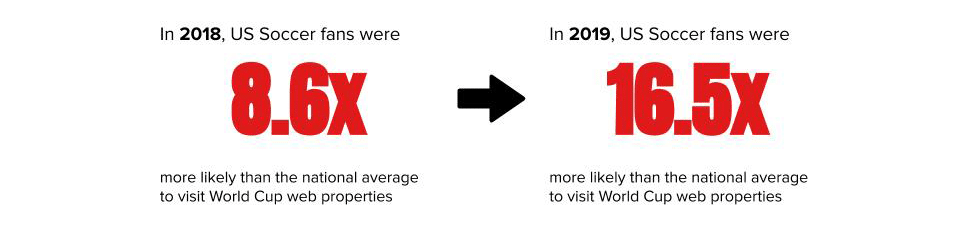
Overall, there was an increased attention to the World Cup in 2019 across the nation. Nielsen reported viewership of the Fox’s broadcast was up 22% from the men’s final last year. However, the interest in the World Cup grew even greater within the niche group of US soccer fans. In one year, US soccer fans’ interest in the World Cup doubled, compared to the national average. Likely driven by the success of the US Women’s National Team in France, the increase is a clear indicator of the digital attention the women’s team’s participation brought to the event. It’s also a reminder for brands that major events draw increased attention from target markets. The 2019 World Cup was an opportunity for sponsors to ride the wave of digital engagement organically generated by the conversations surrounding the women’s team.

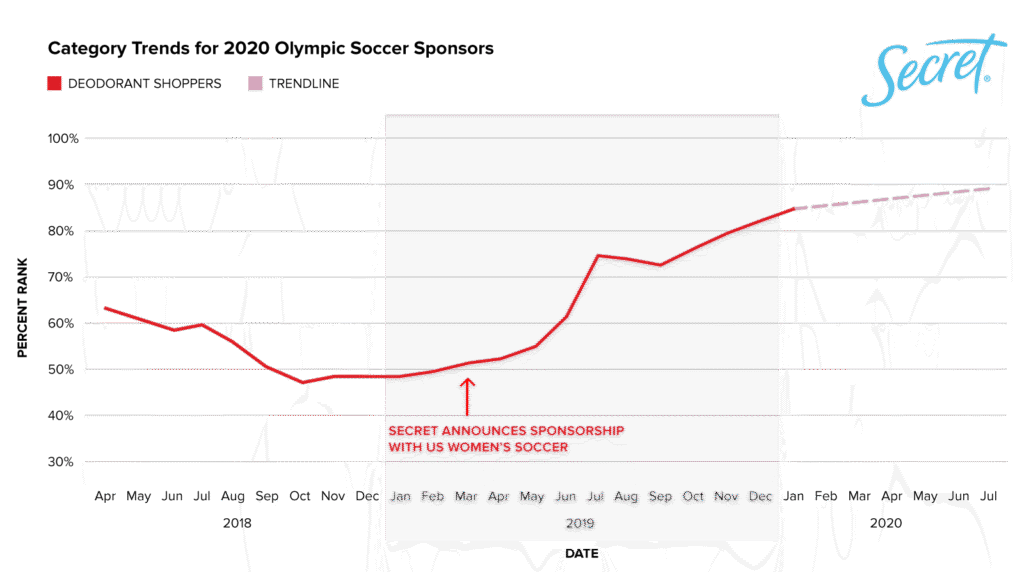
The sponsor who best capitalized on the wave was Secret, a deodorant brand from P&G. Last March, in the lead up to the 2019 World Cup, Secret launched a partnership with the US Women’s National Team. The timing of the announcement aligned perfectly with the increased digital consumption the US women’s team was attracting and propelled digital engagement with the brand’s category. As highlighted above, the US Soccer audience increased their engagement with deodorant shopping, including a massive jump at the start of the World Cup. However, Secret didn’t rely on the momentum of the World Cup to carry their partnership. The brand took it a step further and announced additional financial support amid the USWNT’s push for equal pay. These actions have seen Secret’s alignment with the women’s team become even stronger as deodorant shoppers continue to rank highly for US Soccer Fans.

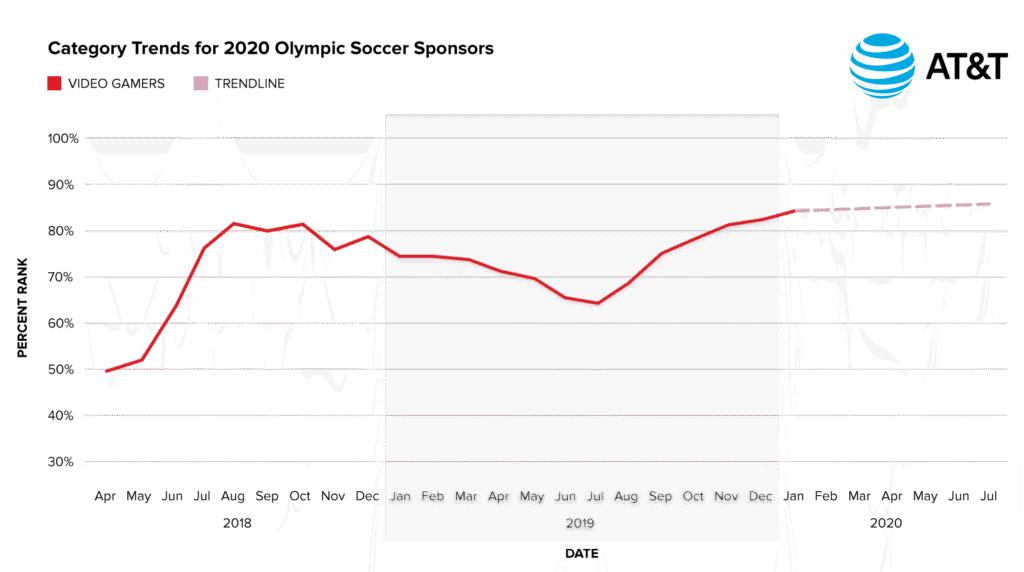
The deodorant brand is not alone. AT&T is another sponsor seeing success in its partnership. As the company rolls out its 5G offering, it has marketed heavily toward video gamers and esports fans. Fortunately for AT&T, US Soccer fans are increasingly interested in video games, which presents a unique opportunity. If the audience’s interest in video games continues, we’re likely to see Video Gamers get closer to the 90th percentile ranking of US Soccer Fans’ behaviors in 2020. The increased percentile ranking would indicate a high affinity of US Soccer Fans for video gaming (i.e. more people engaging with digital gaming content). This is great news for AT&T as it continues its rollout of 5G while maintaining a presence in esports.

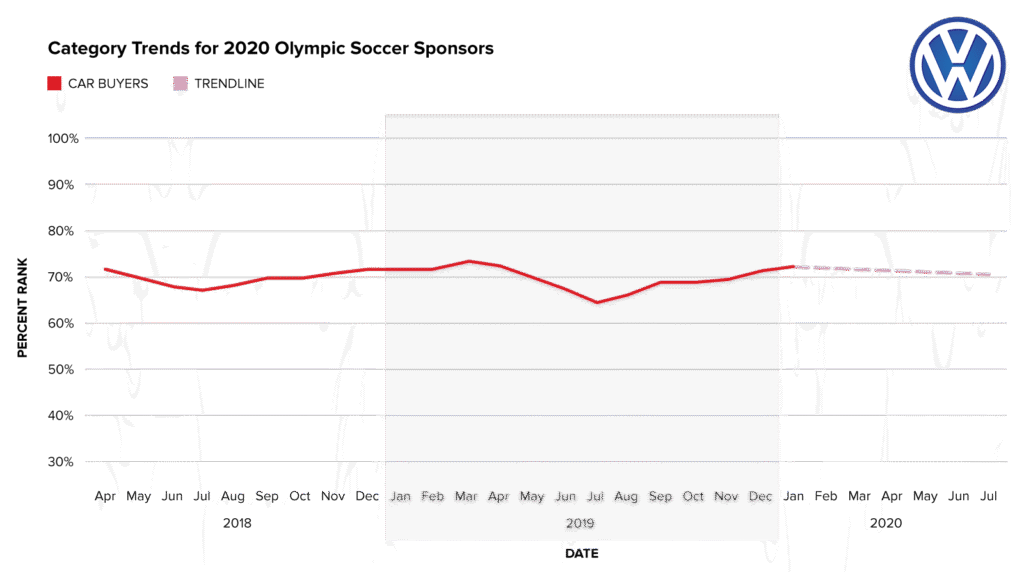
Meanwhile, car buying has remained a consistent behavior of soccer fans over the previous two years, providing steady value for sponsors like Volkswagen. Soccer fans have a strong affinity for buying a car but there are other behaviors that are more consistently characteristic of soccer fans. This could be explained by the lower frequency at which the audience is in-market for a car compared to say, daily or weekly purchases of groceries or video games. Car manufacturers can make an investment, starting with the Tokyo Olympics, in order to stand out to the next generation of car buyers by aligning the brand with a larger purpose. Prophet found that Gen Z, those individuals born between 1997 and 2012, is more committed to “changing the world than their millennial older brothers and sisters” and “expect companies to help, if not take the lead.”

Beyond measuring the success of the dollars they’ve already invested, these brands can use these same trends to predict if their future investments will pay off. Our research suggested a correlation between changes in behavioral composition and sponsorship success. We believe Secret will increase its sponsorship investment with the women’s team and continue to align its brand with the success of the team in Tokyo. AT&T sponsorship investments in soccer, esports, and 5G will present a unique crossover opportunity over the summer and we see AT&T taking advantage. Lastly, Volkswagen faces a challenge to stand out in a crowded automotive category. If the brand can align its messaging with a cause, similar to Secret, it will experience a similar jump in digital engagement and maximize the return on investment. 

Going into the Tokyo Olympics, all three trends appear to be in unique positions to capitalize on the projected attention soccer fans will continue to have on the Olympic games. With the USWNT primed to be among the stars of Olympic coverage this summer, these sponsors can expect continued return for their investments. 

Webinar recording beyond cookies: five things to tell your clients today

DESCRIPTION

Melinda Han Williams shares her insights on how to address your clients’ concerns about audience targeting beyond cookies. You will learn about the current state of cookies, AI targeting strategies that work today with or without cookies, and how to best use AI to reach the people who matter most, regardless of cookies.

PRESENTER
Melinda Han Williams, Chief Data Scientist

Webinar recording: Machine Learning and AI in #MRX

In case you missed it, check out this week’s webinar with our Chief Data Scientist, Melinda Han Williams, you can watch the video recording here.

Webinar details below. Thanks for watching!

DESCRIPTION

An in-depth discussion on one of the most controversial and innovative technologies shaping Market Research today: AI.

Artificial Intelligence and Machine Learning have the potential to revolutionize the market research industry but not all are convinced. Join us as we look at the impact of AI on Market Research as it currently stands, as well as its potential social reverberations on everything from hiring practices, diversity, unconscious bias and other unforeseen side effects of the digital age.

MODERATOR
Kristin Luck, ScaleHouse

PANELISTS
Frank Beirne, Dig Insights
Melinda Han Williams, Dstillery
Connie Zhang, Abbott

WIRe Women in Research logo

Dstillery’s new Predictive Social Audiences

Engage Upper Funnel Consumers 72 Hours Before Social Topics Trend

What are Predictive Social Audiences?

Dstillery’s Predictive Social Audiences are custom audiences built by AI technology based on topics predicted to trend 72-hours before their peak. Data sources including Twitter, Reddit, Instagram, YouTube, and Flickr feed 100 million social posts daily into Dstillery’s custom AI models to create a Predictive Social Audience based on an advertiser’s desired audience segment. Like Dstillery’s other continuously refreshed audiences, Predictive Social Audience members are continuously scored and rescored as conversations and topics change in the social media landscape.

Will Predictive Social Audiences Work for My Brand?

Predictive Social Audiences work for branding advertisers who want the following benefits and the ability to:

  • Discover new customers engaging with content likely to trend
  • Build cultural currency by driving emerging social conversation 
  • Get ahead of trends without chasing them with an audience segment that is always on and constantly updating with AI tech
  • Be top of mind across formats on open web, app, native, audio, and connected TV 

More specifically, Predictive Social Audiences work best for the following Campaign Goals:

  • Reach
  • Awareness
  • Engagement
  • Audience Expansion
  • Relevance with Social Trends

Upper funnel advertisers with the above campaign goals can activate Predictive Social Audiences across all screens and formats like Connected TV, Audio, Native, and Video, everywhere. Please contact us at contact@dstillery.com or your Dstillery sales rep for more information.

A Retail Footwear Advertiser’s Success Story

A major shoe retailer approached Dstillery wanting to insert their brand into pop culture conversations and discover incremental new audiences to engage with their brand. After leveraging Predictive Social Audiences, the advertiser exceeded their KPIs:

  • Click-thru-rate on display was two times above their benchmark
  • New-to-site visits were 95.5% of total visits, which was three times above their display benchmark

The retailer also achieved a halo effect on the parent company’s search performance to drive home the success of using audiences based on predicted social conversations.

Download one-sheet

I know what you did last summer: getting smarter about reaching back to school shoppers

The end of the school year marks a time for relaxing with friends, exploring new destinations, and…shopping for school supplies. Huh? After nine months of early-morning wake up calls, packing lunches, and chasing school buses, the last place one might think to find a parent in the summertime is at a retailer looking for school supplies. Yet, savvy families know that they must start early to find bargain deals on supplies for the next school year. In a 2018 survey conducted by the National Retail Federation, 41% of families reported starting to shop for school supplies three weeks to one month prior to the school year and a whopping 25% of families reported beginning their search for school supplies a full two months prior to the start of the school year.

So Back to School shopping is really more of a season-long affair–far from the jam-packed week of last minute shopping before the first day of school. 

What this means for marketers: reaching Back to School shoppers effectively requires paying special attention to how seasonality influences Back to School shopper behavior.  In designing targeting strategies, marketers can no longer simply rely on indiscriminately advertising half-off promotions a few weeks prior to the beginning of the school year.  This strategy may work fine when the school year looms close, but what about before then?

Here, we set out on a quest for smarter Back to School marketing by analyzing how their behaviors evolve throughout the summer.

THE THREE STAGES OF SUMMER

Early, Mid and Late Summer mindsets of Back to School shoppers

Our analysis revealed that Back to School shoppers experience three distinct mindsets throughout the summer: Keeping Occupied, Amusement & Leisure, and Back to Reality.  Each of these mindsets are characterized by different browsing habits and activity preferences.

Below, we dive further into the distinct characteristics of these different mindsets and unpack what drives them to shop. Using these findings, we provide a blueprint for how retailers can use seasonal changes in shopper behavior to their advantage, helping ensure they reach Back to School consumers with messaging that resonates and products that best fit their needs.

EARLY SUMMER: KEEPING OCCUPIED

Exploring ways to make constructive use of the newfound free time.

With students facing nearly three months of unstructured free time following nine months of a jam-packed school schedule, parents are looking for ways to help their kids occupy their time productively.  Between picking up a hobby, experiencing the great outdoors, and preparing for life after K12 there is no shortage of ways to stave off an idle mind.

To reach incremental Back to School shoppers in June, we recommend targeting segments related to Home Art Projects, Nature & Wildlife, College Planning, and  Photography.

MID SUMMER: AMUSEMENT & LEISURE

Researching leisure activities, summer reads, and children’s summer programs.

A few weeks into summer, things have slowed down considerably.  The regiments of the school year are a distant memory, instead replaced with a light & breezy air.  In this atmosphere, parents are planning family excursions, picking up new leisure reads, and arranging fun activities for their kids.

To reach incremental Back to School shoppers in July, we recommend targeting segments related to Novels, Cub & Girl Scouts, Theme Parks, and Museums & Libraries.

LATE SUMMER: BACK TO REALITY

Cutting back indulgence and dealing with practical matters.

Alas, the impending school year begins to rear its head. It’s time to review the family budget, start buying vegetables again, and stock up on household items in bulk.  And what do you know! The kids grew four inches in four weeks. This calls for a journey to the mall to update their wardrobe.

To reach incremental Back to School shoppers in August, we recommend targeting segments related to Credit Unions, Healthy Eating & Nutrition, Shoes & Accessories, and Pet Supplies.

CONCLUSION

Our findings illuminate the importance of taking seasonal context into account when planning Back to School marketing activations. For any marketer seeking to engage Back to School shoppers, understanding how their behaviors shift at different stages of the summer enables more effective marketing activations. These temporal insights can inform changes in how retailers market their products and help reach incremental audiences.

For example, knowing that Back to School shoppers show a higher likelihood to browse College Planning sites in June and Healthy Eating sites in August, retailers such as Staples can form creative, data-backed strategies to sell more products.  Let’s use notebooks to illustrate this idea. In June, target College Aspirants, College Planning, and Parents of High School Students audiences with a messaging touting notebooks as an essential resource for capturing thoughts during college visits or studying for college prep exams.  Then, in August, target Nutrition Conscious Eaters, Dieters, and Healthy Eating Researchers promoting notebooks as a valuable tool for anyone trying to make a healthy lifestyle change, perhaps serving as a food journal to keep them accountable.

Key Takeaway: Analyzing past seasonal patterns allows marketers to anticipate behavioral changes of their target audience, rather than react to them. Don’t let the Back to School season sneak up on you like a pop quiz – if you study your shoppers over time, your marketing plan will pass with flying colors.

If you’re interested in learning more about our Back to School shopper audiences for your campaign, contact us at contact@dstillery.com.

Beyond the rainbow – a personal story of equality and inclusion in the workplace

2019 marks the 50th anniversary of the Stonewall Riots, one of the most significant events that led to the LGBTQ liberation movement (read more here).

In celebrating equality and inclusion for the LGBTQ community and committing to ensuring that our LGBTQ colleagues, clients and partners feel supported as members of the Dstillery family, Director of Analytics Gilad Barash shares his perspective on what inclusion in the workplace means to him.

Roughly 53% of LGBTQ people are closeted in the workplace. They don’t feel comfortable to come out, and when you’re closeted in the workplace, as I was 15 years ago, it takes up a lot of energy and distracts you from your work. Here are a few things that go through your mind: 

  • You have to think about changing pronouns or names of the significant others that you’re talking about.
  • You have to think about avoiding conversations.
  • You have to continually evaluate how much of yourself you are sharing.. 

The scariest part is that Monday morning water-cooler question, “Oh, what did you do this weekend?” The meme of the “calculating woman” is the best example of what goes through your head. 

That’s what it feels like when you have to start answering questions about your personal life. You want to be included, you want to talk about yourself, you want to bond with your coworkers and you want to be a part of the company culture, but you can’t because you have that barrier. You end up feeling isolated in the workplace, you don’t really make friends, you feel depressed, you’re distracted from the work that you need to do.

Coming out is a decision that everybody has to make and we tend to think of coming out in two extremes. That on one hand if you’re in areas that they tend to be less accepting, there’s a more oppressing feeling, but then, those of us in places like New York and LA, there shouldn’t be a problem, because people are a lot more accepting. But that’s not necessarily the only part of the equation.

It’s a very, very personal journey and people even in New York, they live in gay neighborhoods in Chelsea and Hell’s Kitchen, don’t necessarily feel comfortable coming out at work. They’re dealing with baggage from their families who may live far away or they may live in the city, et cetera. And, not knowing your coworkers background, you don’t know if you can trust them to be accepting. So despite the fact that you could be living in a very nurturing and accepting environment, it’s a very, very personal choice that you may not be able to make those steps to get to the point where you come out.

I remember myself, the first time that I had to come out at work was very nerve-wracking. Like I said, about 15 years ago I was at a previous company in San Diego. There were a couple of other gay people that we had seen each out so we knew but it was a secret. First rule of fight club, you don’t talk about fight club, so we’d come into work and we would just kind of chat quietly about our real lives and weekends. Because I had a boyfriend at the time, I would change the pronouns in conversations and so I would only go so far in what I shared with my other coworkers.

It was very isolating but I managed to get away with it until the day that my boss asked me to add my emergency contact to a spreadsheet he was creating for the team.  Being an immigrant, I didn’t have any family here, everybody knew that. The only person I had that I could possibly put on that sheet was my boyfriend. And I had to stand there and make the decision – “Am I ready to do this? Am I ready to name this person who nobody knows about, and I don’t know how people will feel about?” And I did it. He was very accepting. The team was very accepting and I haven’t looked back since. But it’s a dilemma that straight people never have to face. 

Even when we come out – it’s a very conscious decision that we’re faced with every day. We don’t come out once. We come out continuously, every single day, in every new situation. Every new coworker that comes into the workplace that doesn’t know. Every new office that we go to work at. Every client, every new friend that we meet in a bar. Every day we have situations where we have to do the math. Should we come out, should we not come out? Does it make sense? Does it not? When they talk about their weekend, do we share information about ours honestly or go with the generic canned response?

“We don’t come out once. We come out continuously, every single day, in every new situation.”

For some people, that decision comes a lot easier. For me, today, after being out for 15 years, I don’t care. If you like it, you like it. If you don’t like it, you don’t like it. Your lack of acceptance is your problem, not mine. But some people still have that math that they do and it’s very difficult. 

So in the workplace, despite it being inclusive, we also have to be careful about language and jokes that we make. Even though we can say the work’s “inclusive”, we have to make sure that people feel that as well.

I’m happy and blessed and pleased as a gay man to be working at a company that I know believes in those values and is inclusive. I hope that that continues and that we grow that inclusion and diversity in the company as we go forth.

For more information on the history of Pride Month and how you can support the LGBTQ Community,  check out the resources below: