testAuthor: Dstillery

A+ strategies for education marketing

For education marketing, 2022 is less about finding new marketing tools and more about optimizing existing campaigns to adapt to the changing digital landscape. This year, education marketers have invested more in expanding reach than any year before due to factors like social media marketing, crowdsourcing, and micro-influencer marketing. Even more exciting is that almost everyone is targeting the same demographic: Gen Z. Whether it’s running enrollment-based marketing campaigns or conquesting new students, there has never been a better time to be in education marketing.  And, with 36% of campuses seeing a fall in campus visit requests, universities and other higher education institutions are adopting digital marketing to enhance their student recruitment.

Appealing to Gen Z

Not only was higher education marketing conquesting Gen Z, but they were also adapting to Gen Z students in lockdown. They leverage videos, post photos, and share relevant written content to help students make informed decisions. 20% of the Gen Z students said that YouTube videos play a significant role in their enrollment decision. It has been said that connecting with Gen Z can be difficult if not approached correctly. Gen Zers have also been accused of having a short attention span, not checking emails, or distrusting brands. While all of these are valid criticisms, they are also the most logged-on generation EVER and are willing to become vocal advocates for anything that they deem valid. 

Education Marketing without Cookies

In 2020, Google announced its plan for the retirement of third-party cookies and has since moved the timing to late 2023. However, one thing that didn’t go unnoticed was Google ending the production of their annual search terms report. This report was a key source of data that helped digital marketers across industries optimize campaigns, queries, and keywords. Shortly after in 2021, Facebook and Apple made it harder to target users with cookie-based ads. With worldwide digital ad spending expected to rise to $441.12 billion in 2022 (making up 58.7% of total media spending), it becomes more important than ever to ensure that campaign scale and reach are as precise as possible. As we inch closer to a cookieless future for digital targeting, education marketers can benefit from utilizing Dstillery’s ID-free targeting solutions to help replace the loss of scale and reach in their campaigns. 

Research also revealed that a typical educational institution spends 11% of its annual revenue on education marketing and digital marketing activities. With that in mind, it’s best to focus on precise and ready-to-scale solutions to drive brand growth. Combining your digital marketing due diligence with expanding the subject matter of your digital presence is a sure-fire way to attract not only parents of students but the students themselves. To be an institution now is about more than name recognition; it’s about being compelling, showing that you have a perspective, and are an attractive place to continue education. 

Sail away – Summer travel is back and so is traveler data

Whether you are taking a short vacation to the cabin or shipping off with the whole family off to a Hawaiian beach, this summer is already proving to be explosive in terms of increased travel. Do you ever wonder how much data plays into travel marketing? We do, but of course we do, we’re an audience solutions and data science company. Travel marketing is set to accelerate by 36% in 2022. Travel ad spend is set to grow at six times the normal rate of other industry advertising spend, with more growth expected in key markets such as the UK, US, and Germany.

In the past two years, travel and traveler data have changed dramatically across the globe. The ways people are engaging with the world around them are shifting too, leading to exciting new ways to look at the habits and intentions of citizens everywhere. 43% of travelers claim they enjoy experiences more than things. That’s incredible! It comes as no surprise that over the last few years of on-and-off lockdowns, people are looking forward to reinvigorating their lives with new, exciting moments. What is equally interesting is that those who are traveling have others’ – and the planet’s – well-being in mind as well, with 72% of people who travel believing in “sustainable traveling methods.”

Shifting Trends

These shifts in traveler sensibilities can lead marketers to hedge solid bets on focusing campaigns on digital and physical customer experiences. Using traveler data to create and deliver informed consumer-centric activities will help travelers feel as though they are living their lives to the fullest. In addition, it creates an emotional connection between travel aficionados and travel marketers. Travelers have a moment in time that they can tie back to their experiences with your brand that, in return, makes each consumer feel like they are the center of the marketing strategy itself. This physical-to-digital throughline has prompted a major shift to digital ad spend. Travel brands alone have increased their digital advertising spend from 63% in 2020 to 70% in 2023, driven by the rise of travel apps and digital concierge services.

At the end of the day, before the journey begins, travel data is one of the richest areas within which marketers can work. It’s filled with opportunities and exciting new territory. From resurging budgets to a heavier focus on consumer experience, there has never been a better time to get to know your customer. Summer travel is near pre-pandemic levels, and most travelers plan to spend at least as much as they did on their 2019 vacations. Summer travel in 2022 will be shaped by the continuing surge of remote work, interest in private rentals, excitement and relaxing of flight, and the expectation of flexibility.

Contextual Targeting 101

With Google planning to retire third-party cookie tracking in 2023, marketers everywhere are searching for the next best way to show the most relevant ads to users. How do they reach specific people at the right time? Between behavioral and contextual targeting, marketers need a more flexible way to think about “the right time.”

What Is Contextual Targeting?

Contextual targeting is defined as showing an advertisement directly related to the website content being viewed. For example, if a user reads an article titled “10 Best Electric Vehicles,” a Tesla display ad might show on the page. Another example might be if a user reads about ways to save time, and meal delivery subscription ads are shown. Contextual targeting uses data from website analysis to determine the topics, keywords, and image information (among other details) to determine what a web page is about. Based on the data, the ad servers know what ads to place on that individual page.

What is Context Switching and Why Does it Matter?

As attention spans decrease and the average consumer engages with multiple pieces of content at a time, context switching is essential for marketers to consider. Context switching is moving from one task to another, and it comes with some serious negative side effects. Thanks to cognitive flexibility, humans are able to easily and quickly move from topic to topic. While it seems great to multi-task, context switching eats into focused time.

This movement from one state to another used to be powered by third-party cookie tracking. But with the depreciation of cookies, there is still the question of showing the right ad at the right time. Does this moment of a shifted context matter? Should ad servers still show a relevant ad? For example, attention residue shows that even as a user has moved on, their brain is still thinking about the top 10 best electric vehicles — even if they’re now reading an article on SportsCenter.

The Right Ad at the Right Time

Finding the optimal moment is critical. And as movement and behavior online continually change, the right moment for the right ad might continue to shift. We’re primed at all different times to get a nudge about a topic we were previously researching thanks to the flexible human brain.

At Dstillery, we help clients maximize the value of customer data and transform the way they connect with their audiences. To help prepare for the retirement of third-party cookies, we’ve launched a new cookieless targeting solution that isn’t contextual.

If you’re interested in learning more, visit dstillery.com/go-cookieless.

Programmatic 101

What is Programmatic Buying?

Programmatic ad buying is the use of different pieces of software to buy digital advertising. Many are familiar with the traditional method, which is made up of requests for proposals and negotiation. Programmatic buying uses sophisticated advertising algorithms to buy and sell online advertising display space to buyers and traders across the globe.

Programmatic trading uses traffic data and online display targeting to drive impressions at scale, resulting in a better ROI for marketers. By leveraging machine learning and AI, programmatic ad buying is more efficient, automating many menial and mundane tasks. Programmatic advertising also offers simple ways to reach a desired segment. You can reach your target audience and maximize any ad budget through behavioral, contextual, or geotargeting. Overall, programmatic advertising can yield excellent results for brands of any size, from small to global, so it has quickly become a fundamental part of many brand’s marketing stack.

Programmatic Advertising Terminology

SSP: Supply-side platforms (SSPs) are used by website publishers to manage, sell, and optimize available ad space on their websites or apps. Some popular SSPs are Google Ad Manager, OpenX, Pubmatic, and Magnite.

DSP: Demand-side platforms (DSPs) enable media buyers to automate the purchase of digital ad space from a marketplace. Programmatic DSPs include Google DV 360, The Trade Desk, and Amazon.

Ad Exchanges: Ad exchanges are digital marketplaces where marketers and publishers can buy and sell ad space. These marketplaces allow SSPs to sell ad inventory on behalf of website publishers and DSPs to bid on it.

RTB: Real-time bidding (RTB) is an automated digital auction process of buying and selling ad space on an impression basis through real-time auctions or at a fixed price.

Programmatic vs. Display: In the context of programmatic advertising, programmatic is a method of purchasing and placing ads via automation. Display is the form of the ad itself (video, image, text, etc.) and where the ad appears.

Using DSPs

Before seeking a DSP, it’s best to take a moment to understand your brand goals, KPIs, and your creative approach. After your marketing team has figured out the formula and metrics for success, it’s time to find a DSP. DSP selection should be based on several factors like budget, ease of use, targeting capabilities, and reach. Once you match your KPIs to a DSP, you can begin bidding in real-time. 

After you select your target audience segment, you define your budget and upload your ad / creative onto the platform. Once bidding begins, you will have the option to buy impressions based on segment criteria. The auction happens in real-time once a bid is selected. The winning bid will purchase the space, and the ad will move to the publisher’s website. This all happens within milliseconds from click to placement.

Once your campaign is live, your DSP has various optimization tools. Keeping a close eye on your campaign data is key to helping you and your team make adjustments to enhance your ad performance. 

Why Start Using Programmatic Advertising?

While you can’t automate your way to success, you can strategically optimize your ad dollars to reach your campaign goals. If you want to be a successful trader, you have to understand your audience and prospects. There’s a big human component to trading that requires buyers of digital ad space to have their finger on the pulse of who they are as a brand, product, or service. 

Through programmatic trading, digital advertisers know where their ads are placed, who views them, and how the ads are performing — all on one platform. That said, it’s on the marketing wizards of today, tomorrow, and the future to use their instincts and data to become the marketing master that their brand needs.

Questions? Contact us.

How brand identity is measured in a cookieless future

As marketers everywhere heard the news that Google was sunsetting third-party cookies in late 2023, we asked ourselves, “How will we measure attribution in a cookieless future?”

Historically, marketing value has been tough to track. The advent of cookies and behavioral signals finally gave the industry a firm way to measure message impact and attributed success across multiple channels. Cookies have allowed marketers to personalize user experiences, recommend products, and increase sales, but a global emphasis on privacy and security means behavioral tracking as we know it is changing.

Removing Cookies Affects a Majority of Internet Users

The majority of internet users are on Chrome — 68.1% on desktop and 61.5% on mobile. This is why Google’s decision to double down on user privacy was met with panic across ad tech. However, Tech giants like Apple and Facebook (or Meta) are also strengthening the walls around their user data. This offers marketers a true glimpse into a very private future internet landscape. Meta even provides a specific glimpse into its privacy progress report in a constantly updated platform.

Cookies allow brands to track at scale, while historical measurement tools inherently offer smaller, user-based audiences. The end of widespread, third-party tracking lets brands realign with their traditional positioning and value.

Establishing Brand Positioning and Value in a Cookieless Future

For years, marketers have relied on third-party cookie data to tell them who their audience is — from ages to locations. Gone were the days of focus groups, one on one interviews, and benchmark studies. Suddenly, we had more data at our fingertips than we ever could have dreamed of.

As Al Ries and Jack Trout’s classic marketing text Positioning, the Battle for your Mind explains, brand positioning is the place it occupies in the prospect’s mind. With the retirement of cookies, it begs the question: Did we ever need all of this data to tell us who our customers are? Is it sufficient and even more authentic to simply know audience size and that the product is loved? Can we not simply build brand positioning as we once did?

The Future of Attribution in a More Private World

Looking to a cookieless future, experts encourage a shift to a wider range of data sources and technology to discover consumer interests and maintain cost-effectiveness, according to Marketing Week.

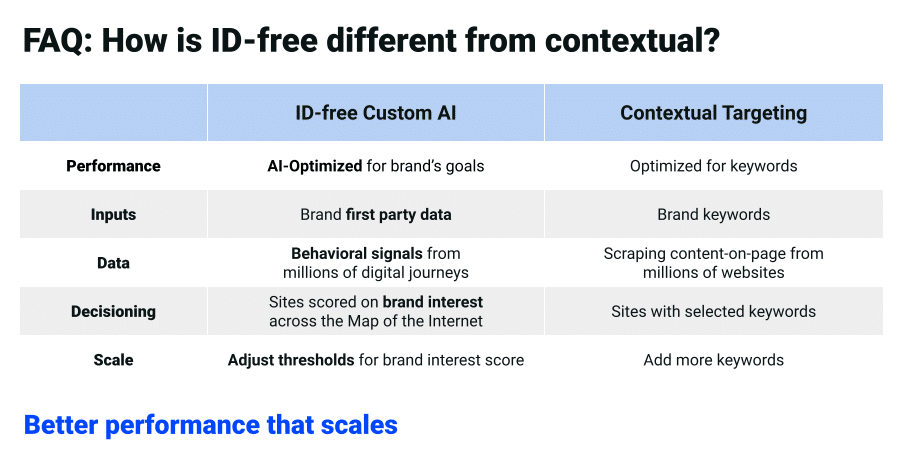
Dstillery’s ID-free Custom AI™️ solution is designed to do just that. With our privacy-by-design behavioral targeting solution, the sunset of cookies becomes less frightening and more of an opportunity to innovate.

As marketers are challenged over the next few years to shift their attribution models, we’ll all be challenged to polish up KPIs and brand measurement standards. We must continue revamping our strategies for a privacy-centric world.

FAQ: Custom Patient Targeting

A new cookieless way to reach your patients, powered by Dstillery’s ID-free technology.

1. What is Custom Patient Targeting?

Custom Patient Targeting is a new privacy-safe patient targeting solution designed for healthcare brands. It offers the precision and customization you need to drive your best patient outcomes. It doesn’t rely on user-based targeting, ensuring compliance with all laws, policies, and guidelines from HIPAA, NAI and DSPs. Using AI-powered predictive modeling, we build a just-for-your-condition targeting model that bids on individual impressions based on aggregated patient behavior.

2. How is it precise?

Every single potential impression ad-supported internet is scored and ranked based on its likelihood of targeting your desired patient. This level of granular targeting is unheard of in healthcare.

3. How is it custom?

Custom Patient Targeting starts with your desired seed dataset, enriches it with our AI-powered understanding of every website on the internet, and creates a model tailored to your specific condition and your patient outcome goals.

4. How is it compliant?

Because Custom Patient Targeting doesn’t rely on user-based targeting, we can ensure compliance with all laws, policies, and guidelines.

5. What seed data can I use?

We recommend seeding with your brand’s first-party data for the most precise results. This can be data from your brand’s web pages or segments from a data management platform. If that’s unavailable, we recommend using your brand’s keywords, including product names, symptoms, and co-morbidities. We are in active discussions with leading healthcare data providers to use their real-world evidence (RWE) datasets, allowing brands to use ICD-10 codes to seed models.

6. How do you collect health data?

Our core dataset consists of healthcare-specific websites and keywords from opted-in devices. When combined with non-healthcare-specific event-level data, we find that these signals allow us to more fully see patients’ journeys, resulting in more accurate and robust models. We are in active discussions with leading RWE data providers rooted in payer and claims data to enhance the models. We will work with beta partners to test these incremental datasets in Q2-Q3 2022.

7. How do you target in a HIPPA-compliant way?

Dstillery’s healthcare targeting methodology doesn’t involve the creation of any health-related profiles. It uses a built-in de-identification to ensure that the data isn’t considered Protected Health Information under HIPAA. It also meets the requirements of the NAI sensitive data guidance by utilizing data minimization techniques that minimize the risk of inadvertently identifying a data subject.

8. How are you able to understand the patient journey without user tracking?

Custom Patient Targeting is powered by AI that identifies and learns the patterns of how, when, and from where anonymous opt-in devices browse the web. These behavioral patterns help the AI predict how anonymous patients browse the web.

9. What is the Map of the Internet?

The Map of the Internet (MOTI) is built by a type of AI called a neural network. It constantly analyzes hundreds of millions of anonymous digital journey patterns and learns the behavioral signals underlying any web visit to build the map. It then takes your seed and extends the patterns detected to all websites. The output is a model that scores and ranks every potential impression on the ad-supported internet and predicts the best patient impressions for your condition.

10. How is it different from contextual, condition, endemic, and traditional behavioral targeting?

Custom Patient Targeting is categorized as predictive behavioral targeting, not any of the following.

  • Contextual: Contextual scrapes words on web pages in an attempt to infer patient behavior. Custom Patient Targeting doesn’t rely solely on keywords (although they can be a helpful dataset). Instead, it predicts patient behavior with AI.
  • Condition: Condition targeting reaches broad demographic groups assumed to be indicative of certain conditions, targeting 10% of the population or more. Custom Patient Targeting can be seeded with demographics, but precisely targets patients based on behavior, not demographics.
  • Endemic: Endemic targeting reaches patients on healthcare-related websites only, while Custom Patient Targeting reaches patients at scale across the entire ad-supported internet.
  • Traditional Behavioral: Traditional behavioral uses third-party cookies to track users. In contrast, Custom Patient Targeting analyzes behavioral signals from millions of anonymous digital journeys to predict the impressions most likely to be your patient without user tracking.

11. Is this affected by cookie deprecation?

Because Custom Patient Targeting doesn’t rely on user tracking, like third-party cookies, it isn’t affected by cookie deprecation.

12. How is it priced?

We’ve priced Custom Patient Targeting to be on par with or less than traditional cookie-based behavioral targeting products. It’s priced at 20% of media, so if you’re clearing $2.00 inventory, it will be about a $0.40 eCPM.

13. How do I get started?

  • Sign targeting agreements
  • Provide targeting API access
  • Select seeds and outcomes
  • Dstillery builds and deploys custom model to campaign

To learn more, please reach out to contact@dstillery.com.

Accessibility statement

Dstillery strives to ensure that its digital services are accessible to people with disabilities. Dstillery has invested significant resources to help ensure access for all users, including people with disabilities, with the strong belief that every person has the right to live with dignity, equality, comfort and independence.

Digital accessibility is not just a target we aim to achieve, but an ongoing commitment that we carry in every aspect of our digital service delivery. We recognize that this requires continuous monitoring, improvement, and adaptation. In the sections below, we elaborate on the various efforts that have been undertaken to address our progress in ensuring digital accessibility for all.

A key element of our accessibility initiative is our engagement with a third-party accessibility consulting organization UserWay to help bring the website into conformance. We use industry standard accessibility methods and tools to accomplish this, in accordance with the relevant version of Web Content Accessibility Guidelines (WCAG) as set forth by the World Wide Web Consortium (W3C) the internet’s main international standards-setting organization.

dstillery.com makes available the UserWay Website Accessibility Widget that is powered by a dedicated accessibility server.

The Widget offers user-triggered enhancements that allow visitors to improve the accessibility of the site. These features will, when selected, increase font size, pause animations, change color contrast, and more. People can choose combinations that suit their needs, as per WCAG Level AAA.

The site has enabled Automated Remediation Technology (ART) for all visitors, whether they use assistive technology or not. ART does not detect Assistive Technology usage; rather, it improves accessibility for all site visitors regardless of ability by deploying remediation capabilities such as (not a complete list):

  • Images and other non-text elements have alternative text associated with them when required;
  • Keyboard navigation is improved with aids such as focus indication and skip links;

Please Contact Us

We are here to assist you and make your experience as smooth and inclusive as possible. If you encounter any digital accessibility issues with our products or services, or need information related to digital accessibility, we want to hear from you! Also, we appreciate and welcome feedback, and we are always ready to embrace suggestions for enhancing our digital accessibility efforts.

Contact Information:

We take accessibility seriously and will get back to you shortly.

Doctor Dstillery, prescribe us a patient targeting solution!

Challenges of Healthcare Targeting

The healthcare advertising space is a dynamic world of its own in terms of marketing. A whopping 66% of internet users look online for information about a specific disease or medical problem. It has more rules and regulations to protect consumer privacy and rightfully so!

We at Dstillery see these rules not as barriers to sidestep and scheme against, but rather as conversation topics to discuss and analyze and then turn into new doors to open that are filled with possibility. Healthcare targeting is currently heavily regulated by HIPAA, NAI, and DSP rules. These guidelines prevent advertisers from focusing too heavily on demographic data and patient condition data. In the healthcare space, it is crucial to protect the patient both physically and informational. That said, naturally, Dstillery wanted to explore how best to serve advertisers and protect patient data at the same time. Like all things, it’s best to start with what we know and then set our sights on the future.

How Are Patients Being Targeted Now?

Healthcare companies’ global advertising expenditure is projected to increase by 4.3% in 2022. As it stands, patients are being targeted in a variety of ways across the healthcare space. Below are some of the current targeting solutions being deployed:

current healthcare targeting methods

There are at least 100 billion searches for healthcare on Google alone each year. That’s 273 million healthcare searches a day. While these targeting solutions are effective in their own individual ways, we wanted to develop something more effective. Born from our existing, trusted technology that best serves the patient and the advertiser. 

Enter Custom Patient Targeting. 

What Is Custom Patient Targeting?

Custom Patient Targeting is Dstillery’s solution to healthcare compliance and digital targeting solutions. Our targeting solution is categorized as predictive behavioral targeting. It’s built from the same technology as our patented ID-free targeting technology called MOTI, or the Map of the Internet. MOTI is built by a type of AI called a neural network. It constantly analyzes hundreds of millions of anonymous digital journey patterns and learns the behavioral signals underlying any web visit to build the map. It then takes your seed set and extends the patterns detected to all websites. The output is a model that scores and ranks every potential impression on the ad-supported internet and predicts the best patient impressions for your condition. Another important trait of Custom Patient Targeting is that it isn’t affected by cookie deprecation. Custom Patient Targeting is built on our ID-free targeting technology, meaning your patient targeting solution is future-proof.

Can You Tell Us More About How Custom Patient Targeting is Compliant?

Great question! Doctor Dstillery has the answer. Our core dataset consists of healthcare-specific websites and keywords from opted-in devices. When combined with non-healthcare-specific event-level data, we find that these signals allow us to more fully see patients’ journeys, resulting in more accurate and robust models.  Additionally, our healthcare targeting methodology doesn’t involve the creation of any health-related profiles. It uses a built-in de-identification to ensure that the data isn’t considered Protected Health Information under HIPAA. It also meets the requirements of the NAI sensitive data guidance by utilizing data minimization techniques that minimize the risk of inadvertently identifying a data subject.

Getting the Script

If you’re curious about our healthcare targeting treatment option, or rather, our healthcare targeting solution reach out to us and one of our data doctors will assess your condition and see what we can do for you. New health-related conditions will begin to flare from allergies to achy bones as we shed our winter bodies and move into an activity-filled summer. Dstillery is here to help you prepare.

The product creation of Custom Patient Targeting

Custom Patient Targeting is a new cookieless way to reach your patients now and in the future. Powered by Dstillery’s patented ID-free™ technology, it doesn’t rely on any form of user-based targeting, ensuring 100% compliance with all laws, policies, and guidelines. Read on to learn more about how Custom Patient Targeting was created and why.

What Problem is Custom Patient Targeting Designed to Solve?

Healthcare brands want to achieve more precise direct-to-consumer targeting but face strict data requirements. The industry grapples with rules from HIPAA, NAI, and DSPs and limitations on first-party data, and strict demographic requirements. These requirements have meant fewer, more narrow options in the marketplace, and have ultimately presented a precision problem. Brands are wasting time, money, impressions, and conversions by targeting people who aren’t their prospective patients. Less waste and more precision are needed. Enter: Custom Patient Targeting.

How Did Custom Patient Targeting Evolve From ID-free?

Dstillery was already in-market with ID-free Custom AI™, also powered by our ID-free tech, when we saw this problem that healthcare brands face. We knew that our ID-free technology could be part of the solution. Custom Patient Targeting (CPT) works the same way as ID-free but is specifically designed to address the needs of healthcare brands.

Like ID-free, we strategically built CPT with data minimization at its core. It only relies on a couple of data points, notably, a seed set with people who search for specific health terms such as product names, symptoms, or comorbidities. As Crossix and IQVIA results come in, our data science team will partner with you to optimize and tune your custom model to drive optimal patient outcomes.

This is incredibly valuable, but not enough to drive scale, performance, and understanding of your patients’ intent across their digital journey. That’s where our AI comes in. Using a continuous influx of patient journeys, our AI learns how, when, and from where people browse the web, finding patterns and applying the signals to all other websites.

This results in a just-for-your-condition behavioral intent score for every website, answering the question, “When someone visits this site, how likely are they to be interested in your brand’s message?” The intent scores give your brand the strategic advantage to predict the ad impressions most likely to convert for your brand. When we see a bid request that’s predicted to be your patient — such as someone visiting lowcarb-diet.com at 9pm, or someone from Austin visiting startsat60.com — we will bid and purchase that impression.

Custom Patient Targeting Key Differentiators

There are 3 key unique and differentiated enhancements that we’ve developed to make Custom Patient Targeting more aligned with what healthcare brands are specifically looking for.

  1. Healthcare search keywords as seeds: While first-party data is preferred, a lot of healthcare brands do not have access to (or are unwilling to share) this data with data vendors. By leveraging our opted-in panel dataset, we are able to use healthcare search keywords — ranging from product names, competitive product names, symptoms, and co-morbidities — as seeds for our ID-free models. Testing has shown that well-selected keywords can drive programmatic performance on par with first-party data.
  2. Model tuning for healthcare performance: Unique to healthcare advertisers, there is a need to not just drive growth in programmatic metrics (ROAS, CPA, CTR, etc.), but also drive high audience quality scores measured via vendors like Crossix and IQVIA. If audience quality results are shared with us, our data science team will partner with healthcare advertisers to optimize and tune the custom model to drive optimal patient outcomes like improved audience quality scores.
  3. (In development) ICD-10 Codes as seeds: We are in active discussions with leading RWD (Real-world data) providers rooted in healthcare data such as claims data, patient surveys, and more to use their data as seeds for our models. This would enable customers to simply provide ICD-10 codes or conditions they are trying to target, and for us to use this dataset to identify patients with the condition.

To learn more about Custom Patient Targeting, click here.

5 steps to prepare now for the cookieless future

The 5 steps are each preceded by a question.

“Great results begin with great questions.”*

In a recent Gartner article, How the CMO Role Has Evolved – and What’s Next, VP Analyst Chris Ross refers to the role as having “undergone a head-spinning transformation over the last decade.”  In the next 5 years, Ross contends, the CMO role will become even more challenging with expectations for supporting the scope, speed, and complexity the business requires… with the need to “measure and optimize everything they do.”  

Add a global pandemic to the equation and the stakes get even higher. In the 2021 Forbes article, 4 Ways the Role of the CMO Has Changed As a Result of the Pandemic, author Greg Salmon contends that CMOs need to “address the fact that we face uncertainties and volatilities as never before.” So where do CMOs turn for advice, future planning insights, and flat-out answers? If there’s one thing that hasn’t changed, it’s where an agency can add its greatest value: Solving problems beyond a brand’s in-house capabilities or expertise.

Enter the Challenge of The Cookieless Future.

Few agencies would offer that they have “the answer.” Meanwhile, marketers, at all levels, readily admit that they need those answers to run successful campaigns in the future.  A future that’s rapidly approaching.  It’s not an overstatement to suggest that addressing the cookieless future, ahead of third-party cookie deprecation, is essential to capturing growth.

IAB’s Internet Advertising Revenue Report, issued earlier this week, shows programmatic advertising growing at 39% YoY, with its share of total digital revenue increasing 52.3%.  Outside of media, the ad agency business would be hard-pressed to identify another direct-path-to-growth that exceeds that trajectory. But what happens when data-driven digital advertising faces a dearth of the very data it has come to rely upon for decades?

The 5 questions CMOs should be asking their agency partners.

CMOs, Heads of Marketing, and any marketer responsible for their brand’s growth should be asking these 5 questions, to prepare for the cookieless future:

  1. To understand changes in data privacy: What’s happening, when, and how will it affect my campaigns?
  2. Data Partners offer options: Are we confident we have the right partners to deliver optimal audiences?
  3. Planning Strategy: What near- and long-term media strategies do you recommend?
  4. Testing Now: What plans are in place to test cookieless solutions now?
  5. Measurement: How are we monitoring performance and measuring successful results, comparing to cookie-based campaigns?

In our own Dstillery ID-free research**, the findings suggest a not-so-surprising range of concerns. What IS surprising is that for every concern that marketing leaders and agency media professionals cite, the solution is merely to develop a preliminary plan and begin testing. Consider how a team approach, where CMOs and their marketing teams work with their programmatic agency partners to plan and run cookieless tests, would address our clients’ key issues:

A. “I don’t have a plan”
B. “Unsure how cookieless works”
C. “Worried about measurement”

CMOs and any marketer embracing their role in driving growth, have not only the right, but arguably, the responsibility to test and share learning with their organizations.  

If you’d like to learn more, visit: dstillery.com/go-cookieless

*Marilee Adams Ph.D., President and CEO of the Inquiry Institute, Originator of the QUESTION THINKING™ methodologies
**Source: Research conducted by Dstillery via Linkedin Polls, Dstillery Digest and 1:1 customer interviews, October 2021- April 2022