testAuthor: Dstillery

An introduction to ICD-10 Codes

icd-10 codes

If you’re familiar with our cookieless healthcare targeting solution, Custom Patient Targeting, you may have noticed a recurring term – ICD-10 codes. Specifically used when we talk about building custom seed sets for healthcare advertisers. So what exactly are these codes? They’re the primary standard for classifying standard medical diagnoses and are utilized by Dstillery to build condition-specific targeting models. Dispelling the ICD-10 code is the fastest way to get your campaign up and running at Dstillery.

The Anatomy of an ICD-10 Code

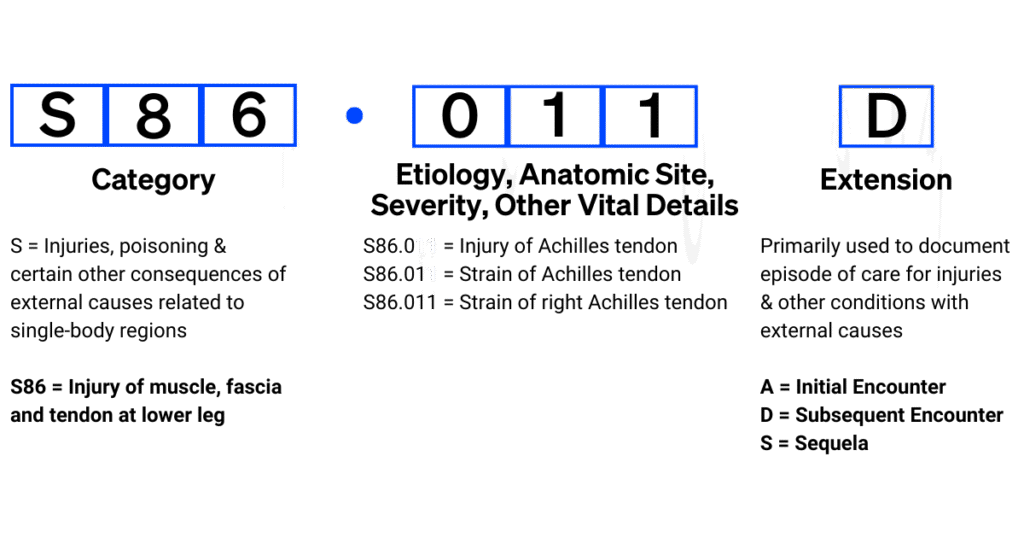
ICD-10 codes range from three to seven characters. The longer the code, the more specific the diagnosis. The first character is always a letter, and the following two codes are either letters or numbers.

The first three characters of an ICD-10 code designate the category of the condition. In this example, the letter S denotes a “poisoning injury and other consequences of external single body regions.” Paired with the 8 and 6, the diagnosis falls into the category of “muscle injury, fascia, and tendon of the lower leg.” A three-character code that lacks further subdivision can stand alone as a code, but when greater specificity is available, it is best to choose the more specific code. We encourage the use of both wide umbrella codes and granular codes to ensure targeting goals are as specific and broad as possible. 

Characters three through six indicated related etiology which is to say that they focus on the cause of the condition, set of causes, manner of causation, anatomic site, severity, and other clinical details. In the example above it helps us understand that the code is specifying the strain of the right Achilles tendon. The final character is usually referred to as the extension. It can provide information about the characteristics of the encounter or moment of injury. Not every ICD-10 code is allowed to use a seventh character. The extension must always be in the seventh position, and any characters in between should be filled by an X. 

Choosing ICD-10 Codes For Your Model

In many cases, you will need to choose multiple ICD-10 codes for a single condition. The more codes and symptoms your targeting model focuses on, the higher the accuracy which will help reduce campaign spend waste and ensure that your patients are being targeted. Oftentimes there are many ICD-10 codes that target or explain similar conditions and ailments. We encourage you to choose as many that seem applicable to your model since many times one condition can occur with another or lead to another. 

With injury-centric codes you can find multiple ICD-10 codes that further describe the scenario that resulted in the injury. These codes are often considered “secondary codes” since they describe the cause of injury rather than a chronic condition and capture the cause, the intent, the place or event, or the activity the patient was engaged in at the time of injury. These are particularly helpful for over-the-counter bandages, splints, crutches, and other medical assistance devices and items. You can use as many external cause codes as necessary to help fuel the model. Furthermore, these ICD-10 codes blended with search keyword data help us build your brand a campaign that targets patients throughout each part of their patient journey from the top to the bottom of the funnel. This blend of search terms and ICD-10 codes create an audience that prioritizes audience quality ensuring that vendors have accurate points of measurement.

Bringing It All Together

Understanding the ICD-10 code structure will help streamline and strengthen your Custom Patient Targeting campaign and ensure that your model is powered by the most precise and widely utilized data signals in the healthcare space. 

Tis the season for holiday shopping trends

Holiday shopping is here. Both advertisers and consumers must be strategic about where they spend their dollars this holiday season. According to Insider Intelligence, advertisers will spend $1.3 billion between October and December this year. Even more importantly, research from 2021 has shown that only 4% of holiday consumers didn’t utilize digital channels to purchase goods. In 2020, retailers chose to deemphasize Christmas holidays in favor of Black Friday and Cyber Monday deals due to the pandemic. Now, budgets are returning to both as holiday spending is expected to surge even amidst inflation.

Lean into Brand Loyalty 

To keep their brands relevant this holiday season, advertisers need to budget toward higher spending and scale across the internet and digital platforms. Native ads, high-impact ads, banner display, and video across all digital devices, from desktop to mobile, will be a crucial playground for those looking to be the king of the hill this holiday season with their profits. Last year, holiday shoppers started buying sooner rather than later, breaking the long tradition of last-minute gift-buying madness.

Brand loyalty programs had a lot to do with this. Brands are pushing customers to skip the door-buster deal fear and hedge their bets on earlier sales. 81% of consumers shopped for specific brands during the 2021 holiday season because they were a member. Notice an increase in ads offering Cyber deals, or even huge sales early, like right-this-instant early. It is no mistake that brands are activating earlier, more often, for the holiday season.

Retail Media 

This heavier spending is leading to the emergence of a subsection of advertising called retail media. Retail media is advertising within the retailer sites and apps that builds and feeds the brand story. This technique uses both a retailer’s omnichannel properties and data each time a consumer comes into contact with the brand –  from being on the brand website on their phone to being physically present in the store –  to serve them content relevant to their desired experience with the brand.

Brands like Amazon are embracing this advertising method and looking to capitalize on the digital-first experience by building their brand presence into worlds for the customer to inhabit. These worlds are filled with deals and media content that indulges each area where the customer wants to interact with the brand. Brands are expected to grow their retail media spending by 27% moving into 2023 as consumers seek more authentic connections with the brands they consume. 

What now?

What does this mean for digital marketers? Invest in your brands! This requires leveraging your brand’s first-party data to make informed decisions about where the customer wishes to adventure within the brand world. Building an omnichannel marketing campaign is the absolute baseline for success during the holiday season. Taking things to the next level by investing more in a specific brand’s retail media is a way to seal the deal and form a perfect digital-to-physical relationship between your brand and its customers. 

If you’re ready to put your first-party data to use, contact us today.

Preparing your Black Friday advertising strategy

Black Friday and its sibling, Cyber Monday, are almost here. These two have become the premiere retail days of the year and now more than ever, it’s time for brands to prepare their campaigns. Curious about the best ways to approach campaigns for the biggest retail weekend of the year? Look no further.

Lead with Data

More important than any catchy slogan or meme is data. Does your brand resonate in market? Who are the customers? What do they want? Why do they want it? The foundation of any successful campaign is data analysis and segmentation to reveal the real customer story behind your brand. Figure out who your customers are, understand their behaviors, and build around these data points. 

Last year, despite the surging COVID variants, Black Friday and Cyber Monday broke several online retail records with over $200 billion spent online over the entire holiday season, another $100 billion spent during Cyber Week, and $9 billion spent on Black Friday alone. To put this into perspective, Black Friday sales figures clocked in at $6.2 billion in 2018, $7.4 billion in 2019, and $8.9 billion in 2020.

Although last year was a record-breaking holiday shopping season overall, the average eCommerce conversion rates dropped in 2021 by over 20%, landing just under the 2019 number. Curious about more? A deeper analysis of over two billion eCommerce store sessions every single week showed that the average conversion rate globally for Black Friday in 2021 was 3.2%, compared to 4.5% in 2019. While a 1.2% drop seems insignificant as a number, for marketers, this means brand messages need to speak louder to customers, lest a brand is left behind. The US scored slightly better than the global average, with conversion rates at 3.6% in 2021, vs. 4.3% in 2020. Nonetheless, that doesn’t mean we can rest on our laurels. It’s hustle time. 

Be Seen or Be Left Behind

If you’re not first, you’re last, and absolutely no one wants to lose. The weeks before Black Friday and Cyber Monday are all about honing your brand’s perfect message and serving it over and over again. This isn’t the time to scatter-shot a hundred different ads with different messages. This is the time for a solid message and driving it home. Reduce your campaign budgets to focus on only the best-performing ads and maximize spend in those areas. It’s vital for your brand to produce and finalize creative early on and allocate budgets toward success. Is your brand worth shouting about? Prove it in your marketing campaigns. 

Many brands are shifting their Black Friday sales as early as late October, while others begin offering promotions in early November. 75% of retailers surveyed in 2020 said they offered deals before Black Friday, with some lasting several days or weeks. 83% of holiday shoppers stated that they started their holiday shopping earlier than Black Friday, and with the persistent economic uncertainty, it is likely that 2022 will bring in the same.

Custom AI: Your cookie-based AND cookie-free targeting solution

Google Chrome has been the leading browser of choice for online consumers for quite a few years now. According to www.statcounter.com, in May 2022, Chrome was dominating the web browser market share by 64.34%. As Google previously announced, Chrome internet browser will stop supporting the user-tracking technology called third-party cookies by late 2024. Cookies are small files sent to your browser from websites you visit. These files track and monitor the sites you visit and the items you click on these pages. This announcement sent shockwaves through the AdTech industry. Third-party cookies have been a foundational part of the technology that enables personalized digital ads, allowing advertisers to personalize ads to users based on their behaviors and site-visit history for decades.

So, what does a cookieless world mean for Dstillery and our audience model building? We have it all covered! Besides offering our premium ID-based methodology for building audiences with cookies, we also have ID-free audiences that do not rely on any user-tracking, cookies, or IDs.

ID-based Custom AI Audiences

Dstillery builds predictive models for audiences by analyzing the data on users who visited certain domains. This data is completely anonymous. It comes from sources like the programmatic ad environment (the bid-stream) and 3rd party data partners, and it is cookie-based. 

Once we receive this cookie-based data, we store it under anonymous user profiles in our system. When we talk about examining data on users, we mean understanding their online behavior. After analyzing common patterns among the users who visited a certain domain, Dstillery builds a model consisting of the online behaviors most likely to lead to conversions or actions among all these users. This predictive model is then used for targeting consumers on the internet who would be most likely to exhibit the same behaviors that the model has already identified.

The model is then used daily to score devices that match the model features and build a probabilistic ID-based audience for targeting. All ID-based audiences are refreshed every day by scoring new qualifying devices in and scoring out the ones that do not fit the model criteria anymore. This guarantees that Dstillery’s audiences are always relevant, up-to-date, and ready for immediate use.

Dstillery offers a wide range of ID-based audiences. They fall into different categories based on the way they are built and their composition.

How are Custom AI audiences built by applying the ID-based methodology?

For Custom AI audiences, Dstillery requires first-party data that comes directly from the client, not just any domain or source, in order for the target user behavior for that brand’s signal to be identified. This first-party data can be collected by placing a Dstillery Pixel on the client’s website or by ingesting CRM data offline. The collected first-party data is then analyzed by finding common browsing behaviors among the client’s consumers and used to create Custom AI models that are 100% tailored to the client’s brand and needs. 

ID-based Custom AI audiences deliver some of the best results and precision. Why?

First-party data, whether it comes from pixel-based devices or from other data sources such as CRM-based lists, provide the strongest signal for interest in your brand. It is also important to note that the models for Custom AI audiences are rebuilt every 24 hours due to the constant flow of new devices to pixels that sets off the model refresh. Additionally, all Custom AI audiences are refreshed daily by having devices scored in and out of them, which always guarantees strong relevance and excellent performance. Internal studies have shown a 15x lift in conversion rate for qualified customers identified in our ID-based Custom AI Audiences.

ID-free® Custom AI Audiences

Dstillery already has a plan and a solution for the ‘Post Cookie Era.’ Enter ID-free® targeting, a methodology for model and audience building without using third-party cookies. Dstillery has adapted its proven ID-based model-building technology so that cookie IDs are not necessary to create high-quality predictive audiences. In our ID-free environment, we do not rely on tracking the devices we are trying to target. This makes ID-free the ideal choice for advertisers who want to get ahead of consumer privacy concerns without compromising campaign performance and scale. 

Dstillery’s ID-free methodology for building audiences is based on patented neural network technology that analyzes hundreds of millions of anonymous digital journey patterns to learn the behavioral signals underlying any web visit. By using this influx of hundreds of millions of anonymous digital journeys our algorithm learns how, when, and from where people browse the web and derive a multidimensional map of the web where the closer the points, the more similar the actions of visitors to those sites. Dstillery builds these statistical predictive models from opt-in first-party data (such as pixels, surveys, and panels) that are then applied to the ID-free universe of prospects. This enables brands to identify the right impression opportunities among all these untracked browsers and devices.

Our Chief Data Scientist, Melinda Han Williams, explains how our cookieless targeting solution is not the same as contextual targeting. “ID-free doesn’t read the words on the webpage or scrape content from websites, it is entirely a behavioral solution. So, it is picking up on signals that reflect interest in the brand, regardless of the content on the webpage. ID-free can take a high-performing 1st party signal, amplify it and activate it at internet scale.”

Who are ID-free audiences for?

The core of ID-free technology, and its inherent cookieless nature, delivers performance and scale for all brands. ID-free audiences are particularly great for industries that have strict privacy standards, like healthcare and finance. We can confidently conclude that ID-free is an excellent solution for everybody, for two reasons:

  1. Cookies will be going away, so brands can get ahead of the curve now.
  2. It opens up a whole universe of devices that brands have not been engaged with, so it’s good for performance and incremental scale today!
How is Custom AI implemented through Dstillery’s ID-free methodology?

Just like ID-based, ID-free Custom AI audiences deliver some of the best results and precision because these models are built with first-party data or keywords. Dstillery’s multidimensional Map of the Internet (MOTI) is compounded with the client’s first-party signal. This allows our AI to learn the browsing patterns of anonymous opt-in devices identified in the client’s seed and to create a base model. Then, the identified patterns are extended to all websites by utilizing our neural network technology, allowing the client to select opportunities that are predictive of desired behaviors. When a Custom AI model is generated and applied to the ID-free universe of devices, this creates tailored ‘just-for-your-brand’ predictions to identify the most valuable impressions for the client’s brand.

ID-free Custom AI is a proven post-cookie solution, available now, it works on every browser and across all types of devices including desktop, mobile, and tablet. It performs on par with the best ID-based Custom AI solutions, sometimes even better based on current campaign results. ID-free Custom AI could be used strategically as a way of adding incremental scale to any client’s campaign by unlocking a whole new universe of devices that aren’t being tracked.

How is ID-free Custom AI tailored for healthcare brands?

Custom Patient Targeting is a version of Dstillery’s ID-free Custom AI product made specifically for healthcare. Because the core ID-free methodology doesn’t create profiles, doesn’t “know” the names of the sites that any user visited to make predictions, and doesn’t target any IDs or cookies, ID-free targeting offers optimal precision, customization, and compliance for healthcare brands in programmatic advertising. For advertisers in healthcare looking to engage with consumers in a completely privacy-friendly manner, Custom Patient Targeting is Dstillery’s privacy-safe behavioral targeting solution that provides performance and precise reach without user tracking.

How Dstillery processes its data

Dstillery ingests billions of data points daily. This includes website visitations, foot traffic, and app usage, which are processed into consumer behavior. With that data, individual devices (mobile and desktop) are scored in and out of specific audiences across different topics and then organized into categories. Dstillery audiences are up-to-date as audience segments are refreshed daily to deliver an unparalleled level of advertising effectiveness. 

Although Dstillery audiences are continuously refreshed on a daily basis, and users are scored in and out of audiences across our different audience categories, users can still leave our data store/ecosystem at any time. 

Dstillery has over 2,800 prebuilt audiences. Audiences are created using our AI models. These models score users in and out of specific audiences across different behaviors. As a result, valuable data is produced through graphs that reveal audience composition, demographics, locations, and the trail of sites visited.

How Users Score into an Audience:

To score means that the model analyzes the browsing history of the users who visited particular websites that revolve around the same topic. The AI model then uses that data to find other users with similar behaviors and interests. 

Moreover, the AI model analyzes URLs to find similar browsing histories of individual users and search for common behavioral patterns. After those common web behavioral patterns are identified, the model uses that information to score users in and out of particular audiences. 

How We Build a Pre-built Audience:

To have a better understanding of what a Pre-built audience is, let’s take a look at an example. “Toyota Vehicle Shoppers” is a Pre-built audience. This audience was built by putting together URLs that show users who are looking to buy a Toyota car or someone who is browsing anything related to Toyota vehicles. For example, www.olathetoyota.com, www.toyota.co.uk, www.toyota.com, and www.toyotacertified.com are fed into the model as input known as seed sets. The AI model will use these URLs to find users who have similar URLs in their web history. Users with these URLs in their web history are analyzed as users of interest. The model uses that information to find users with similar web patterns and interests, allowing it to score users into specific audiences. This process enables us to create accurate profiles of the users.

How Users Score out of an Audience:

Above, we described how to score into a specific audience. Now, let’s look at how the AI model scores a user out of an audience. Scoring out means that when users no longer demonstrate a particular pattern, they are scored out of an audience. For example, if the user’s web behavior has changed from buying a car to buying a jacket, the AI model would then score that user out of the “Toyota Vehicle Shopper” audience and into a “Jacket Lovers” audience.

As the AI model scores users in and out of the audience daily, another system – the data retention system looks at a user’s cookie history.  

Data Retention Period for Audiences:  

Data retention period across different audiences refers to how long users are retained in our scoring system. When users clear out their cookie history, we can no longer score that particular user into any audience because the AI model does not have any web history to analyze and score. Our data retention system checks users’ web history every day for 60 days. If the system doesn’t see the user’s web history, the system will delete the user from our database. Suppose/if we see that user’s cookies again, that user will return as a brand-new user. The AI model will analyze the web behavior of the new user and score them into a new audience.  

Custom AI Audiences Built by First-Party Data to Create Specific Profiles for Brands:

Custom AI audiences are built by analyzing your first-party data to create a profile specific to your brand. When a user clicks on a pixel on the client’s website or web page, we automatically receive the user’s cookies. Our AI model then uses those cookies as model input to train the model. The AI model is trained to find users with similar web behavior to those who click the pixel. After the patterns in web behavior are identified, the AI model uses that information to score users into retarget audiences. The Custom AI Audience is one of our best audiences because it is 100% customizable to your brand. 

The AI model rebuilds itself whenever users click on a pixel. By clicking on a pixel, new input is used to train the model even more. Let’s look at the data retention period for the Custom AI audience. The data retention period differs from the Pre-built audience because we look at the users who click on the pixel.  

Once the pixel is placed on the client’s web page, we activate it to receive users’ cookies. When a user stops interacting with that pixel for 180 days, the user will be removed from the model input. Users get updated into the model input every time they interact with a pixel. 

If a user doesn’t interact with a pixel for 180 days, that user will be removed from the model input. Furthermore, the behavioral history of that user will also be removed. Moreover, if the same user interacts with the same pixel on day 181, the system will look at it as a new user that clicks on the pixel. 

What will happen to our first-party data if you create a custom AI audience and leave the pixel active without us terminating our contract with Dstillery? 

As long as that pixel is active and the user constantly interacts with that pixel, the user will be a member of that Custom AI segment audience. Any data collected from that pixel older than two years will be removed from our system.

What will happen to our first-party data if the pixel gets deactivated? 

Upon the deactivation of the pixel, after 14 days, our system will score out every device from the custom AI segment audience. If your custom AI audience is reactivated, our system will find the users that interact with the pixel placed on the web page. 

To learn more about Dstillery audiences, please visit our products page.

Shaping the future of the web: internet privacy

For as long as the internet has existed, there have been well-founded concerns about its threats to privacy. Though largely brushed aside historically, when innovation and monetization took priority, during this fourth decade of life with the web concerns about privacy rights have been taken up in every corner of our digital society.

We can distill the essence of the privacy concern to the questions: 

  • Who is allowed to recognize the devices you use, and by extension, you?
  • Under what circumstances — and with what limits — can recognizable data generated by your devices be captured, stored, and shared?

The causes for concern are readily apparent: people don’t want to be surreptitiously tracked or have profiles they have no control over created from their online activity by unknown parties. They don’t want their information bundled up and shared with vast networks of potential buyers with whom they have no direct relationship, without their knowledge, much less consent, for unlimited, unspecified purposes. They don’t want to have the phone and computer that have become keystones of their lives spying on them. 

But each negative sits beside a positive. Tracking users’ online behavior allows us to learn what is normal, making it possible to better support them and identify abnormalities that point to a host of problems, from breakage to fraud to misappropriation and attack. Building profiles allows us to personalize experiences and provide relevant recommendations. Being able to positively identify devices and verify users allows us to be confident in the trustworthiness of an interaction. Knowing you’re the same person using different services allows for more useful constellations and configurations of applications and, for many enterprise applications, is a requirement.

To say it more simply: what is known about you can be used both to diminish and enhance your online experience, which is what makes the changes to enhance privacy so tricky. 

We have all opened our homes, our businesses, and the majority of the relationships that make up our daily lives, to the Internet. For the most part, those with access to the data generated by these online interactions have used it appropriately, or at least non-destructively. But some haven’t, and the threat posed by the minority which misuses our data is great enough that we all must take very seriously the question of how we safeguard personal data and the effort to find answers that carefully and appropriately balance utility and privacy. 

If we are not careful about how we reform things, we risk sacrificing much of the transcendent value of the Internet in our quest to protect privacy. The “We” identified here includes browser vendors and the larger community of volunteers working with them in many different venues to manage the transition to a more privacy, and user, respecting internet. If you have use cases that depend upon the web, hopefully, “we” also includes you.

Growing Pains

The implications and impact of privacy-focused changes are increasingly far-reaching and profound. These changes push platforms and providers to demand of users ever more onerous terms of service. They push regulators and legislatures increasingly to pursue the imposition of restrictions on behalf of users. They encourage tech behemoths to stake claims in the privacy frontier that prioritize corporate agendas and lock in relationships.

However, almost all of the impacts to date have been a relatively quiet prelude to the storm of transformation and disruption that our digital world will experience when Google fully transitions to the privacy updates that are being developed for Chrome, the world’s most popular web browser. These include tracking prevention technologies and the promised end of support for third-party cookies in the second half of 2024.

One privacy-motivated impact that was decidedly not quiet, and which may give us some foreshadowing of the impacts of the Chrome updates, was the release of Apple’s App Tracking Transparency (ATT) in iOS. Finally turned on in iOS 14.5 in the spring of 2021, after being postponed from the fall of 2020 due to an outcry from app developers, it had an immediate, negative impact on the iPhone advertising ecosystem. Despite the long-delayed release, app developers saw revenues drop by as much as 40% or more overnight.

The negative impacts persisted through the end of the 2021, resulting in significant drops in user acquisition spend, app installs and in-app purchases on iOS. During this period, Android experienced significant increases in the same KPIs. The magnitude of the impact was underscored when Meta identified ATT as a principal reason for the quarterly revenue miss that triggered the biggest loss of value by a US company in history.

Early Efforts

Though ATT is perhaps the most dramatic of Apple’s efforts to promote privacy, it is by no means the first: WebKit (Safari’s browser engine) first implemented tracking prevention in 2003 with Safari 1.0. There is much to appreciate in Apple’s commitment to its ideals, but in some areas, the focus on privacy and doing things “the Apple way” has done as much to discourage success as it has to ensure it; Safari being a case in point. 

Since its inception, Safari has struggled to gain traction, never achieving more than 10% market share for desktop browsers even though it has been bundled with the Mac OS since launch and was available for Windows from 2007 to 2012. This is also despite being launched within a year of Firefox, which managed to achieve greater than 30% market share before being usurped by Chrome.

Released in 2008, Chrome’s popularity surpassed Safari’s within a year and Firefox’s within 3.5 years. Within four years, Chrome had taken the top spot from the most popular browser from 1999 through the first decade of the century, Internet Explorer, which many had considered irreplaceable.

There are many reasons why Chome found success while Safari did not. The most important was that the team behind Chrome prioritized replicating IE’s functionality and assuring it was compatible with the majority of websites of the day, going to great lengths to work with site developers and incorporate their feedback. In contrast, the Safari team chose to do things their way, emphasizing design, security, and user experience over site compatibility. 

As a result, Chrome worked everywhere from the start, while Safari constantly had problems on all but the simplest of sites. This led to the general belief that Safari was passable for basic browsing, but to get things done, you had to use IE or Chrome and eventually just the latter.

Safari has always strived to support web standards and actively participate in their development, and today it works more reliably across the web than it has historically. This is due to efforts by both the Webkit team and website developers, with both having benefited from active engagement in the broader community to create standards and encourage their adoption. 

However, even today, after almost two decades of updates and improvements, Safari continues to support only a subset of common functionality and lacks compatibility with sites in many areas where standards are lacking. A big reason for this continued lag is that Chrome works with the vast majority of websites and use-cases, is available on every major platform and so there just hasn’t been a need to put the effort into improving compatibility with Safari. A developer of enterprise applications put it very succinctly recently when asked about support for Safari: “We just tell people: use Chrome.”

Help Wanted

With ATT we have seen the potential for disruption that unilateral changes by a platform in how end-user relationships are mediated can have. With Safari we’ve seen the results of failing to engage deeply in the community process and provide site developers adequate support for their critical use-cases.

Chrome is taking a different approach as it seeks to increase user privacy by founding its efforts on a broad invitation to participate and public outreach efforts aimed at users, developers, and business communities. They have spun up groups in various public standards bodies through which they have sought to understand use-case requirements, presented proposals, and solicited and incorporated feedback as they search for ways to support a more private web. But, the results will be no different with Chrome than they were with ATT and Safari if we do not collectively step forward and engage.

Google, Apple, and other browser vendors are offering all who are willing to engage an opportunity to work with some of the most capable product and engineering teams on the planet, asking only that we own the role of business stakeholder the web has cast us in. They have teams working on the future who are ready, willing, and able to find privacy-friendly solutions for our business problems. They’re asking us to describe our use cases, review proposals and offer alternatives, for collaboration in testing, for feedback. More simply, they are asking for our participation, and for our help in defining the standards for the next iteration of the web.

Second (And Third) Chances

In response to the broader community’s concerns and well-founded claims of unpreparedness, we’ve had a couple of reprieves: Apple’s delay of the ATT release from fall 2020 to spring 2021 and Google’s delay of cookie deprecation from early 2022 to late 2023 and more recently to the second half of 2024.

In the case of ATT, despite the postponement, not enough was done to stave off a withering shock to the ecosystem. We’re now midway into our third chance from Google, with potentially much greater disruption and orders of magnitude more at stake. We can’t afford to be complacent and go back to business as usual, but that’s exactly what many have done in the wake of Google’s postponements.

Participation Required

If we work on this together, we will collectively build a future that works for most of us. It will never work for us all, but at least for those whom it can’t support, there will be the opportunity to make their case and hopefully an understanding of why they can’t be supported, what the alternatives are and how to break things gracefully. 

It isn’t perfect; it will never be that: perfection squanders too many possibilities. What it will be is the best new start we can muster, and that is by far a better alternative than having well-intentioned but poorly informed efforts creating chaos in our digital lives.

I’m confident that we can no more remove the Internet from our lives than we can any other public utility, but we can diminish the Internet’s promise and value to each and all of us. Let’s work together and actively take up the challenge of assuring the Internet supports the vast majority of us, the vast majority of the time, and offers alternatives we can all live with in those cases where it doesn’t.

Getting Involved 

Various groups have been organized to collaborate on improving privacy online, and several of them are focused specifically on solving for a future in which ad-tech fulfills its promise while also being privacy-preserving.

IAB Tech Lab seeks to bring member companies from the ads business community, including advertisers, publishers, and their technology providers, together to develop standards to support the digital advertising ecosystem in the transition to a more privacy-focused web.

W3C Improving Web Advertising Business Group seeks to bring together ad-tech, the web development community, and browser vendors to collaborate on refactoring online advertising to remove dependencies on privacy-invasive technologies.

W3C Private Advertising Technology Community Group is a technology and solutions-focused group representing interests from across the web that seeks to be the home for ad-tech-related proposals within the W3C, an open web technology standards body.

Web Platform Incubator Community Group (WICG) offers members a venue to propose, discuss, test and generally incubate new web platform features with the potential for adoption by a W3C Working Group for standardization.

Dstillery’s privacy-safe audience targeting solution can now activate Deal IDs

New capability makes it easier to integrate ID-free™️ into advertising campaigns

NEW YORK, Aug. 11, 2022Dstillery, the custom audience solutions company, announced today the activation of its ID-free Custom AI solution on any demand-side platform (DSP) via Deal IDs. This new targeting vehicle, made possible in partnership with Microsoft (formerly Xandr), using their curation platform, Microsfot Curate, offers a flexible, easy-to-activate private marketplace (PMP) option that expands the use of ID-free.

ID-free Custom AI

ID-free Custom AI is a patented, privacy-by-design targeting solution that works by reaching inventory, not users, across all internet browsers. It’s a new category of targeting that uses AI to predict the likelihood of conversion based on privacy-safe behavioral signals like URL, geographic area and time of day. ID-free gives agencies and brands the ability to deliver advertising performance that rivals today’s best cookie-based solutions without user tracking. ID-free is neither a new identifier nor is it contextual targeting.

Deal IDs

A Deal ID is a container for inventory that is defined on the supply side to identify relevant impression opportunities, and can be used to express targeting today, and in the cookieless future.

“As programmatic buyers look for alternatives to cookie-based targeting, Deal IDs provide an opportunity for enhancing the distribution of ID-free Custom AI in their strategy,” said Evan Hills, SVP of Strategy & Partnerships, Dstillery. “We’ve already demonstrated the power of ID-free through our buy-side partners – availability via deals will bring even more programmatic media buyers into the fold.”

Through the Microsoft Curate platform, Dstillery will create easy-to-use Deal IDs that offer the same privacy-safe targeting available previously exclusively via APIs on DSPs.

“The agencies buying on our platform are eager for these curated deal IDs, because they’re a critical part of how brands will connect with consumers moving forward as the identity landscape continues to evolve,” said Chris Cattie, Associate Director, Xandr. “With Deal IDs, Dstillery has made it a frictionless experience to tap into rich, privacy-friendly targeting, and we’re proud to be able to provide the platform to help make that possible.”

Digital marketing firms, such as Distillery client KORTX, are already experiencing success using the deal ID method.

“With Deal IDs, we can connect without an external API integration for programmatic ad buys, which means ID-free audiences are easier than ever to activate for clients like Tropical Smoothie Cafe. Since we began using ID-free to help drive more purchases to Tropical Smoothie in March, we’ve experienced a $14.34 CPA for Display and $62.33 for Video, rivaling or even beating results from previous ID-based campaigns. We are proud to be Dstillery’s first partner for execution on Xandr,” said Bryan Presti, Senior Ad Ops Specialist at KORTX.

Deal IDs are now available for all of Dstillery’s ID-free audiences, which include Custom AI, Pre-built and custom-built. To learn more about Dstillery’s ID-free Custom AI, visit www.dstillery.com/blog/dstillery-product-updates.

About Dstillery

Dstillery, the custom audience solutions company, empowers brands and agencies to reach their best customers across the programmatic web. Backed by our award-winning data science, Dstillery has earned 16 patents (and counting) for the AI technology that powers our precise, scalable solutions. Our newest innovation, ID-free Custom AI, is a privacy-by-design behavioral targeting solution that performs on par with cookies — without user tracking. Our ID-based premier product, Custom AI Audiences, is a just-for-your-brand targeting solution that continuously scores hundreds of millions of users to deliver the best audiences for your brand. To learn more, visit us at www.dstillery.com or follow us on LinkedIn.

About Xandr

Xandr, a part of Microsoft Advertising, powers a global marketplace for premium advertising. Our data-enabled technology platform, encompassing Xandr Invest, Xandr Monetize, and Xandr Curate, optimizes return on investment for both buyers and sellers, while maintaining a commitment to an open marketplace and empowering the open web globally.

About KORTX

KORTX is a digital marketing and data strategy company based in Detroit that provides customized media solutions for brands and agencies. As a minority-owned, independently held organization built from the ground up, KORTX has crafted products and services based on the needs and challenges of clients, and provides support through digital advertising, data strategy and data-inspired creative. KORTX is in the Inc. 5000, recognized as a “Great Place to Work”, featured on the Black LUMAscape, and NMSDC-certified. Visit www.kortx.io for more information.

Media Contact
Raven Carpenter
BLASTmedia for Dstillery
dstillery@blastmedia.com
317-806-1900 ext. 171

Does Google’s cookie retirement timeline matter anymore? 

Google delays cookie retirement… again.

This week, Google announced that it would once again delay its retirement of third-party cookies from the Chrome browser. Originally planned for 1Q 2022, Google had shifted the timeline to 4Q 2023 last June. Now, it is targeting
2H 2024.

Why the delay?

The reason Google gave is that its own post-cookie solutions, known as the Privacy Sandbox, will not be ready in time to provide the industry with a viable alternative to cookies by 4Q 2023 – a requirement for regulators focused on Google’s market power.

A further delay is not wholly unexpected. In fact, it has been consensus for some time in the programmatic ad industry that Google would not meet its timeline, and many believe that cookies will live on indefinitely.

But the industry momentum behind new targeting technologies is not exclusively about Google’s plans for cookies. Indeed, that is only the most visible element of a bigger, more fundamental industry movement towards privacy-safe digital advertising technologies, a movement that is unlikely to abate.

What does this mean for advertisers today?

That does not mean that we think advertisers ought to stop using cookies. Indeed, our point of view has been that advertisers should use that technology for as long as it is available, if it is delivering value for them.

It does mean, though, that we believe that advertisers should also be leveraging — or at a minimum, testing —the new technologies that the privacy wave has inspired. Among those technologies, there may be something better than cookie-based solutions that brands should be using today instead of or in addition to them.

Cookieless targeting is available now.

At Dstillery, we are super-proud of our cookieless targeting solution, which we call ID-free Custom AI™. The patented technology uses aggregate behaviors of consented users (from, say, a panel) to make predictions about what ad inventory is likely to convert for a specific brand. The accuracy of those predictions is on par with the accuracy of our high-performing user-based audiences, despite having no user histories and no ID in the bid request. And all of this at the scale that advertisers need.

ID-free has had a strong reception from the market and has unlocked a wave of innovation and growth at Dstillery. We have developed an ID-free targeting solution for the healthcare industry, which we call Custom Patient Targeting, that delivers privacy-compliant but highly accurate, scaled digital targeting to healthcare brands. We have launched targeting in new forms beyond user-based audiences, including custom bidding algos and Deal-IDs. And we have seen intense initial interest in ID-free from advertisers in Europe, where user targeting is constrained by GDPR.

Whatever Google’s timeline, Dstillery is well positioned today with the combination of best-in-class ID-based audience targeting products and easy-to-activate ID-free solutions that provide scale, performance, and precision in a privacy-safe way. Those solutions are available for activation here and now, and drive better performance than the most widely used cookie-based audiences.

The wave of privacy-inspired innovation that is underway will keep on rolling, regardless of whether cookie retirement happens or not. Advertisers would do well to ride that wave.

Contextual targeting vs. behavioral targeting

Updated: November 7, 2024

In the noisy digital world, ad relevance is crucial to reaching your target audience. Digital ads need to be approached carefully so as not to disrupt your potential customers’ online experiences. And with third-party cookie retirement on the horizon, digital marketers should evaluate new cookieless advertising strategies to ensure their ads are being seen by the right people, at the right time.

Contextual and behavioral targeting are two techniques that you should be testing now. Neither requires cookies, both are privacy-safe, and when implemented correctly, these can be highly effective for reaching your target audiences.

What is contextual targeting? 

Contextual targeting is a form of digital advertising that places display ads based on a website’s content. We’ve all seen them. It’s the reason why you’re served a meal kit delivery ad while browsing a recipe website, or a bridal gown ad on a wedding planning blog. Contextual targeting is the digital form of running a printed ASICS ad in Runner’s World magazine. The process matches display ads to relevant websites based on keywords, topics, and context.

What is behavioral targeting?

While contextual targeting relies on keywords and topics, behavioral targeting is based on a user’s online behaviors. By analyzing online browsing habits – i.e. sites visited, search queries, purchase behavior – behavioral targeting leverages user data to create a more personalized experience. 

Timely and effective advertising requires a deep understanding of your audience. Behavioral targeting does just that by going deeper than website content.

Dstillery’s cookieless behavioral targeting solution

To get ahead of the retirement of third-party cookies, we created a privacy-by-design, behavioral targeting solution called ID-free®. Instead of reading the words on a page or scraping content, our behavioral solution picks up on other signals that reflect brand interest by using AI optimization toward a client’s first-party data. Unlike standard behavioral targeting, ID-free takes advantage of predictive behavioral signals without tracking your audience. ID-free evaluates individual impression opportunities to provide intelligent decisioning without compromising anonymity, resulting in better performance that scales.

ID-free Custom AI behavioral targeting solution compared to contextual targeting.

As long as first-party data is available, ID-free audiences can be implemented in your next campaign. Whether you’re looking for a behavioral targeting solution or want to future-proof your ad campaigns, now’s the time to test. Contact us today to learn more.

FAQ: Deal IDs

A brief inquiry into the newest way to activate Dstillery audiences.

1. What is a Deal ID?

A Deal ID is a packaging of ad-supported inventory that allows buyers access to unique or specialized inventory.  This can take many forms such as private deals, programmatic guarantees, or open deals. Publishers or supply side players can identify relevant opportunities and apply a unique deal ID on top of the impression opportunity. Buyers then implement these IDs within the targeting items in the DSP and will only buy against impressions that have the Deal ID present on the bid request.

2. Is the bidding process different than the current ID-free process?

We use the same bidding algorithm process that we apply within the DSP but instead of decisioning on each bid request that gets received, it works higher up the chain at the supply side to make the same evaluations and will only apply a Deal ID to the most desired impressions.

3. Who does Dstillery leverage for Deal IDs?

Currently, we are leveraging the Microsoft Curate supply exchange to create our ID-free Deal IDs.

4. Can the Deal IDs only be used on Microsoft Curate?

While these are created using the Microsoft Curate supply exchange, the Deals can be activated on any leading DSP.

5. Is a Deal ID the same as a Private Marketplace (PMP)?

A PMP and a Deal ID are not exactly the same thing.  A PMP is a package of usually premium direct sold inventory set up privately for a buyer.  PMPs leverage Deal IDs as the mechanism for a DSP to identify and buy against a specific PMP on behalf of the PMP buyer.  Only the buyer who works with the PMP creator will have access to the Deal ID to input into their platform.

6. What formats/environments are supported?

Deals can be created for Display, Video, and Native. Each format would have its own set of deals.

7. Will this change how Dstillery customers interact with the ID-free audience?

Yes. With a direct API integration, the client sends Dstillery ad group/line item IDs.  We then take those IDs and place domain, time, dma targeting to the separate targeting sections on their behalf.  With Deal IDs, we will create the model and associated Deal IDs which we will then send to the client.  They will then target these Deal IDs themselves within the platform in the way that they are used to with other types of PMPs/Deal IDs.

Deal ID vs. API - Comparison Chart

8. What types of audiences can deals be created for?

Deals aren’t restricted so the same audiences can be built as with standard ID-free via API. Custom AI, Pre-built, Custom-built can all be turned into Deals.

9. How many Deal IDs are created per audience?

Custom AI will be 8 deals which can be targeted together or separately within the DSP and Prebuilt audiences will have 1.

10. How do I get started?

To learn more, please reach out to your Account Executive or email contact@dstillery.com.