testAuthor: Dstillery

Considering a consideration campaign?

consideration campaign

Building your brand’s consideration campaign is a crucial step for companies trying to catch the eye of prospects throughout the sales process. Programmatic advertising is a key component of making digital impressions on your customer base that will push them toward your product or brand. The consideration phase of the sales funnel is far and wide the most difficult to optimize against. However, it isn’t impossible, nor should you feel intimidated by the prospect of creating a sharpened consideration-oriented programmatic campaign. Dstillery is here to help and break out some of the key points you should remember when building your mid-funnel campaign. 

Understanding customer intent in your consideration campaigns

The first thing to understand about the consideration phase of the sales funnel is that it’s based on customer intent. What do we mean by intent? We know that people like to take vacations. However, the idea of a vacation means different things to different people; some want to end up on a beach in Thailand or check out a national park, and others might want to take a  cruise in the Bahamas. Targeting these people based on age or gender is ineffective and outdated. Great consideration campaigns are built around why people vacation. 

With vacation top of mind, let’s say you have a campaign goal to get people to consider vacationing in Yellowstone National Park. Aside from being a beautiful national park, ask yourself, why would people want to visit Yellowstone? When we dove into understanding the Yellowstone experience and began matching it with our audience taxonomy, we built a base of eight audiences that appeal to the Yellowstone visitor. 

  • Hiking Enthusiasts
  • Camping Enthusiasts
  • Rock Climbing Enthusiasts
  • Sightseeing Travelers
  • Outdoor Enthusiasts
  • Craft Beer Enthusiasts
  • U.S. History Buffs
  • Nature and Outdoor Book Readers

Mapping out a digital journey

But there is more to it than just identifying the habits of these people in our audience taxonomy. We also have to understand their habits from a domain perspective; where do these people go on the internet, what websites interest them, and where is their digital journey most likely to take them? By working closely with our data partners and utilizing partnerships with opt-in data providers, Dstillery can weave domain data into our Consideration Solutions and help further map customers not solely based on assumed interest but also by their digital journey and online intentions. 

Intent-based marketing doesn’t manifest itself insidiously for a customer either. For example, someone looking at hiking boots may then be served an ad for Yellowstone National Park. Their adjacency to the subject of your campaign based on their internet habits is that it improves Dstillery Considerations Solutions’ effectiveness and thereby creates a microcosm based on your customers and their digital experiences and serves them ads that will ideally push them toward a real-world action. You can build this out further too – we know that people who enjoy nature also tend to enjoy craft beer and breweries. Your consideration campaign can grow in reach to include these people as well and serve them ads that usher them down your funnel. By understanding your consumer’s activities, you can continually grow your consideration campaign and optimize it based on what groups are showing interest. 

Using data to optimize

The consideration phase of the campaign is also a key point in which to hone your brand’s message and creative. In this phase, you can see in a very clear way who is engaging with your campaign message and optimize against it. You can create or re-work messages in real-time to guide your narrative. For example, you may notice that American History Buffs are starting to take an interest in Yellowstone and may begin to optimize campaign creative toward that and shift away from Craft Beer Enthusiasts.

Consideration is far and wide the most impactful portion of the sales funnel and the one where most marketers tend to optimize and re-optimize the most due to how critical it is to capture customer interest. That said, it’s important to note that its the place where your investment in programmatic campaigns goes the longest way as it connects passive interest to real conversions. 

Interested in using Dstillery audiences in your consideration campaigns? Let’s chat.

What makes the best brand awareness campaigns? 

awareness campaigns

Building your brand’s awareness is a crucial step for companies trying to make their name in the marketplace. Utilizing programmatic advertising is key to building the foundation for your brand since everyone is always online. While programmatic advertising has a seemingly high barrier to entry, we’re going to break down some of the key components to building a top-of-funnel, awareness-focused marketing campaign.

Programmatic brand awareness campaigns

Programmatic marketing is the perfect entry point for awareness-focused marketing campaigns. Digital advertising offers marketers a variety of media buying options. The most common way to buy digital ads is through real-time bidding (RTB). With RTB auctions, you can access many different kinds of publishers with many types of inventory and audiences. This type of media buying is great for increasing brand awareness because you can get global exposure at a very low price.

Whether your brand is in its early stages or is a marketplace mainstay letting consumers know what you have to offer is undeniably advantageous. It’s important to generate excitement and measure your brand’s reach in the market.

Real-time optimizations

The main benefit of programmatic-based awareness marketing is that it allows your brand to tell its story in a much easier way that is optimized for both reach and cost. Storytelling through programmatic is a data-driven pursuit insofar that advertisers can test and optimize their message by seeing which ads perform best in the market in real-time. The ability to drive and optimize consumer awareness in the moment is an amazing advantage for anyone in the digital marketing space. Your customers are everywhere, and your marketing should be too. People are on their computers or cell phones nearly 9 hours a day and then come home to their smart TVs and tablets for the other 5 hours they’re awake. That’s 14 hours of the waking day where your brand’s message can be a potential customer’s next interest or purchase.

Campaigns that scale

The second and most budget-centric advantage of programmatic advertising regarding brand awareness campaigns is that it provides campaign reach at scale. What do we mean when we say “reach at scale?” Your brand’s reach is directly proportional to how much money your brand invests into the final result. With RTB auctions, you can scale and bid on ad space in real-time, allowing you to see how far your campaign investment goes in the marketplace day by day. The ability to track spend in such a manner allows you to have total control over not just your brand’s narrative but your campaign’s financial investment by being able to optimize against the last week’s or last month’s results.

Actionable analysis and learnings

The last great advantage of programmatic marketing regarding brand awareness campaigns is that when the campaign ends, it allows marketers to understand all of the people who were attracted to their product or campaign and create customer groups from these segments.

This is such a massive win for marketers because it makes the final two portions of the sales funnel – consideration and conversion, so much easier to action against in further programmatic campaigns. By understanding your consumers on a deeper, more demographic level, your brand can craft even sharper and more effective campaigns that speak less generally and more specifically to your target audiences. This information allows every dollar you put into your campaigns to be pushed toward an end result that you control to people that you understand.

Awareness campaigns are the fundamental bread and butter for brand awareness so it’s important to always ensure that you’re exacting the most value when you cast your brand’s widest net. Programmatic ad technology is always evolving to help markets reach their customers in the most effective manner possible.

Reach out and talk to us about optimizing your campaign’s digital capabilities, efficiency, and scalability today.

What is connected TV advertising?

connected tv advertising

What is Connected TV advertising, or CTV? Chances are, you’re already using it in your home and office. Any smart TV, video game console, or TV connected to a device, like an Apple TV or an Amazon Firestick, is Connected TV. With CTV, audiences are encouraged to do the same operations as a smartphone but on a television, like watching YouTube videos, listening to music on Spotify, and surfing the web. You’re probably starting to connect the dots if you’re programmatically minded – those websites have ads, surely the CTV versions must as well, right? Yes, they do!

Benefits of Connected TV Advertising

While we already made the TV-as-a-smartphone reference earlier, it’s important to note that approach is precisely how marketers should look at CTV with the added benefits of television marketing. Programmatic buying for CTV is based on purchasing advertising inventory that is placed on media companies’ platforms (streaming services and ad inventory). Compared to direct media buying, programmatic CTV is time-saving, which is its primary benefit.

Precise Targeting: Brands can reach highly targeted, active audiences based on various interests, personality traits, and intentions.

Measurement: Clicks are not great indicators of success for CTV campaign effectiveness. That said, CTV’s primary focus is cost per completed view (CPCV), video click rate (VCR), or CPM. By optimizing for these metrics, advertisers are able to keep costs down while reaching as many viewers as possible. For this reason, CTV shines in awareness campaigns but is equally actionable elsewhere in the sales funnel.

Multi-Device Targeting: Due to the large variety of connected devices in homes, CTV campaigns hugely benefit advertisers who want to push ads across multiple device formats. 90% of people who are watching TV are also using their phones. Imagine being able to target one person with two devices? You can effectively doubly target them with the same ad to reinforce your message.

The Rise of CTV

Last year, 76% of video marketers across all industry verticals considered CTV advertising to be a requirement for their media plans. CTV allows marketers to take advantage of a premium advertising environment while remaining highly cost-effective. 

Just how premium is CTV inventory? CTV viewers have an 88% video completion rate and a 3.4% engagement rate, which are 1.1 and 10.3 times higher than non-interactive formats. CTV users are highly interested individuals who are ready, willing, and able to engage with your content from the comfort of their homes. 

Connected TV has become a hugely popular marketing tool for CPG, QSR, automotive, and independent agency clients. Products that have, or need, an omnichannel approach are poised to benefit the most from CTV as it connects viewers to products across ages, demographics, and interests. 

Challenges and Considerations for Advertisers

CTV is a wonderful tool for marketers but it’s important to acknowledge some of the current challenges facing the channel as well. As CTV popularity grows, expert marketers seek better ways to measure their CTV investments across marketing platforms and publishers. Other marketers have called out that managing CTV ads, their frequency, and inventory is another challenge. However, the outlook toward both of these concerns is largely optimistic as CTV programmatic investments gain more traction, as will the tools to support, measure, and optimize them. 

Looking to the future, as CTV ad spend increases, there will likely be a more competitive inventory landscape for advertisers. Nearly 40,000 people continue to cut their cable in favor of more cost-effective ways to access media and it’s more important than ever for brands to be able to spring forward against competitors to get their message across. It’s important to be aware of the challenges facing advertisers with CTV but it’s a great time to be optimistic about the channel’s future since it provides another powerful and innocuous opportunity to reach customers.

Tips to launch your 4th of July advertising campaigns

2023-Blog-Image-Size-opt

In the U.S., the Fourth of July is not just a day on the calendar but a massive celebration of independence and gathering of community. It’s also a huge marketing vehicle for brands to capitalize on anything from consumer packaged goods to decorations to travel. Fourth of July’s influence on the American marketing landscape is strong, so it is important to arm yourself and your digital campaigns. Every brand can connect with the holiday in some way, so here are some things to keep top of mind when working on your Fourth of July-based campaigns.

Pre-Holiday Awareness Campaigns Are Crucial

In the leadup to the Fourth of July, it’s essential to position your brand ahead of the competition by starting awareness campaigns as early as April or May. Start with a slow drip campaign or go robust with an evolving marketing narrative to put your product ahead of the rest. Want to be the top dog? Focus on honing your brand’s message and product benefits now.

In 2023, Fourth of July, consumer spending for consumer packaged goods such as food, beverages, and party supplies is expected to be north of 7.2 billion dollars in the U.S. In the months leading up to the holiday, it is crucial to develop brand recognition that resonates with consumers while they are spread thin focusing on other things like planning summer travel, their kids being home from school, and leisure. Americans have an average attention span of 8.25 seconds meaning your brand should focus on capturing their attention with sharp, decisive ads and awareness campaigns that clearly define product value with memorable visuals and distinct benefits that set it apart from the competition.

In-Market Customers Want Your Product

The great thing about the Fourth of July is that the products canonically associated with the holiday, like food, drink, and entertainment, are generally no-brainer purchases for those looking to celebrate. While brand awareness is a massive part of finding success with your campaigns during the lead-up to the holiday, once the week before and of the Fourth of July lands, it’s go time. Consumers will no doubt be out deciding and purchasing products at the store, especially last minute when they’ve realized they forgot something on the way to the barbecue.

The consideration phase is a crucial area for spending in the marketing funnel in the weeks leading up to the Fourth of July – it’s primed for aggressive programmatic spend to put your product in front of the eyes of people who are ready to make both calculated and last minute decisions. Also note that this is the most competitive stage for items in the consumer packaged goods category. Brands will duke it out for ad space, especially alcohol and soda brands. Other fundamental aspects of holiday eating, such as meat brands, will see some competition but remain the most expensive part of the meal due to beef, chicken, and seafood costs rising 30% since 2021. The big takeaway? With a strong awareness campaign and heavy spending push in the second and third weeks before and during the holiday week, your brand will surely perform well amongst the holiday shopping chaos.

Of the Americans that celebrate the holiday, the majority tend to do their shopping in the three weeks leading into the holiday. With that in mind, it’s time to start thinking about the Fourth of July now, rather than later when consumers are begin to settle into familiar brands and patterns.

So, a recap on what we know: Fourth of July 2023 is expected to be a BIG year for competition within the alcohol marketplace as beer alternatives like hard seltzers and kombucha have begun to take up a larger share of the alcoholic beverage space. Hot dogs remain unaffected and surprisingly, spending will grow by 20% as it traditionally has year over year. And would it be a Fourth of July blog without acknowledging fireworks? A purported $2.5 billion will be spent on fireworks this year.

The numbers around this holiday are massive, if not overwhelming, but that doesn’t mean your brand has to watch from the sidelines while the major players take up the space. With a tactical approach to awareness and consideration campaigns, your brand can carve out space for itself during the greatest American holiday in the peak of summer.

How to thrive with third-party cookies going away

In the ever-evolving world of digital advertising, staying ahead of the curve is essential to reaching your target audience effectively. However, with the impending demise of third-party cookies, advertisers face a paradigm shift in how they target their audience. This is where Dstillery comes into play as a game-changing solution for your programmatic ad targeting needs. Keep reading to explore the challenges the disappearing cookie brings and how we can help.

Cookies are Going Away

Third-party cookies have been a staple in the digital advertising world for years. They have enabled marketers to track user behavior, gather insights, and serve personalized ads to the right audience. However, growing concerns over privacy and the ever-evolving regulatory landscape have put cookies on the chopping block. Major web browsers, including Google Chrome and Safari, are phasing out support for third-party cookies, leaving advertisers with a looming void in their arsenal.

The Rise of First-Party Data

First-party data has become increasingly valuable, with third-party cookies on the way out. First-party data is information collected directly from your users, such as website behavior or interactions with your brand. This data is not subject to the same privacy concerns and regulations as third-party data, making it a crucial asset for advertisers.

Dstillery is the leading AI ad targeting company. We’re uniquely positioned to help you address the challenges created by the cookie’s departure and thrive without them.

That’s why we created ID-free®. ID-free is a first-of-its-kind targeting technology that delivers scale and privacy for advertisers’ programmatic ad campaigns. Our technology predicts the value of an impression to a brand without knowing anything about the user. The technology also uses AI to learn from browsing patterns detected in de-identified opt-in panel data. Just like how ChatGPT learns by predicting the next word in a sentence, ID-free learns by predicting the next website visit in an anonymous site visitor’s journey.

Neural network technology called the Map of the Internet (MOTI) powers ID-free. Using MOTI, we create a model that identifies the best impression opportunities. ID-free is the future of ad targeting without cookies. It’s an innovative one-of-a-kind targeting technology that delivers scale and privacy for advertisers’ programmatic ad campaigns.

Advertisers must reimagine their targeting strategies as the era of third-party cookies draws to a close. Don’t let the cookie crumble your advertising efforts; turn to Dstillery for a brighter, data-driven future in digital advertising.

Google sunsetting Similar Audiences, now what?

google similar audiences

Dstillery’s Custom AI to Lead Replacement Solutions

With Google sunsetting its lookalike solution, Similar Audiences, in DV360 in May 2023, it’s time for media buyers to look for an alternative that can provide similar or better performance. With Dstillery’s Custom AI audiences, media buyers can seamlessly activate first-party data to build lookalike models in DV360 and be fully prepared for this transition.

What are lookalike audiences?

Lookalike audiences are groups of people who share similar characteristics and behaviors to a brand’s existing customers or audience. Once a lookalike audience is created, it can be used for targeted advertising campaigns on various activation platforms, including Google’s Display & Video 360 (DV360). The idea behind using lookalike audiences is to expand the reach of a campaign to a larger pool of potential customers who are more likely to be interested in the company’s products or services.

Why Use Dstillery’s Custom AI Audiences?

Dstillery’s Custom AI audiences is a lookalike alternative to Similar Audiences in DV360. While the desired goal of expanding reach to find potential customers is the same, the methodology is very different. Traditional lookalike solutions look at overlap against the original seed data to find and target additional audience segments with the highest overlap.Taking a much more precise approach, Dstillery’s Custom AI audiences score and rank every single unique device on its similarity to the brand’s existing customers daily to ensure the best prospects are part of the lookalike audience. By continuously updating the audience on new data every 24 hours, Custom AI audiences are always up-to-date, relevant, and ready to drive optimal performance goals.

How to get started with Dstillery’s Custom AI audiences?

Media buyers who want to start using Dstillery’s Custom AI audiences in DV360 can follow these simple steps:

  • Reach out to your Dstillery sales representative. Don’t have one? Email us at contact@dstillery.com
  • Define and send the first-party data you want to use to build lookalike models
  • Dstillery will generate the Custom AI audience and syndicate it to your seat in DV360
  • Begin targeting the audience in DV360

With Google sunsetting Similar Audiences in DV360, media buyers must find an alternative that can provide similar or better results. Dstillery’s Custom AI audiences offer a flexible and powerful alternative to help media buyers reach their target audience more effectively, improve campaign performance, and be fully prepared for this transition. Contact us today to get started.

Audience Taxonomy User Guide

audience taxonomy user guide

If you’re new to Dstillery’s Audience Taxonomy pages or simply want a refresher, you’ve come to the right place. After reading this User Guide, you’ll know your way around audiences.dstillery.com like a pro.

Looking for something else? Please visit help.dstillery.com.

Table of Contents

  1. Summary of Features
  2. Data Dictionary
  3. User Action Guide
  4. FAQ

1. Summary of Features

  • Available Columns in UI and Export: Audience Name, Description, Taxonomy, Scale, Platform, Size, and Category
  • Audience Search
  • Smart Search
  • Export results into Dstillery Branded Template
  • Filter by Column
  • Customizable Column View

2. Data Dictionary

Column NameDefinitionExample Input
Audience NameThe name of the audienceHome DIY Enthusiast
DescriptionSummary of details specifc to the AudiencePeople enthusiastic about Home DIY projects
TaxonomyThe full path of the audience nameDstillery > Auto > Gas Stations > Circle K Gas Station Likely Visitors
ScaleIndicator that distinguishes between the scale/confidence level of the segmentExtreme Confidence, Extended Scale, Standard
PlatformThe activation platform that have this audienceTTD/Liveramp/DV360
TypeIndicator that distinguishes between Dstillery and Partnership audiencesDstillery, ScreenEngine, GFK, Resonate
SizeThis is an estimated measure that reflects how many devices are associated to this segment10,000,000
Category The industry/vertical associated to the audienceAuto

3. User Action Guide

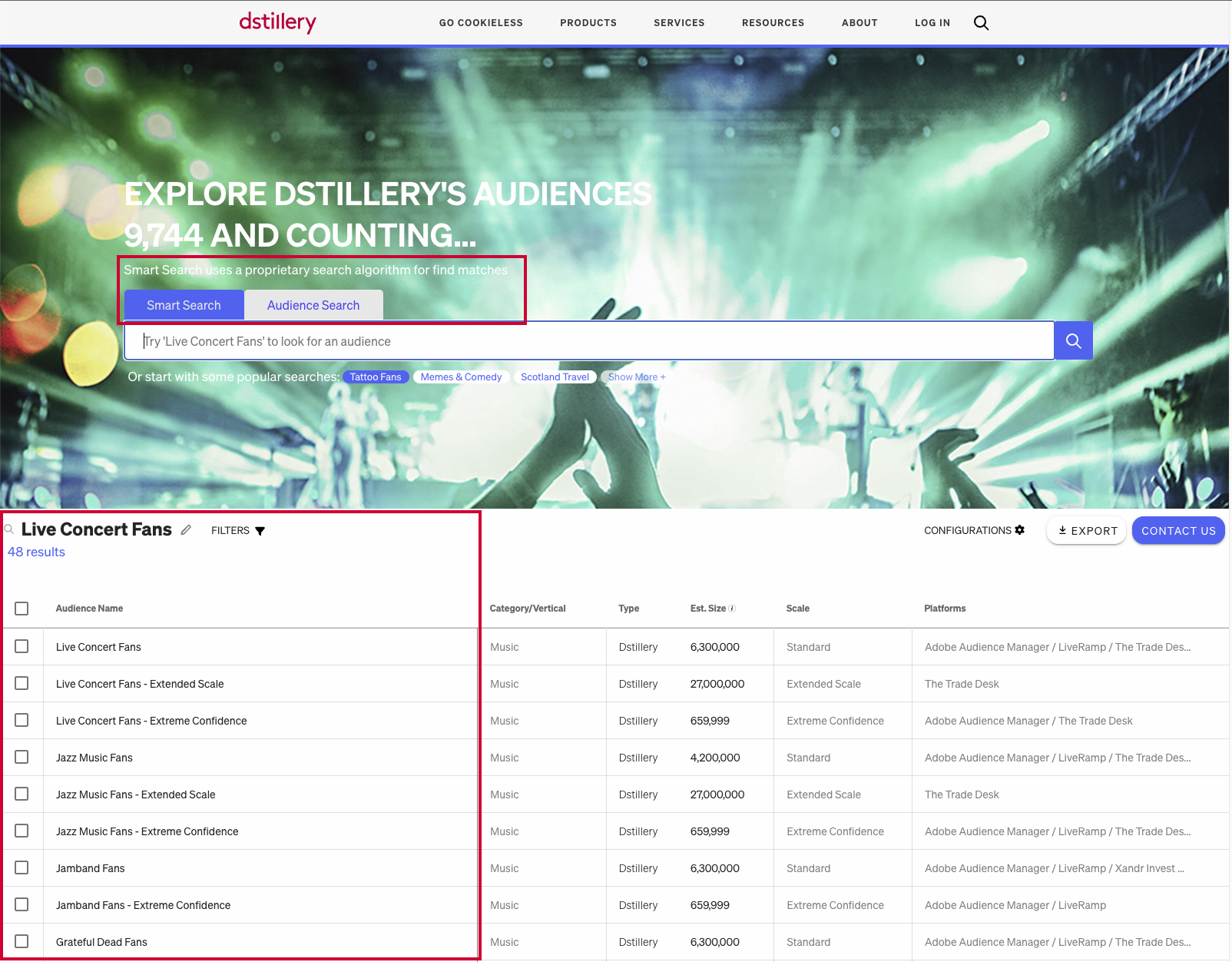
Audience Search & Smart Search – Initial Page Load

Audience Search & Smart Search – Results Loaded

image.png
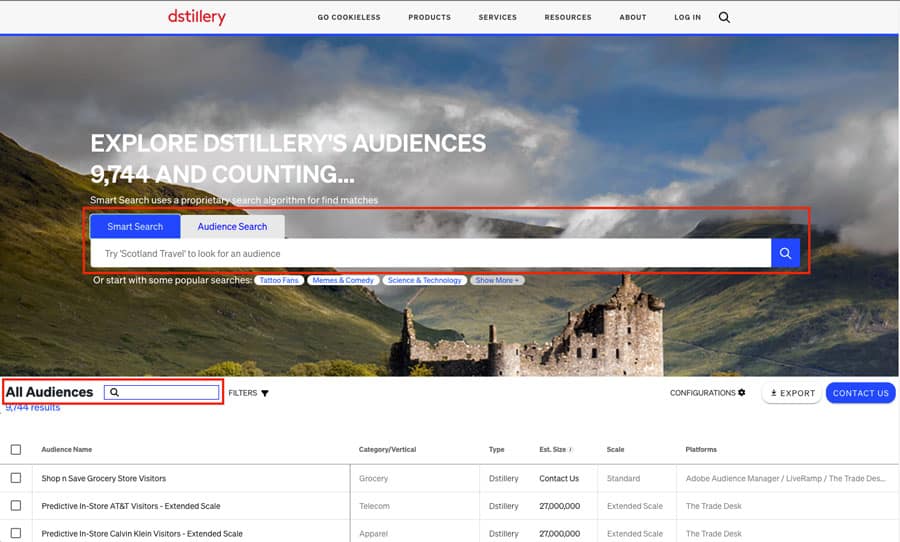
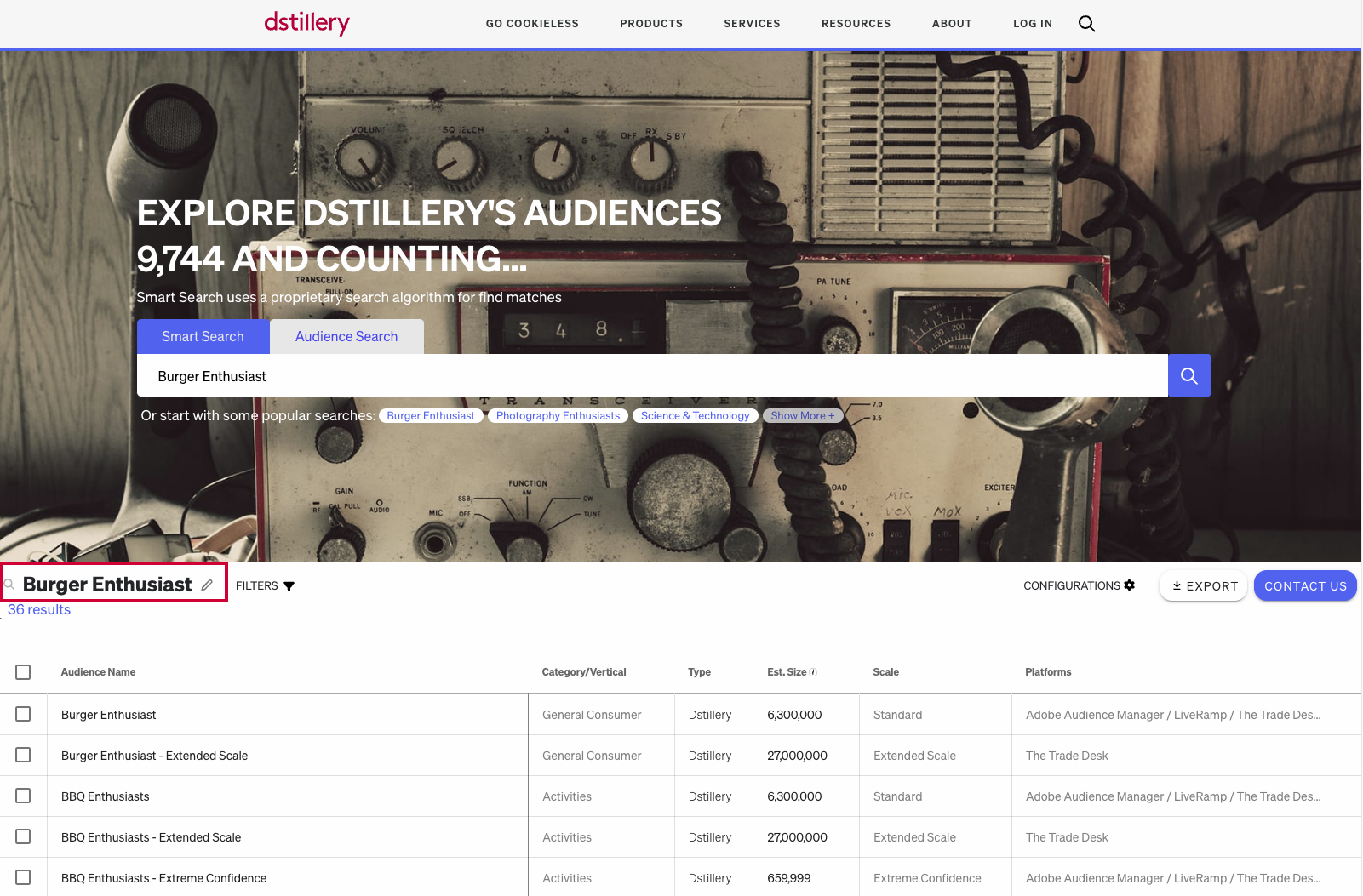
  1. In order to return results against our Audience library, users can input the search term using either search bars available on the page
  2. When the results are rendered, you should see your search term appear in the search bar directly above the results table
  3. By clicking into the “pencil” icon, you can edit or enter a new search term to search against
  4. There are also “Popular Search” term recommendations that you can use. These live under the search bar and, when clicked into, will generate those results automatically

Audience Search vs. Smart Search

Audience Search

Smart Search

image.png
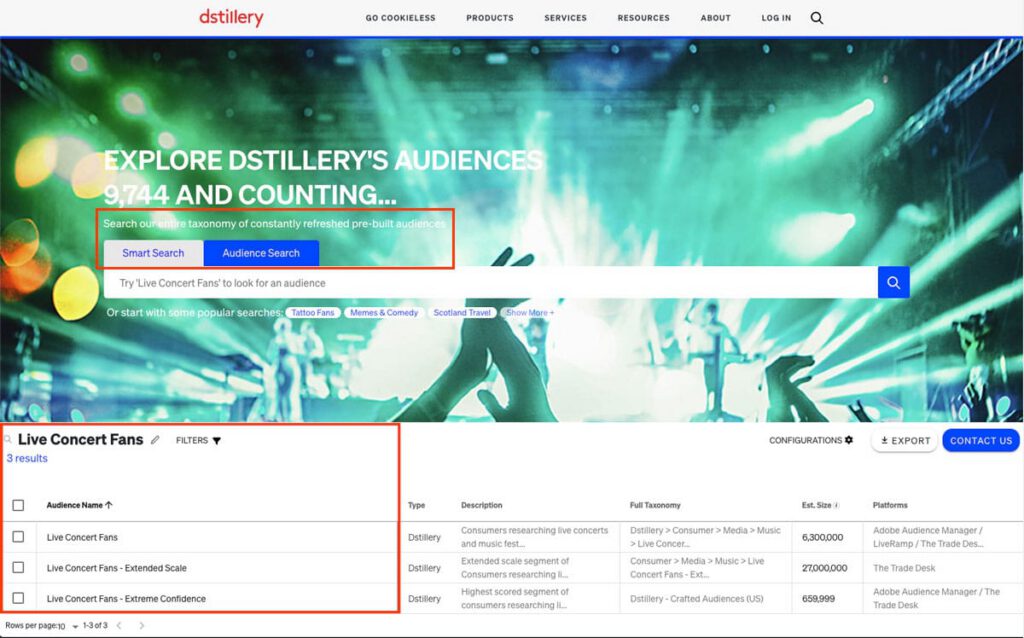
  1. Audience Search, also known as Exact Search, will generate results that contain the words you have included in your search term
  2. Smart Search leverages our patented technology to generate results that align closely with your search term
    • If you are looking to increase scale and are seeking audience recommendations that may not intuitively have been part of your curated blend, you should consider exploring the Smart Search feature

Export – Export All

image.png

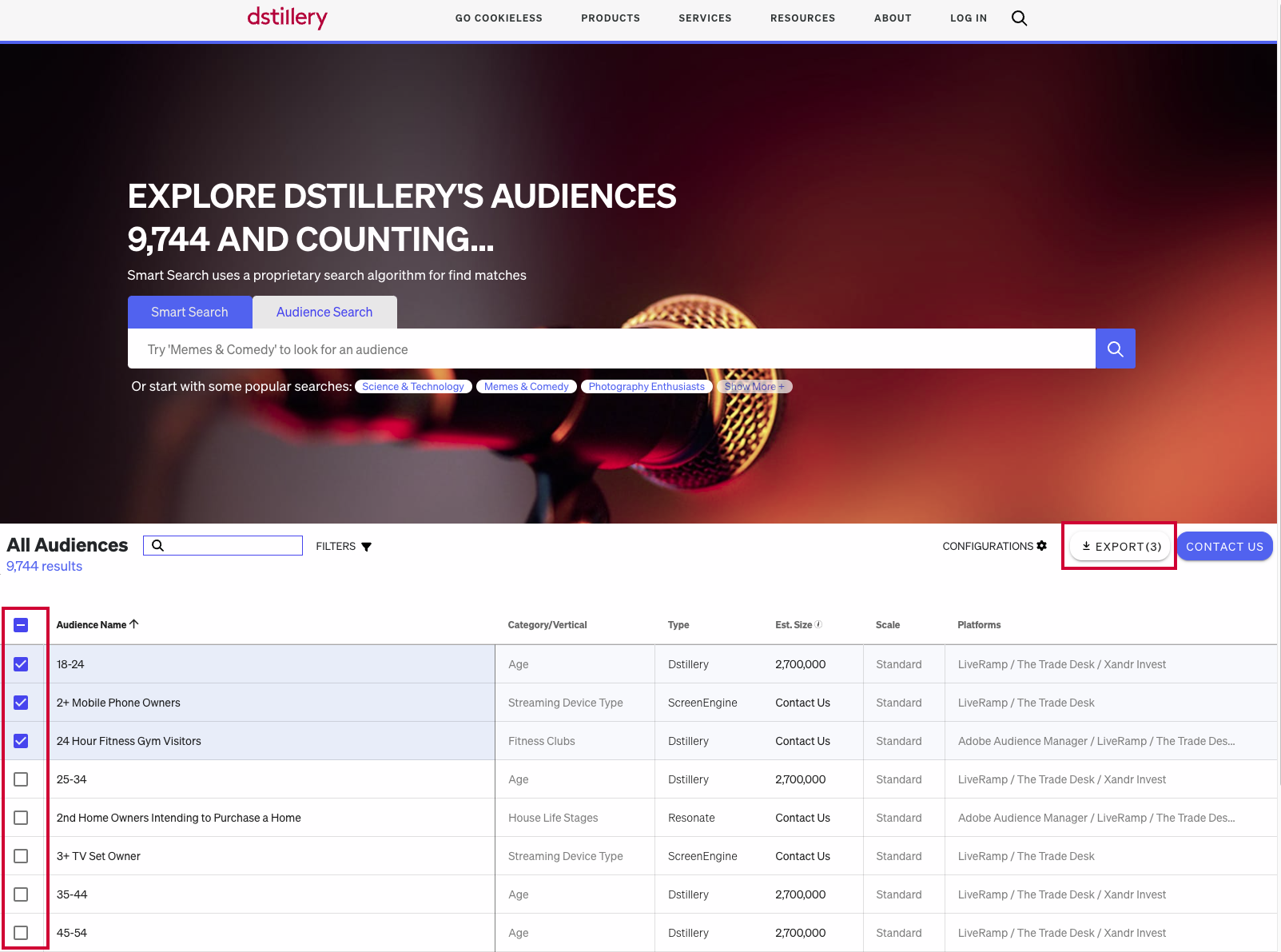
Export – Multi-Select

image.png

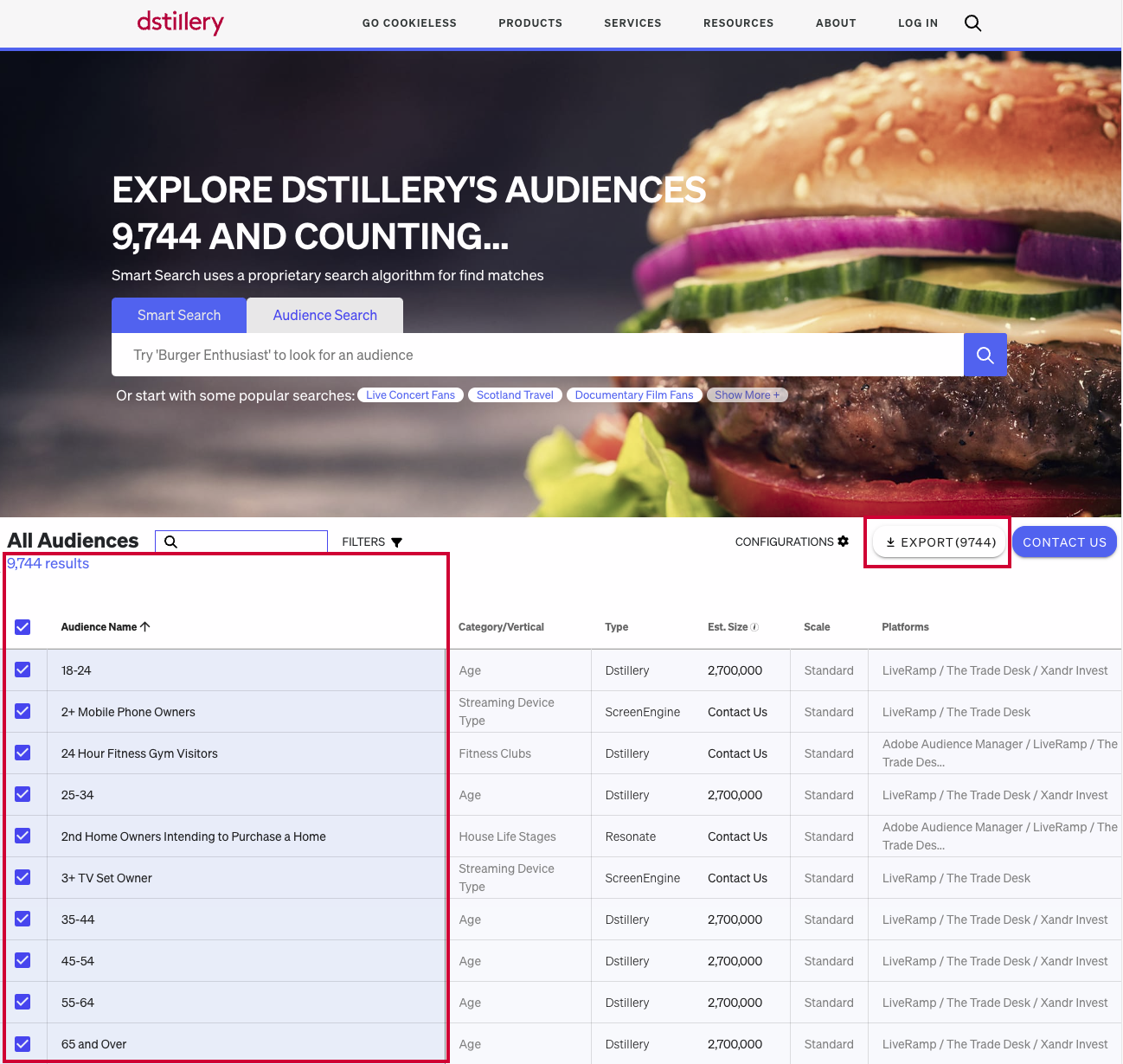
Previously users had to manually copy and paste results returned from the audiences.dstillery.com page and input it into a e-mail to share Audience recommendations. To simplify this process, we have updated the functionality of the page to allow users to export data against the desired audience selections.

The export will automatically land in a Dstillery branded template, so users will not have to drop the data into the template manually.

  • Export All
    • In order to “Export All,” users can click the top left checkbox to select all items. You should notice that a counter will appear next to “Export” and will reflect the total results returned. Click Export, and .CSV should be automatically downloaded.
  • Export Select Audiences
    • In order to Export specific audiences, you will need to click the relevant Audiences checkboxes individually. Once selected, the counter in the Export button will reflect the total selections. Once all desired audiences have been selected, click Export and a file will be automatically downloaded.
    • If no checkbox is selected (i.e select all or specific audiences), clicking export will not generate the output.
    • If a user selects audiences and then inputs a new search term and executes the search, the previously selected audiences will be unselected. We recommend that the user exports the selected audiences on the current search term before initiating another search.

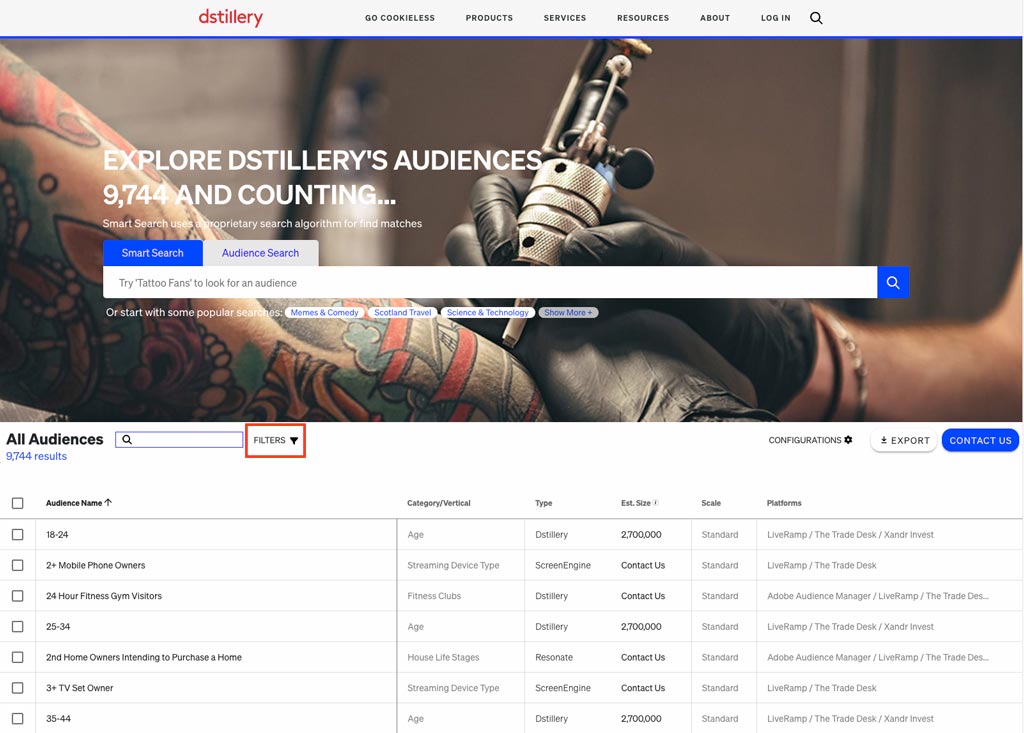
Filters – Initial

image-23

Filters – Selection

image-22-min

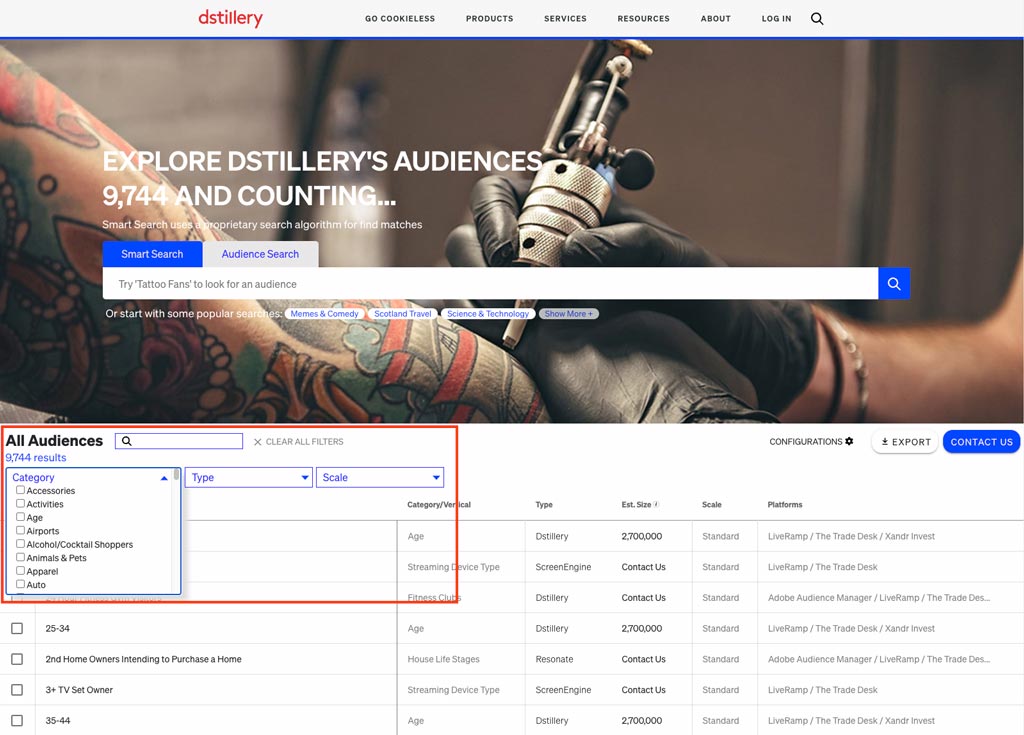
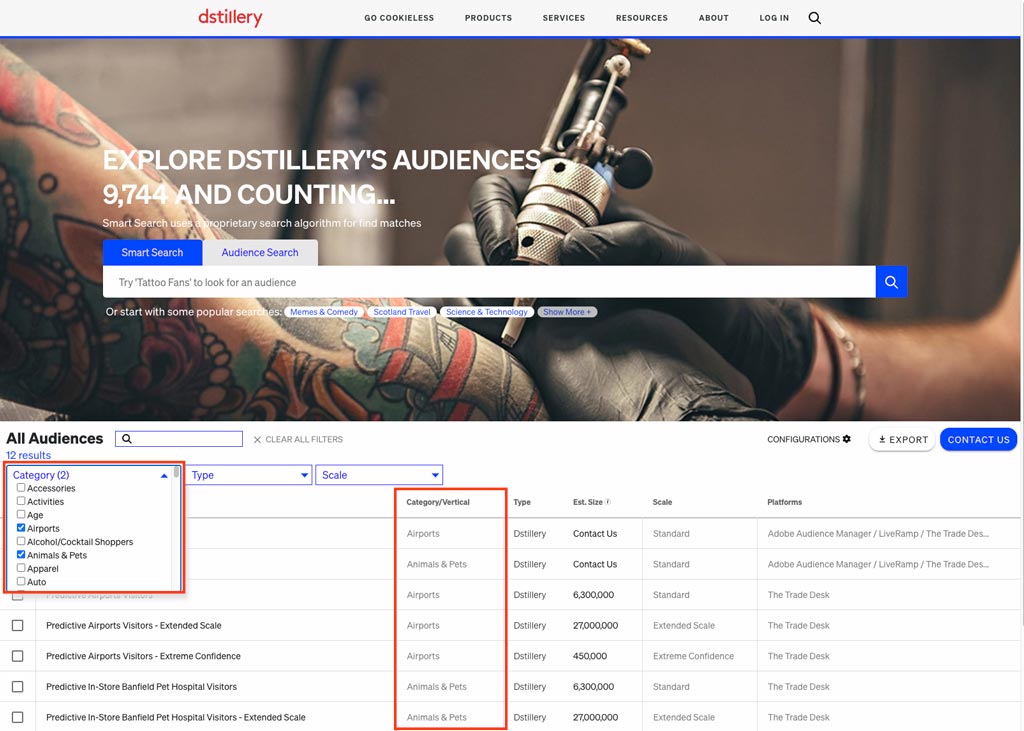
We have incorporated functionality that will allow users to filter search results within the UI based on the following columns: Category, Type and Scale.

  1. In order to use this feature, you can click the “Filters” icon, which will cause the 3 filter dropdowns to appear
  2. You can either single select or multi-select across any of the 3 dropdown lists in order to refine your search results to your liking
    • Note that clicking outside of the filter dropdown lists will collapse/close the filter drop down list
  3. Once your filters checkbox is selected, the filter will automatically update the table results accordingly
  4. You can either unselect the checkboxes or use the “Clear All Filters” button to reset your filter selections

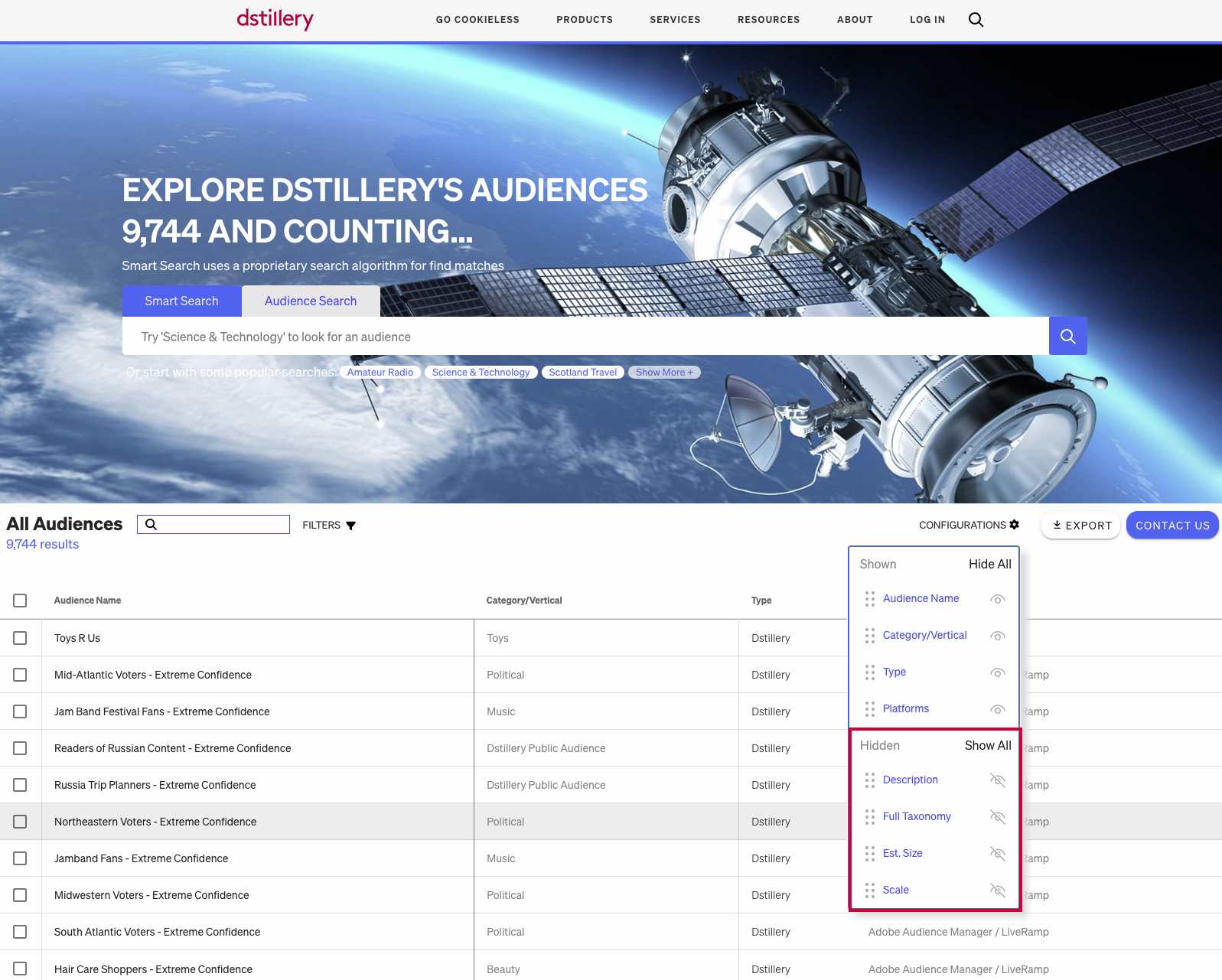
Configurations – Initial

image.png

Configurations – Shown

image.png

Configurations – Hidden

image.png

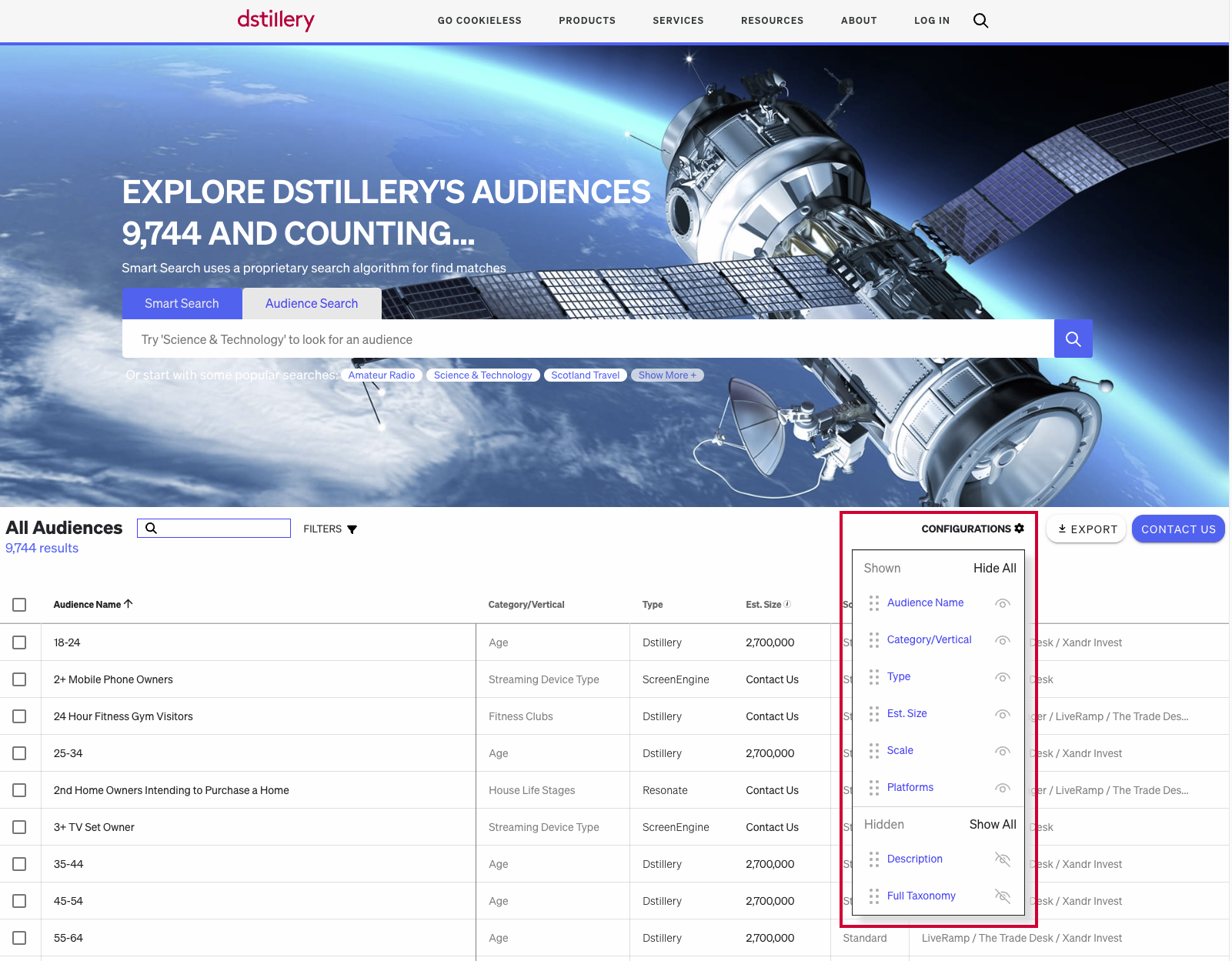
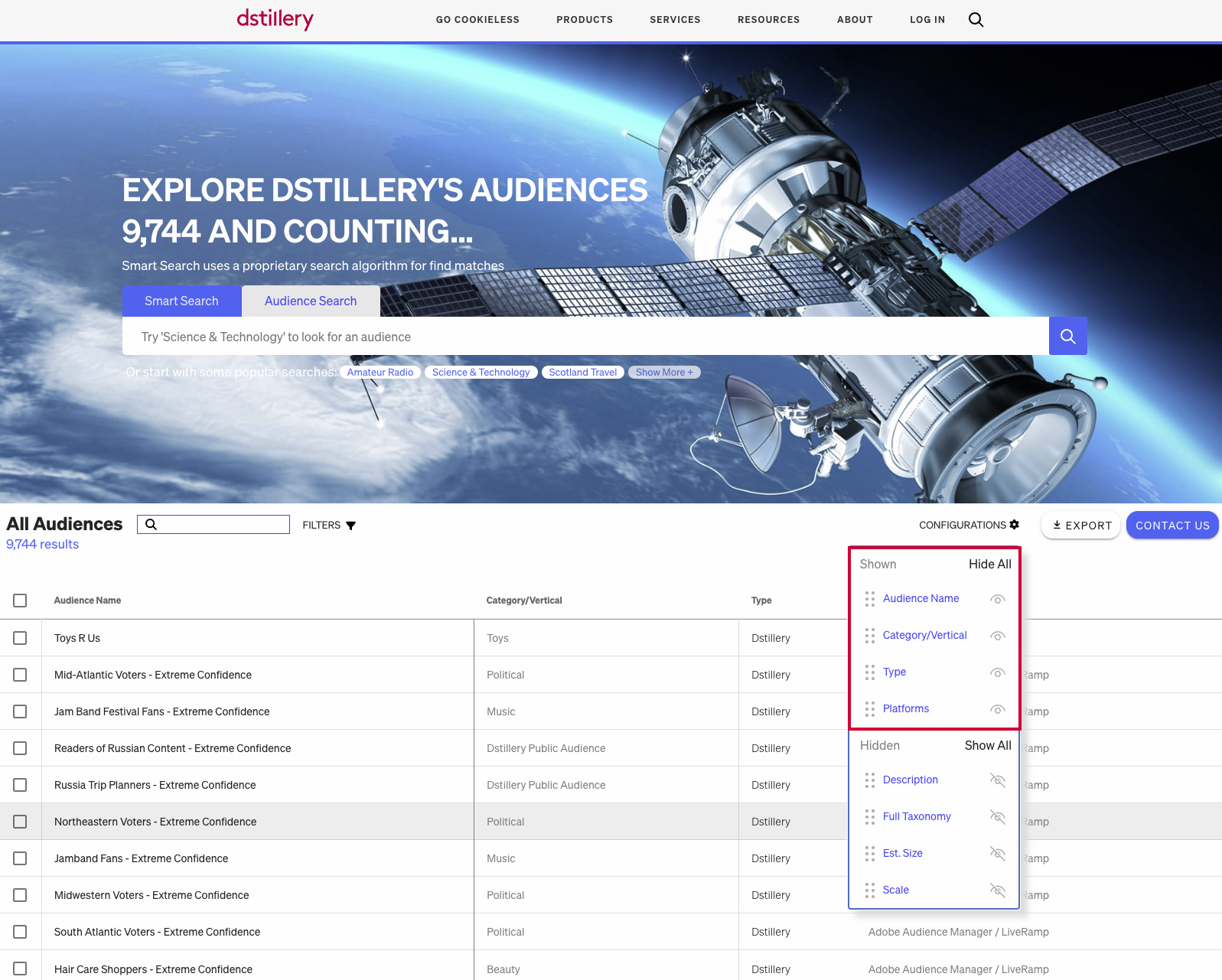
The configurations feature will allow users to select/deselect what columns will be available in the table so they can focus on the relevant fields for their view.

  1. You can click the “Configurations” icon, which will cause a dropdown inclusive of all possible column selections to appear
  2. To change the column order, you can click and drag the columns within the shown section accordingly (i.e select the icon to the left of the column name)
  3. The “Show All” button will include all columns within the view, while the “Hide All” will only include the “Audience Name” dimension in view.
  4. Note that the “Configurations” selection will impact the columns that appear in the export

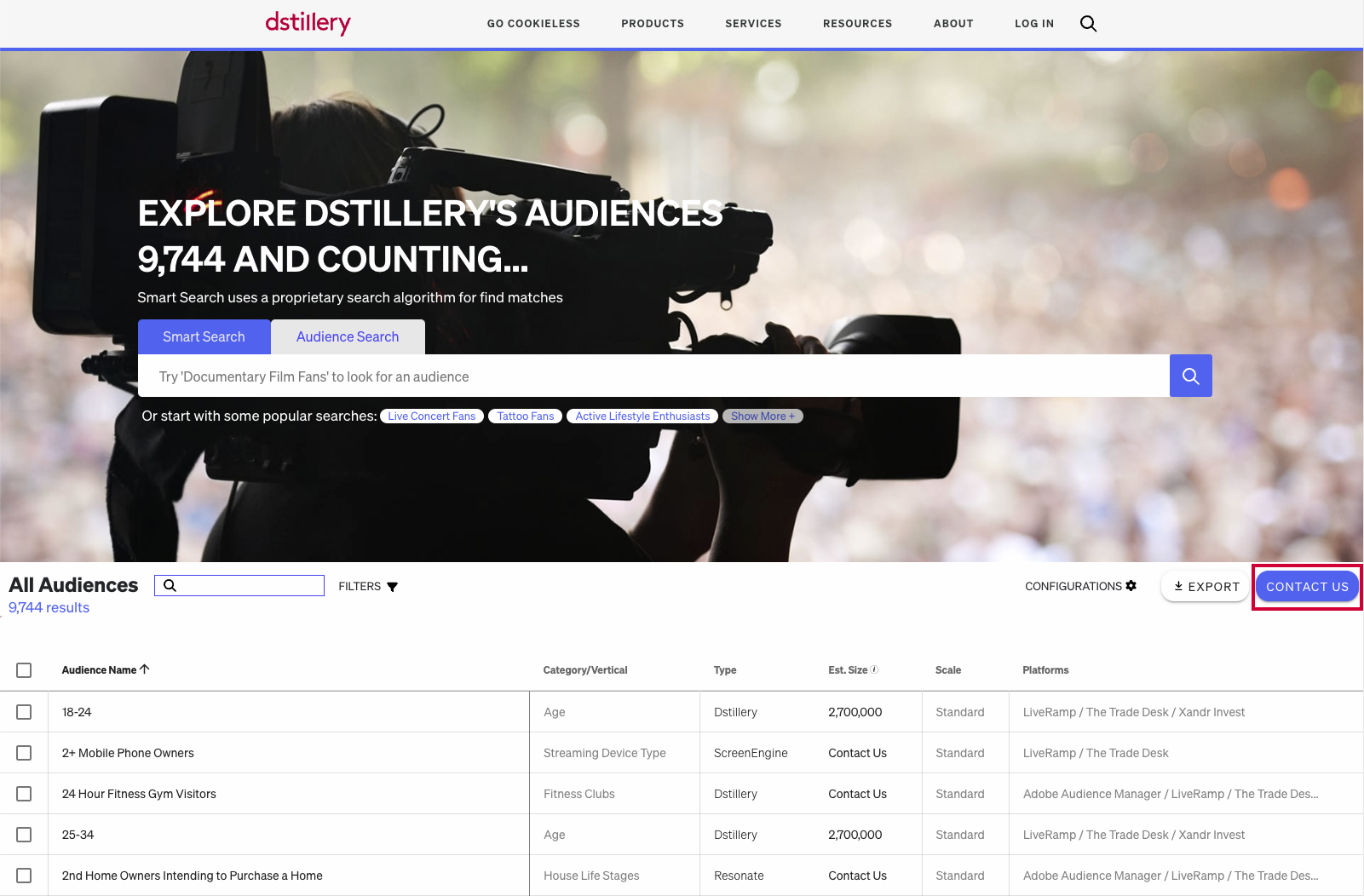
Contact Us

image.png

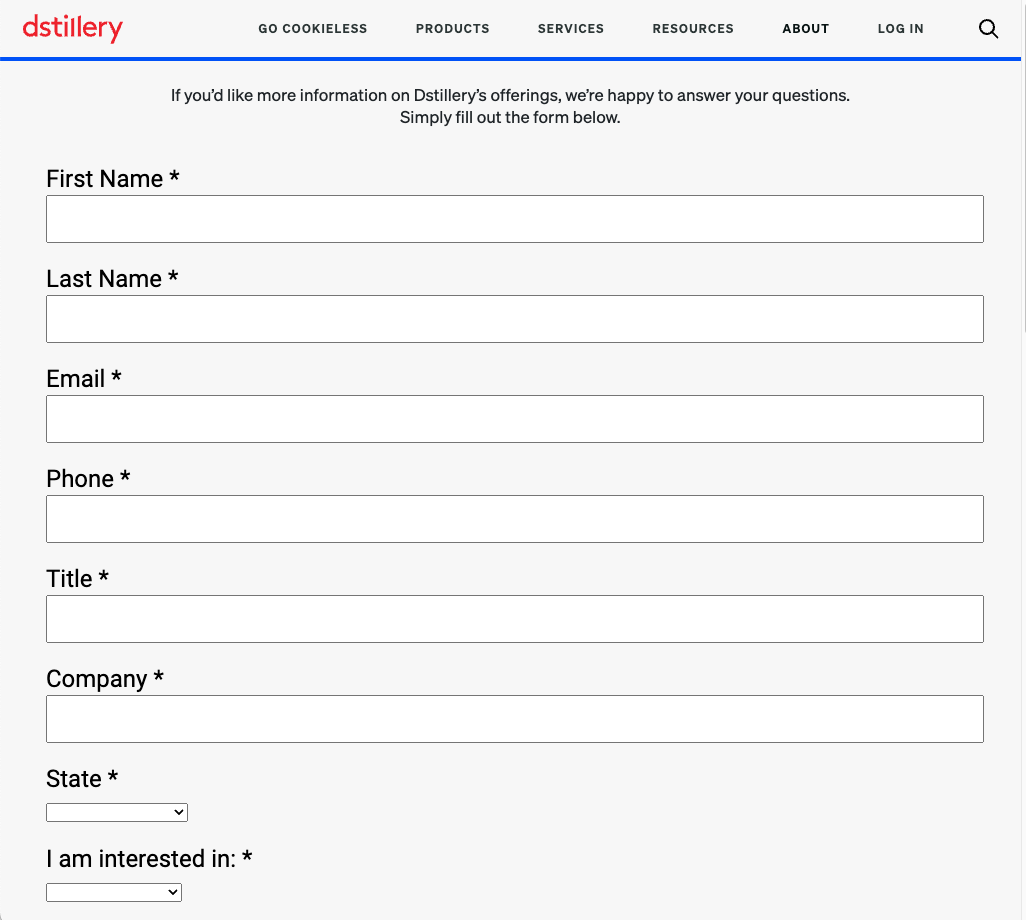
Contact Us – Form Page

image.png

For more information, reach out to Dstillery via the “Contact Us” button. This will link directly to dstillery.com/contact.


4. FAQ

  • How often does the data refresh?
    • Daily
  • What Browsers are supported?
    • Google Chrome, Safari, Mozilla Firefox and Microsoft Edge
  • Are Partnership Audiences available?
    • Yes, you can use the “Type” column to filter by the partners
  • Why don’t I see my Audiences reflected in the table?
    • The Audience Taxonomy Explorer will reflect all our Audiences in our system to date. If you noticed that a segment was available within a DSP but not available within the Explorer table, it is possible that our system is rendering a recent update. We recommend waiting 24 hours to see if the change has processed.
  • How come the estimated size here doesn’t look the same as the estimated size in my DSP?
    • The number shown on the page reflects the count of devices we expect to be associated to a particular segment. With DSPs all having different identify match rates with Dstillery, along with different cadences for audience refreshing and TTL (time-to-live), it is expected to see audiences sizes vary across different platforms. These audience sizes are directionally correct and can be used for campaign planning and estimating potentially scale.
  • Does the selected audiences Export” directly into the DSP?
    • The “Export” button will only export the selected audiences into a branded Dstillery excel file. This function is not integrated with DSPs
  • I selected audiences that wanted to export, but I noticed that when I performed another search, those selections were not included. What happened?
    • If a user has selected audiences and then inputs a new search term and executes a new search, the previously selected audiences will be unselected and will not be included in the export. We recommend that the user exports the selected audiences on the current search term before initiating another search
  • In case of any additional questions not covered in this FAQ, who should I contact for more information?
    • Please fill out the form on our Contact Us page, and we will get in touch with you shortly.

Cutting the adtech clutter: ID-free® is just that – free of IDs

ID-free®

This week, I’ve had an unusual amount of time to think about AdTech terms, as in “How clear is our industry?”, “If not clear, is that intentional?” and “Why such an overdose of relentless acronyms?”

With no shortage of alphabet soup in AdTech, it shouldn’t surprise anyone that our industry is often adrift in a sea of verbal confusion.  Imagine if each company in our grand Lumascape were to take the “Programmatic Oath.”  Much like Medicine’s Hippocratic Oath, we’d promise to uphold ethics, speak clearly, and define simple reasons behind our brand names (e.g., “Dstillery – the DS is for Data Science”).  We’d flat-out avoid the buzzwords.

The same standard should be upheld when distinguishing between two, three, or seven things that all sound like one.  Take, for example, the oft-used and seemingly benign term “platform”.  With DSPs, DMPs, SSPs, and CDPs, how does shortening to the word “platform” help get anyone’s point across?

And what’s all the industry buzz about ID-free?

Unless you’ve been living under a rock for a few years, ignoring the clamor for cookieless and ID-free ad targeting has been impossible.  The accelerating noise level won’t be put off by anything that Google does or doesn’t do, nor will any other industry titan “solve this” for our whole ecosystem. At Dstillery, we decided to take Privacy matters into our own virtual hands and boldly go where no other AdTech company has gone.  We invented a truly ID-free® technology that is now the only ad targeting tech of its kind on the market that’s truly without identifiers.  No alternate IDs, no ID-based probabilistic IDs, no bait-and-switch fingerprinting tactics.  And unlike contextual, we’re not reading words on a page.  Instead, Dstillery’s ID-free uses predictive behavioral signals to understand the best inventory moments on a given website.

Will the real ID-free please stand up?

You’re looking to cut through the clutter.  You’ve heard enough noise about whose solution is the “real ID-free”.  Now, we have something for you and you don’t have to just take our word for it.  That’s because at Dstillery, we’ve earned both a patent* for our tech and the registered trademark for our name.  Yes – The USPTO – unconfined by all the shackles and shortcomings of AdTech vernacular – has definitively decided that our ID-free is THE ID-free.  

Show me the Money.

If you’re a senior media professional in a programmatic agency, you and your Brand Marketer counterparts control your digital media budgets. Based on your campaign’s goals and your values on Privacy, you may be interested in finding an ID-free ad targeting solution that performs on par with the ID-based stuff.  And as such, you have choices.  We invite you to test drive our ID-free.  Compare it to ID-based.  Test both of ours together to gain 80% more reach.  Scour the market to find other ID-free wannabees.   

We think you’ll find that nearly one hundred of the Fortune 500 and a monthly average of 150 major media agencies can’t be wrong.  We’ve got something and we want to share it with many more of you.

*U.S. Pat. 11,068,935

A healthcare advertising solution unlike any other

healthcare advertising

When approaching healthcare advertising, there are many considerations an advertiser must navigate regarding data cleanliness and privacy. Advertisers face strict guidelines when targeting potential and current patients. The future is becoming more consumer privacy-focused as we march toward advertising in a cookieless world. At Dstillery, we find these changes exciting and fundamental to our core values as thinkers. So we approached the creation of our healthcare targeting solution, Custom Patient Targeting, with the current and future state of ad targeting in mind.

Custom Patient Targeting is fundamentally a product that satisfies two needs in the healthcare space – consumer privacy and intuitive, cookieless targeting that is based in AI learning, not contextual or behavioral targeting methods. Let’s dive into how Custom Patient Targeting utilizes data and how we build seed sets for clients that help them meet and exceed their campaign goals.

Dstillery’s Privacy-Forward Data 

When building Custom Patient Targeting, we focused on perfecting what we knew to be a meaningful industry-standard – data privacy. After vetting various partners, Dstillery exclusively partnered with PurpleLab, a leading real-world data (RWD) provider in the healthcare industry. PurpleLab has access to 40 billion medical and pharmacy claims capturing 350m+ patient lives and 98% of payer data. PurpleLab’s sources for claims data are derived from a network of 11 “Open Claims” sources. These are organizations involved in the generation, transmission, or processing of medical and pharmacy claims from providers to insurers. 

Dstillery has found that using search data from our opted-in panel has been truly predictive of patient definition. Using anonymous patients searching for specific drug names, symptoms, and co-morbidities in the largest search engines as seeds have been proven to provide strong performance. Combining this data with ICD-10 codes provides the most accurate definition of a patient for a majority of our customers. In parallel, we identify the anonymous devices that have searched for desired search terms and extract the top targeting features from the Search-only model. As a final step, we combine the best targeting feature from both models to create a single model.

A New Era of Healthcare Advertising & Targeting

The result is a privacy-safe, waste-reducing, cookieless healthcare targeting solution that can scale and transform to adapt to any campaign KPI. This blended data for your model ranks high in AQ, or audience quality, a key measurement in the healthcare targeting space. Dstillery uses the best possible data to guarantee the best possible results. Custom Patient Targeting is a breakthrough method for healthcare brands to reach the right patients. It provides a level of precision targeting that is unheard of in the industry, reducing campaign waste drastically. If you’re thinking about using Custom Patient Targeting, don’t think — do

Thanks to our unique approach that allows us to be more precise compared to modeled condition segments, Custom Patient Targeting is more effective at finding net new patients at a lower cost of media than all other healthcare targeting products today.

What is de-identified data and how can it benefit your business?

Marketers are constantly facing new challenges in reaching target audiences while adhering to strict data regulations, especially as more and more consumers opt out of cookies. De-identified data offers a powerful solution, allowing marketers to collect and analyze valuable insights while protecting consumer privacy. By removing personal identifiers, like names and contact information, businesses can still create personalized campaigns and improve marketing strategies while staying compliant with laws like GDPR and CCPA.

Dstillery is leading the way with our ID-free® targeting technology, which helps marketers reach their audience without using personal data or cookies. Instead, ID-free uses advanced AI technology to create accurate audience targeting that respects privacy.

Here, we’ll explore de-identified data, how it’s generated, and how it can enhance your marketing efforts while building consumer trust.

What is De-Identified Data?

De-identified data is information that has been processed to remove personal identifiers, such as names, addresses, or social security numbers. This ensures that individuals cannot be readily identified from the dataset. By transforming sensitive data into an anonymous format, businesses can maintain privacy while leveraging valuable insights for decision-making and analysis.

For marketers and advertisers, de-identified data provides a way to understand audience behavior, preferences, and trends without compromising consumer privacy. This approach not only ensures compliance with data protection regulations but also helps build trust with consumers who are increasingly concerned about how their data is used.

To learn more about how de-identified data fits into cookieless advertising, check out our FAQ on ID-free targeting

Why Is De-Identification Important?

Data de-identification is critical for protecting consumer privacy. By safeguarding sensitive information, organizations can mitigate the risks associated with data breaches, unauthorized access, or misuse of personal data. This protection is essential for maintaining regulatory compliance under frameworks like GDPR, CCPA, and HIPAA.

Benefits of Using De-Identified Data in Marketing

Using de-identified data for your advertising efforts offers numerous benefits, including:

  • Enhanced Privacy Compliance: Avoid potential fines or penalties by adhering to privacy regulations
  • Improved Consumer Trust: Show customers that you prioritize their privacy by using de-identified data responsibly
  • Accurate Insights: Access detailed audience reports and behavioral insights without compromising personal identifiers
  • Scalable Solutions: Implement strategies that work across regions and industries without the need for personal data

De-identified data reports can help businesses refine their marketing strategies while maintaining the integrity of consumer privacy. Discover how Dstillery’s ID-free technology leverages these benefits to improve targeting precision in a privacy-first world. 

How Dstillery Uses De-Identified Data

Our patented ID-free targeting solution is a prime example of how de-identified data can be used effectively in marketing. By leveraging advanced AI algorithms, we create audience insights and precision targeting without relying on personal identifiers or cookies. This approach allows digital advertisers and marketers to:

  • Reach their ideal audience with confidence and without cookies
  • Deliver personalized campaigns that respect consumer privacy
  • Access de-identified data reports that offer actionable insights

Our commitment to privacy and innovation sets us apart in the advertising industry. Learn more about how ID-free targeting can enhance your advertising strategy.

Driving Success 

De-identified data is a vital tool for businesses looking to thrive in a privacy-first, cookieless advertising ecosystem. By understanding what de-identified data is and how to use it effectively, you can enhance your marketing efforts, build consumer trust, and ensure regulatory compliance.

Ready to transform your advertising strategy with privacy-safe solutions? Let’s connect.