testTag: cookieless

FAQ: ID-free®

Explore how Dstillery’s ID-free® targeting, an AI-powered technology that predicts ad impressions without user tracking, can enhance your programmatic campaigns in our frequently asked questions.

What is Dstillery’s ID-free® targeting?

ID-free is an AI-powered targeting technology that predicts the best ad impressions for a brand without any user tracking.

What problems does ID-free solve?

ID-free delivers performance and scale for advertisers’ programmatic campaigns. It also solves user privacy issues by not tracking users or creating user profiles. This makes ID-free a perfect solution for cookie deprecation and any privacy laws or regulations, including GDPR.

What are the use cases for ID-free?

ID-free is proven to drive both performance and scale. It can be modeled and optimized across the marketing funnel for most key performance indicators (KPIs), but it is most commonly used for upper-funnel campaigns driving qualified reach. By adding predictive bidding on The Trade Desk, it can also deliver up to 2.5x the performance of cookies for mid- and lower-funnel campaigns (more on this below).

What makes ID-free different from competitors’ solutions?

ID-free solves problems like performance, scale, and privacy for advertisers today. It’s not contextual nor an alternative ID; it’s patented technology in a category of its own.

ID-free uses AI to learn privacy-safe browsing patterns and applies these insights to inventory targeting. Think of it like this: ChatGPT understands words based on their use in a sentence. Similarly, ID-free understands website visits based on how they appear in browsing patterns. The result is privacy-safe behavioral targeting that reaches any display, in-app, or CTV ad impression with or without IDs.

How can I activate ID-free?

Partnering with Dstillery lets you choose the best ID-free activation method for your brand.

Activate via:

PMP directly on your DSP.

Predictive Bidding supported by The Trade Desk. Rather than making binary ‘buy’ or ‘don’t buy’ decisions, our AI predicts the precise value of each impression to your brand and exactly how much you should pay for it, maximizing every ad dollar.

Contextual Integration found in The Trade Desk’s contextual marketplace.

How do I get started?

You can buy off-the-shelf ID-free audiences today on your DSP. If you’re looking for a custom, first-party data-powered ID-free audience, contact your Dstillery representative today or click here to get in touch.

Ready for a Cookieless Future? Check Out Our ID-free® Testing Guide

With cookie deprecation and cookieless testing top-of-mind for many media buyers, here is a quick overview of the best ways to set up and test Dstillery’s ID-free®, the only behavioral targeting solution without IDs. 

ID-free is a first-of-its-kind targeting technology that delivers performance, privacy, and scale by predicting the value of an impression to a brand without knowing anything about the user. This patented technology uses AI to learn from browsing patterns detected in de-identified opt-in panel data, ultimately answering the question: When someone visits a site, how likely will they be interested in your brand’s message?

Audience Definition

The first step is defining your target audience in your display, search, or CTV campaign. If you have used an ID-based Dstillery audience in the past and found it successful, you can simply request an ID-free version of the audience. If you haven’t, you can use a variety of signals such as first-party data, search terms, URL lists, or our catalog of thousands of pre-built audiences to seed your ID-free model.  

Campaign Setup

One of the most common pitfalls we see with testing is not allocating enough budget and time to allow the model to perform and optimize. We recommend three months for a proper cookieless test to truly understand how the audience performs against your KPIs. Beyond awareness metrics, ID-free excels in cost-per metrics such as:

  • Cost per action (CPA)
  • Cost per click (CPC)
  • Cost per complete view (CPCV)
  • Cost per site visit (CPSV)
  • Return on ad spend (ROAS)

In terms of budget, we recommend a $30,000 monthly budget in media – split out evenly between ID-free and ID-based versions of your audience – without highly restrictive inclusion lists and operating all hours of the day. These campaign parameters will allow you to truly understand and optimize your ID-free campaign with the most information available throughout the testing period.

Make the Most of Your ID-free Test

Our experienced Client Success teams can help you through all the details of creating a proper A/B testing framework. Beyond campaign parameters, to properly assess ID-free performance, efficiency, and scale, we recommend an A/B testing approach by running both ID-based and ID-free audiences in parallel. We recommend creating one line item for your ID-based audience and one for your ID-free audience. When creating these line items, try duplicating them rather than creating them from scratch. This ensures that various settings in your line items are identical, except for the singular variable (ID-based vs ID-free audience) you are testing. Also, since our industry still uses third-party cookies for attribution KPIs, we recommend targeting trackable Chrome inventory for both line items. 

Bonus Test to Assess Performance Outside of 3rd Party Cookies

Using conversions measured on trackable inventory, Dstillery can model the conversion rate per site across all domains specific to the campaign. Using this data, we can understand the performance of impressions delivered on inventory with no trackable identifiers. To learn more about this measurement, read our case study with Tombras, where we drove 2.5x more conversions than traditional cookie-based targeting.

Ready to test ID-free? Amazing. It’s available on every DSP. Contact one of our representatives to get started today.

FAQ: Deal IDs

A brief inquiry into the newest way to activate Dstillery audiences.

1. What is a Deal ID?

A Deal ID is a packaging of ad-supported inventory that allows buyers access to unique or specialized inventory.  This can take many forms such as private deals, programmatic guarantees, or open deals. Publishers or supply side players can identify relevant opportunities and apply a unique deal ID on top of the impression opportunity. Buyers then implement these IDs within the targeting items in the DSP and will only buy against impressions that have the Deal ID present on the bid request.

2. Is the bidding process different than the current ID-free process?

We use the same bidding algorithm process that we apply within the DSP but instead of decisioning on each bid request that gets received, it works higher up the chain at the supply side to make the same evaluations and will only apply a Deal ID to the most desired impressions.

3. Who does Dstillery leverage for Deal IDs?

Currently, we are leveraging the Microsoft Curate supply exchange to create our ID-free Deal IDs.

4. Can the Deal IDs only be used on Microsoft Curate?

While these are created using the Microsoft Curate supply exchange, the Deals can be activated on any leading DSP.

5. Is a Deal ID the same as a Private Marketplace (PMP)?

A PMP and a Deal ID are not exactly the same thing.  A PMP is a package of usually premium direct sold inventory set up privately for a buyer.  PMPs leverage Deal IDs as the mechanism for a DSP to identify and buy against a specific PMP on behalf of the PMP buyer.  Only the buyer who works with the PMP creator will have access to the Deal ID to input into their platform.

6. What formats/environments are supported?

Deals can be created for Display, Video, and Native. Each format would have its own set of deals.

7. Will this change how Dstillery customers interact with the ID-free audience?

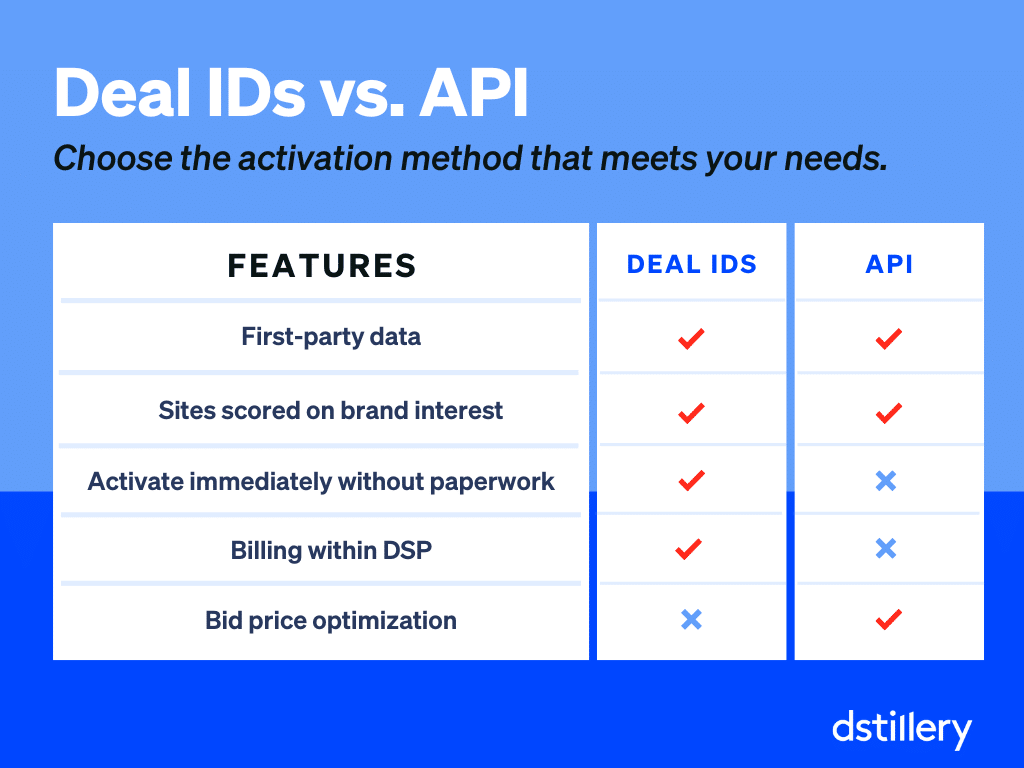
Yes. With a direct API integration, the client sends Dstillery ad group/line item IDs.  We then take those IDs and place domain, time, dma targeting to the separate targeting sections on their behalf.  With Deal IDs, we will create the model and associated Deal IDs which we will then send to the client.  They will then target these Deal IDs themselves within the platform in the way that they are used to with other types of PMPs/Deal IDs.

Deal ID vs. API - Comparison Chart

8. What types of audiences can deals be created for?

Deals aren’t restricted so the same audiences can be built as with standard ID-free via API. Custom AI, Pre-built, Custom-built can all be turned into Deals.

9. How many Deal IDs are created per audience?

Custom AI will be 8 deals which can be targeted together or separately within the DSP and Prebuilt audiences will have 1.

10. How do I get started?

To learn more, please reach out to your Account Executive or email contact@dstillery.com.

How Brand Identity Is Measured in a Cookieless Future

As marketers everywhere heard the news that Google was sunsetting third-party cookies in late 2023, we asked ourselves, “How will we measure attribution in a cookieless future?”

Historically, marketing value has been tough to track. The advent of cookies and behavioral signals finally gave the industry a firm way to measure message impact and attributed success across multiple channels. Cookies have allowed marketers to personalize user experiences, recommend products, and increase sales, but a global emphasis on privacy and security means behavioral tracking as we know it is changing.

Removing Cookies Affects a Majority of Internet Users

The majority of internet users are on Chrome — 68.1% on desktop and 61.5% on mobile. This is why Google’s decision to double down on user privacy was met with panic across ad tech. However, Tech giants like Apple and Facebook (or Meta) are also strengthening the walls around their user data. This offers marketers a true glimpse into a very private future internet landscape. Meta even provides a specific glimpse into its privacy progress report in a constantly updated platform.

Cookies allow brands to track at scale, while historical measurement tools inherently offer smaller, user-based audiences. The end of widespread, third-party tracking lets brands realign with their traditional positioning and value.

Establishing Brand Positioning and Value in a Cookieless Future

For years, marketers have relied on third-party cookie data to tell them who their audience is — from ages to locations. Gone were the days of focus groups, one on one interviews, and benchmark studies. Suddenly, we had more data at our fingertips than we ever could have dreamed of.

As Al Ries and Jack Trout’s classic marketing text Positioning, the Battle for your Mind explains, brand positioning is the place it occupies in the prospect’s mind. With the retirement of cookies, it begs the question: Did we ever need all of this data to tell us who our customers are? Is it sufficient and even more authentic to simply know audience size and that the product is loved? Can we not simply build brand positioning as we once did?

The Future of Attribution in a More Private World

Looking to a cookieless future, experts encourage a shift to a wider range of data sources and technology to discover consumer interests and maintain cost-effectiveness, according to Marketing Week.

Dstillery’s ID-free Custom AI™️ solution is designed to do just that. With our privacy-by-design behavioral targeting solution, the sunset of cookies becomes less frightening and more of an opportunity to innovate.

As marketers are challenged over the next few years to shift their attribution models, we’ll all be challenged to polish up KPIs and brand measurement standards. We must continue revamping our strategies for a privacy-centric world.

FAQ: Custom Patient Targeting

A new cookieless way to reach your patients, powered by Dstillery’s ID-free technology.

1. What is Custom Patient Targeting?

Custom Patient Targeting is a new privacy-safe patient targeting solution designed for healthcare brands. It offers the precision and customization you need to drive your best patient outcomes. It doesn’t rely on user-based targeting, ensuring compliance with all laws, policies, and guidelines from HIPAA, NAI and DSPs. Using AI-powered predictive modeling, we build a just-for-your-condition targeting model that bids on individual impressions based on aggregated patient behavior.

2. How is it precise?

Every single potential impression ad-supported internet is scored and ranked based on its likelihood of targeting your desired patient. This level of granular targeting is unheard of in healthcare.

3. How is it custom?

Custom Patient Targeting starts with your desired seed dataset, enriches it with our AI-powered understanding of every website on the internet, and creates a model tailored to your specific condition and your patient outcome goals.

4. How is it compliant?

Because Custom Patient Targeting doesn’t rely on user-based targeting, we can ensure compliance with all laws, policies, and guidelines.

5. What seed data can I use?

We recommend seeding with your brand’s first-party data for the most precise results. This can be data from your brand’s web pages or segments from a data management platform. If that’s unavailable, we recommend using your brand’s keywords, including product names, symptoms, and co-morbidities. We are in active discussions with leading healthcare data providers to use their real-world evidence (RWE) datasets, allowing brands to use ICD-10 codes to seed models.

6. How do you collect health data?

Our core dataset consists of healthcare-specific websites and keywords from opted-in devices. When combined with non-healthcare-specific event-level data, we find that these signals allow us to more fully see patients’ journeys, resulting in more accurate and robust models. We are in active discussions with leading RWE data providers rooted in payer and claims data to enhance the models. We will work with beta partners to test these incremental datasets in Q2-Q3 2022.

7. How do you target in a HIPPA-compliant way?

Dstillery’s healthcare targeting methodology doesn’t involve the creation of any health-related profiles. It uses a built-in de-identification to ensure that the data isn’t considered Protected Health Information under HIPAA. It also meets the requirements of the NAI sensitive data guidance by utilizing data minimization techniques that minimize the risk of inadvertently identifying a data subject.

8. How are you able to understand the patient journey without user tracking?

Custom Patient Targeting is powered by AI that identifies and learns the patterns of how, when, and from where anonymous opt-in devices browse the web. These behavioral patterns help the AI predict how anonymous patients browse the web.

9. What is the Map of the Internet?

The Map of the Internet (MOTI) is built by a type of AI called a neural network. It constantly analyzes hundreds of millions of anonymous digital journey patterns and learns the behavioral signals underlying any web visit to build the map. It then takes your seed and extends the patterns detected to all websites. The output is a model that scores and ranks every potential impression on the ad-supported internet and predicts the best patient impressions for your condition.

10. How is it different from contextual, condition, endemic, and traditional behavioral targeting?

Custom Patient Targeting is categorized as predictive behavioral targeting, not any of the following.

  • Contextual: Contextual scrapes words on web pages in an attempt to infer patient behavior. Custom Patient Targeting doesn’t rely solely on keywords (although they can be a helpful dataset). Instead, it predicts patient behavior with AI.
  • Condition: Condition targeting reaches broad demographic groups assumed to be indicative of certain conditions, targeting 10% of the population or more. Custom Patient Targeting can be seeded with demographics, but precisely targets patients based on behavior, not demographics.
  • Endemic: Endemic targeting reaches patients on healthcare-related websites only, while Custom Patient Targeting reaches patients at scale across the entire ad-supported internet.
  • Traditional Behavioral: Traditional behavioral uses third-party cookies to track users. In contrast, Custom Patient Targeting analyzes behavioral signals from millions of anonymous digital journeys to predict the impressions most likely to be your patient without user tracking.

11. Is this affected by cookie deprecation?

Because Custom Patient Targeting doesn’t rely on user tracking, like third-party cookies, it isn’t affected by cookie deprecation.

12. How is it priced?

We’ve priced Custom Patient Targeting to be on par with or less than traditional cookie-based behavioral targeting products. It’s priced at 20% of media, so if you’re clearing $2.00 inventory, it will be about a $0.40 eCPM.

13. How do I get started?

  • Sign targeting agreements
  • Provide targeting API access
  • Select seeds and outcomes
  • Dstillery builds and deploys custom model to campaign

To learn more, please reach out to contact@dstillery.com.

5 Steps To Prepare Now for the Cookieless Future

The 5 steps are each preceded by a question.

“Great results begin with great questions.”*

In a recent Gartner article, How the CMO Role Has Evolved – and What’s Next, VP Analyst Chris Ross refers to the role as having “undergone a head-spinning transformation over the last decade.”  In the next 5 years, Ross contends, the CMO role will become even more challenging with expectations for supporting the scope, speed, and complexity the business requires… with the need to “measure and optimize everything they do.”  

Add a global pandemic to the equation and the stakes get even higher. In the 2021 Forbes article, 4 Ways the Role of the CMO Has Changed As a Result of the Pandemic, author Greg Salmon contends that CMOs need to “address the fact that we face uncertainties and volatilities as never before.” So where do CMOs turn for advice, future planning insights, and flat-out answers? If there’s one thing that hasn’t changed, it’s where an agency can add its greatest value: Solving problems beyond a brand’s in-house capabilities or expertise.

Enter the Challenge of The Cookieless Future.

Few agencies would offer that they have “the answer.” Meanwhile, marketers, at all levels, readily admit that they need those answers to run successful campaigns in the future.  A future that’s rapidly approaching.  It’s not an overstatement to suggest that addressing the cookieless future, ahead of third-party cookie deprecation, is essential to capturing growth.

IAB’s Internet Advertising Revenue Report, issued earlier this week, shows programmatic advertising growing at 39% YoY, with its share of total digital revenue increasing 52.3%.  Outside of media, the ad agency business would be hard-pressed to identify another direct-path-to-growth that exceeds that trajectory. But what happens when data-driven digital advertising faces a dearth of the very data it has come to rely upon for decades?

The 5 questions CMOs should be asking their agency partners.

CMOs, Heads of Marketing, and any marketer responsible for their brand’s growth should be asking these 5 questions, to prepare for the cookieless future:

  1. To understand changes in data privacy: What’s happening, when, and how will it affect my campaigns?
  2. Data Partners offer options: Are we confident we have the right partners to deliver optimal audiences?
  3. Planning Strategy: What near- and long-term media strategies do you recommend?
  4. Testing Now: What plans are in place to test cookieless solutions now?
  5. Measurement: How are we monitoring performance and measuring successful results, comparing to cookie-based campaigns?

In our own Dstillery ID-free research**, the findings suggest a not-so-surprising range of concerns. What IS surprising is that for every concern that marketing leaders and agency media professionals cite, the solution is merely to develop a preliminary plan and begin testing. Consider how a team approach, where CMOs and their marketing teams work with their programmatic agency partners to plan and run cookieless tests, would address our clients’ key issues:

A. “I don’t have a plan”
B. “Unsure how cookieless works”
C. “Worried about measurement”

CMOs and any marketer embracing their role in driving growth, have not only the right, but arguably, the responsibility to test and share learning with their organizations.  

If you’d like to learn more, visit: dstillery.com/go-cookieless

*Marilee Adams Ph.D., President and CEO of the Inquiry Institute, Originator of the QUESTION THINKING™ methodologies
**Source: Research conducted by Dstillery via Linkedin Polls, Dstillery Digest and 1:1 customer interviews, October 2021- April 2022 

Weaving Dstillery’s Data Fabric for the World of Healthcare

If there’s one thing we know about a new year it is that people have a renewed focus on their health and personal fitness. After dealing with the past two and a half years of the pandemic, healthcare has become an even greater if not the most important focus in our lives. From personal fitness goals to chronic illness, the world of healthcare is vast and frankly, dense, for marketers on internal and agency teams to crack.

The trick, however, is to understand who you want to reach and how to get them. Doing so requires key data insights around behavior, consumer spending habits, and demographics and the way that they all coalesce into your target demographic. What’s fascinating from the Dstillery side is how much our healthcare audiences have grown and changed over the course of the pandemic and how new pockets of overlaps and intenders have emerged.

In addition to making pre-pandemic healthcare assumptions, marketers must open their minds to healthcare’s newer audiences and the ways they overlap with other consumer segments such as fitness and mental health, along with industry mainstays such as chronic illness and medical procedure research. This means looking at more data over a wider array of topics and data points to drive interest and return on investment. Luckily for those in healthcare, the data is out there and it is plentiful.

Choosing Your Targets

If one industry is tried and true with its audiences, it’s healthcare. People all follow the same arc, they’re little, they grow, and they grow, and they grow, and suddenly they’re old. Within all of that growth, they’re getting sick, recovering, developing new health conditions, and making lifestyle changes to increase the longevity of their lives. The life story has a ton of component pieces that Dstillery has taken and parsed out into tons of pre-built audiences that can be utilized for marketing campaigns. Considering the three main stages of human life, let’s look at three segments of healthcare consumers:

  • Children and Teenagers
  • Middle Aged People
  • Elderly People

Understanding the Influence of Healthcare Trends

Sure, it’s easy to identify the three most obvious groups of consumers in healthcare but let’s bring it down into a more approachable level. Looking back on 2021 it seems like everyone was wrapped up with COVID in mind regarding their personal health. 

However, many personal healthcare motivations remained the same. For example, many people renewed their interest in personal fitness early in the year. Kids are outdoors more than ever, but also more digitally connected with devices and screens for schooling and leisure activity. Over the summer, we began to see a renewed interest in action sports and physical activity that required consumers to be outside and engaged with their bodies. For older consumers, there was a blanket uptick in regular check-ups, with an emphasis on heart and lung health as well as increased interest in exploring regular exercise activity. 

What this tells us is that the average healthcare consumer within our classic targeting groups is much more dynamic and sophisticated than being summarized as simply a “fitness intender” or a “medical procedure researcher.” The three demographics we looked at before suddenly become more interesting when you view them like this:

Children and Teenagers 

  • Eyeglasses Shoppers
  • Eyeglasses and Contact Lens Buyers
  • Dermatology / Dermatologists
  • Pediatricians
  • Asthma Sufferers
  • Dentists

Middle Aged People

  • Cardio Health Researchers
  • Vegans / Vegetarians
  • Oncologists
  • Endocrinology
  • Fertility Treatment Researchers
  • Gastroenterologists 
  • Reproductive Health

Late Aged and Elderly People

  • Joint Pain Sufferers
  • Generic Prescription Pill Shoppers
  • Arthritis Sufferers
  • Neurologists
  • Heart Surgery Researchers
  • Orthopedic Health Researchers

Observing and Predicting Healthcare Trends

Now that you can begin to see how complex the average healthcare consumer is and how their needs are determined by lifestyle or seasonal activities, you can begin to needle in on new ways to leverage their motivations. 

Healthcare marketers must understand that one-size-fits-all audiences may be useful in gaining large swaths of consumer segments, but needling in and understanding their behaviors seasonally or habitually will provide the most return on investment. These audiences can come from our recommendations based on pre-built data segments and seed sets, or via first-party data. 

With an ever-changing and evolving customer base, our audiences can be as fluid as your campaign demands. 

Consumer Trends and Data Privacy

One approach to reaching new healthcare-based audiences is to leverage our ID-free Custom AI solution to provide a more privacy-forward and behavior-forward audience solution. ID-free is built differently than our cookie-based audiences. The product is a new privacy-by-design patient targeting solution that reaches your healthcare brand’s best patients while protecting their privacy. Unlike wasteful and stagnant audience segmentation, ID-free is a dynamic model that targets individual impressions based on patients’ behavior. This is all done without any user tracking ensuring 100% compliance with all laws, policies, and guidelines.

Powered by patented neural network technology, the product constantly analyzes hundreds of millions of anonymous patient journey patterns and learns the health condition and behavioral signals underlying any web visit. Using a healthcare brand’s first-party data, the product creates a just-for-your-brand model that evaluates anonymous impressions individually to select the ones most likely to convert.

We do this all without the use of cookies, but rather behaviors that we see trend across websites, seed sets, and other data points to build privacy-forward audiences to help future-proof digital marketing campaigns.

Leveraging the Signals

The segmentation and trend analysis we just walked through is commonplace within all Dstillery campaigns. Consumers broadcast tons of signals out into the ether of the internet and it’s our job to understand and distill that information into useful, tangible results for digital marketers. There’s a huge chance that your brand has useful seed set data for us to utilize and build custom AI audiences for your next marketing campaign. 

It’s not worth the time or money to throw marketing dollars into the hands of audience solutions companies that won’t explain, research, or optimize your campaigns for you. Our audience solutions are dynamic, cutting edge, and built on seizing opportunities as they are and as they arise.

Momentum Behind Ad-Tech Innovation & Privacy Goes Beyond Cookies

Google’s timeline shift for its retirement of support for third-party cookies in Chrome, announced June 24, 2021, was met by the programmatic advertising industry with relief. And with good reason: Most of the industry was simply not ready for the transition to happen in the first quarter of 2022.

Under the new timeline, Chrome’s phase-out of support for third-party cookies will begin in the middle of 2023, exactly two years from now.  With that longer horizon, it might be tempting to power down efforts to develop alternative targeting and measurement technologies, and address it in the future, maybe in mid-2022.

To do so, though, would be to waste a powerful opportunity.

Over the last six months, the industry has seen an explosion in innovation in preparation for the change and has developed tremendous momentum.  The new class of emerging solutions has been inspired by the threatened imminent demise of cookie-based targeting, but their value propositions are aligned with the more macro trend of rising consumer privacy standards.  

Indeed, Chrome’s third-party cookie retirement is less of a one-off catalyst for more privacy-friendly targeting than it is a punctuation of a multi-year trend.  Regulations like GDPR and CCPA and commercial moves by Apple and Mozilla have all set the stage for Google Chrome’s final act in support of third-party cookies.

The previous short-term timeline was a wake-up call for the programmatic advertising ecosystem.

Advertisers faced a probable disruption to their programmatic campaigns & ROI.  Agencies faced a discontinuity in their digital services and revenue streams.  Publishers faced a precipitous decline in the value of their ad inventory.  And advertising technology companies faced what for many would be an existential reckoning.

Faced with this imminent disruption, the whole programmatic ecosystem has been investing behind a wave of innovation that includes a host of new opt-in identity solutions, publisher-led targeting solutions, and new privacy-compliant targeting techniques built around signals that are not user-based.  That momentum has been breathtaking to behold and has inspired a renaissance for the advertising technology industry that has included renewed investor interest, appreciating valuations, IPOs, and strategic M&A.

It is ID-free™ because it enables targeting without knowing anything at all about the user seeing the ad. Custom AI, because it uses a bespoke AI model, powered by a brand’s own first-party customer data.

Best of all, our ID-free Custom AI performs on-par with our best cookie-based targeting solutions, and outperforms contextual, the next-best alternative to cookie-based targeting.

Our ID-free targeting is creating a new category of ad targeting — a third way. It starts with an understanding of the common digital journeys that an individual brand’s customers take to conversion, and targets moments in that journey, without tracking or relying on cookies.

While the imperative to replace third-party cookies has become less immediate, we as an industry should ride the cresting wave of innovation to address the macro condition of rising consumer privacy standards and capitalize on the powerful momentum we have built.  We now have more time to test new technologies, to learn and adapt them, and to deploy them well ahead of the catalyst.  

Adopting new and innovative solutions now, including Dstillery’s ID-free®, can provide real value-add today, demonstrate the industry’s respect for consumer privacy, and de-risk the retirement of third-party cookies, whenever it occurs.  

Questions? Contact us today.

*Patent Pending

Why post-cookie targeting solutions can not retread old ideas

It has been more than a year since Google announced that it would stop supporting third-party cookies in its Chrome browser in early 2022. In that time, the advertising technology industry has been developing post-cookie plans and products to fill the white space in targeting that cookie retirement will expose.

The trouble is that many of the proposed solutions are really simple retreads of old ideas. This is not a moment for retrograde thinking — it is a moment for the industry to innovate.

Path of Least Resistance

For advertisers, the path of least resistance may be to fall back on targeting technologies available today that are not dependent upon cookies, or to rely on one or more yet-to-emerge ID spaces to replace cookies.

As far as currently available solutions, proposals usually involve one or more of the following strategies:

  1. Double down on first-party data to target existing customers who have opted in to receiving an advertiser’s messages
  2. Return to classic contextual targeting, using words, images, audio and video on page to show ads in environments that are brand-safe and relevant
  3. Dedicate even more budget to the walled gardens that benefit from a large base of opted-in users with consent

Surely, brands and their agencies will employ all of these strategies to some degree, but they come at a cost. Plainly stated, this is why advertisers do not concentrate their budgets against them today.

First-party Data

When brands focus messaging against first-party data, they sacrifice new customer growth opportunities. Needless to say, abandoning any method of new customer acquisition in a crowded advertising market is not a sound business strategy. Yes, brands can try to find new prospects who look exactly like current customers, but without cookies and retargeting, that will become more difficult.

Contextual Targeting

By allocating more budget to classic contextual, brand marketers give up precision, which deteriorates return on ad spend. Most advertisers are aware that contextual goes beyond basic keyword targeting. But, it’s harder to create a perfect match between the ad and customer interest when using page signals alone.

Walled Gardens

If brands increase reliance on walled gardens, they cede control of customer relationships to these massive platforms. These behemoths share woefully little data or insight with the brand and agency, forcing marketers to rely on a black box of reporting. It is sort of the opposite of relying on first-party data — the brand might get scale and new customer opportunities but at a loss of any insight into their best customers or prospects

Emerging Multi-ID Options

Those are the options available now. As for what will be available in the future, there are a number of strong proposals across the industry for IDs that are functionally equivalent to third-party cookies, yet respectful of consumer privacy.

The Trade Desk’s UID2, LiveRamp’s ATS, LiveIntent’s nonID, ID5’s Universal ID, and Britepool’s ID have all emerged as independent options. While Google is developing a one-to-several solution called FLoCs, or Federated Learning of Cohorts. FLoCs propose to protect consumer privacy by grouping users into cohorts with similar behaviors – allowing one-to-several, rather than one-to-one tracking and targeting.

This emerging multi-ID space will definitely occupy a valuable place in the post-cookie targeting landscape. These solutions do not suffer the same drawbacks as the options described above, but they do have their own.

Most notably, the opt-in paradigm of the one-to-one proposals means these new identifiers will have much less scale than cookies. Given the number of competing proposals, the multi-ID space will be fragmented, introducing tremendous complexity.

Embrace the post-cookie transition

The transition away from cookies gives advertising organizations choices. Anchor to the familiar, such as first-party data, contextual advertising, walled gardens, or a raft of cookie-like IDs. Or, brands and agencies can embrace the transition.

The readily available cookie-free options come with clear limitations. Simply substituting an emerging identifier for cookies carries lots of uncertainty. Settling for a substitute is not going to give advertisers what they are looking for, and they will undoubtedly express disappointment.

But resting on one’s laurels, waiting for the ideal future path to emerge is not exactly innovative — it is passive. Brands and agencies can proactively develop new solutions to the issues of targeting and privacy. This requires these organizations to embrace some of the new limitations, rather than finding new ways around the resistance. If brand marketers only have access to certain signals, how can they combine them to deliver the best ad experiences? How much are brands willing to invest in testing right now? How willing are they to accelerate the percentage of budget they devote to cookieless solutions?

If the current post-cookie options on the table make one thing clear, it is that marketers cannot wait. If none of the options seem palatable, each individual brand has time to create the formulas that will work for them. Digital advertising is not going anywhere. But those that opt for the path of least resistance are going to be left behind.

If you want to learn more about how Dstillery can help you prepare for a post-cookie future, contact us.

A Deliberate Oversimplification of Audience Targeting without Cookies

Paradigm shifts are hard. When you’re used to doing something a certain way, realizing that you can do it in a completely different way (and get similar results) is really hard to grasp. It can take anywhere from 18 days to almost a year to form a new habit. So it’s no surprise that many advertisers are expecting to have a difficult time with audience targeting, once third-party cookies go away. 

But what if there is a way to achieve the scale and accuracy of audience targeting in today’s cookie-based world, without third-party cookies or any form of alternative identifiers? To explain, here’s a deliberately oversimplified example of how to do audience targeting without cookies.

Deliberately oversimplified audience targeting example 

Let’s use a hypothetical campaign with very simple audience targeting criteria. A video game company is launching a new game and wants to target “gamers.” In the current cookie-based paradigm, a programmatic buyer could go into their buying platform, search for “gamer” and run the campaign across any of the hundreds of relevant gamer audiences that show up.

In the post-cookie paradigm, the programmatic buyer has a much harder task at hand. Without gamer audiences readily available, he/she will have to use a variety of identity-free signals and tactics. In the examples below, I’m going to make some generalizations for the sake of simplicity but will show how three identity-free signals — hour, designated market areas (DMAs), and website domains — can be used to accurately target the gamers audience.

Using HOUR as a signal

There are 24 hours in a day. If you had to guess, what are the times that video gamers are browsing the internet and most likely to be receptive to an ad for a video game? To keep things simple, let’s say that late nights from 9 p.m. to 2 a.m. are more likely than early mornings from 6 a.m. to 9 a.m.

Using DMA as a signal

There are 210 DMAs in the US. Using first-party data or third-party research, a brand can determine those that might be the best targets for a campaign.

Based on a study from WalletHub that used factors like internet speed and video-game stores per capita, certain cities in the US tend to be very conducive for a gamer lifestyle. These include Orlando, Seattle, Austin, New York, Los Angeles, Las Vegas, Irvine, Boston, and San Diego. This is just one data source, but for the purposes of this hypothetical campaign, it’s a good list of areas to target gamers.

Using DOMAIN as a signal

There are a handful of domains that gamers frequent to learn more about games: kotaku.com, reddit.com, twitch.tv, steampowered.com, and ign.com. But of course video gamers also visit websites not related to gaming at all. Tech blogs like gizmodo.com and theverge.com, music sites like pitchfork.com and spotify.com, news sites like nytimes.com and cnn.com, and much more.

Letting AI do the complicated parts for audience targeting 

Using these hours, DMAs, and domains as individual signals would probably yield a decent strategy for targeting an audience of gamers. But what if I told you there is a way to get much more accurate results, with a lot less manual work?

Using AI, there are ways to identify the most precise hours, DMAs, and domains that work best for an audience without having to have any pre-existing understanding of that audience or having to perform market research to figure out the signals. Further, as the target audience changes and shifts over time, the AI model will pick up on nuanced changes in behavior and automatically adjust to pick out the most accurate signals.

Using AI, decisions can also be made not only across the individual signals but across a combination of all three signals for maximum precision and accuracy. For example, imagine if an ad opportunity at 10 p.m, in the Orlando area, on kotaku.com was available in the buying platform. There’s a really good chance that you’d be looking at a gamer.

This might sound simple, but it can get complicated really fast. Take 24 hours, 210 DMAs, and let’s just say 50,000 domains. That creates more than 250 million combinations that have to be scored and ranked to accurately target a gamer audience! And of course, the audience targeting strategies that brands deploy get much more granular and complex than simply targeting “gamers.” They want to target gamers who use specific consoles or have preferences in the kinds of games that they play.

Shifting to id-free signals

The good news is all this complication is a problem that machine-learning and AI have been solving in digital advertising for a decade. While the application to date has primarily been for a cookie-based world, reapplying this technology to identity-free signals — and shifting our preconceived notions on how audience targeting has to work — would create a path to scalable and performant audience targeting, without using any IDs at all.

If you want to learn more about Dstillery’s latest product offerings, contact us.