testCategory: FAQ

FAQ: ID-free®

Explore how Dstillery’s ID-free® targeting, an AI-powered technology that predicts ad impressions without user tracking, can enhance your programmatic campaigns in our frequently asked questions.

What is Dstillery’s ID-free® targeting?

ID-free is an AI-powered targeting technology that predicts the best ad impressions for a brand without any user tracking.

What problems does ID-free solve?

ID-free delivers performance and scale for advertisers’ programmatic campaigns. It also solves user privacy issues by not tracking users or creating user profiles. This makes ID-free a perfect solution for cookie deprecation and any privacy laws or regulations, including GDPR.

What are the use cases for ID-free?

ID-free is proven to drive both performance and scale. It can be modeled and optimized across the marketing funnel for most key performance indicators (KPIs), but it is most commonly used for upper-funnel campaigns driving qualified reach. By adding predictive bidding on The Trade Desk, it can also deliver up to 2.5x the performance of cookies for mid- and lower-funnel campaigns (more on this below).

What makes ID-free different from competitors’ solutions?

ID-free solves problems like performance, scale, and privacy for advertisers today. It’s not contextual nor an alternative ID; it’s patented technology in a category of its own.

ID-free uses AI to learn privacy-safe browsing patterns and applies these insights to inventory targeting. Think of it like this: ChatGPT understands words based on their use in a sentence. Similarly, ID-free understands website visits based on how they appear in browsing patterns. The result is privacy-safe behavioral targeting that reaches any display, in-app, or CTV ad impression with or without IDs.

How can I activate ID-free?

Partnering with Dstillery lets you choose the best ID-free activation method for your brand.

Activate via:

PMP directly on your DSP.

Predictive Bidding supported by The Trade Desk. Rather than making binary ‘buy’ or ‘don’t buy’ decisions, our AI predicts the precise value of each impression to your brand and exactly how much you should pay for it, maximizing every ad dollar.

Contextual Integration found in The Trade Desk’s contextual marketplace.

How do I get started?

You can buy off-the-shelf ID-free audiences today on your DSP. If you’re looking for a custom, first-party data-powered ID-free audience, contact your Dstillery representative today or click here to get in touch.
Product Updates: What’s New?

If you’re looking for the latest Dstillery product updates, you’ve come to the right place. Scroll for the latest updates, features, and announcements.

Never miss an update when you subscribe to our product emails.

April 9, 2024
ID-free® Key Product Updates

New year, new ways to harness our ID-free targeting technology. Since last year, we’ve added some big solutions to our ID-free-powered product suite:

  • Predictive Bidding: Instead of making buy or don’t buy decisions, Predictive Bidding chooses the best price to pay for your best impression. Available exclusively on The Trade Desk.
  • Dstillery CTV: Eliminate the time-consuming hassle of manual PMP setup and breakthrough cross-device limitations. Powered by ID-free, Dstillery CTV has precision and is customized for relevance.
  • Custom Search Lookalikes: Leveraging ID-free technology and data from a 2 million-plus opted-in panel, Custom Search Lookalikes gain unparalleled visibility into the digital behaviors of millions of users. Custom Search Lookalike audiences assess and rank every ad impression based on its likelihood to target individuals actively searching for brand-specific keywords.

January 24, 2023
ID-free® Registered Trademark

It’s official! We’re so proud to announce that — after a lengthy 20-month process — ID-free Custom AI® is now a registered trademark with the US Patent and Trademark Office. 

That makes Dstillery’s ID-free a patented AND registered cookieless targeting solution. 

Give ID-free a try and start extending your campaign reach today.

September 1, 2022
ICD-10 Codes for Custom Patient Targeting

Custom Patient Targeting, Dstillery’s privacy-safe patient targeting solution for healthcare brands, now accepts ICD-10 Codes as seeds for the model, making targeting specific conditions even more precise.

Healthcare clients that don’t have access to first-party data can now leverage Dstillery’s access to Real World Data (RWD) to seed their models.

Click here to get started with Custom Patient Targeting.

July 26, 2022
Deal IDs for ID-free Custom AI

In partnership with Microsoft (formerly Xandr Curate), our Deal IDs offer a flexible, easy-to-activate PMP option for your next ad campaign. We custom create your deals in the Xandr supply exchange, mimicking the same privacy-safe targeting that we apply directly via API, and send them your way for activation.

Deal IDs — which connect curated and desirable inventory from your SSP to your DSP via a unique ID — can be used today and in the cookieless future.

Click here for our Deals ID FAQ.

July 20, 2022
UID2 for ID-free Custom AI

We’re excited to launch one of our most requested features. Your custom model just got even more custom. You can now send us your brand’s first-party data as UID2s, giving you another option for seeding your ID-free Custom AI model. Enjoy the same ID-free behavioral targeting, now with more options.

Audience Taxonomy User Guide

audience taxonomy user guide

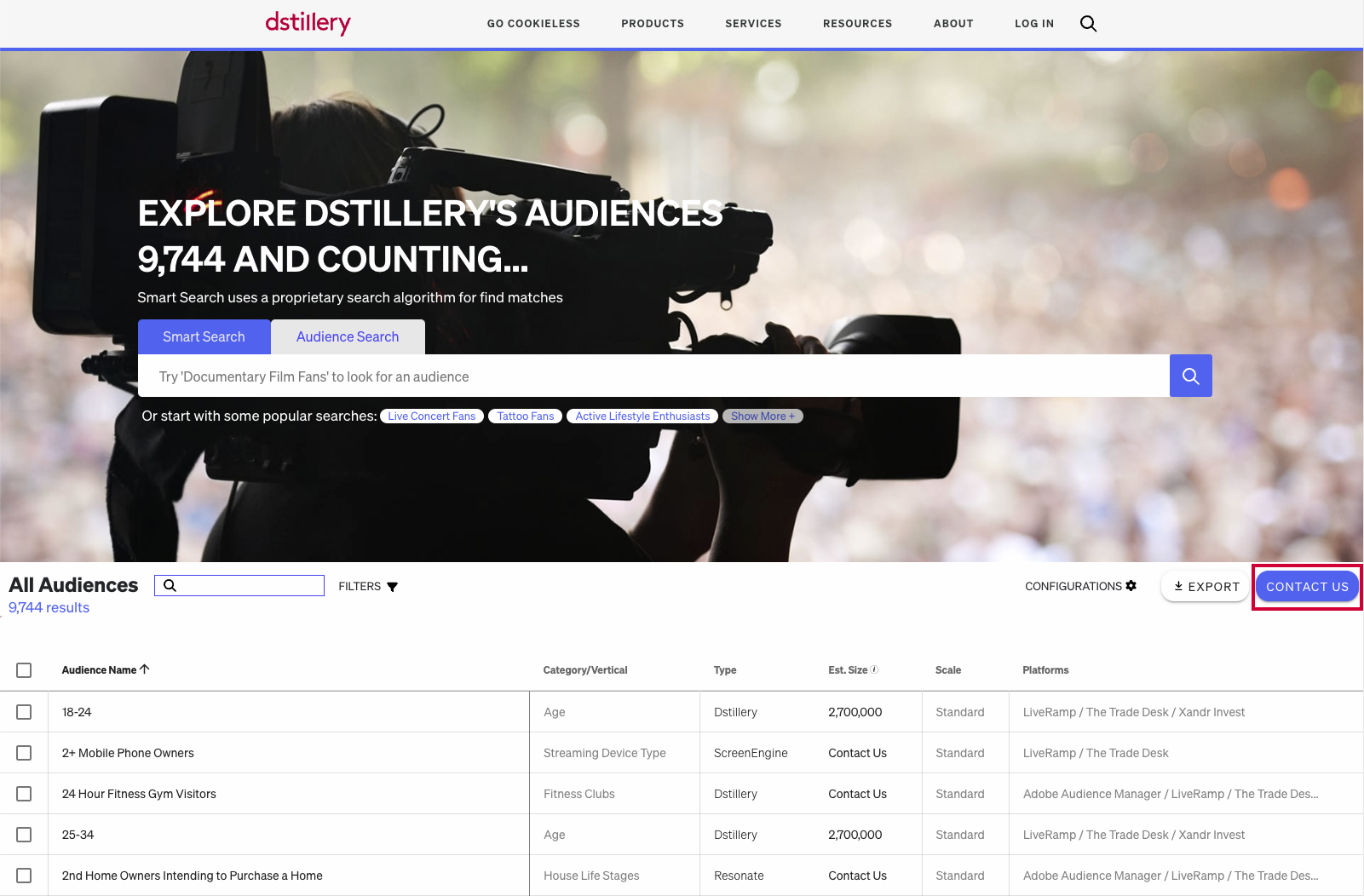
If you’re new to Dstillery’s Audience Taxonomy pages or simply want a refresher, you’ve come to the right place. After reading this User Guide, you’ll know your way around audiences.dstillery.com like a pro.

Looking for something else? Please visit help.dstillery.com.

Table of Contents

  1. Summary of Features
  2. Data Dictionary
  3. User Action Guide
  4. FAQ

1. Summary of Features

  • Available Columns in UI and Export: Audience Name, Description, Taxonomy, Scale, Platform, Size, and Category
  • Audience Search
  • Smart Search
  • Export results into Dstillery Branded Template
  • Filter by Column
  • Customizable Column View

2. Data Dictionary

Column NameDefinitionExample Input
Audience NameThe name of the audienceHome DIY Enthusiast
DescriptionSummary of details specifc to the AudiencePeople enthusiastic about Home DIY projects
TaxonomyThe full path of the audience nameDstillery > Auto > Gas Stations > Circle K Gas Station Likely Visitors
ScaleIndicator that distinguishes between the scale/confidence level of the segmentExtreme Confidence, Extended Scale, Standard
PlatformThe activation platform that have this audienceTTD/Liveramp/DV360
TypeIndicator that distinguishes between Dstillery and Partnership audiencesDstillery, ScreenEngine, GFK, Resonate
SizeThis is an estimated measure that reflects how many devices are associated to this segment10,000,000
Category The industry/vertical associated to the audienceAuto

3. User Action Guide

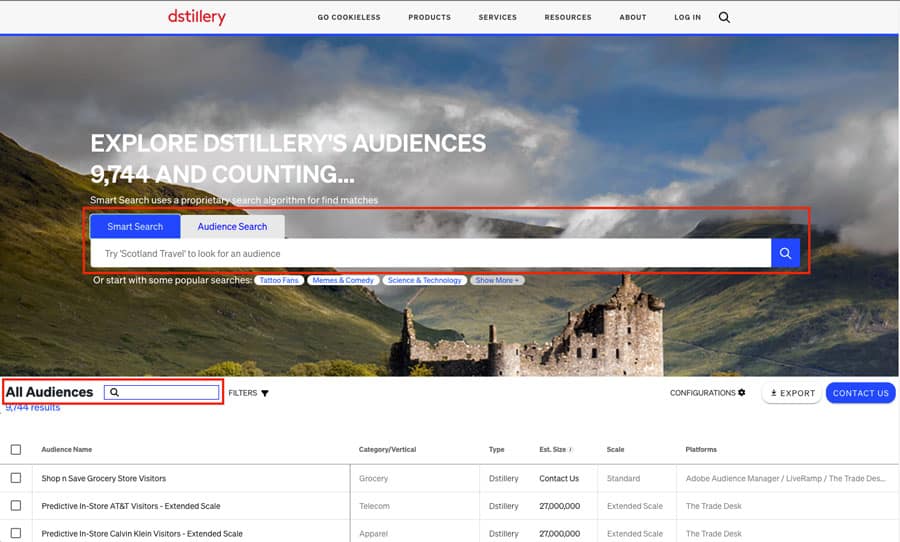
Audience Search & Smart Search – Initial Page Load

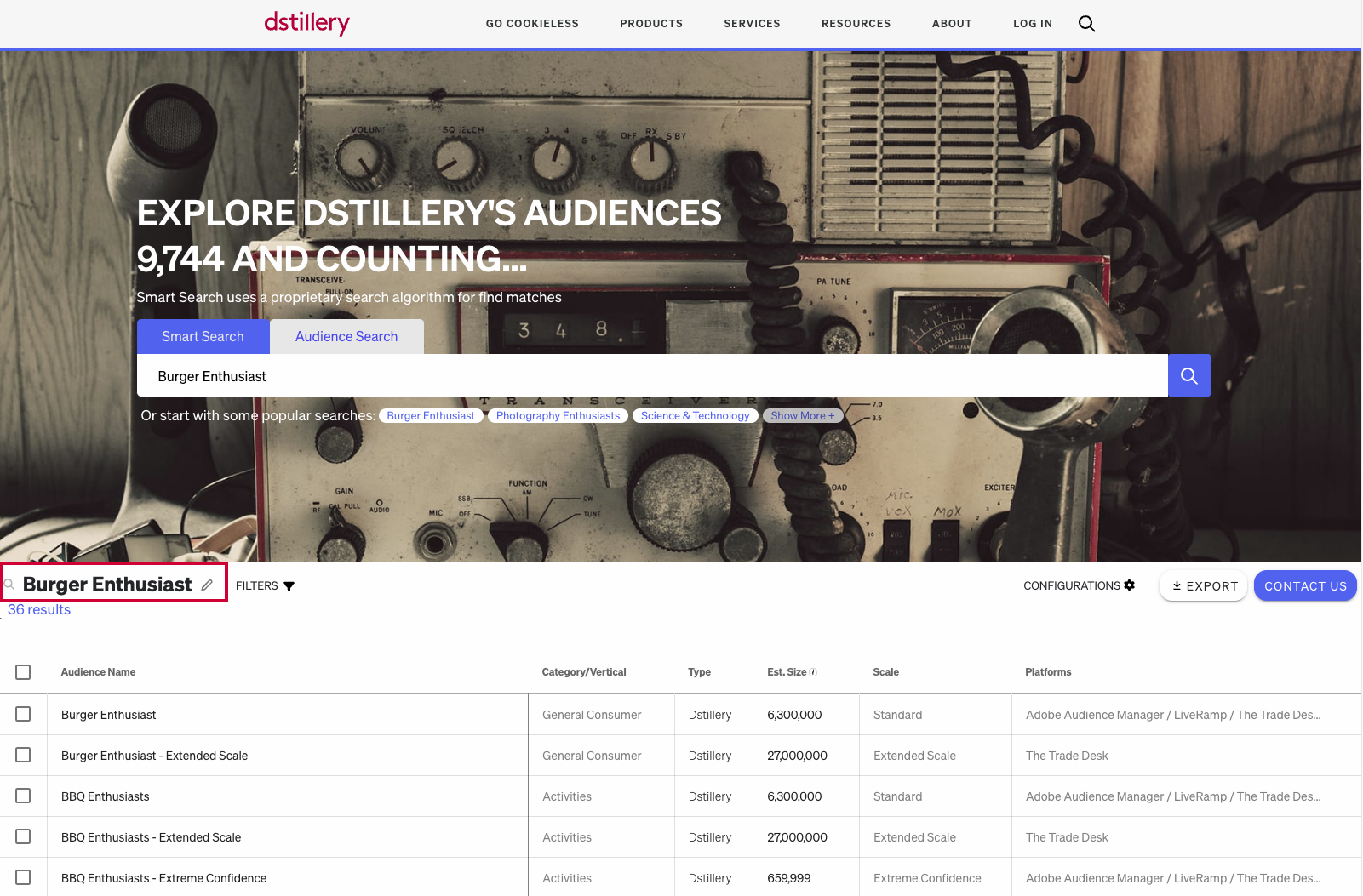
Audience Search & Smart Search – Results Loaded

image.png
  1. In order to return results against our Audience library, users can input the search term using either search bars available on the page
  2. When the results are rendered, you should see your search term appear in the search bar directly above the results table
  3. By clicking into the “pencil” icon, you can edit or enter a new search term to search against
  4. There are also “Popular Search” term recommendations that you can use. These live under the search bar and, when clicked into, will generate those results automatically

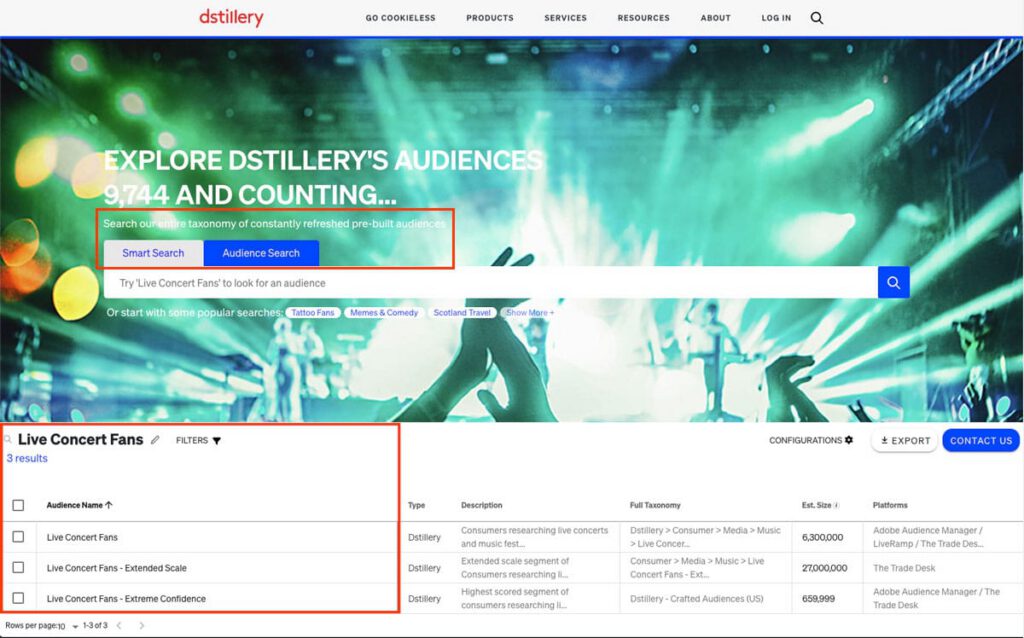
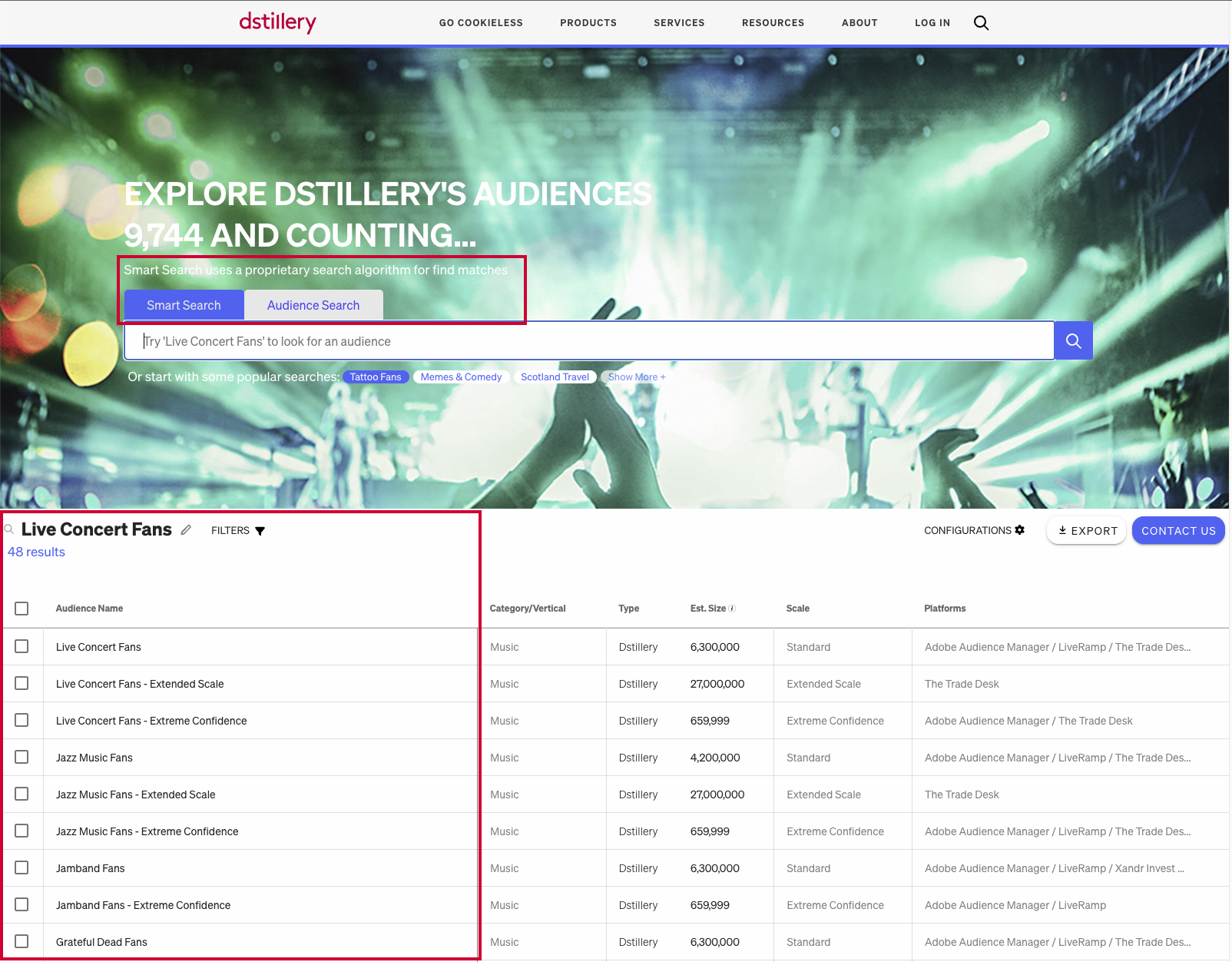
Audience Search vs. Smart Search

Audience Search

Smart Search

image.png
  1. Audience Search, also known as Exact Search, will generate results that contain the words you have included in your search term
  2. Smart Search leverages our patented technology to generate results that align closely with your search term
    • If you are looking to increase scale and are seeking audience recommendations that may not intuitively have been part of your curated blend, you should consider exploring the Smart Search feature

Export – Export All

image.png

Export – Multi-Select

image.png

Previously users had to manually copy and paste results returned from the audiences.dstillery.com page and input it into a e-mail to share Audience recommendations. To simplify this process, we have updated the functionality of the page to allow users to export data against the desired audience selections.

The export will automatically land in a Dstillery branded template, so users will not have to drop the data into the template manually.

  • Export All
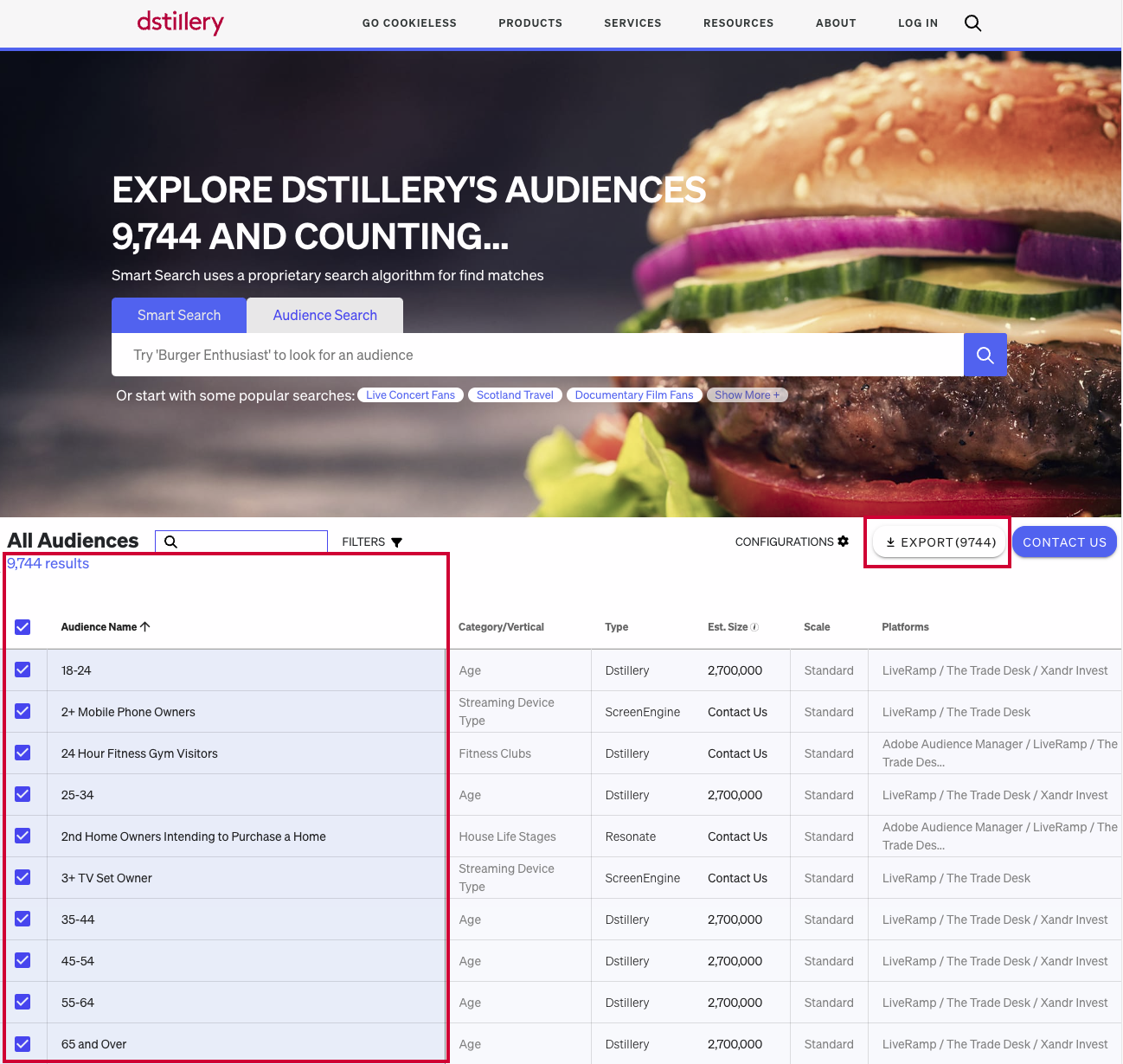
    • In order to “Export All,” users can click the top left checkbox to select all items. You should notice that a counter will appear next to “Export” and will reflect the total results returned. Click Export, and .CSV should be automatically downloaded.
  • Export Select Audiences
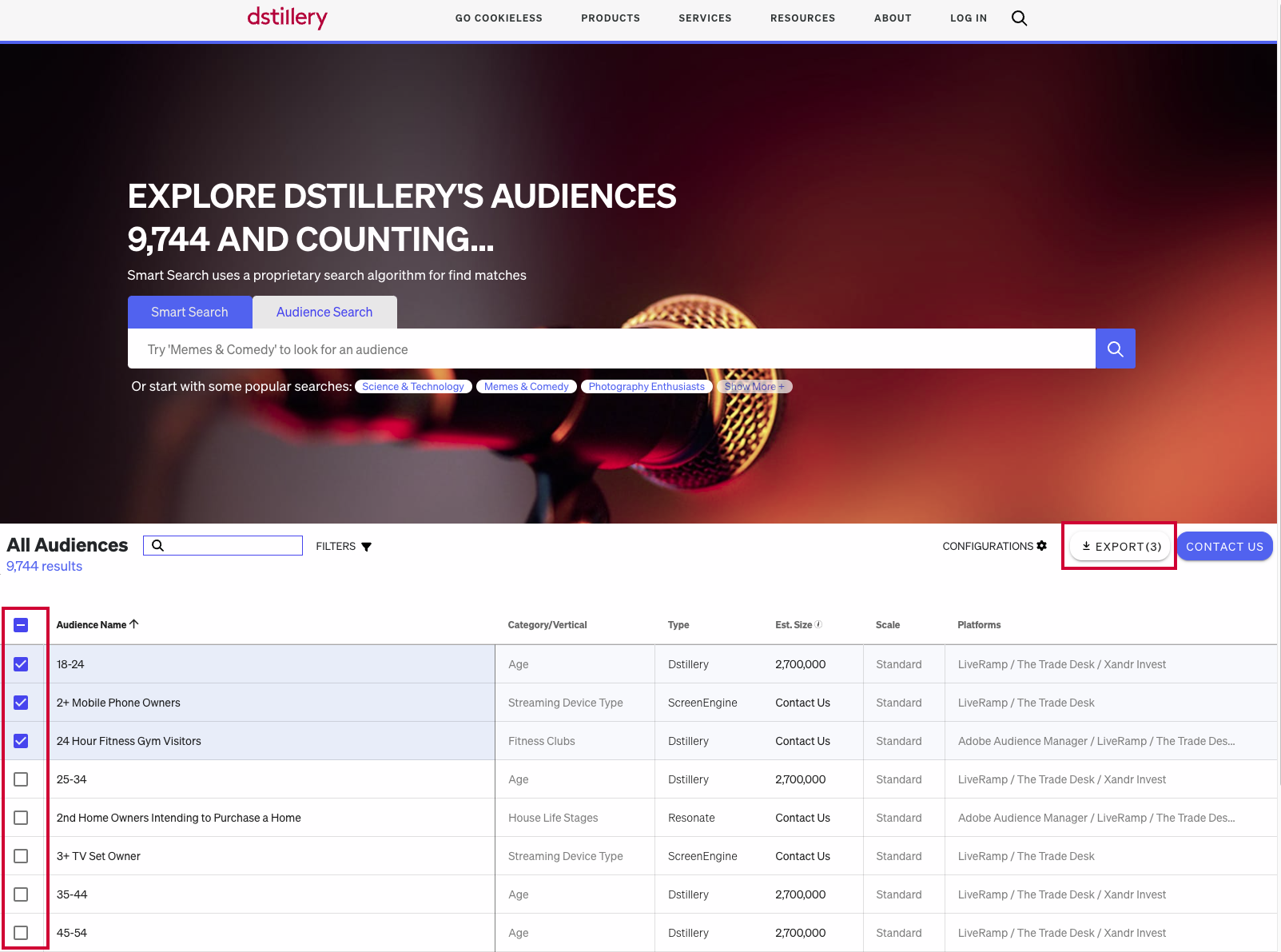
    • In order to Export specific audiences, you will need to click the relevant Audiences checkboxes individually. Once selected, the counter in the Export button will reflect the total selections. Once all desired audiences have been selected, click Export and a file will be automatically downloaded.
    • If no checkbox is selected (i.e select all or specific audiences), clicking export will not generate the output.
    • If a user selects audiences and then inputs a new search term and executes the search, the previously selected audiences will be unselected. We recommend that the user exports the selected audiences on the current search term before initiating another search.

Filters – Initial

image-23

Filters – Selection

image-22-min

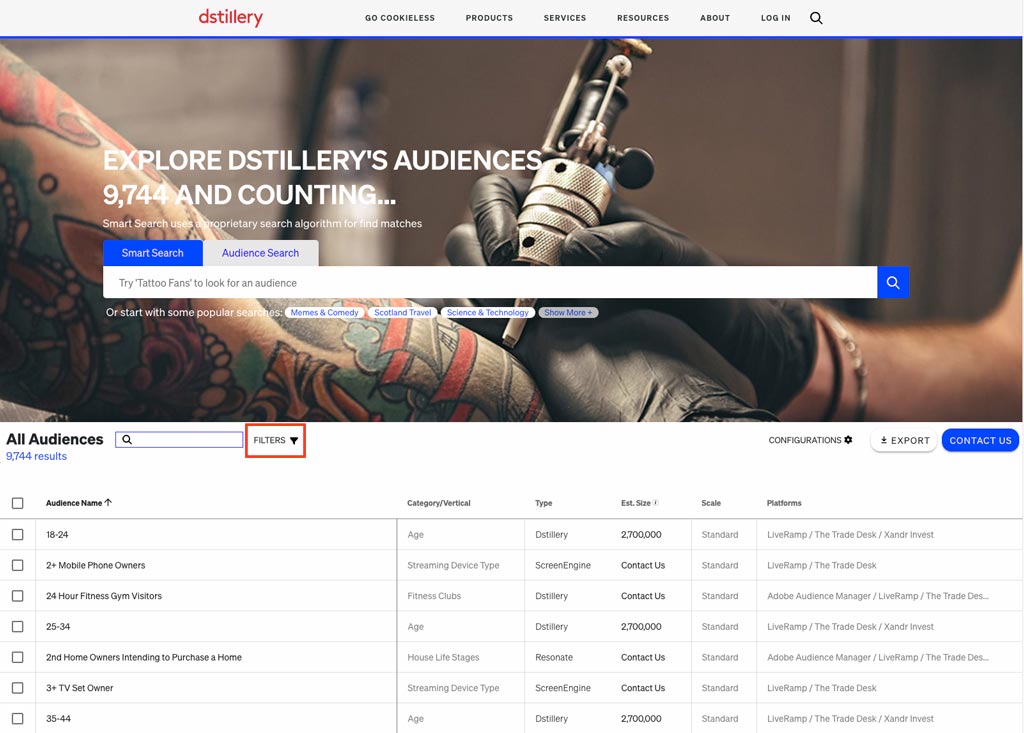
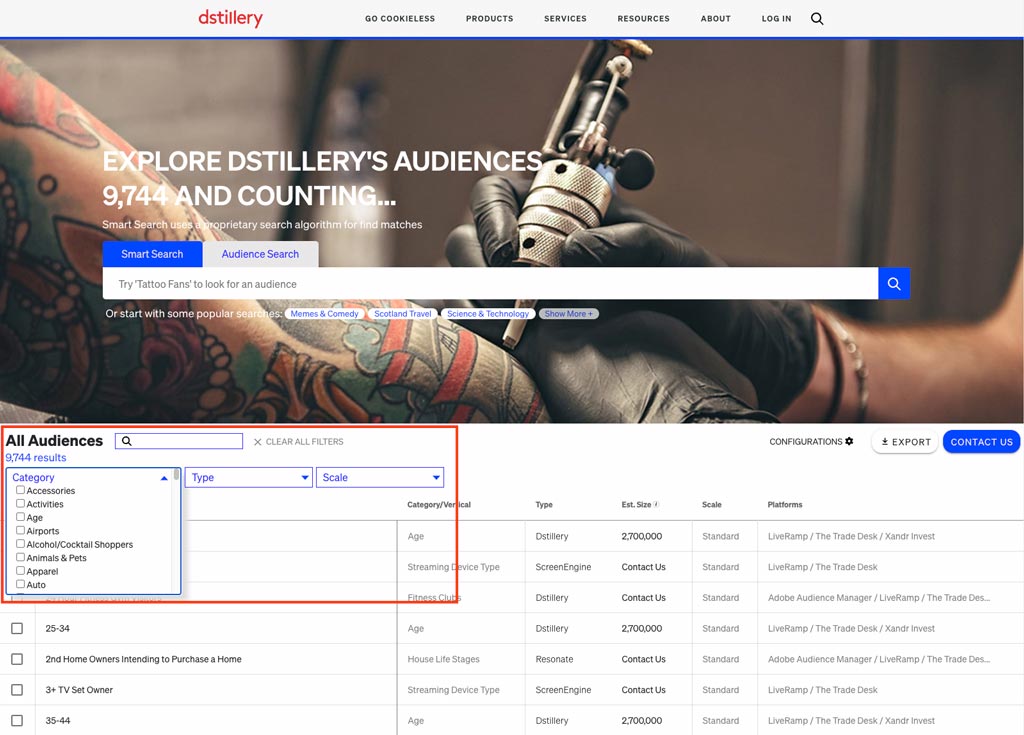
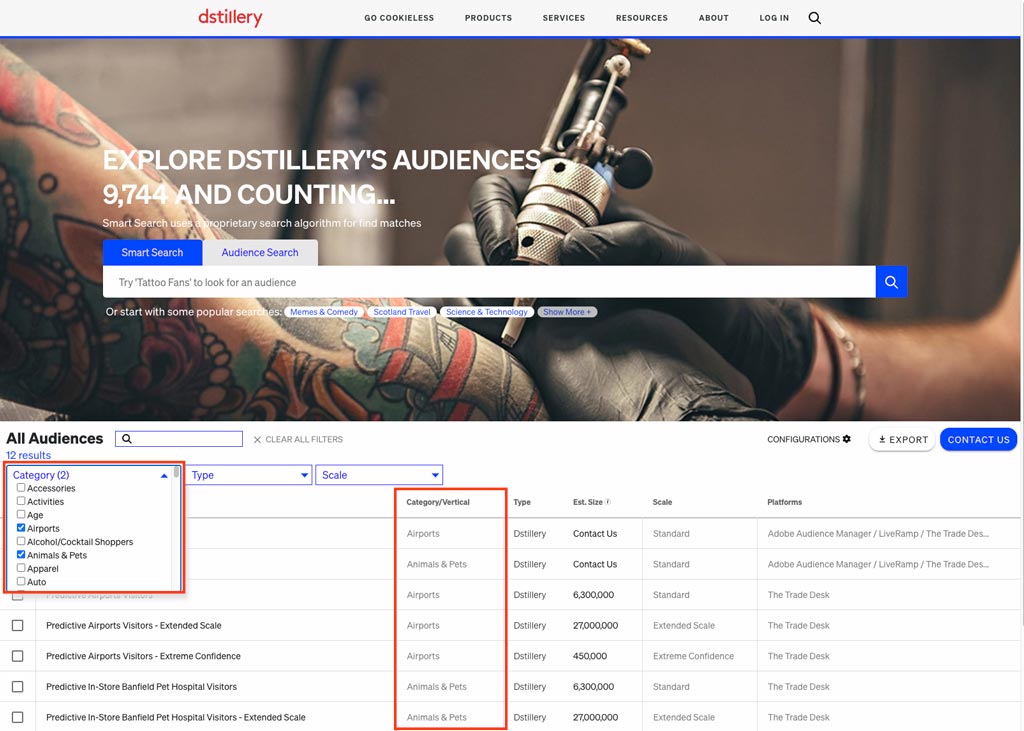
We have incorporated functionality that will allow users to filter search results within the UI based on the following columns: Category, Type and Scale.

  1. In order to use this feature, you can click the “Filters” icon, which will cause the 3 filter dropdowns to appear
  2. You can either single select or multi-select across any of the 3 dropdown lists in order to refine your search results to your liking
    • Note that clicking outside of the filter dropdown lists will collapse/close the filter drop down list
  3. Once your filters checkbox is selected, the filter will automatically update the table results accordingly
  4. You can either unselect the checkboxes or use the “Clear All Filters” button to reset your filter selections

Configurations – Initial

image.png

Configurations – Shown

image.png

Configurations – Hidden

image.png

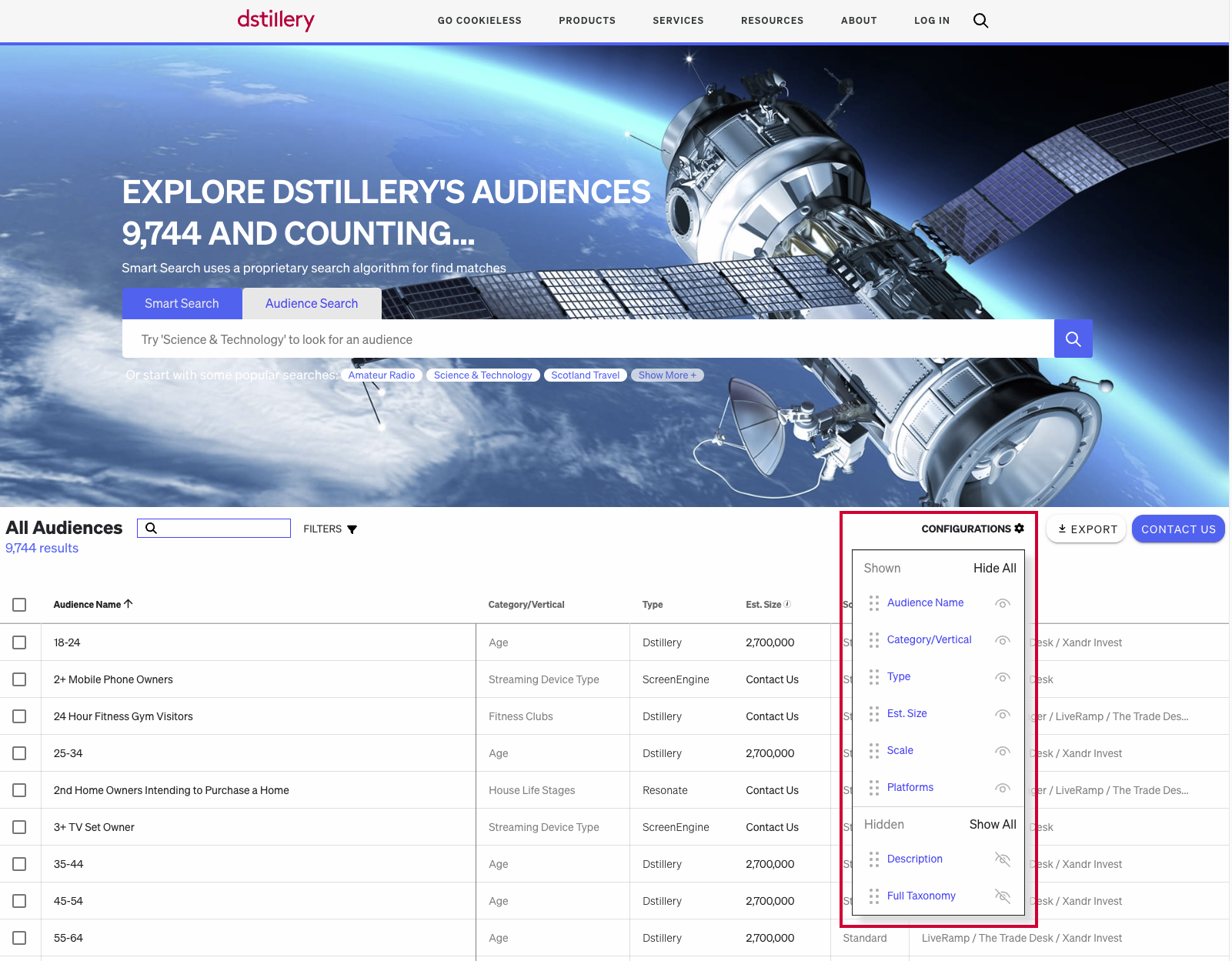
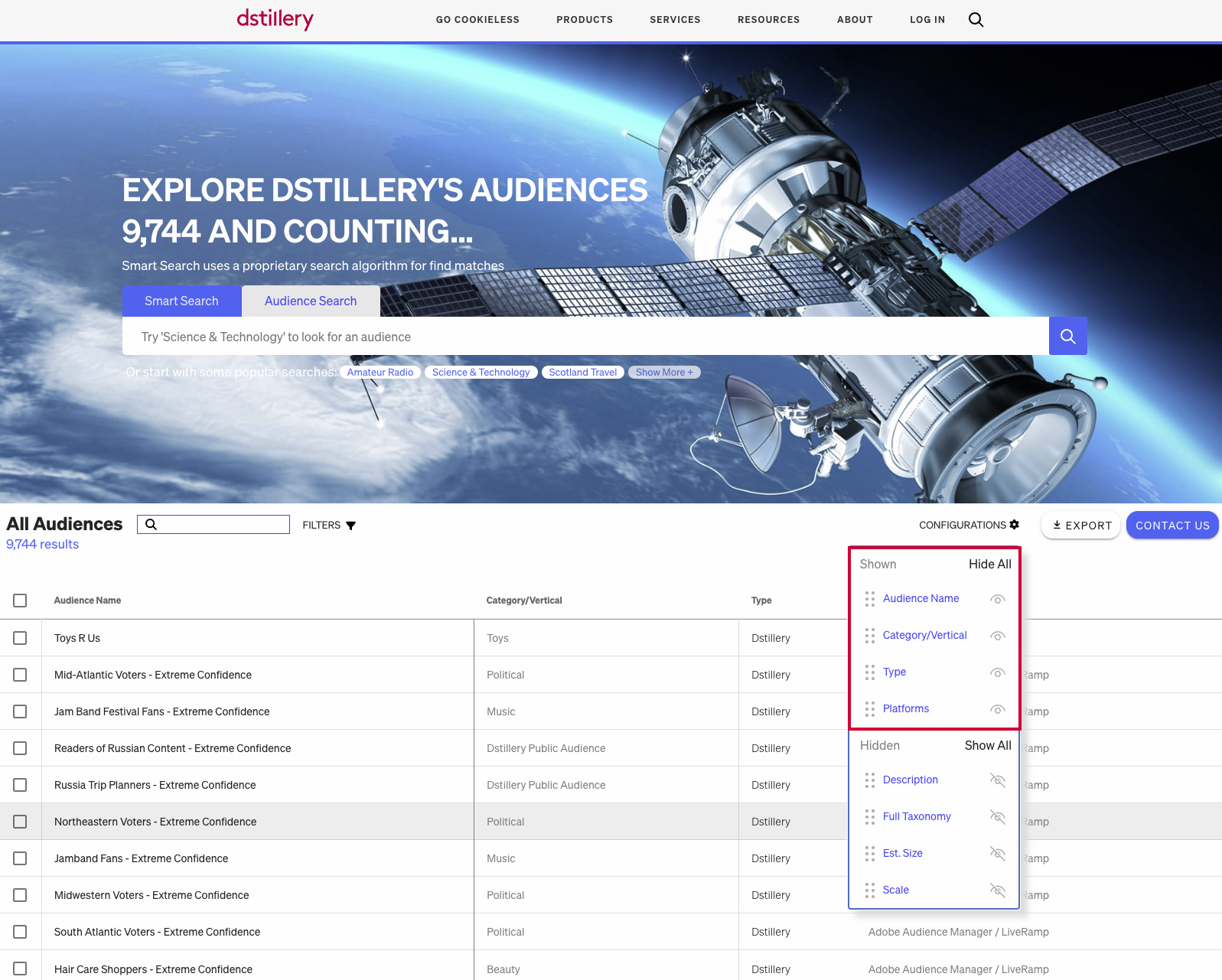
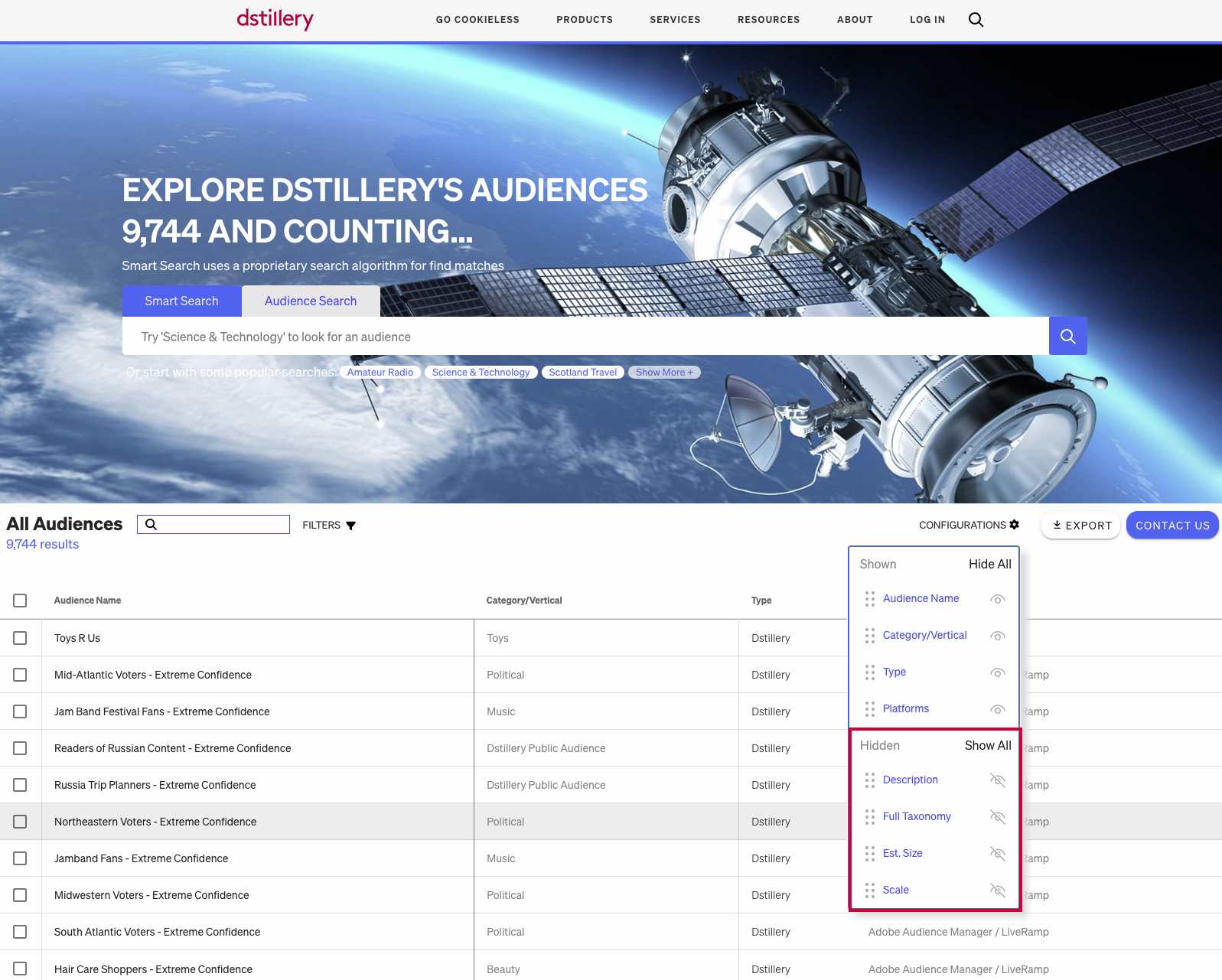
The configurations feature will allow users to select/deselect what columns will be available in the table so they can focus on the relevant fields for their view.

  1. You can click the “Configurations” icon, which will cause a dropdown inclusive of all possible column selections to appear
  2. To change the column order, you can click and drag the columns within the shown section accordingly (i.e select the icon to the left of the column name)
  3. The “Show All” button will include all columns within the view, while the “Hide All” will only include the “Audience Name” dimension in view.
  4. Note that the “Configurations” selection will impact the columns that appear in the export

Contact Us

image.png

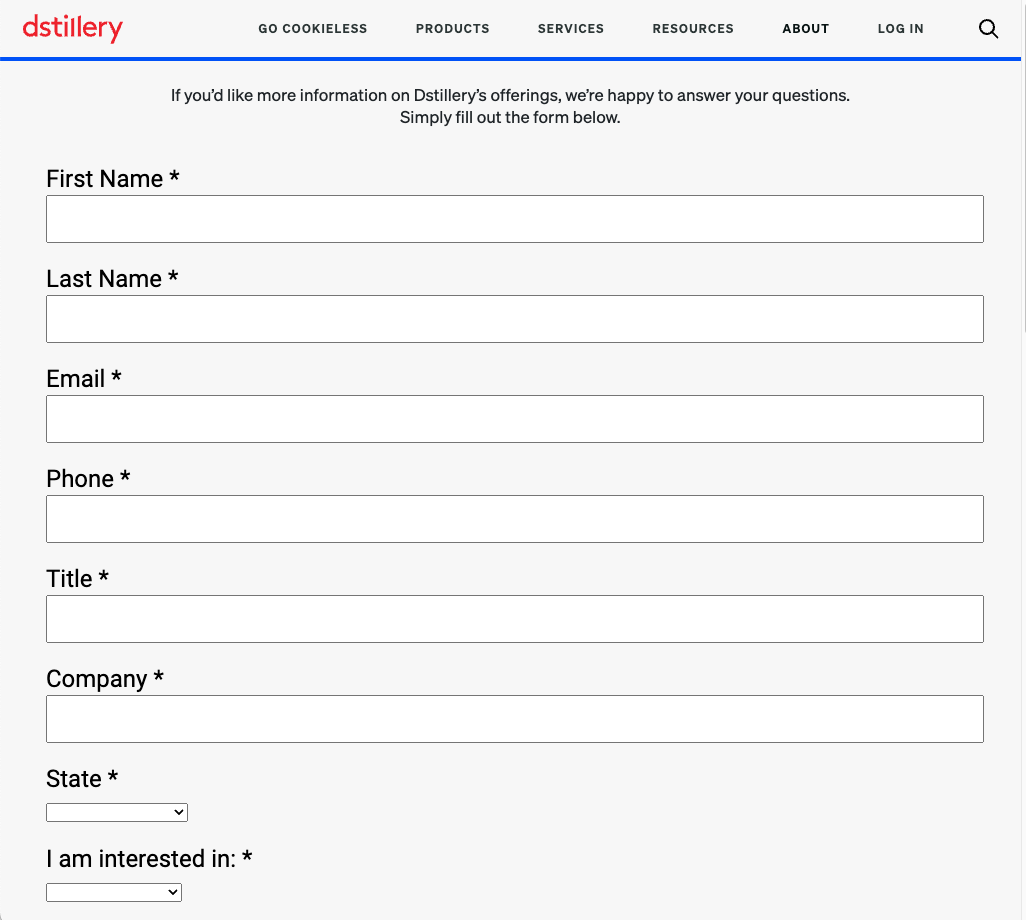
Contact Us – Form Page

image.png

For more information, reach out to Dstillery via the “Contact Us” button. This will link directly to dstillery.com/contact.


4. FAQ

  • How often does the data refresh?
    • Daily
  • What Browsers are supported?
    • Google Chrome, Safari, Mozilla Firefox and Microsoft Edge
  • Are Partnership Audiences available?
    • Yes, you can use the “Type” column to filter by the partners
  • Why don’t I see my Audiences reflected in the table?
    • The Audience Taxonomy Explorer will reflect all our Audiences in our system to date. If you noticed that a segment was available within a DSP but not available within the Explorer table, it is possible that our system is rendering a recent update. We recommend waiting 24 hours to see if the change has processed.
  • How come the estimated size here doesn’t look the same as the estimated size in my DSP?
    • The number shown on the page reflects the count of devices we expect to be associated to a particular segment. With DSPs all having different identify match rates with Dstillery, along with different cadences for audience refreshing and TTL (time-to-live), it is expected to see audiences sizes vary across different platforms. These audience sizes are directionally correct and can be used for campaign planning and estimating potentially scale.
  • Does the selected audiences Export” directly into the DSP?
    • The “Export” button will only export the selected audiences into a branded Dstillery excel file. This function is not integrated with DSPs
  • I selected audiences that wanted to export, but I noticed that when I performed another search, those selections were not included. What happened?
    • If a user has selected audiences and then inputs a new search term and executes a new search, the previously selected audiences will be unselected and will not be included in the export. We recommend that the user exports the selected audiences on the current search term before initiating another search
  • In case of any additional questions not covered in this FAQ, who should I contact for more information?
    • Please fill out the form on our Contact Us page, and we will get in touch with you shortly.

Contextual Targeting vs. Behavioral Targeting

Updated: November 7, 2024

In the noisy digital world, ad relevance is crucial to reaching your target audience. Digital ads need to be approached carefully so as not to disrupt your potential customers’ online experiences. And with third-party cookie retirement on the horizon, digital marketers should evaluate new cookieless advertising strategies to ensure their ads are being seen by the right people, at the right time.

Contextual and behavioral targeting are two techniques that you should be testing now. Neither requires cookies, both are privacy-safe, and when implemented correctly, these can be highly effective for reaching your target audiences.

What is contextual targeting? 

Contextual targeting is a form of digital advertising that places display ads based on a website’s content. We’ve all seen them. It’s the reason why you’re served a meal kit delivery ad while browsing a recipe website, or a bridal gown ad on a wedding planning blog. Contextual targeting is the digital form of running a printed ASICS ad in Runner’s World magazine. The process matches display ads to relevant websites based on keywords, topics, and context.

What is behavioral targeting?

While contextual targeting relies on keywords and topics, behavioral targeting is based on a user’s online behaviors. By analyzing online browsing habits – i.e. sites visited, search queries, purchase behavior – behavioral targeting leverages user data to create a more personalized experience. 

Timely and effective advertising requires a deep understanding of your audience. Behavioral targeting does just that by going deeper than website content.

Dstillery’s cookieless behavioral targeting solution

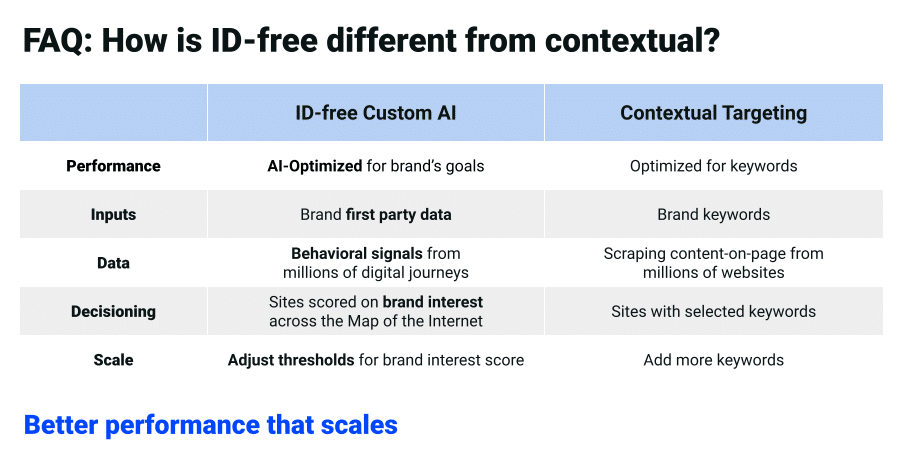
To get ahead of the retirement of third-party cookies, we created a privacy-by-design, behavioral targeting solution called ID-free®. Instead of reading the words on a page or scraping content, our behavioral solution picks up on other signals that reflect brand interest by using AI optimization toward a client’s first-party data. Unlike standard behavioral targeting, ID-free takes advantage of predictive behavioral signals without tracking your audience. ID-free evaluates individual impression opportunities to provide intelligent decisioning without compromising anonymity, resulting in better performance that scales.

ID-free Custom AI behavioral targeting solution compared to contextual targeting.

As long as first-party data is available, ID-free audiences can be implemented in your next campaign. Whether you’re looking for a behavioral targeting solution or want to future-proof your ad campaigns, now’s the time to test. Contact us today to learn more.

FAQ: Deal IDs

A brief inquiry into the newest way to activate Dstillery audiences.

1. What is a Deal ID?

A Deal ID is a packaging of ad-supported inventory that allows buyers access to unique or specialized inventory.  This can take many forms such as private deals, programmatic guarantees, or open deals. Publishers or supply side players can identify relevant opportunities and apply a unique deal ID on top of the impression opportunity. Buyers then implement these IDs within the targeting items in the DSP and will only buy against impressions that have the Deal ID present on the bid request.

2. Is the bidding process different than the current ID-free process?

We use the same bidding algorithm process that we apply within the DSP but instead of decisioning on each bid request that gets received, it works higher up the chain at the supply side to make the same evaluations and will only apply a Deal ID to the most desired impressions.

3. Who does Dstillery leverage for Deal IDs?

Currently, we are leveraging the Microsoft Curate supply exchange to create our ID-free Deal IDs.

4. Can the Deal IDs only be used on Microsoft Curate?

While these are created using the Microsoft Curate supply exchange, the Deals can be activated on any leading DSP.

5. Is a Deal ID the same as a Private Marketplace (PMP)?

A PMP and a Deal ID are not exactly the same thing.  A PMP is a package of usually premium direct sold inventory set up privately for a buyer.  PMPs leverage Deal IDs as the mechanism for a DSP to identify and buy against a specific PMP on behalf of the PMP buyer.  Only the buyer who works with the PMP creator will have access to the Deal ID to input into their platform.

6. What formats/environments are supported?

Deals can be created for Display, Video, and Native. Each format would have its own set of deals.

7. Will this change how Dstillery customers interact with the ID-free audience?

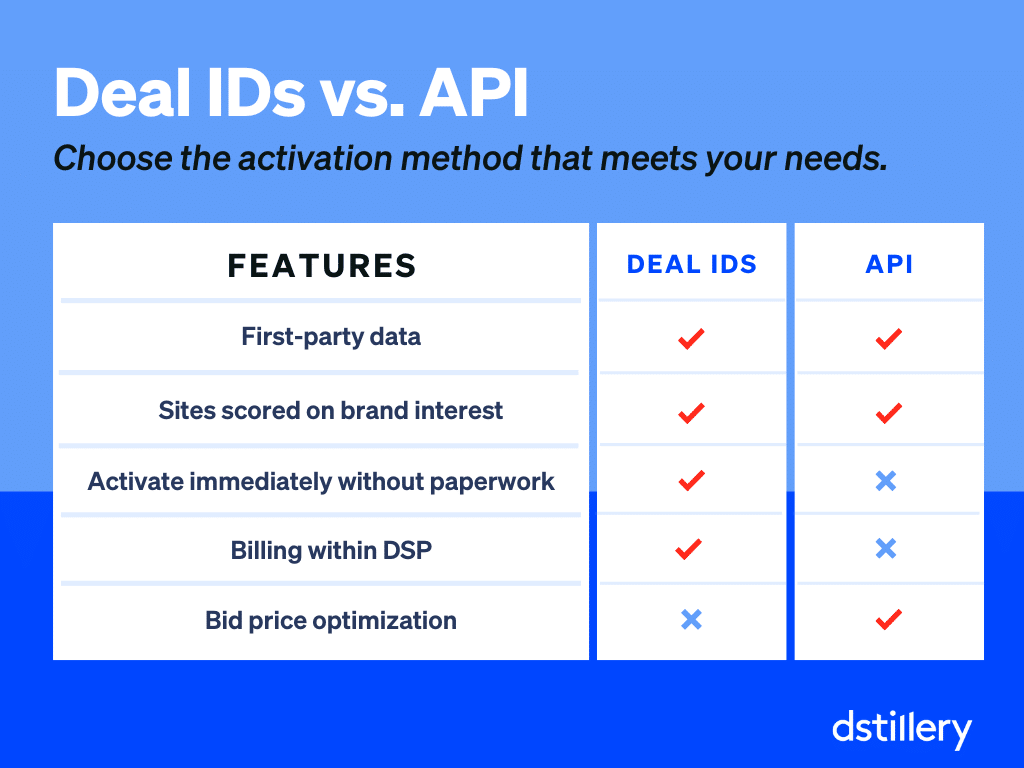
Yes. With a direct API integration, the client sends Dstillery ad group/line item IDs.  We then take those IDs and place domain, time, dma targeting to the separate targeting sections on their behalf.  With Deal IDs, we will create the model and associated Deal IDs which we will then send to the client.  They will then target these Deal IDs themselves within the platform in the way that they are used to with other types of PMPs/Deal IDs.

Deal ID vs. API - Comparison Chart

8. What types of audiences can deals be created for?

Deals aren’t restricted so the same audiences can be built as with standard ID-free via API. Custom AI, Pre-built, Custom-built can all be turned into Deals.

9. How many Deal IDs are created per audience?

Custom AI will be 8 deals which can be targeted together or separately within the DSP and Prebuilt audiences will have 1.

10. How do I get started?

To learn more, please reach out to your Account Executive or email contact@dstillery.com.

Contextual Targeting 101

With Google planning to retire third-party cookie tracking in 2023, marketers everywhere are searching for the next best way to show the most relevant ads to users. How do they reach specific people at the right time? Between behavioral and contextual targeting, marketers need a more flexible way to think about “the right time.”

What Is Contextual Targeting?

Contextual targeting is defined as showing an advertisement directly related to the website content being viewed. For example, if a user reads an article titled “10 Best Electric Vehicles,” a Tesla display ad might show on the page. Another example might be if a user reads about ways to save time, and meal delivery subscription ads are shown. Contextual targeting uses data from website analysis to determine the topics, keywords, and image information (among other details) to determine what a web page is about. Based on the data, the ad servers know what ads to place on that individual page.

What is Context Switching and Why Does it Matter?

As attention spans decrease and the average consumer engages with multiple pieces of content at a time, context switching is essential for marketers to consider. Context switching is moving from one task to another, and it comes with some serious negative side effects. Thanks to cognitive flexibility, humans are able to easily and quickly move from topic to topic. While it seems great to multi-task, context switching eats into focused time.

This movement from one state to another used to be powered by third-party cookie tracking. But with the depreciation of cookies, there is still the question of showing the right ad at the right time. Does this moment of a shifted context matter? Should ad servers still show a relevant ad? For example, attention residue shows that even as a user has moved on, their brain is still thinking about the top 10 best electric vehicles — even if they’re now reading an article on SportsCenter.

The Right Ad at the Right Time

Finding the optimal moment is critical. And as movement and behavior online continually change, the right moment for the right ad might continue to shift. We’re primed at all different times to get a nudge about a topic we were previously researching thanks to the flexible human brain.

At Dstillery, we help clients maximize the value of customer data and transform the way they connect with their audiences. To help prepare for the retirement of third-party cookies, we’ve launched a new cookieless targeting solution that isn’t contextual.

If you’re interested in learning more, visit dstillery.com/go-cookieless.

Programmatic 101

What is Programmatic Buying?

Programmatic ad buying is the use of different pieces of software to buy digital advertising. Many are familiar with the traditional method, which is made up of requests for proposals and negotiation. Programmatic buying uses sophisticated advertising algorithms to buy and sell online advertising display space to buyers and traders across the globe.

Programmatic trading uses traffic data and online display targeting to drive impressions at scale, resulting in a better ROI for marketers. By leveraging machine learning and AI, programmatic ad buying is more efficient, automating many menial and mundane tasks. Programmatic advertising also offers simple ways to reach a desired segment. You can reach your target audience and maximize any ad budget through behavioral, contextual, or geotargeting. Overall, programmatic advertising can yield excellent results for brands of any size, from small to global, so it has quickly become a fundamental part of many brand’s marketing stack.

Programmatic Advertising Terminology

SSP: Supply-side platforms (SSPs) are used by website publishers to manage, sell, and optimize available ad space on their websites or apps. Some popular SSPs are Google Ad Manager, OpenX, Pubmatic, and Magnite.

DSP: Demand-side platforms (DSPs) enable media buyers to automate the purchase of digital ad space from a marketplace. Programmatic DSPs include Google DV 360, The Trade Desk, and Amazon.

Ad Exchanges: Ad exchanges are digital marketplaces where marketers and publishers can buy and sell ad space. These marketplaces allow SSPs to sell ad inventory on behalf of website publishers and DSPs to bid on it.

RTB: Real-time bidding (RTB) is an automated digital auction process of buying and selling ad space on an impression basis through real-time auctions or at a fixed price.

Programmatic vs. Display: In the context of programmatic advertising, programmatic is a method of purchasing and placing ads via automation. Display is the form of the ad itself (video, image, text, etc.) and where the ad appears.

Using DSPs

Before seeking a DSP, it’s best to take a moment to understand your brand goals, KPIs, and your creative approach. After your marketing team has figured out the formula and metrics for success, it’s time to find a DSP. DSP selection should be based on several factors like budget, ease of use, targeting capabilities, and reach. Once you match your KPIs to a DSP, you can begin bidding in real-time. 

After you select your target audience segment, you define your budget and upload your ad / creative onto the platform. Once bidding begins, you will have the option to buy impressions based on segment criteria. The auction happens in real-time once a bid is selected. The winning bid will purchase the space, and the ad will move to the publisher’s website. This all happens within milliseconds from click to placement.

Once your campaign is live, your DSP has various optimization tools. Keeping a close eye on your campaign data is key to helping you and your team make adjustments to enhance your ad performance. 

Why Start Using Programmatic Advertising?

While you can’t automate your way to success, you can strategically optimize your ad dollars to reach your campaign goals. If you want to be a successful trader, you have to understand your audience and prospects. There’s a big human component to trading that requires buyers of digital ad space to have their finger on the pulse of who they are as a brand, product, or service. 

Through programmatic trading, digital advertisers know where their ads are placed, who views them, and how the ads are performing — all on one platform. That said, it’s on the marketing wizards of today, tomorrow, and the future to use their instincts and data to become the marketing master that their brand needs.

Questions? Contact us.

FAQ: Custom Patient Targeting

A new cookieless way to reach your patients, powered by Dstillery’s ID-free technology.

1. What is Custom Patient Targeting?

Custom Patient Targeting is a new privacy-safe patient targeting solution designed for healthcare brands. It offers the precision and customization you need to drive your best patient outcomes. It doesn’t rely on user-based targeting, ensuring compliance with all laws, policies, and guidelines from HIPAA, NAI and DSPs. Using AI-powered predictive modeling, we build a just-for-your-condition targeting model that bids on individual impressions based on aggregated patient behavior.

2. How is it precise?

Every single potential impression ad-supported internet is scored and ranked based on its likelihood of targeting your desired patient. This level of granular targeting is unheard of in healthcare.

3. How is it custom?

Custom Patient Targeting starts with your desired seed dataset, enriches it with our AI-powered understanding of every website on the internet, and creates a model tailored to your specific condition and your patient outcome goals.

4. How is it compliant?

Because Custom Patient Targeting doesn’t rely on user-based targeting, we can ensure compliance with all laws, policies, and guidelines.

5. What seed data can I use?

We recommend seeding with your brand’s first-party data for the most precise results. This can be data from your brand’s web pages or segments from a data management platform. If that’s unavailable, we recommend using your brand’s keywords, including product names, symptoms, and co-morbidities. We are in active discussions with leading healthcare data providers to use their real-world evidence (RWE) datasets, allowing brands to use ICD-10 codes to seed models.

6. How do you collect health data?

Our core dataset consists of healthcare-specific websites and keywords from opted-in devices. When combined with non-healthcare-specific event-level data, we find that these signals allow us to more fully see patients’ journeys, resulting in more accurate and robust models. We are in active discussions with leading RWE data providers rooted in payer and claims data to enhance the models. We will work with beta partners to test these incremental datasets in Q2-Q3 2022.

7. How do you target in a HIPPA-compliant way?

Dstillery’s healthcare targeting methodology doesn’t involve the creation of any health-related profiles. It uses a built-in de-identification to ensure that the data isn’t considered Protected Health Information under HIPAA. It also meets the requirements of the NAI sensitive data guidance by utilizing data minimization techniques that minimize the risk of inadvertently identifying a data subject.

8. How are you able to understand the patient journey without user tracking?

Custom Patient Targeting is powered by AI that identifies and learns the patterns of how, when, and from where anonymous opt-in devices browse the web. These behavioral patterns help the AI predict how anonymous patients browse the web.

9. What is the Map of the Internet?

The Map of the Internet (MOTI) is built by a type of AI called a neural network. It constantly analyzes hundreds of millions of anonymous digital journey patterns and learns the behavioral signals underlying any web visit to build the map. It then takes your seed and extends the patterns detected to all websites. The output is a model that scores and ranks every potential impression on the ad-supported internet and predicts the best patient impressions for your condition.

10. How is it different from contextual, condition, endemic, and traditional behavioral targeting?

Custom Patient Targeting is categorized as predictive behavioral targeting, not any of the following.

  • Contextual: Contextual scrapes words on web pages in an attempt to infer patient behavior. Custom Patient Targeting doesn’t rely solely on keywords (although they can be a helpful dataset). Instead, it predicts patient behavior with AI.
  • Condition: Condition targeting reaches broad demographic groups assumed to be indicative of certain conditions, targeting 10% of the population or more. Custom Patient Targeting can be seeded with demographics, but precisely targets patients based on behavior, not demographics.
  • Endemic: Endemic targeting reaches patients on healthcare-related websites only, while Custom Patient Targeting reaches patients at scale across the entire ad-supported internet.
  • Traditional Behavioral: Traditional behavioral uses third-party cookies to track users. In contrast, Custom Patient Targeting analyzes behavioral signals from millions of anonymous digital journeys to predict the impressions most likely to be your patient without user tracking.

11. Is this affected by cookie deprecation?

Because Custom Patient Targeting doesn’t rely on user tracking, like third-party cookies, it isn’t affected by cookie deprecation.

12. How is it priced?

We’ve priced Custom Patient Targeting to be on par with or less than traditional cookie-based behavioral targeting products. It’s priced at 20% of media, so if you’re clearing $2.00 inventory, it will be about a $0.40 eCPM.

13. How do I get started?

  • Sign targeting agreements
  • Provide targeting API access
  • Select seeds and outcomes
  • Dstillery builds and deploys custom model to campaign

To learn more, please reach out to contact@dstillery.com.

Top 10 Frequently Asked Questions About GDPR and Dstillery

What is GDPR?

The General Data Protection Regulation (GDPR) is a new comprehensive data protection law that updates existing EU laws to strengthen the protection of personal data. It replaces the current patchwork of national data protection laws with a single set of rules, directly enforceable in each EU member state. The GDPR took effect on May 25, 2018.

Dstillery’s Response

In response to the GDPR, Dstillery immediately blocks any information that arrives from a device originating from the EU. No EU user data is persisted in Dstillery servers, and Dstillery does not attempt to do any OBA to EU based devices. Dstillery’s general approach is to not collect data from EU data subjects. We block it prior to ingestion to our platform. Prior to May of 2018, Dstillery was not particularly active in the EU and didn’t derive significant revenue from the EU. As such, the recent passing of the GDPR has not had and will not have a financial impact to our business.

FAQs

1. Which, if any, of your location data collection methods are impacted by GDPR? Dstillery only collects location data from devices located in the US and Canada. 2. What data collection policy changes are you making in response to GDPR? All data that is determined to have originated from the EU is prevented from entering our systems. 3. Does this policy differ within the US and Canada? If so, how? Dstillery’s US and Canada data collection and use policies have not changed and remain in accordance with the company’s privacy policy, applicable law and industry self-regulatory codes. 4. Are there any types of data that you are no longer able to collect within the US and Canada? If so, please explain how this will impact/change the way you build your audience segments. GDPR does not affect Dstillery’s data intake within the US and Canada and therefore has no effect on the company’s audience building capabilities. 5. How do you anticipate GDPR impacting audience sizes? Please provide % estimate. GDPR does not have an impact on US and Canada audience sizes. 6. How are you collecting data tracking approval from consumers in response to GDPR? Is this a new process? Is this being done in the US and Canada? The GDPR imposes a strict opt-in consent standard for processing precise location data. We don’t anticipate a similar ruleset to be released in the U.S. at any time in the near future. Under the Digital Advertising Alliance Code in the U.S. and Canada, companies that seek to use precise location for ad targeting purposes must obtain reasonable assurances that upstream partners have obtained user consent. Dstillery obtain such assurances from our upstream partners in accordance with the DAA Codes. 7. If you have a measurement offering, please explain how GDPR will impact that capability. Not applicable to Dstillery. We will not collect data on EU data subjects on the platform. All of Dstillery’s offerings are unaffected by the GDPR, as Dstillery does not leverage any data determined to have originated from devices located in the EU. 8. If we syndicate European audiences to another delivery platform does the onus shift to the delivery platform or is Dstillery still liable as they built the audiences? There is potential liability, so we are avoiding any situations where we could potentially capture/use known EU data or be seen in a position to question whether we are. We do not do any manner of audience building using data from devices in Europe. 9. Can Dstillery deliver in Europe if we use a 3rd party platform and 3rd party audiences? No. 10. Are EU visitors to the US and Canada or EU citizens living in the US or Canada impacted by GDPR? EU data subjects who happen to be visiting the US and Canada are generally subject to US and Canada law. As a practical matter, the only way we can ascertain jurisdiction is by an IP address lookup and/or lat/long passed to us via partners. If you have additional questions, contact us here.