Dstillery’s Custom AI to Lead Replacement Solutions
With Google sunsetting its lookalike solution, Similar Audiences, in DV360 in May 2023, it’s time for media buyers to look for an alternative that can provide similar or better performance. With Dstillery’s Custom AI audiences, media buyers can seamlessly activate first-party data to build lookalike models in DV360 and be fully prepared for this transition.
What are lookalike audiences?
Lookalike audiences are groups of people who share similar characteristics and behaviors to a brand’s existing customers or audience. Once a lookalike audience is created, it can be used for targeted advertising campaigns on various activation platforms, including Google’s Display & Video 360 (DV360). The idea behind using lookalike audiences is to expand the reach of a campaign to a larger pool of potential customers who are more likely to be interested in the company’s products or services.
Why Use Dstillery’s Custom AI Audiences?
Dstillery’s Custom AI audiences is a lookalike alternative to Similar Audiences in DV360. While the desired goal of expanding reach to find potential customers is the same, the methodology is very different. Traditional lookalike solutions look at overlap against the original seed data to find and target additional audience segments with the highest overlap.Taking a much more precise approach, Dstillery’s Custom AI audiences score and rank every single unique device on its similarity to the brand’s existing customers daily to ensure the best prospects are part of the lookalike audience. By continuously updating the audience on new data every 24 hours, Custom AI audiences are always up-to-date, relevant, and ready to drive optimal performance goals.
How to get started with Dstillery’s Custom AI audiences?
Media buyers who want to start using Dstillery’s Custom AI audiences in DV360 can follow these simple steps:
Reach out to your Dstillery sales representative. Don’t have one? Email us at contact@dstillery.com
Define and send the first-party data you want to use to build lookalike models
Dstillery will generate the Custom AI audience and syndicate it to your seat in DV360
Begin targeting the audience in DV360
With Google sunsetting Similar Audiences in DV360, media buyers must find an alternative that can provide similar or better results. Dstillery’s Custom AI audiences offer a flexible and powerful alternative to help media buyers reach their target audience more effectively, improve campaign performance, and be fully prepared for this transition. Contact us today to get started.
This week, I’ve had an unusual amount of time to think about AdTech terms, as in “How clear is our industry?”, “If not clear, is that intentional?” and “Why such an overdose of relentless acronyms?”
With no shortage of alphabet soup in AdTech, it shouldn’t surprise anyone that our industry is often adrift in a sea of verbal confusion. Imagine if each company in our grand Lumascape were to take the “Programmatic Oath.” Much like Medicine’s Hippocratic Oath, we’d promise to uphold ethics, speak clearly, and define simple reasons behind our brand names (e.g., “Dstillery – the DS is for Data Science”). We’d flat-out avoid the buzzwords.
The same standard should be upheld when distinguishing between two, three, or seven things that all sound like one. Take, for example, the oft-used and seemingly benign term “platform”. With DSPs, DMPs, SSPs, and CDPs, how does shortening to the word “platform” help get anyone’s point across?
And what’s all the industry buzz about ID-free?
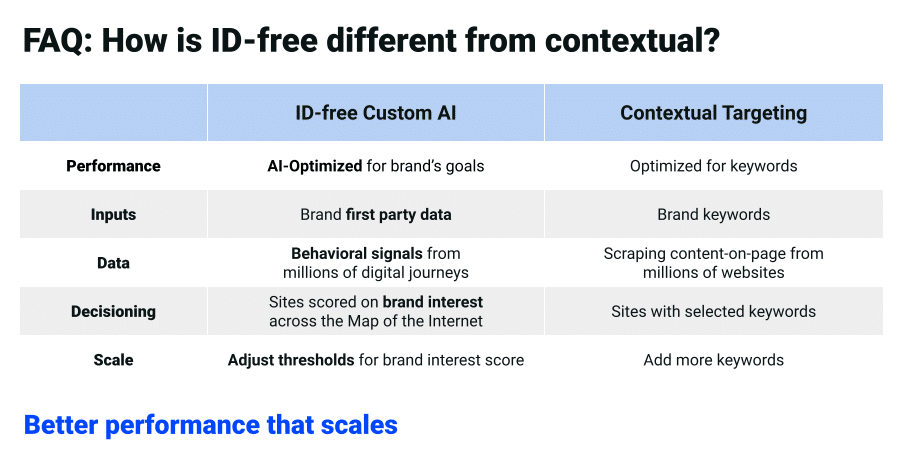
Unless you’ve been living under a rock for a few years, ignoring the clamor for cookieless and ID-free ad targeting has been impossible. The accelerating noise level won’t be put off by anything that Google does or doesn’t do, nor will any other industry titan “solve this” for our whole ecosystem. At Dstillery, we decided to take Privacy matters into our own virtual hands and boldly go where no other AdTech company has gone. We invented a truly ID-free® technology that is now the only ad targeting tech of its kind on the market that’s truly without identifiers. No alternate IDs, no ID-based probabilistic IDs, no bait-and-switch fingerprinting tactics. And unlike contextual, we’re not reading words on a page. Instead, Dstillery’s ID-free uses predictive behavioral signals to understand the best inventory moments on a given website.
Will the real ID-free please stand up?
You’re looking to cut through the clutter. You’ve heard enough noise about whose solution is the “real ID-free”. Now, we have something for you and you don’t have to just take our word for it. That’s because at Dstillery, we’ve earned both a patent* for our tech and the registered trademark for our name. Yes – The USPTO – unconfined by all the shackles and shortcomings of AdTech vernacular – has definitively decided that our ID-free is THE ID-free.
Show me the Money.
If you’re a senior media professional in a programmatic agency, you and your Brand Marketer counterparts control your digital media budgets. Based on your campaign’s goals and your values on Privacy, you may be interested in finding an ID-free ad targeting solution that performs on par with the ID-based stuff. And as such, you have choices. We invite you to test drive our ID-free. Compare it to ID-based. Test both of ours together to gain 80% more reach. Scour the market to find other ID-free wannabees.
We think you’ll find that nearly one hundred of the Fortune 500 and a monthly average of 150 major media agencies can’t be wrong. We’ve got something and we want to share it with many more of you.
New capability makes it easier to integrate ID-free™️ into advertising campaigns
NEW YORK, Aug. 11, 2022 – Dstillery, the custom audience solutions company, announced today the activation of its ID-free Custom AI solution on any demand-side platform (DSP) via Deal IDs. This new targeting vehicle, made possible in partnership with Microsoft (formerly Xandr), using their curation platform, Microsfot Curate, offers a flexible, easy-to-activate private marketplace (PMP) option that expands the use of ID-free.
ID-free Custom AI
ID-free Custom AI is a patented, privacy-by-design targeting solution that works by reaching inventory, not users, across all internet browsers. It’s a new category of targeting that uses AI to predict the likelihood of conversion based on privacy-safe behavioral signals like URL, geographic area and time of day. ID-free gives agencies and brands the ability to deliver advertising performance that rivals today’s best cookie-based solutions without user tracking. ID-free is neither a new identifier nor is it contextual targeting.
Deal IDs
A Deal ID is a container for inventory that is defined on the supply side to identify relevant impression opportunities, and can be used to express targeting today, and in the cookieless future.
“As programmatic buyers look for alternatives to cookie-based targeting, Deal IDs provide an opportunity for enhancing the distribution of ID-free Custom AI in their strategy,” said Evan Hills, SVP of Strategy & Partnerships, Dstillery. “We’ve already demonstrated the power of ID-free through our buy-side partners – availability via deals will bring even more programmatic media buyers into the fold.”
Through the Microsoft Curate platform, Dstillery will create easy-to-use Deal IDs that offer the same privacy-safe targeting available previously exclusively via APIs on DSPs.
“The agencies buying on our platform are eager for these curated deal IDs, because they’re a critical part of how brands will connect with consumers moving forward as the identity landscape continues to evolve,” said Chris Cattie, Associate Director, Xandr. “With Deal IDs, Dstillery has made it a frictionless experience to tap into rich, privacy-friendly targeting, and we’re proud to be able to provide the platform to help make that possible.”
Digital marketing firms, such as Distillery client KORTX, are already experiencing success using the deal ID method.
“With Deal IDs, we can connect without an external API integration for programmatic ad buys, which means ID-free audiences are easier than ever to activate for clients like Tropical Smoothie Cafe. Since we began using ID-free to help drive more purchases to Tropical Smoothie in March, we’ve experienced a $14.34 CPA for Display and $62.33 for Video, rivaling or even beating results from previous ID-based campaigns. We are proud to be Dstillery’s first partner for execution on Xandr,” said Bryan Presti, Senior Ad Ops Specialist at KORTX.
Deal IDs are now available for all of Dstillery’s ID-free audiences, which include Custom AI, Pre-built and custom-built. To learn more about Dstillery’s ID-free Custom AI, visit www.dstillery.com/blog/dstillery-product-updates.
About Dstillery
Dstillery, the custom audience solutions company, empowers brands and agencies to reach their best customers across the programmatic web. Backed by our award-winning data science, Dstillery has earned 16 patents (and counting) for the AI technology that powers our precise, scalable solutions. Our newest innovation, ID-free Custom AI, is a privacy-by-design behavioral targeting solution that performs on par with cookies — without user tracking. Our ID-based premier product, Custom AI Audiences, is a just-for-your-brand targeting solution that continuously scores hundreds of millions of users to deliver the best audiences for your brand. To learn more, visit us at www.dstillery.com or follow us on LinkedIn.
About Xandr
Xandr, a part of Microsoft Advertising, powers a global marketplace for premium advertising. Our data-enabled technology platform, encompassing Xandr Invest, Xandr Monetize, and Xandr Curate, optimizes return on investment for both buyers and sellers, while maintaining a commitment to an open marketplace and empowering the open web globally.
About KORTX
KORTX is a digital marketing and data strategy company based in Detroit that provides customized media solutions for brands and agencies. As a minority-owned, independently held organization built from the ground up, KORTX has crafted products and services based on the needs and challenges of clients, and provides support through digital advertising, data strategy and data-inspired creative. KORTX is in the Inc. 5000, recognized as a “Great Place to Work”, featured on the Black LUMAscape, and NMSDC-certified. Visit www.kortx.io for more information.
Media Contact Raven Carpenter BLASTmedia for Dstillery dstillery@blastmedia.com 317-806-1900 ext. 171
This week, Google announced that it would once again delay its retirement of third-party cookies from the Chrome browser. Originally planned for 1Q 2022, Google had shifted the timeline to 4Q 2023 last June. Now, it is targeting 2H 2024.
Why the delay?
The reason Google gave is that its own post-cookie solutions, known as the Privacy Sandbox, will not be ready in time to provide the industry with a viable alternative to cookies by 4Q 2023 – a requirement for regulators focused on Google’s market power.
A further delay is not wholly unexpected. In fact, it has been consensus for some time in the programmatic ad industry that Google would not meet its timeline, and many believe that cookies will live on indefinitely.
But the industry momentum behind new targeting technologies is not exclusively about Google’s plans for cookies. Indeed, that is only the most visible element of a bigger, more fundamental industry movement towards privacy-safe digital advertising technologies, a movement that is unlikely to abate.
What does this mean for advertisers today?
That does not mean that we think advertisers ought to stop using cookies. Indeed, our point of view has been that advertisers should use that technology for as long as it is available, if it is delivering value for them.
It does mean, though, that we believe that advertisers should also be leveraging — or at a minimum, testing —the new technologies that the privacy wave has inspired. Among those technologies, there may be something better than cookie-based solutions that brands should be using today instead of or in addition to them.
Cookieless targeting is available now.
At Dstillery, we are super-proud of our cookieless targeting solution, which we call ID-free Custom AI™. The patented technology uses aggregate behaviors of consented users (from, say, a panel) to make predictions about what ad inventory is likely to convert for a specific brand. The accuracy of those predictions is on par with the accuracy of our high-performing user-based audiences, despite having no user histories and no ID in the bid request. And all of this at the scale that advertisers need.
ID-free has had a strong reception from the market and has unlocked a wave of innovation and growth at Dstillery. We have developed an ID-free targeting solution for the healthcare industry, which we call Custom Patient Targeting, that delivers privacy-compliant but highly accurate, scaled digital targeting to healthcare brands. We have launched targeting in new forms beyond user-based audiences, including custom bidding algos and Deal-IDs. And we have seen intense initial interest in ID-free from advertisers in Europe, where user targeting is constrained by GDPR.
Whatever Google’s timeline, Dstillery is well positioned today with the combination of best-in-class ID-based audience targeting products and easy-to-activate ID-free solutions that provide scale, performance, and precision in a privacy-safe way. Those solutions are available for activation here and now, and drive better performance than the most widely used cookie-based audiences.
The wave of privacy-inspired innovation that is underway will keep on rolling, regardless of whether cookie retirement happens or not. Advertisers would do well to ride that wave.
In the noisy digital world, ad relevance is crucial to reaching your target audience. Digital ads need to be approached carefully so as not to disrupt your potential customers’ online experiences. And with third-party cookie retirement on the horizon, digital marketers should evaluate new cookieless advertising strategies to ensure their ads are being seen by the right people, at the right time.
Contextual and behavioral targeting are two techniques that you should be testing now. Neither requires cookies, both are privacy-safe, and when implemented correctly, these can be highly effective for reaching your target audiences.
What is contextual targeting?
Contextual targeting is a form of digital advertising that places display ads based on a website’s content. We’ve all seen them. It’s the reason why you’re served a meal kit delivery ad while browsing a recipe website, or a bridal gown ad on a wedding planning blog. Contextual targeting is the digital form of running a printed ASICS ad in Runner’s World magazine. The process matches display ads to relevant websites based on keywords, topics, and context.
What is behavioral targeting?
While contextual targeting relies on keywords and topics, behavioral targeting is based on a user’s online behaviors. By analyzing online browsing habits – i.e. sites visited, search queries, purchase behavior – behavioral targeting leverages user data to create a more personalized experience.
Timely and effective advertising requires a deep understanding of your audience. Behavioral targeting does just that by going deeper than website content.
To get ahead of the retirement of third-party cookies, we created a privacy-by-design, behavioral targeting solution called ID-free®. Instead of reading the words on a page or scraping content, our behavioral solution picks up on other signals that reflect brand interest by using AI optimization toward a client’s first-party data. Unlike standard behavioral targeting, ID-free takes advantage of predictive behavioral signals without tracking your audience. ID-free evaluates individual impression opportunities to provide intelligent decisioning without compromising anonymity, resulting in better performance that scales.
As long as first-party data is available, ID-free audiences can be implemented in your next campaign. Whether you’re looking for a behavioral targeting solution or want to future-proof your ad campaigns, now’s the time to test. Contact us today to learn more.
As marketers everywhere heard the news that Google was sunsetting third-party cookies in late 2023, we asked ourselves, “How will we measure attribution in a cookieless future?”
Historically, marketing value has been tough to track. The advent of cookies and behavioral signals finally gave the industry a firm way to measure message impact and attributed success across multiple channels. Cookies have allowed marketers to personalize user experiences, recommend products, and increase sales, but a global emphasis on privacy and security means behavioral tracking as we know it is changing.
Removing Cookies Affects a Majority of Internet Users
The majority of internet users are on Chrome — 68.1% on desktop and 61.5% on mobile. This is why Google’s decision to double down on user privacy was met with panic across ad tech. However, Tech giants like Apple and Facebook (or Meta) are also strengthening the walls around their user data. This offers marketers a true glimpse into a very private future internet landscape. Meta even provides a specific glimpse into its privacy progress report in a constantly updated platform.
Cookies allow brands to track at scale, while historical measurement tools inherently offer smaller, user-based audiences. The end of widespread, third-party tracking lets brands realign with their traditional positioning and value.
Establishing Brand Positioning and Value in a Cookieless Future
For years, marketers have relied on third-party cookie data to tell them who their audience is — from ages to locations. Gone were the days of focus groups, one on one interviews, and benchmark studies. Suddenly, we had more data at our fingertips than we ever could have dreamed of.
As Al Ries and Jack Trout’s classic marketing text Positioning, the Battle for your Mind explains, brand positioning is the place it occupies in the prospect’s mind. With the retirement of cookies, it begs the question: Did we ever need all of this data to tell us who our customers are? Is it sufficient and even more authentic to simply know audience size and that the product is loved? Can we not simply build brand positioning as we once did?
The Future of Attribution in a More Private World
Looking to a cookieless future, experts encourage a shift to a wider range of data sources and technology to discover consumer interests and maintain cost-effectiveness, according to Marketing Week.
Dstillery’s ID-free Custom AI™️ solution is designed to do just that. With our privacy-by-design behavioral targeting solution, the sunset of cookies becomes less frightening and more of an opportunity to innovate.
As marketers are challenged over the next few years to shift their attribution models, we’ll all be challenged to polish up KPIs and brand measurement standards. We must continue revamping our strategies for a privacy-centric world.
In a recent Gartner article, How the CMO Role Has Evolved – and What’s Next, VP Analyst Chris Ross refers to the role as having “undergone a head-spinning transformation over the last decade.” In the next 5 years, Ross contends, the CMO role will become even more challenging with expectations for supporting the scope, speed, and complexity the business requires… with the need to “measure and optimize everything they do.”
Add a global pandemic to the equation and the stakes get even higher. In the 2021 Forbes article, 4 Ways the Role of the CMO Has Changed As a Result of the Pandemic, author Greg Salmon contends that CMOs need to “address the fact that we face uncertainties and volatilities as never before.” So where do CMOs turn for advice, future planning insights, and flat-out answers? If there’s one thing that hasn’t changed, it’s where an agency can add its greatest value: Solving problems beyond a brand’s in-house capabilities or expertise.
Enter the Challenge of The Cookieless Future.
Few agencies would offer that they have “the answer.” Meanwhile, marketers, at all levels, readily admit that they need those answers to run successful campaigns in the future. A future that’s rapidly approaching. It’s not an overstatement to suggest that addressing the cookieless future, ahead of third-party cookie deprecation, is essential to capturing growth.
IAB’s Internet Advertising Revenue Report, issued earlier this week, shows programmatic advertising growing at 39% YoY, with its share of total digital revenue increasing 52.3%. Outside of media, the ad agency business would be hard-pressed to identify another direct-path-to-growth that exceeds that trajectory. But what happens when data-driven digital advertising faces a dearth of the very data it has come to rely upon for decades?
The 5 questions CMOs should be asking their agency partners.
CMOs, Heads of Marketing, and any marketer responsible for their brand’s growth should be asking these 5 questions, to prepare for the cookieless future:
To understand changes in data privacy: What’s happening, when, and how will it affect my campaigns?
Data Partners offer options: Are we confident we have the right partners to deliver optimal audiences?
Planning Strategy: What near- and long-term media strategies do you recommend?
Testing Now: What plans are in place to test cookieless solutions now?
Measurement: How are we monitoring performance and measuring successful results, comparing to cookie-based campaigns?
In our own Dstillery ID-free research**, the findings suggest a not-so-surprising range of concerns. What IS surprising is that for every concern that marketing leaders and agency media professionals cite, the solution is merely to develop a preliminary plan and begin testing. Consider how a team approach, where CMOs and their marketing teams work with their programmatic agency partners to plan and run cookieless tests, would address our clients’ key issues:
A. “I don’t have a plan” B. “Unsure how cookieless works” C. “Worried about measurement”
CMOs and any marketer embracing their role in driving growth, have not only the right, but arguably, the responsibility to test and share learning with their organizations.
*Marilee Adams Ph.D., President and CEO of the Inquiry Institute, Originator of the QUESTION THINKING™ methodologies **Source: Research conducted by Dstillery via Linkedin Polls, Dstillery Digest and 1:1 customer interviews, October 2021- April 2022
Data-driven digital advertising in 2021 means working in a world where everything is changing, always. The biggest recent change for advertisers is the extended timeframe for the planned retirement of third-party cookies.
Even with this change, it’s clear that the industry’s future is based on opt-in identifiers, rather than default-on tracking. Lots of advertisers spent a year scrambling to get ready before Google provided an additional two years to prepare for losing cookies entirely. However, the addition of more time hasn’t changed advertisers’ goals. They must prepare for the future and optimize for today, all at the same time.
These two needs are at odds. How do you optimize actions for today and tomorrow simultaneously? How can you prepare for a cookieless future without giving up performance benefits prematurely?
The answer: Do everything.
Think like Zaila Avant-garde, the winner of the 2021 Scripps National Spelling Bee and a multiple Guinness World Record holder. Avant-garde can dribble six basketballs at once. Fortunately, marketers won’t have to do that. But they do need to think about a targeting strategy that uses multiple approaches to finding their best audience. The trick is to balance these approaches in an optimized digital advertising targeting portfolio.
Your Digital Advertising Targeting Portfolio
Digital advertisers generally run lots of tactics at once, and most have testing and scaling phases for new tactics. This is a great practice to maintain in order to explore new emerging approaches. But it’s not what we mean when we talk about an optimized digital targeting portfolio. We’re talking about a portfolio of tactics that gives you the best possible performance now. And the good news is this portfolio is likely to include approaches that also prepare you for tomorrow.
This is because some post-cookie solutions work well enough to improve ROI and performance right now if allocated correctly. As the landscape transitions away from cookies over the next two years, the optimal allocation of these post-cookie solutions will change. Right now, cookies drive the strongest performance. Somewhere between now and mid-2023, there will be a point where cookies aren’t gone yet but more post-cookie solutions are ready to use at a scale beyond what would make sense today.
The optimal portfolio will keep changing over time, and at every point, it will make sense to use both cookie-based and post-cookie solutions. Start by choosing what to include in your portfolio; Including today’s best solutions as well as the solutions you’ll want post-cookie keeps you prepared for the future. Then optimize for any scenario by turning those knobs to dial up the solutions you need.
The Dstillery post-cookie solution
One way to start strengthening your portfolio now is by adding Dstillery’s ID-free Custom AI cookie-less solution.
ID-free Custom AI is a privacy-first behavioral targeting solution that performs on par with cookies and reaches users without using an identifier. Because ID-free doesn’t use identifiers, it works on any browser, today and in the future.
Best of all, it works, at scale, and can (and should) be used to complement ID-based solutions.
ID-free Custom AI takes a similar approach to what we’ve been using for years to build our ID-based Custom AI audiences. We’ve just reapplied the technology to ID-free signals. Big picture: this is a privacy-friendly approach to targeting users, without any kind of ID, by identifying the impression opportunities that drive performance.
This solution works so well in a portfolio alongside ID-based solutions because it’s a true complement to those approaches. ID-free signals are based on the impression opportunity, rather than persistent information about the user. Since it uses separate signals to make decisions, the ID-free approach is able to take advantage of opportunities that ID-based solutions miss. It remains to be seen how much inventory will be sold without any IDs after cookies are fully retired, but one thing we know for sure is identifier-free inventory will exist in that world, because it already exists today. Running Dstillery ID-free Custom AI in a portfolio along with ID-based solutions is an easy way to improve your ROI today, and be prepared to turn the dial to stay optimized in the future.
We are proud to announce our 16th patent awarded for visionary techniques that will help guide marketers into a post-cookie future, officially titled “Artificial Intelligence and/or Machine Learning Models Trained to Predict User Actions Based on an Embedding of Network Locations.”
Our newest patent describes an approach for advertisers to deliver targeted advertising in a privacy-friendly manner, to users without any identifiers or cookies.
The patent grant is especially timely in light of Dstillery’s development of its ID-free solutions, designed to help agencies and brands target digital advertising effectively without the use of third-party cookies or any type of user IDs.
Google’s latest announcement that it will delay the deprecation of third-party cookies on Chrome extends the timeline for advertisers to solidify their plans for post-cookie targeting. During this exploration and testing period, it is essential for marketers to put in place solutions that address inventory where user IDs are available, using new post-cookie identifiers, and to reach inventory with no available identifiers. Dstillery’s ID-free solutions will prepare advertisers for any future digital advertising landscape.
There’s been a great deal of hand-wringing over the future of identity in digital advertising. Google Chrome’s plan to retire third-party cookies and Apple’s move to make IDFAs opt-in have kicked off what, to many, feels like a crisis for digital advertising.
Google’s recent announcement that it won’t provide alternate user-level identifiers is just the latest indication that we are well within an inexorable shift towards an opt-in world. This world is one where the only industry-accepted (and, in increasingly many jurisdictions, legally-accepted) means of addressable digital targeting is through an ID which the user has explicitly opted-in to using.
To be clear, there will be alternate user-level identifiers, just not built or used by Google. That horse race is well underway and will continue, unaffected by this news from Google. But new identifiers are not going to solve the ad world’s problems. Google’s announcement confirms that we won’t see one built into Chrome, and without the penetration provided by being default-on in a major browser, no new identifier will fill the hole left by cookies.
With the looming Chrome change in 2022, the frogs felt the water warming. Targeting remains possible, so there hasn’t been much urgency. But now that the identifiable internet is about to be reduced to a fraction of its size, the water is boiling. Advertisers need an escape, and switching to another identifier is the same as jumping to another pot. The only way off the hot stove is for advertisers to break free of identifiers as much as possible.
Insufficient replacements for third-party cookies
“Replacement” identifiers are jockeying for position, and are expected to provide precise targeting and granular measurement. The key improvement in these solutions is that the user consent is clear and explicit.
These replacement identifiers are built by companies other than the browser vendors and were never expected to be a Chrome-built browser feature, so to the extent that they are adopted by publishers and users, they will work regardless of whether Google buys into this philosophy.
Still, even before Google’s move this week, it would have been a mistake to think of these new opt-in identifiers as full replacement solutions. Any advertiser who plans on relying on these new identifiers to solve their problems needs to ask themselves, just how many of these impressions will be available? And am I willing to tie my campaign’s success to that number?
The availability, penetration, and number of impressions available with those solutions will depend on a number of factors, including publisher adoption and user behavior around opt-ins.
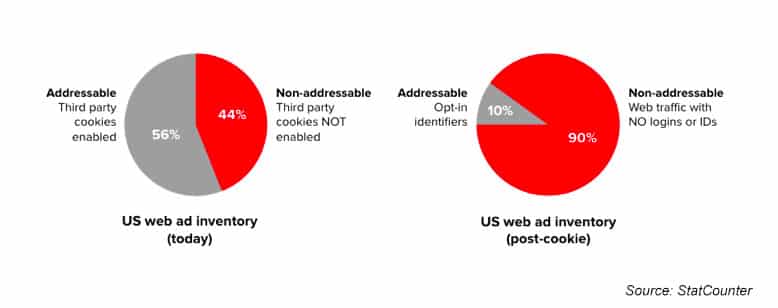
Certainly, the number of display impressions that can be targeted based on an addressable ID will be far less than today’s 56%. (Currently, about 44% of US internet users are already using web browsers without third-party cookies enabled.) The most ambitious estimates put the number of addressable impressions at around 30%, while many publishers believe 10% is optimistic. Whatever the end state, it will require a long adoption ramp-up, not a flip of a switch.
Think about that: Up to 90% of all display impressions will have no ID attached to them. Though the details remain uncertain, it’s clear that the replacement identifiers will not be enough. In order to effectively target at scale in the post-cookie world, advertisers need to adopt a portfolio of approaches that includes solutions to intelligently target ads where no identifiers are available.
Getting used to a non-identifiable world
The time to reach beyond addressable impressions is right now, before third-party cookies are retired from Chrome in 2022. Since 44% of US web impressions don’t have any IDs, smart, identifier-free targeting solutions could improve scaled performance immediately. Consider Safari users, who already exist outside the cookied universe. These consumers are on Apple products, which makes them highly-desirable, and it’s possible to reach them through a diversified approach.
Why is most of the industry still waiting to adopt identifier-free targeting solutions? The answer is measurement. It remains one of digital advertising’s key promises, which is why the industry has remained hooked on identifiers up to this point.
Google’s Chrome team has promised that a new measurement method will be in place before cookies are retired. But remember, Google can’t control what Apple, Mozilla, or others do with their browsers. After cookies are gone, targeting on the web without user IDs requires buying inventory that lacks a precise measurement mechanism.
But the other option, the choice most advertisers are already making, is sacrificing scale. Today, dedication to device-level measurement means ignoring more than 40% of online consumers on the web. In the very near future, they’ll have to decide whether they’d rather ignore 70-90% of online consumers, or have fuzzier measurement across 100% of potential customers.
A “fuzzier” measurement solution might mean extrapolating performance into the non-addressable web, or using a more traditional measurement framework like media mix modeling. Yes, this feels counter to everything we’ve gained in the last decade of hyper-granular data collection and analytics. But most brands will actually see a better ROI when they expand their views and target across the entire internet at its full scale. Even better, adopting an identifier-agnostic strategy now will leave advertisers well positioned to deal with the continued shift towards opt-in identification across all digital environments, not just the web.
While looking ahead is frightening, remember that we’re starting at a point where roughly half of the online audience can’t be identified, right now. Waiting around for new identifiers only limits advertisers even more.
The lost opportunities have already arrived, via browsers like Safari. Why are advertisers abandoning huge segments simply to maintain the status quo, and why continue doing so? The water is about to boil, and advertisers need to decide whether to stick around, jump to a new pot, or get off the stove altogether.