testCategory: Cookieless

How Does ID-free® Differ from Contextual Targeting?

Back in January 2020, when Google first announced its intention to deprecate third-party cookies, marketers and advertisers started exploring alternative strategies to reach audiences effectively. And while third-party cookies are technically still here, the need for new privacy-safe targeting solutions remains.  

Two popular approaches are ID-free® targeting and contextual targeting. While both methods help deliver privacy-friendly advertising, they are distinct in how they operate and how they identify the best audiences.

Understanding ID-free Targeting

Dstillery’s patented ID-free targeting is a revolutionary technology that employs a totally different approach than basic content analysis. ID-free targeting is rooted in data science and machine learning, leveraging sophisticated algorithms to find the right audiences without relying on any form of personal identification, cookies, or device IDs. By analyzing the aggregated behaviors of an anonymous consumer panel, such as browsing behavior, content consumption, and time of day, ID-free targeting finds your best audiences based on behavioral inventory signals. What’s more? ID-free predicts which sites are likely to convert for your brand without any user profiles or tracking.

The power of our ID-free technology lies in its ability to be adaptive and intuitive. It allows advertisers to reach users who are most likely to engage with their messages, based on patterns of behavior that indicate interest, rather than matching specific topics or keywords. This level of precision not only enhances campaign performance but also meets the growing need for privacy-safe solutions.

What is Contextual Targeting?

Contextual targeting is an advertising method that involves placing ads based on the content of the webpage, or the context in which the ad is served. For example, an ad for gym clothes might appear in a blog article about workout routines. This approach uses keywords, page topics, and sentiment analysis to ensure that ads align with the content that users are currently viewing.

While contextual targeting can effectively place ads in relevant environments, it is limited by its reliance on immediate content. It does not account for user behavior beyond the current page the way ID-free does which will cause advertisers to miss out on reaching pertinent audiences.

Contextual targeting is a good way to understand the keyword clusters an audience member might search for along their digital journey. However, if you craft a deep profile of understanding around your audience, only a tiny fraction of that audience will be targeted by contextual solutions. 

Key Differences Between ID-free and Contextual Targeting

ID-free technologyContextual Targeting
Audience PrecisionLeverages complex data science techniques to identify ideal audiences based on anonymous behavioral signalsMatches ads to specific content, ignoring interest patterns or user journeys 
Privacy StandardsPrivacy-safe, does not rely on any personal dataPrivacy-safe 
AdaptabilityDynamically adjusts to shifting behaviors and trends in real-time, enabling brands to stay relevantTied to specific page content and may not capture broader audience interest shifts

Choosing the Right Solution for Your Brand

As more and more people opt out of cookies, it’s crucial to understand the differences between ID-free and contextual targeting. While contextual targeting is effective in aligning ads with relevant content, ID-free offers a powerful alternative for brands and their agencies aiming for audience precision without sacrificing privacy. 

If you’d like to test ID-free targeting in your next campaign, reach out to get started.

Cookies are Here to Stay

Google’s decision to abort its retirement of third-party cookies from Chrome is kind of like President Biden’s decision to withdraw his candidacy for president. It is a massive fundamental shift in direction, but at the same time it is really not surprising at all.

In its announcement, Google indicated that though cookies will remain, it will take steps to ensure that consumers have more control over their personal data, yet telegraphing that data collection will be more difficult for the adtech industry. Combined with other privacy-related developments, this will pressure the quantity and velocity of user data in the adtech ecosystem. But that loss of signal will now be a steady and manageable decline, rather than a cliff.

Google’s plan to retire cookies has inspired a lot of innovation over the last four years, and there is no putting that genie back in the bottle. There are new, privacy-safe technologies like Dstillery’s ID-free® behavioral targeting in the market, and the overall trend toward higher privacy standards, if it continues, will open up opportunities for those that perform to thrive, regardless of the continued existence of cookies.

A collective sigh of relief

That said, I suspect that brands and their agencies are breathing a collective sigh of relief. The transition from cookies to something else was always going to be hard, and messy.

Media agencies are enormous, distributed and complex operations, and their workflows, partners and tools all had to adapt. Scale of the alternatives was a question. Some of the alternatives, like probabilistic IDs, had problematic privacy credentials of their own. And measurement was going to be challenging. Brand KPIs were going to break. Essentially, the fabric of the programmatic ad industry needed to be rewoven.

Media agencies had little control over this process, and not much choice. Like the adtech industry, they were being forced to adapt to the agenda of a large and powerful industry platform. The industry had done an admirable job preparing for this future, and had invested significant brain power, people hours and dollars to make this transition.

Despite all of that investment, there was still a great deal of uncertainty about how exactly this transition would unfold. The risks, uncertainties and operational challenges that accompanied cookie retirement from Chrome, and the headaches that created for media agencies, can now be pushed to the back burner.

Rebalancing our attention

From Dstillery’s perspective, we recognize the magnitude of this shift in the industry’s agenda.

We said at the beginning of this year that 2024 for our industry would be a year like no other, and that the only thing we knew for sure was that there would be a lot of change. From the halfway point of the year, it has lived up to its billing.

Dstillery is uniquely positioned, in that we can provide highly effective targeting solutions with or without IDs, and we are rebalancing our attention across our portfolio.

Our cookie-based audiences continue to deliver best in class performance, and we see opportunities to invest in new types of seeds, new modes of activation, new modeling technologies, and new distribution. Our ID-free targeting provides privacy-safe targeting solutions for parts of the market where that is important, and through our Predictive Bidding actually drives superior scale and performance to even our best cookie audiences.

Together, our ID-based and ID-free targeting solutions can fulfill the targeting needs of our programmatic partners and advertisers, with or without cookies, and we are excited for the new opportunities that this most recent shift will bring.

4 Simple Decisions to Unlock Your Post-Cookie Targeting Strategy

The rise of AI and the fall of the cookie together are creating profound change for the programmatic advertising industry. With Chrome’s deprecation of third-party cookies now just months away, nearly every part of the ecosystem needs a plan to adapt its programmatic execution to the new reality.

The result is a seemingly endless swirl of technologies – new and old – with an increasing number of AdTech companies claiming to have the solution. The cacophony of pitches and promises is dizzying, and many marketers are understandably paralyzed by the chaos of the marketplace.

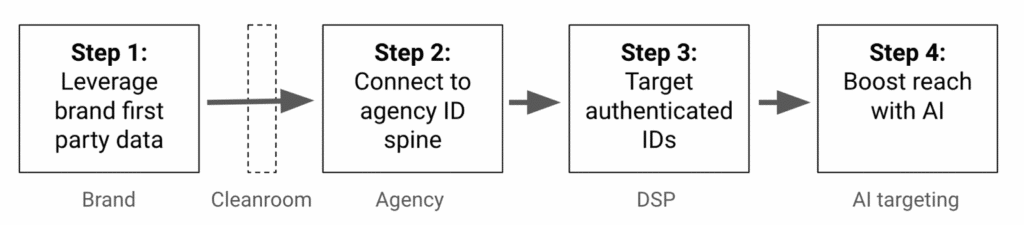
While there is definitely some complexity, a simple four-step approach will allow brands and agencies to clarify and unlock their post-cookie targeting strategy.  

4 simple steps

1. Leverage brand first-party data.  Building closer relationships with customers is always a good thing, and a strong first-party data set is a solid foundation for post-cookie success. But it is only a first step.  

2. Connect to agency identity spine.  Media agencies of all sizes have been building (or buying) identity spines that provide them with a broad understanding of mostly offline consumer behaviors, and deep demographic, psychographic, and behavioral profiles. Brands can connect their first-party data with these larger data sets via clean rooms to provide a privacy-safe path to activation.

3. Target authenticated IDs. There are a number of emerging alternative IDs that let advertisers find their customers, or lookalike customers, in the digital advertising ecosystem.  Authenticated IDs like UID2 will drive performance that is superior to the less-precise third-party cookies, and will be a fundamental pillar of cookieless programmatic execution. Allocate the first budget dollars here for precision 1:1 targeting and measurement.

4. Boost reach with AI (this is where the magic happens!).  Authenticated IDs are unlikely to deliver the scale of third-party cookies, so advertisers will need to spend more against impressions without IDs to drive reach and deliver brand KPIs.  Some will default to classic contextual solutions, but new and emerging AI-driven targeting technologies offer a better way to fill the gap in reach left by cookie retirement.  Delivering scale and performance that’s superior to contextual, they complement authenticated IDs by using the same behavioral signals and extend reach to the growing proportion of impressions without IDs.  These innovative AI-driven technologies are the key to delivering reach, budget efficiency, and consumer privacy in a cookieless world.


Simplify your post-cookie targeting strategy

To simplify their approach to post-cookie targeting, brands should select best-in-class technology/partners at each step of this process.  Choose your cleanroom partner, leverage your agency’s ID spine, work with your DSP in the authenticated space, and choose your AI reach boost partner.  

Surely, there is a lot more complexity to work through than captured in this deliberate oversimplification.  But by breaking the problem into just a handful of key decisions that fill the gaps left by cookie retirement, brands can create order from chaos, break the paralysis, and start executing an effective post-cookie programmatic targeting strategy. 

FAQ: ID-free®

Explore how Dstillery’s ID-free® targeting, an AI-powered technology that predicts ad impressions without user tracking, can enhance your programmatic campaigns in our frequently asked questions.

What is Dstillery’s ID-free® targeting?

ID-free is an AI-powered targeting technology that predicts the best ad impressions for a brand without any user tracking.

What problems does ID-free solve?

ID-free delivers performance and scale for advertisers’ programmatic campaigns. It also solves user privacy issues by not tracking users or creating user profiles. This makes ID-free a perfect solution for cookie deprecation and any privacy laws or regulations, including GDPR.

What are the use cases for ID-free?

ID-free is proven to drive both performance and scale. It can be modeled and optimized across the marketing funnel for most key performance indicators (KPIs), but it is most commonly used for upper-funnel campaigns driving qualified reach. By adding predictive bidding on The Trade Desk, it can also deliver up to 2.5x the performance of cookies for mid- and lower-funnel campaigns (more on this below).

What makes ID-free different from competitors’ solutions?

ID-free solves problems like performance, scale, and privacy for advertisers today. It’s not contextual nor an alternative ID; it’s patented technology in a category of its own.

ID-free uses AI to learn privacy-safe browsing patterns and applies these insights to inventory targeting. Think of it like this: ChatGPT understands words based on their use in a sentence. Similarly, ID-free understands website visits based on how they appear in browsing patterns. The result is privacy-safe behavioral targeting that reaches any display, in-app, or CTV ad impression with or without IDs.

How can I activate ID-free?

Partnering with Dstillery lets you choose the best ID-free activation method for your brand.

Activate via:

PMP directly on your DSP.

Predictive Bidding supported by The Trade Desk. Rather than making binary ‘buy’ or ‘don’t buy’ decisions, our AI predicts the precise value of each impression to your brand and exactly how much you should pay for it, maximizing every ad dollar.

Contextual Integration found in The Trade Desk’s contextual marketplace.

How do I get started?

You can buy off-the-shelf ID-free audiences today on your DSP. If you’re looking for a custom, first-party data-powered ID-free audience, contact your Dstillery representative today or click here to get in touch.

Exploring Predictive Behavioral Targeting: What It Is and How It Works

In the fast-paced world of digital advertising, the ability to anticipate customer behavior isn’t just an advantage — it’s a game-changer. Predictive behavioral targeting offers advertisers a powerful way to unlock this potential, ensuring ads don’t just reach an audience, but the right audience at the right moment. But how exactly does predictive behavioral targeting work, and why should it be a part of your advertising strategy? In this blog, we’ll dive into the fundamentals of behavioral targeting and how predictive models can supercharge your campaigns.

Understanding Predictive Behavioral Targeting

What is behavioral targeting, and how does it differ from other forms of advertising? Simply put, behavioral targeting is a technique that uses data from a user’s online behaviors — such as search terms, website visits, or online purchases — to show relevant ads to individuals. The goal is to ensure the right message reaches the right person at the right time. 

However, predictive behavioral targeting takes this a step further. It involves using machine learning algorithms and AI to predict future behaviors based on past actions. So, instead of just responding to customer behavior after it happens, you’re anticipating it, offering a more personalized and timely experience without compromising user privacy. 

Examples of Behavioral Targeting

For example, if users frequently visit travel blogs and airline websites, predictive behavioral targeting might serve them ads for vacation deals, travel insurance, or hotel stays. Similarly, if someone has shown interest in fitness equipment, they may start seeing ads for gym memberships or nutritional supplements.

With predictive behavioral targeting, advertisers can go beyond simple demographic data and tap into the evolving preferences and needs of their audience, ultimately increasing engagement and conversion rates.

To learn more about how behavioral targeting is different than contextual targeting, click here

How Predictive Behavioral Targeting Works

The mechanics of predictive behavioral targeting rely on data analytics, machine learning, and AI. By analyzing massive datasets, algorithms can identify patterns in user behavior and predict future actions. 

Here’s a breakdown of how it works:

1. Data Observation: The process begins with collecting and observing data from various sources such as website interactions, purchase history, search queries, and social media activity. This data is critical for building a profile of each anonymous user.

2. Data Segmentation: Once the data is collected, users are segmented into different groups based on shared behaviors or characteristics. For example, users who frequently visit luxury car websites would be grouped as “high-end car buyers.”

3. Prediction Models: Using machine learning algorithms, the targeting technology then predicts what actions users in each segment are likely to take. For instance, it might predict that a user is likely to purchase a product within the next 30 days based on their previous browsing habits.

4. Ad Delivery: Finally, personalized ads are delivered to these segments, ensuring the right message is sent at the right time, boosting the likelihood of engagement and conversion.

Benefits of Predictive Behavioral Targeting

Now that we’ve covered how it works, let’s look at the benefits of using predictive behavioral targeting in your advertising campaigns. This advanced form of targeting offers multiple advantages for businesses looking to optimize their existing and new ad campaigns, no matter the vertical or campaign objective. 

1. Increased Personalization: Predictive behavioral targeting allows for a more tailored approach to advertising. By understanding a user’s past behavior and predicting their future actions, brands, and agencies can create ads that resonate on a personal level, improving engagement rates and reducing wasted ad spend. 

2. Higher Conversion Rates: With highly personalized ads, customers are more likely to take action. Whether clicking on an ad or making a purchase, behaviorally targeted ads are proven to increase conversions compared to generic, one-size-fits-all campaigns.

3. Better Resource Allocation: By focusing on the most relevant audiences, brands and agencies can spend their ad budgets more efficiently. Rather than casting a wide net, predictive targeting ensures that resources are directed toward users who are most likely to convert, leading to a higher return on ad spend.

4. Improved Customer Experience: By anticipating the needs of users, predictive behavioral targeting can enhance the overall customer experience. Ads are no longer seen as intrusive but as helpful suggestions based on individual preferences.

Getting Started with Predictive Behavioral Targeting with Dstillery

If you’re ready to implement predictive behavioral targeting into your marketing strategy, Dstillery can help. Our patented ID-free® targeting technology is the industry’s only predictive behavioral targeting technology without IDs. It delivers scale, performance, and privacy for advertisers’ campaigns by using AI to predict the best impressions without user tracking. 

With ID-free, you can reach high-value audiences without relying on third-party cookies, ensuring your campaigns stay ahead as more and more users opt out of cookies. Start delivering ads that resonate with your audience and drive meaningful results.

Contact us to get started. 

Who cares about Google’s cookie timeline?

On April 23, Google delayed the deprecation of 3P cookies to 1Q 2025 due to concerns raised by the UK’s CMA (antitrust authority) and ICO (privacy authority). The delay itself is not terribly surprising, and the fact that it was only shifted by one calendar quarter does not seem material.

Nevertheless, and predictably for an industry as large and diverse as programmatic advertising, reactions in the marketplace have ranged the full gamut, depending on the commentators’ perspectives.  

The Google delays have become the story

Some skeptics have said with great conviction and a certain amount of schadenfreude that this delay is not the last and that there will inevitably be more. Maybe many more. 

At the extreme, some have embraced the idea that the series of delays indicate that full cookie deprecation from Chrome will never happen. These absolute denialists tend to be people and companies with a vested interest in the status quo, reliant on 3P cookies, unprepared for change, who would prefer that it never happens. Their opinion reflects their fears. 

Meanwhile, many journalists who cover Google and adtech make light of it, with quips about cookies crumbling or not. For them, the story has evolved beyond the ultimate demise of cookies and implications for the industry; it has become the story of ongoing delays. 

While these articles are clever and amusing, they in effect validate the skeptics’ views by focusing not on the impact of signal loss, but on Google’s struggle to actually make it happen.

The genie is out of the bottle

There is also a growing cohort of adtech companies who dismiss the continually shifting timeline as irrelevant. Many companies have been developing innovations inspired by the threat of cookie deprecation since early 2020, many of which have value propositions that go beyond just filling the gap left by cookies.  

These emerging solutions are now genies that are out of the bottle, and cannot be put back due simply to delays. Indeed, whether cookie deprecation ever actually occurs, new competing technologies will chip away at different functions cookies have served.  

At Dstillery, we clearly identify with this perspective.  Our ID-free® technology uses AI to do behavioral targeting without any user tracking at all.  It is 100% privacy compliant, with no consumer tracking or profiling via cookies or any other IDs.  What’s more, ID-free performs 2.5X better than cookie-based user targeting, and delivers significantly greater scale.

Whether or not cookies ever go away, we see a bright future for ID-free. 

Some of our clients are already using it as a standalone alternative to user targeting, with superior performance, scale and privacy.  

Some are using it to complement their user targeting, boosting reach while adding campaign efficiency.  

Some are using it to replace crude and less effective content-based contextual targeting.  

And some clients in the healthcare industry and in Europe are using it today to address privacy-based user targeting constraints that are particular to their industry and geography.

We have a lot more ID-free innovation in the pipeline, as do many of our adtech peers.  Our clients and partners are hungry for more.

While it is still highly uncertain, it seems safe to assume that cookies will be retired from Google’s Chrome within the next 12 months. But maybe not. Who cares? 

The genie of innovation is out of the bottle. The industry ought to focus less on debating Google’s timeline and more on the benefits from the wave of adtech innovation that it has inspired.  

Ready for a Cookieless Future? Check Out Our ID-free® Testing Guide

With cookie deprecation and cookieless testing top-of-mind for many media buyers, here is a quick overview of the best ways to set up and test Dstillery’s ID-free®, the only behavioral targeting solution without IDs. 

ID-free is a first-of-its-kind targeting technology that delivers performance, privacy, and scale by predicting the value of an impression to a brand without knowing anything about the user. This patented technology uses AI to learn from browsing patterns detected in de-identified opt-in panel data, ultimately answering the question: When someone visits a site, how likely will they be interested in your brand’s message?

Audience Definition

The first step is defining your target audience in your display, search, or CTV campaign. If you have used an ID-based Dstillery audience in the past and found it successful, you can simply request an ID-free version of the audience. If you haven’t, you can use a variety of signals such as first-party data, search terms, URL lists, or our catalog of thousands of pre-built audiences to seed your ID-free model.  

Campaign Setup

One of the most common pitfalls we see with testing is not allocating enough budget and time to allow the model to perform and optimize. We recommend three months for a proper cookieless test to truly understand how the audience performs against your KPIs. Beyond awareness metrics, ID-free excels in cost-per metrics such as:

  • Cost per action (CPA)
  • Cost per click (CPC)
  • Cost per complete view (CPCV)
  • Cost per site visit (CPSV)
  • Return on ad spend (ROAS)

In terms of budget, we recommend a $30,000 monthly budget in media – split out evenly between ID-free and ID-based versions of your audience – without highly restrictive inclusion lists and operating all hours of the day. These campaign parameters will allow you to truly understand and optimize your ID-free campaign with the most information available throughout the testing period.

Make the Most of Your ID-free Test

Our experienced Client Success teams can help you through all the details of creating a proper A/B testing framework. Beyond campaign parameters, to properly assess ID-free performance, efficiency, and scale, we recommend an A/B testing approach by running both ID-based and ID-free audiences in parallel. We recommend creating one line item for your ID-based audience and one for your ID-free audience. When creating these line items, try duplicating them rather than creating them from scratch. This ensures that various settings in your line items are identical, except for the singular variable (ID-based vs ID-free audience) you are testing. Also, since our industry still uses third-party cookies for attribution KPIs, we recommend targeting trackable Chrome inventory for both line items. 

Bonus Test to Assess Performance Outside of 3rd Party Cookies

Using conversions measured on trackable inventory, Dstillery can model the conversion rate per site across all domains specific to the campaign. Using this data, we can understand the performance of impressions delivered on inventory with no trackable identifiers. To learn more about this measurement, read our case study with Tombras, where we drove 2.5x more conversions than traditional cookie-based targeting.

Ready to test ID-free? Amazing. It’s available on every DSP. Contact one of our representatives to get started today.

Introducing Custom Search Lookalikes

custom search lookalikes

Dstillery is excited to announce the debut of our newest product, Custom Search Lookalikes. Custom Search Lookalikes were born from the observation that our access to unique search and retail signals and 2M+ opt-in panel data could be combined to create a targeting solution that answers the question, “When people search for a specific phrase, where else do they visit frequently on the internet?” – making it easy for brands to identify and target that hard-to-reach consideration audience.

How Did We Build Custom Search Lookalikes?

Powered by Dstillery’s patented ID-free® technology, Custom Search Lookalikes helps advertisers reach the people searching for their brands’ keywords on the inventory most likely to drive their campaign goal. Instead of relying on searches from limited publisher sources, this solution has privacy-safe visibility into consumers’ browsing patterns, including website visits and keyword searches on top search engines and retailer platforms. ID-free® learns these patterns and extends its understanding to all impressions on the internet, scoring and ranking every ad impression on its likelihood of targeting a person searching for a brand’s keywords. The model is available to activate as a PMP or custom bidding algorithm.

Get Started With Custom Search Lookalike Solutions

If you are interested in utilizing Dstillery’s Custom Search Lookalike solutions, one of our sales team members will work with you to understand your brand’s best keywords based on what your customers are most likely to search for. From there, we’ll build our model and learn the browsing patterns of those searching those brand keywords and build your custom model. After that, activation is as simple as activating a PMP; we’ll send the Deal ID directly to your seat in your DSP. We’re excited to make this product available to everyone. This product allows us to offer something truly custom without brands having to share their first-party data that is available the moment you need it. Contact us today to get started.

How to Thrive with Third-Party Cookies Going Away

In the ever-evolving world of digital advertising, staying ahead of the curve is essential to reaching your target audience effectively. However, with the impending demise of third-party cookies, advertisers face a paradigm shift in how they target their audience. This is where Dstillery comes into play as a game-changing solution for your programmatic ad targeting needs. Keep reading to explore the challenges the disappearing cookie brings and how we can help.

Cookies are Going Away

Third-party cookies have been a staple in the digital advertising world for years. They have enabled marketers to track user behavior, gather insights, and serve personalized ads to the right audience. However, growing concerns over privacy and the ever-evolving regulatory landscape have put cookies on the chopping block. Major web browsers, including Google Chrome and Safari, are phasing out support for third-party cookies, leaving advertisers with a looming void in their arsenal.

The Rise of First-Party Data

First-party data has become increasingly valuable, with third-party cookies on the way out. First-party data is information collected directly from your users, such as website behavior or interactions with your brand. This data is not subject to the same privacy concerns and regulations as third-party data, making it a crucial asset for advertisers.

Dstillery is the leading AI ad targeting company. We’re uniquely positioned to help you address the challenges created by the cookie’s departure and thrive without them.

That’s why we created ID-free®. ID-free is a first-of-its-kind targeting technology that delivers scale and privacy for advertisers’ programmatic ad campaigns. Our technology predicts the value of an impression to a brand without knowing anything about the user. The technology also uses AI to learn from browsing patterns detected in de-identified opt-in panel data. Just like how ChatGPT learns by predicting the next word in a sentence, ID-free learns by predicting the next website visit in an anonymous site visitor’s journey.

Neural network technology called the Map of the Internet (MOTI) powers ID-free. Using MOTI, we create a model that identifies the best impression opportunities. ID-free is the future of ad targeting without cookies. It’s an innovative one-of-a-kind targeting technology that delivers scale and privacy for advertisers’ programmatic ad campaigns.

Advertisers must reimagine their targeting strategies as the era of third-party cookies draws to a close. Don’t let the cookie crumble your advertising efforts; turn to Dstillery for a brighter, data-driven future in digital advertising.

Google Similar Audiences Going Away: What it Means and the Best Alternative

google similar audiences going away

Google recently announced the sunsetting of its Similar Audiences feature in May 2023. While this may come as a blow to advertisers relying on this feature to connect with relevant audiences, this move is necessary to keep up with changes in consumer behavior as the privacy environment rapidly evolves. In this article, we’ll explore why Google Similar Audiences are going away and the best alternative for advertisers.

What are Google Similar Audiences?

Similar Audiences are Google’s version of lookalike audiences, which work by finding individuals who exhibit similar online behavior to those in your remarketing lists, such as website visitors, customer lists, and video viewers. The feature can be used across all campaign types, including search, display, and video campaigns.
Google Similar Audiences analyzes users’ behavior patterns in a remarketing list and creates new segments of users who exhibit similar behavior. By targeting these new segments, advertisers can expand their reach and connect with new audiences more likely to be interested in their products or services.

Why are Google Similar Audiences going away?

Google is sunsetting Similar Audiences to help advertisers keep up with changes in consumer behavior and online marketing strategies as the privacy environment rapidly evolves. With privacy concerns becoming increasingly prevalent, Google recognizes that ad practices are becoming more restricted and regulated. As a result, the company is transitioning to more powerful, tested, privacy-centric automated solutions that will help advertisers connect with relevant audiences.

What is the Best Alternative to Google Similar Audiences?

There are various alternatives marketers can leverage once Similar Audiences are no longer available. Creating different types of custom audiences is the best way to use data from multiple sources, such as:

  • Website Visitors: users who have visited your website or specific pages on your website
  • Customer Lists: users who have purchased from your business or provided their contact information
  • App Users: users who have downloaded and used your mobile app
  • Offline Data: users who have interacted with your business offline, such as in-store visitors
  • Dstillery’s Custom AI Audiences: Dstillery’s Custom AI audiences are a lookalike alternative to Similar Audiences in DV360

Dstillery’s Custom AI Audiences

Dstillery’s Custom AI audiences are the perfect lookalike alternative to Google Similar Audiences. While the desired goal of expanding reach to find potential customers is the same, the methodology is quite different. We take a much more precise approach. Our Custom AI audiences score every unique device on its similarity to the brand’s existing customers to ensure the best prospects are part of the lookalike audience. By updating the audience with new data every 24 hours, Dstillery’s Custom AI audiences are always up-to-date, relevant, and ready to drive optimal performance goals.

While the sunset of Google Similar Audiences may come as a surprise, keeping up with the ever-changing AdTech industry is necessary. The sunset also presents an opportunity for advertisers to explore new tools and strategies to help reach their target audience and achieve their business goals.By staying up-to-date with the latest trends and best practices in online advertising, advertisers can continue to connect with customers and build successful campaigns.

To learn more about Dstillery’s custom audiences, contact us.