Given the fragmentation of the audience data industry, the sameness of adtech marketing claims, and the sea of cherry-picked case studies, answering that question has long been a pain point for buyers. But it does not have to be.
The Trade Desk objectively scores every one of the 1+ million audience segments in its data marketplace on 2 metrics:
1 – Relevance is a measure of how closely a segment matches the brand’s converters based on observed variables.
2 – Value is relevance per penny of cost.
Using these scores, buyers can optimize performance and efficiency by building their campaigns around audiences with the highest relevance and value. And every data company can use these scores to see how it stacks up vs the overall marketplace, and optimize its segments to drive better results for advertisers.
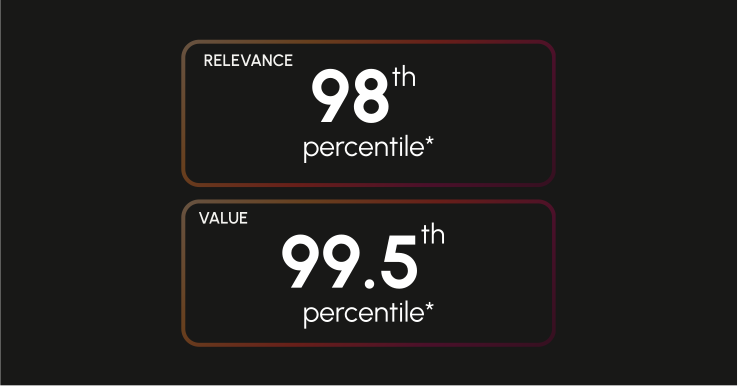
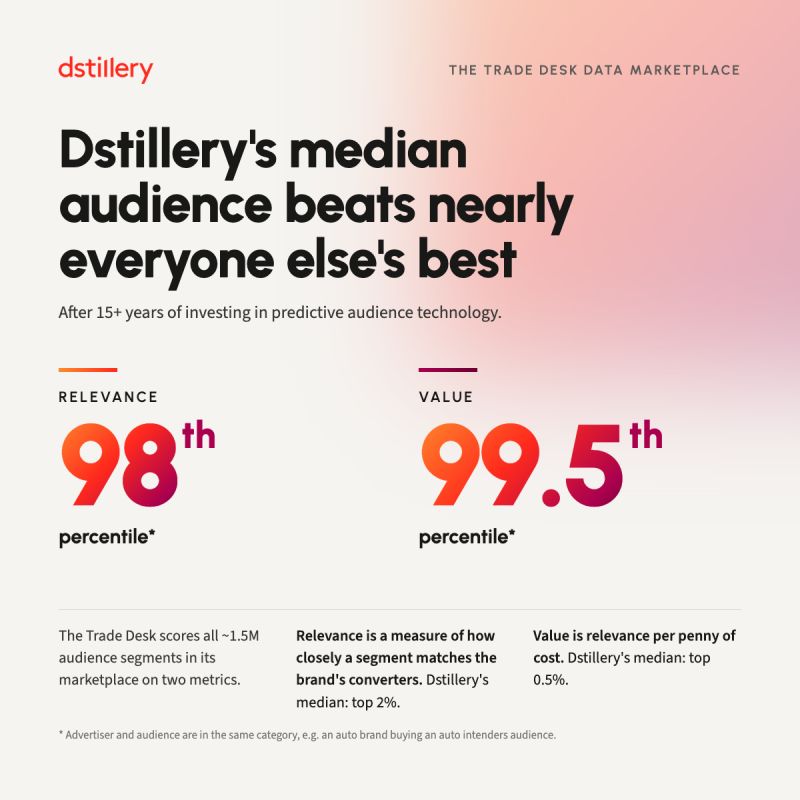
For in-category campaigns, Dstillery’s median relevance score is in the 98th percentile across a marketplace of over 1 million segments, and in the 99.5th percentile in value.
After 15+ years of investing in predictive audience technology, Dstillery’s median audience beats nearly everyone else’s best.
As digital marketers and advertisers know, effective audience targeting can make or break your campaigns. With the right audience, brands can spark more engagement, stretch their ad dollars, and maximize return on investment (ROI). However, as marketers strive to connect with their ideal customers, they face a crucial targeting decision: Should they rely on Pre-built audiences or invest in Custom Built audiences that cater specifically to their campaigns’ needs?
Let’s decide together. At Dstillery, we offer advanced audience targeting solutions built using patented AI technology. In this blog, we’ll walk you through the ins and outs of our Pre-built and Custom audiences, so you can decide which option will give your campaigns the edge they need. With the right insights, you’ll be ready to make smart moves that drive results and perfectly align with your unique campaign goals.
Understanding Audience Targeting
What is audience targeting and why does it matter? Audience targeting is the marketing practice of identifying and segmenting specific groups of consumers to deliver personalized messages. It’s a vital component in the success of any digital marketing campaign – getting your ads in front of the right people who are most likely to engage with your brand.
In today’s data-driven world, the ability to refine your audience based on demographics, behavior, and interests is more powerful than ever. Whether you’re using Pre-built or Custom Built solutions, when you hit the mark with your targeting, you’ll see increased conversions, stronger customer relationships, and a much smarter use of your ad dollars.
Creating a custom audience is where the magic happens. Marketers often utilize data sources like first-party data from CRM databases, website traffic, or third-party data to build audiences that target specific customer personas. The result? You get precise and effective communication with the people who matter most to your brand.
What Are Dstillery’s Pre-built Audiences?
Pre-built audiences are Dstillery’s off-the-shelf audiences, powered by behavioral, demographic, search-based, and partner data. These audiences are high-performing, ready-to-activate, and proven to drive qualified reach.
Advantages of Pre-built Audiences
Convenience: You can easily select from a variety of predefined audience categories. Click here to browse Dstillery’s library of over 15,000 Pre-built audience segments.
Speed: All Pre-built audiences are available for immediate activation, allowing you to launch campaigns quickly and seamlessly.
If you’re launching upper-funnel digital campaigns optimized for driving reach or building brand awareness, Pre-built audiences are for you. Pre-built audiences are ideal for broad brand awareness campaigns or testing new markets. On the flip side, they may not deliver the same engagement when your target market is niche or you’re looking to optimize for lower-funnel KPIs like conversions.
What Are Custom Built Audiences?
Custom Built audiences are tailored to meet the unique needs of your organization. Built primarily using first-party data, these audiences let you create highly targeted segments based on specific behaviors, preferences, and demographics.
The process of creating these custom audiences is all about leveraging data to craft an audience that closely matches your ideal customer profile. Whether you’re using custom audience targeting for healthcare, retail, or B2B campaigns, this personalized approach ensures that your ads land in front of the right people.
Advantages of Custom Built Audience
Precision Targeting: Custom audiences allow you to focus on highly specific segments, improving the relevancy of your ads.
Personalization: You can tailor your ad messaging to resonate with your audience’s needs and interests, increasing engagement.
Better Performance: With precise targeting and personalized content, custom audiences can lead to higher conversion rates and a better ROI.
However, there are some challenges. Building a custom audience takes time, resources, and access to reliable data. Additionally, if not managed carefully, custom audiences could get a bit too narrow, which means less reach and ad fatigue.
But don’t worry – when you team up with Dstillery, your Custom Built audiences are refreshed every 24 hours, so you’ll always have fresh audiences across the flight of your entire campaign. Our experts will launch and optimize your campaigns to help you meet and exceed your KPIs.
Discover our recent success with advertising agency Sokal, where our custom audiences generated a 75% better CPM against client benchmarks.
Key Factors to Consider When Choosing Between Pre-built and Custom Built Audiences
Choosing between Pre-built and Custom Built audiences depends largely on your business goals, resources, and the type of campaign you want to run. Here are some factors to consider when deciding which option is best for you:
Pre-built Audiences
Custom Built Audiences
Campaign Objectives
Brand awareness, upper-funnel KPIs
Retargeting past customers , promoting a niche product, lower-funnel KPIs
Data Availability
Frst-party data is not available
First-party data is available
Scalability
Scalable Refreshed every 24 hours
Scalable Refreshed every 24 hours
For more guidance on audience selection, read about our Custom Built audiences here and our Pre-built audiences here.
Elevate Your Campaigns with Custom AI Audience Targeting
Both Pre-built and Custom Built audiences are proven highly effective in a successful advertising campaign strategy. The key is understanding which solution aligns with your campaign goals, budget, and data availability. By understanding the differences between the two audience types, you can ensure that your advertising campaigns are set up for success.
With only six weeks to go from Oracle’s end-date for its well-publicized exit from the ad business, the countdown is on. Oracle’s decision earlier this summer caught many by surprise, though many leading brands and agencies remain concerned about how to replace targeted audiences for their ad campaigns. Oracle’s targeted audience products will no longer be available beyond September 30, 2024. That said, there’s good news for any advertisers questioning the future of their audience data and media targeting partnerships.
What Oracle’s Exit Means for You
While Oracle’s exit from the AdTech space creates a gap that many advertisers need to address swiftly, the company’s decision presents a new opportunity to re-evaluate solutions with better scale, efficiency, and reach.
At Dstillery, we want to assure our current clients that we have you covered. And for those not already working with Dstillery, the leading AI ad targeting company, we invite you to connect with us. Our ready-to-go, off-the-shelf Pre-built audiences and just-for-your brand Custom Built audiences are seamless alternatives to Oracle Audiences and BlueKai. And for those using Oracle’s Grapeshot for contextual targeting, our privacy-safe ID-free® Pre-built taxonomy of over 1600 audiences is now available within the Trade Desk Contextual Marketplace. Through these targeting solutions, you’ll see how easily and immediately we can support your highest-priority campaigns.
Your Trusted Partner in Audience Solutions
At Dstillery, we understand the critical role that accurate and comprehensive audience data plays in driving successful digital advertising campaigns. As our client, you can rest easy knowing that we have a robust suite of audience solutions that are ready to fill the gap left by Oracle.
Here’s how we ensure your audience needs are met:
1. Extensive Audience Data:
Our AI-driven models are highly targeted, continually refreshed audience segments that span topics across various industries and consumer interests. Whether you’re targeting specific demographics, behaviors, or interests, our selection of audiences is extensive and precise, ensuring your ads will reach the right customers and prospects, at the right time, with your campaign messages.
2. Customizable Audience Segments:
One size does not fit all in marketing. That’s why we offer customizable audience segments tailored to your unique campaign needs. Our team works closely with you to understand your objectives and creates bespoke audience segments that maximize your campaign’s effectiveness.
3. Advanced Data Science:
Leveraging our advanced, award-winning data science capabilities, we deliver highly accurate and relevant audiences, custom curated for your industry, brand, and campaign goals. Our proprietary, multi-patented AI technology analyzes vast amounts of data to identify patterns and trends, helping you target the right audience at the right time.
4. Seamless Integration:
Transitioning from Oracle to Dstillery is seamless and requires no long-term commitments. Our solutions integrate smoothly with your existing platform partners, ensuring no disruption to your operations. Our dedicated Dstillery Client Success team is on hand to support the transition and answer any questions you may have.
5. Commitment to Privacy and Compliance:
Data privacy and compliance are at the core of our solutions. We adhere to stringent data protection regulations, ensuring that your campaign audiences are of the highest quality, recency, and effectiveness, while maintaining privacy standards.
Why Choose Dstillery?
Choosing Dstillery means choosing a partner dedicated to your team’s success. Our expertise in audience targeting, combined with our continuous track record of industry innovation, makes us the ideal choice for agencies and brands looking to navigate the accelerating pace of change in the digital advertising ecosystem.
“Oracle’s decision presents a new opportunity for the advertising industry to re-evaluate targeting. Our advanced audience targeting solutions and unique targeting approach positions us as the ideal choice for agencies and brands aiming to adapt to the rapid changes in the digital advertising ecosystem,” said Michael Beebe, CEO of Dstillery.
Now is the perfect time to explore how Dstillery can elevate your audience targeting strategies. We are here to ensure your campaigns continue to reach the right audiences effectively and efficiently, achieving and often exceeding your KPIs.
With 85% of the Fortune 100 as our customers, you don’t just have to take our word for it. Our customer satisfaction ratings and success stories, plus patented technologies, are testimonies to our track record.
Get Started Today
We look forward to continuing our partnership with you and helping you confidently achieve your marketing goals. Let’s embrace the future of audience targeting together.
Contact us today to learn more about how Dstillery can support your audience targeting needs going forward. If we’re not already working together, we invite you to reach out to learn more.
Together, we can drive scale, efficiency, and campaign success to new heights.
Dstillery’s Audience Brief Genius is not just a tool; it’s a time-saving, stress-reducing partner designed to streamline the audience selection process for your campaigns. Fueled by cutting-edge technology from OpenAI, this advanced AI tool instantly transforms your audience brief into a curated list of audience recommendations, saving you the headache of manually searching for new audiences when your campaign needed to start yesterday.
Personalized audience recommendations in a snap of a finger
We’ve all seen it before. A brand’s unique persona — detailed in a nuanced audience brief — unjustly minimized into a handful of 3rd party audiences.
For example, take this food brand’s persona: “Adventurous and thoughtful food consumers, who like to make choices good for the environment and their bodies, while also prioritizing getting the most out of life. They are willing to sacrifice a little taste for a healthier alternative. They are typically in a household without kids and have the disposable income to spend on unique food experiences.“
This might get manually translated into three audiences: ‘Foodies’, ‘Healthy eaters’, ‘Household income $150K+’. While this selection is acceptable, with the advancements in AI and LLMs, there has to be a better way.
With Dstillery incorporating OpenAI’s technology that powers ChatGPT into Audience Explorer, we finally have a way to understand and quantify the relationship between the audience persona and specific audience segments like never before.
Feels like magic
When AI just works, it feels like magic. And when you use our new LLM-based search feature in Audience Explorer, you might just feel this way, too. So how does it work?
Getting a bit into the technical details, Dstillery leverages OpenAI’s embeddings to create a method for establishing a meaningful relationship between an audience brief and Dstillery’s audience taxonomy.
First, Audience Brief Genius takes an audience brief as an input, which typically includes descriptions of interests, demographics, affinities, and other relevant information. OpenAI’s embedding technology is then employed to convert this input into high-dimensional vector representations — a fancy way to say number sequences that are easy for computers to understand.
Next, these embeddings are compared with Dstillery’s entire audience taxonomy, which has already been translated into vector representations similar to the audience brief.
By analyzing the vector similarities, we can identify the audience segments with the closest similarities to the text in the audience brief. This approach not only saves you time from manually selecting audiences, but also ensures that your campaigns are using the audiences most aligned with your audience persona ultimately leading to a highly targeted, more effective ad campaign.
Activation in the blink of an eye
Audience Explorer, powered by OpenAI, now enables advertisers to finally bridge the gap between your brand’s unique audience personas and targetable audience segments. With Dstillery’s audiences found in every major DSP, and made available as user-based segments, PMPs, and custom bidding algorithms, activating any of these audiences is just a few clicks away.
Dstillery is excited to announce the debut of our newest product, Custom Search Lookalikes. Custom Search Lookalikes were born from the observation that our access to unique search and retail signals and 2M+ opt-in panel data could be combined to create a targeting solution that answers the question, “When people search for a specific phrase, where else do they visit frequently on the internet?” – making it easy for brands to identify and target that hard-to-reach consideration audience.
How Did We Build Custom Search Lookalikes?
Powered by Dstillery’s patented ID-free® technology, Custom Search Lookalikes helps advertisers reach the people searching for their brands’ keywords on the inventory most likely to drive their campaign goal. Instead of relying on searches from limited publisher sources, this solution has privacy-safe visibility into consumers’ browsing patterns, including website visits and keyword searches on top search engines and retailer platforms. ID-free® learns these patterns and extends its understanding to all impressions on the internet, scoring and ranking every ad impression on its likelihood of targeting a person searching for a brand’s keywords. The model is available to activate as a PMP or custom bidding algorithm.
Get Started With Custom Search Lookalike Solutions
If you are interested in utilizing Dstillery’s Custom Search Lookalike solutions, one of our sales team members will work with you to understand your brand’s best keywords based on what your customers are most likely to search for. From there, we’ll build our model and learn the browsing patterns of those searching those brand keywords and build your custom model. After that, activation is as simple as activating a PMP; we’ll send the Deal ID directly to your seat in your DSP. We’re excited to make this product available to everyone. This product allows us to offer something truly custom without brands having to share their first-party data that is available the moment you need it. Contact us today to get started.
Building your brand’s consideration campaign is a crucial step for companies trying to catch the eye of prospects throughout the sales process. Programmatic advertising is a key component of making digital impressions on your customer base that will push them toward your product or brand. The consideration phase of the sales funnel is far and wide the most difficult to optimize against. However, it isn’t impossible, nor should you feel intimidated by the prospect of creating a sharpened consideration-oriented programmatic campaign. Dstillery is here to help and break out some of the key points you should remember when building your mid-funnel campaign.
Understanding customer intent in your consideration campaigns
The first thing to understand about the consideration phase of the sales funnel is that it’s based on customer intent. What do we mean by intent? We know that people like to take vacations. However, the idea of a vacation means different things to different people; some want to end up on a beach in Thailand or check out a national park, and others might want to take a cruise in the Bahamas. Targeting these people based on age or gender is ineffective and outdated. Great consideration campaigns are built around why people vacation.
With vacation top of mind, let’s say you have a campaign goal to get people to consider vacationing in Yellowstone National Park. Aside from being a beautiful national park, ask yourself, why would people want to visit Yellowstone? When we dove into understanding the Yellowstone experience and began matching it with our audience taxonomy, we built a base of eight audiences that appeal to the Yellowstone visitor.
Hiking Enthusiasts
Camping Enthusiasts
Rock Climbing Enthusiasts
Sightseeing Travelers
Outdoor Enthusiasts
Craft Beer Enthusiasts
U.S. History Buffs
Nature and Outdoor Book Readers
Mapping out a digital journey
But there is more to it than just identifying the habits of these people in our audience taxonomy. We also have to understand their habits from a domain perspective; where do these people go on the internet, what websites interest them, and where is their digital journey most likely to take them? By working closely with our data partners and utilizing partnerships with opt-in data providers, Dstillery can weave domain data into our Consideration Solutions and help further map customers not solely based on assumed interest but also by their digital journey and online intentions.
Intent-based marketing doesn’t manifest itself insidiously for a customer either. For example, someone looking at hiking boots may then be served an ad for Yellowstone National Park. Their adjacency to the subject of your campaign based on their internet habits is that it improves Dstillery Considerations Solutions’ effectiveness and thereby creates a microcosm based on your customers and their digital experiences and serves them ads that will ideally push them toward a real-world action. You can build this out further too – we know that people who enjoy nature also tend to enjoy craft beer and breweries. Your consideration campaign can grow in reach to include these people as well and serve them ads that usher them down your funnel. By understanding your consumer’s activities, you can continually grow your consideration campaign and optimize it based on what groups are showing interest.
Using data to optimize
The consideration phase of the campaign is also a key point in which to hone your brand’s message and creative. In this phase, you can see in a very clear way who is engaging with your campaign message and optimize against it. You can create or re-work messages in real-time to guide your narrative. For example, you may notice that American History Buffs are starting to take an interest in Yellowstone and may begin to optimize campaign creative toward that and shift away from Craft Beer Enthusiasts.
Consideration is far and wide the most impactful portion of the sales funnel and the one where most marketers tend to optimize and re-optimize the most due to how critical it is to capture customer interest. That said, it’s important to note that its the place where your investment in programmatic campaigns goes the longest way as it connects passive interest to real conversions.
Interested in using Dstillery audiences in your consideration campaigns? Let’s chat.
Building your brand’s awareness is a crucial step for companies trying to make their name in the marketplace. Utilizing programmatic advertising is key to building the foundation for your brand since everyone is always online. While programmatic advertising has a seemingly high barrier to entry, we’re going to break down some of the key components to building a top-of-funnel, awareness-focused marketing campaign.
Programmatic brand awareness campaigns
Programmatic marketing is the perfect entry point for awareness-focused marketing campaigns. Digital advertising offers marketers a variety of media buying options. The most common way to buy digital ads is through real-time bidding (RTB). With RTB auctions, you can access many different kinds of publishers with many types of inventory and audiences. This type of media buying is great for increasing brand awareness because you can get global exposure at a very low price.
Whether your brand is in its early stages or is a marketplace mainstay letting consumers know what you have to offer is undeniably advantageous. It’s important to generate excitement and measure your brand’s reach in the market.
Real-time optimizations
The main benefit of programmatic-based awareness marketing is that it allows your brand to tell its story in a much easier way that is optimized for both reach and cost. Storytelling through programmatic is a data-driven pursuit insofar that advertisers can test and optimize their message by seeing which ads perform best in the market in real-time. The ability to drive and optimize consumer awareness in the moment is an amazing advantage for anyone in the digital marketing space. Your customers are everywhere, and your marketing should be too. People are on their computers or cell phones nearly 9 hours a day and then come home to their smart TVs and tablets for the other 5 hours they’re awake. That’s 14 hours of the waking day where your brand’s message can be a potential customer’s next interest or purchase.
Campaigns that scale
The second and most budget-centric advantage of programmatic advertising regarding brand awareness campaigns is that it provides campaign reach at scale. What do we mean when we say “reach at scale?” Your brand’s reach is directly proportional to how much money your brand invests into the final result. With RTB auctions, you can scale and bid on ad space in real-time, allowing you to see how far your campaign investment goes in the marketplace day by day. The ability to track spend in such a manner allows you to have total control over not just your brand’s narrative but your campaign’s financial investment by being able to optimize against the last week’s or last month’s results.
Actionable analysis and learnings
The last great advantage of programmatic marketing regarding brand awareness campaigns is that when the campaign ends, it allows marketers to understand all of the people who were attracted to their product or campaign and create customer groups from these segments.
This is such a massive win for marketers because it makes the final two portions of the sales funnel – consideration and conversion, so much easier to action against in further programmatic campaigns. By understanding your consumers on a deeper, more demographic level, your brand can craft even sharper and more effective campaigns that speak less generally and more specifically to your target audiences. This information allows every dollar you put into your campaigns to be pushed toward an end result that you control to people that you understand.
Awareness campaigns are the fundamental bread and butter for brand awareness so it’s important to always ensure that you’re exacting the most value when you cast your brand’s widest net. Programmatic ad technology is always evolving to help markets reach their customers in the most effective manner possible.
Google recently announced the sunsetting of its Similar Audiences feature in May 2023. While this may come as a blow to advertisers relying on this feature to connect with relevant audiences, this move is necessary to keep up with changes in consumer behavior as the privacy environment rapidly evolves. In this article, we’ll explore why Google Similar Audiences are going away and the best alternative for advertisers.
What are Google Similar Audiences?
Similar Audiences are Google’s version of lookalike audiences, which work by finding individuals who exhibit similar online behavior to those in your remarketing lists, such as website visitors, customer lists, and video viewers. The feature can be used across all campaign types, including search, display, and video campaigns. Google Similar Audiences analyzes users’ behavior patterns in a remarketing list and creates new segments of users who exhibit similar behavior. By targeting these new segments, advertisers can expand their reach and connect with new audiences more likely to be interested in their products or services.
Why are Google Similar Audiences going away?
Google is sunsetting Similar Audiences to help advertisers keep up with changes in consumer behavior and online marketing strategies as the privacy environment rapidly evolves. With privacy concerns becoming increasingly prevalent, Google recognizes that ad practices are becoming more restricted and regulated. As a result, the company is transitioning to more powerful, tested, privacy-centric automated solutions that will help advertisers connect with relevant audiences.
What is the Best Alternative to Google Similar Audiences?
There are various alternatives marketers can leverage once Similar Audiences are no longer available. Creating different types of custom audiences is the best way to use data from multiple sources, such as:
Website Visitors: users who have visited your website or specific pages on your website
Customer Lists: users who have purchased from your business or provided their contact information
App Users: users who have downloaded and used your mobile app
Offline Data: users who have interacted with your business offline, such as in-store visitors
Dstillery’s Custom AI Audiences: Dstillery’s Custom AI audiences are a lookalike alternative to Similar Audiences in DV360
Dstillery’s Custom AI Audiences
Dstillery’s Custom AI audiences are the perfect lookalike alternative to Google Similar Audiences. While the desired goal of expanding reach to find potential customers is the same, the methodology is quite different. We take a much more precise approach. Our Custom AI audiences score every unique device on its similarity to the brand’s existing customers to ensure the best prospects are part of the lookalike audience. By updating the audience with new data every 24 hours, Dstillery’s Custom AI audiences are always up-to-date, relevant, and ready to drive optimal performance goals.
While the sunset of Google Similar Audiences may come as a surprise, keeping up with the ever-changing AdTech industry is necessary. The sunset also presents an opportunity for advertisers to explore new tools and strategies to help reach their target audience and achieve their business goals.By staying up-to-date with the latest trends and best practices in online advertising, advertisers can continue to connect with customers and build successful campaigns.
To learn more about Dstillery’s custom audiences, contact us.
Dstillery’s Custom AI to Lead Replacement Solutions
With Google sunsetting its lookalike solution, Similar Audiences, in DV360 in May 2023, it’s time for media buyers to look for an alternative that can provide similar or better performance. With Dstillery’s Custom AI audiences, media buyers can seamlessly activate first-party data to build lookalike models in DV360 and be fully prepared for this transition.
What are lookalike audiences?
Lookalike audiences are groups of people who share similar characteristics and behaviors to a brand’s existing customers or audience. Once a lookalike audience is created, it can be used for targeted advertising campaigns on various activation platforms, including Google’s Display & Video 360 (DV360). The idea behind using lookalike audiences is to expand the reach of a campaign to a larger pool of potential customers who are more likely to be interested in the company’s products or services.
Why Use Dstillery’s Custom AI Audiences?
Dstillery’s Custom AI audiences is a lookalike alternative to Similar Audiences in DV360. While the desired goal of expanding reach to find potential customers is the same, the methodology is very different. Traditional lookalike solutions look at overlap against the original seed data to find and target additional audience segments with the highest overlap.Taking a much more precise approach, Dstillery’s Custom AI audiences score and rank every single unique device on its similarity to the brand’s existing customers daily to ensure the best prospects are part of the lookalike audience. By continuously updating the audience on new data every 24 hours, Custom AI audiences are always up-to-date, relevant, and ready to drive optimal performance goals.
How to get started with Dstillery’s Custom AI audiences?
Media buyers who want to start using Dstillery’s Custom AI audiences in DV360 can follow these simple steps:
Reach out to your Dstillery sales representative. Don’t have one? Email us at contact@dstillery.com
Define and send the first-party data you want to use to build lookalike models
Dstillery will generate the Custom AI audience and syndicate it to your seat in DV360
Begin targeting the audience in DV360
With Google sunsetting Similar Audiences in DV360, media buyers must find an alternative that can provide similar or better results. Dstillery’s Custom AI audiences offer a flexible and powerful alternative to help media buyers reach their target audience more effectively, improve campaign performance, and be fully prepared for this transition. Contact us today to get started.
Google Chrome has been the leading browser of choice for online consumers for quite a few years now. According to www.statcounter.com, in May 2022, Chrome was dominating the web browser market share by 64.34%. As Google previously announced, Chrome internet browser will stop supporting the user-tracking technology called third-party cookies by late 2024. Cookies are small files sent to your browser from websites you visit. These files track and monitor the sites you visit and the items you click on these pages. This announcement sent shockwaves through the AdTech industry. Third-party cookies have been a foundational part of the technology that enables personalized digital ads, allowing advertisers to personalize ads to users based on their behaviors and site-visit history for decades.
So, what does a cookieless world mean for Dstillery and our audience model building? We have it all covered! Besides offering our premium ID-based methodology for building audiences with cookies, we also have ID-free audiences that do not rely on any user-tracking, cookies, or IDs.
ID-based Custom AI Audiences
Dstillery builds predictive models for audiences by analyzing the data on users who visited certain domains. This data is completely anonymous. It comes from sources like the programmatic ad environment (the bid-stream) and 3rd party data partners, and it is cookie-based.
Once we receive this cookie-based data, we store it under anonymous user profiles in our system. When we talk about examining data on users, we mean understanding their online behavior. After analyzing common patterns among the users who visited a certain domain, Dstillery builds a model consisting of the online behaviors most likely to lead to conversions or actions among all these users. This predictive model is then used for targeting consumers on the internet who would be most likely to exhibit the same behaviors that the model has already identified.
The model is then used daily to score devices that match the model features and build a probabilistic ID-based audience for targeting. All ID-based audiences are refreshed every day by scoring new qualifying devices in and scoring out the ones that do not fit the model criteria anymore. This guarantees that Dstillery’s audiences are always relevant, up-to-date, and ready for immediate use.
Dstillery offers a wide range of ID-based audiences. They fall into different categories based on the way they are built and their composition.
How are Custom AI audiences built by applying the ID-based methodology?
For Custom AI audiences, Dstillery requires first-party data that comes directly from the client, not just any domain or source, in order for the target user behavior for that brand’s signal to be identified. This first-party data can be collected by placing a Dstillery Pixel on the client’s website or by ingesting CRM data offline. The collected first-party data is then analyzed by finding common browsing behaviors among the client’s consumers and used to create Custom AI models that are 100% tailored to the client’s brand and needs.
ID-based Custom AI audiences deliver some of the best results and precision. Why?
First-party data, whether it comes from pixel-based devices or from other data sources such as CRM-based lists, provide the strongest signal for interest in your brand. It is also important to note that the models for Custom AI audiences are rebuilt every 24 hours due to the constant flow of new devices to pixels that sets off the model refresh. Additionally, all Custom AI audiences are refreshed daily by having devices scored in and out of them, which always guarantees strong relevance and excellent performance. Internal studies have shown a 15x lift in conversion rate for qualified customers identified in our ID-based Custom AI Audiences.
ID-free® Custom AI Audiences
Dstillery already has a plan and a solution for the ‘Post Cookie Era.’ Enter ID-free® targeting, a methodology for model and audience building without using third-party cookies. Dstillery has adapted its proven ID-based model-building technology so that cookie IDs are not necessary to create high-quality predictive audiences. In our ID-free environment, we do not rely on tracking the devices we are trying to target. This makes ID-free the ideal choice for advertisers who want to get ahead of consumer privacy concerns without compromising campaign performance and scale.
Dstillery’s ID-free methodology for building audiences is based on patented neural network technology that analyzes hundreds of millions of anonymous digital journey patterns to learn the behavioral signals underlying any web visit. By using this influx of hundreds of millions of anonymous digital journeys our algorithm learns how, when, and from where people browse the web and derive a multidimensional map of the web where the closer the points, the more similar the actions of visitors to those sites. Dstillery builds these statistical predictive models from opt-in first-party data (such as pixels, surveys, and panels) that are then applied to the ID-free universe of prospects. This enables brands to identify the right impression opportunities among all these untracked browsers and devices.
Our Chief Data Scientist, Melinda Han Williams, explains how our cookieless targeting solution is not the same as contextual targeting. “ID-free doesn’t read the words on the webpage or scrape content from websites, it is entirely a behavioral solution. So, it is picking up on signals that reflect interest in the brand, regardless of the content on the webpage. ID-free can take a high-performing 1st party signal, amplify it and activate it at internet scale.”
Who are ID-free audiences for?
The core of ID-free technology, and its inherent cookieless nature, delivers performance and scale for all brands. ID-free audiences are particularly great for industries that have strict privacy standards, like healthcare and finance. We can confidently conclude that ID-free is an excellent solution for everybody, for two reasons:
Cookies will be going away, so brands can get ahead of the curve now.
It opens up a whole universe of devices that brands have not been engaged with, so it’s good for performance and incremental scale today!
How is Custom AI implemented through Dstillery’s ID-free methodology?
Just like ID-based, ID-free Custom AI audiences deliver some of the best results and precision because these models are built with first-party data or keywords. Dstillery’s multidimensional Map of the Internet (MOTI) is compounded with the client’s first-party signal. This allows our AI to learn the browsing patterns of anonymous opt-in devices identified in the client’s seed and to create a base model. Then, the identified patterns are extended to all websites by utilizing our neural network technology, allowing the client to select opportunities that are predictive of desired behaviors. When a Custom AI model is generated and applied to the ID-free universe of devices, this creates tailored ‘just-for-your-brand’ predictions to identify the most valuable impressions for the client’s brand.
ID-free Custom AI is a proven post-cookie solution, available now, it works on every browser and across all types of devices including desktop, mobile, and tablet. It performs on par with the best ID-based Custom AI solutions, sometimes even better based on current campaign results. ID-free Custom AI could be used strategically as a way of adding incremental scale to any client’s campaign by unlocking a whole new universe of devices that aren’t being tracked.
How is ID-free Custom AI tailored for healthcare brands?
Custom Patient Targeting is a version of Dstillery’s ID-free Custom AI product made specifically for healthcare. Because the core ID-free methodology doesn’t create profiles, doesn’t “know” the names of the sites that any user visited to make predictions, and doesn’t target any IDs or cookies, ID-free targeting offers optimal precision, customization, and compliance for healthcare brands in programmatic advertising. For advertisers in healthcare looking to engage with consumers in a completely privacy-friendly manner, Custom Patient Targeting is Dstillery’s privacy-safe behavioral targeting solution that provides performance and precise reach without user tracking.