Why the 2026 Big Game was more than halftime entertainment—it marked a turning point for AI in digital advertising.
For the first time since AI entered the mainstream with tools like ChatGPT in 2022, it wasn’t a sidebar in advertising — it was central to how brands approached the Super Bowl itself. Super Bowl LX reflected a broader shift in how agencies and brands are using AI to inform strategy, shape investment decisions, and decide when they’re ready to compete on marketing’s biggest stage.
1) AI Is No Longer About Tools—It’s a Defining Position
AI-driven decisioning wasn’t just influencing how ads were created, but which brands chose to show up at all.
That shift was especially evident in the rise of first-time Super Bowl advertisers. Performance-minded, growth-focused brands were willing to make high-stakes investments in live TV, using AI-backed insights to validate reach, relevance, and scale before committing to the biggest media buy of the year.
We want to give a shout-out to our TV advertising platform partner, Tatari, on securing and managing the ultimate in premium media placements for four first-time Super Bowl brand advertisers—Life360, Manscaped, Ro, and Tecovas—each making a deliberate bet on relevance, reach, and measurable outcomes. These brands didn’t simply “jump in” to the Super Bowl; they’ve been expanding beyond their original target markets and hero products. While AI may have played a role in their media strategies and ad targeting decisions, what’s clear is that the legacy brand-building playbook still has a valuable role, with agency partnerships and relationship currency more important than ever.
This theme of blending top performance and playing to win extended beyond the game itself. At Adweek House, these brands joined a panel led by Tatari’s SVP of Marketing, Amit Sharan. See the full story here: First-Time Playbooks for the Big Game
2) AI-Powered Targeting Is Now the Confidence Engine Behind Media Decisions
Super Bowl advertising has always been a media decision as much as a creative one. What changed this year was the confidence behind those decisions.
Rather than relying on broad demographics or legacy assumptions, advertisers leaned on AI-powered audience prediction and targeting to reduce risk and increase certainty. AI is no longer optimizing campaigns after launch—it’s shaping upfront investment decisions, giving brands the confidence to take bigger bets with expectations.
3) AI Is Embedded in Prediction and Engagement (Not Just Creation)
Every Super Bowl ad is ultimately a prediction: a bet on what audiences will remember, share, or act on. AI is accelerating that predictive capability across both media and messaging.
This year, that showed up through AI-forward brand narratives and competitive positioning that used AI as both a capability and a differentiator. The most effective advertisers weren’t chasing novelty—they were using AI to align insight, timing, and engagement to drive impact.
The Bigger Signal
Super Bowl LX made one thing clear: AI in advertising has moved beyond experimentation. It’s shaping confidence, precision, and prediction—helping marketers ensure the right messages reach the right audiences at the right moment.
Multimodal learning is the next frontier in machine learning. It allows machines to combine different types of data to understand more than is possible from any one source.
Think of the example of understanding a scene in a play. As humans, our brains seamlessly integrate visual cues, auditory input, text, and prior knowledge. In a scene, we may see a waiter fall and drop a tray of drinks, we hear the crash of objects falling, we hear language spoken as someone reacts to the accident, and we read a caution sign saying the floor is wet. From this input, we easily conclude that the waiter slipped on the wet floor and dropped the drinks. This is due to our brains combining visual cues, auditory input, text, and prior knowledge. Without the combination of all of these inputs, we risk drawing the wrong conclusion about the scene. Auditory input alone might tell us an accident occurred, while visual cues may show a waiter slipping and drinks falling – but without reading the sign that says the floor is wet, we can’t fully understand why it happened.
Multimodal machine learning allows machines to perform a similar fusion of different data modalities, giving machines the ability to understand context, respond naturally, and make smart decisions in complex environments.
At Dstillery, we are experts at using AI to perform ad targeting. A powerful data modality in this space is user browsing behavior. The success of ad targeting campaigns is often measured by a conversion event performed online, such as purchasing a product or visiting a homepage. The journeys a user takes across the internet can be very predictive of whether they are likely to perform a particular online conversion or not.
For example, online retail sites visited by a consumer tells us the user’s style and the amount they may be willing to pay, and gives clues to demographic attributes such as gender and age. It is intuitive to see how this leads to useful features in an ad targeting campaign for a clothing brand. With the recent development in LLMs and generative AI, highly accurate text features can be generated for almost anything. This gives a second highly performing data modality we can use in our ad targeting campaigns.
We have built a modular, scalable multimodal architecture to integrate these data modalities and produce high-performing CTV ad targeting. Our patent-pending approach combines web behavioral features and text features to generate richer predictions, better personalization, and smarter automation of CTV ad targeting.
Our Approach: A Modular Multimodal Architecture for CTV Ad Targeting
Our CTV ad targeting system is built on a modular multimodal architecture that combines a foundation model with a lightweight mapping model. The foundation model is trained on large-scale web browsing behavior, while the mapping model enables us to extend that model’s capabilities to other data types — such as text — by projecting them into the same embedding space.
Foundation Model: Learning Behavioral Embeddings from Web Journeys
At the core of our system is a foundation model trained on web visitation sequences, producing what we call MOTI embeddings — short forMap Of The Internet. These embeddings are learned using self-supervised learning on billions of sequential website visits. The model is trained to predict the next website in a user’s browsing journey, allowing it to learn the behavioral patterns and intent behind web visits.
This results in a rich embedding space that captures user behavior across the open web — not just what sites users visit, but why and in what context. MOTI embeddings provide a strong signal for predicting future behavior, especially web-based conversions.
Mapping Model: Extending MOTI Embeddings to New Modalities
To enable multimodal learning, we train a mapping model that projects from text space into the MOTI embedding space. This allows us to represent any domain described by text — such as CTV content metadata — using the behavioral signal embedded in our foundation model.
We train this mapping model by aligning two modalities:
MOTI embeddings for a large set of websites.
LLM-generated keyword embeddings extracted from the same websites using generative AI.
By training a model to predict MOTI embeddings from LLM embeddings, we learn a cross-modal projection that allows us to map new text inputs (e.g., CTV parameters) into our MOTI space — effectively teaching the text modality to “speak the language” of web behavior.
Brand-Specific Models: Optimizing for Conversions
Clients often wish to drive outcomes measurable by web conversions — such as site visits, keyword searches, or product views. Since MOTI embeddings capture real behavioral intent, they serve as high-performing features for building client-specific models trained on conversion outcomes.
These models learn what types of behavior (in MOTI space) are most predictive of desired outcomes for each brand — allowing us to personalize targeting at scale.
CTV Targeting: Scoring Content Using Behavioral Signals
Once we’ve trained a brand-specific model in MOTI space, we can use it to score any other domain that can be described in text. For CTV ad targeting, we use generative AI to extract semantic features from content metadata — such as series, title, genre, language, rating, and channel.
These features are embedded using an LLM, then mapped into MOTI space via our mapping model. This allows us to use the brand’s web conversion model to score and rank CTV inventory based on how closely it aligns with high-performing web behaviors — creating a seamless link between behavioral intent and CTV content.
This architecture enables us to fuse two distinct data modalities — behavioral browsing data and structured text — through a shared representation space. It’s a powerful, scalable approach to multimodal learning: one that leverages foundation models, bridges across modalities, and delivers measurable performance in production systems. You can think of it as teaching the text modality to speak the behavioral language of MOTI embeddings, allowing both modalities to contribute meaningfully to targeting decisions.
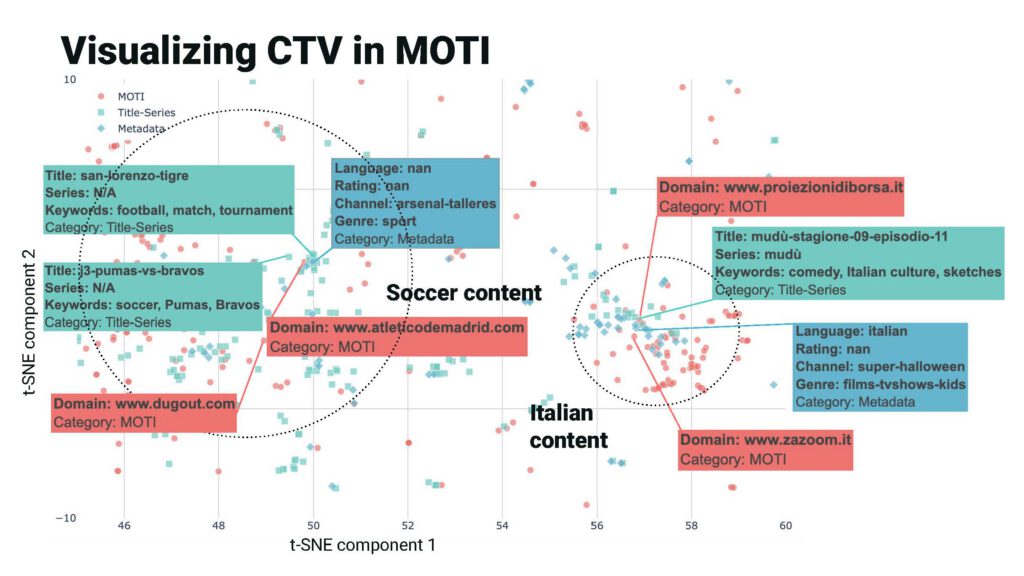
FIGURE: TSNE visualization of CTV attributes (series, title, language, rating, channel, genre) in the same space as websites in MOTI. As indicated by the left dotted circle, CTV attributes related to soccer, as well as soccer related domains are close by in the MOTI space. Another example indicated by the right dotted circle shows CTV attributes and nearby domains are related to Italian content.
A powerful, flexible approach to multimodal learning
Scalable: Leveraging an existing foundation model trained on large amounts of streaming data allows the training of CTV models at scale. Training a model for each of our clients is fast and efficient.
Flexible: As text features from LLMs improve, or new CTV shows are aired, we can represent this new data in our multimodal model without retraining our large and computationally expensive foundation model.
Composable: As text features have emerged over the past couple of years, if there is a new data modality that is useful for ad targeting we can simply train a new mapping model and produce a multimodal solution with a new modality
Interpretable: Our solution is highly interpretable because we can query the joint representation space easily, giving us a clear understanding of the relationship between modalities
Results in the real world
Our modular multimodal targeting system has delivered strong, measurable performance across verticals, proving its value in real-world, ID-free environments.
An automotive client sought to reach high-intent car shoppers using an ID-free CTV strategy. Using our modular multimodal architecture, we built a custom brand model for the campaign.
– The ID-free CTV model outperformed the client’s ID-based audience from day one, ultimately achieving a 98% higher video completion rate (VCR) by the end of the campaign. – The model also delivered better cost efficiency, producing more CTV conversions at a lower cost per conversion (CPC), obtaining a CPC of $9.13. – The client’s agency concluded that adding ID-free targeting alongside traditional ID-based models significantly expanded reach without sacrificing performance.
Kitchen Appliance Brand: Sustained Success Across CTV and Display
A kitchen appliance brand partnered with Dstillery to raise awareness for their new products using CTV and display media. They measured success using VCR and clickthrough rate (CTR) as KPIs.
– The campaign achieved a 94% average VCR on CTV beating the client benchmark of 70%. – Display ads delivered a 0.14% CTR beating the 0.10% benchmark. – Top-performing CTV channels included AT&T TV, Discovery Channel, and Food Network Kitchen — all aligned with high behavioral intent signals captured in our MOTI embeddings.
Multimodal AI for CTV: A Real-World Blueprint for Smarter Ad Targeting
Our solution is a framework for practical multimodal AI. When there are two complementary data sources and a unimodal foundation model exists for at least one of the modalities, a fast and efficient solution to multimodal machine learning is to train a model to learn a mapping from one modality to another. This produces an efficient multimodal solution that is interpretable and adaptable. You don’t need to train all modalities together from day one. Multimodal learning can be layered, modular, and immediately impactful. Multimodal learning isn’t just about giant models – It’s about combining signals to see more clearly and building systems that grow with your product.
Following our Dstillery sponsorship of the first annual BrXnd AI event last May in NYC, our Executive Director, Taylor Zamora, and I attended the first LA version at the NeueHouse Hollywood.
BrXnd AI Founder Noah Brier has emerged as a leading authority on how brands can and should use, and are using, generative AI tools at all stages of the marketing process. Brier’s team consults with companies of all shapes and sizes about using AI, publishes a newsletter and Marketing AI landscape, and hosts in-person events.
Reflecting on a day of learning and inspiration, I am thoroughly convinced that AI is not overhyped. It is having real impact.
The first half of the day was mostly about the state of AI and trends in how brands are using it. The second half was essentially demos/pitches. Both were impressive and thought-provoking. A few themes emerged:
– The consensus view is that we are still very much in the discovery & experimentation stage with AI
– The LLM model itself is a tool, and our collective imagination in using it to solve business challenges is the value-add
– ROI is hard to measure at this stage and it is premature to try and assign dollar values
Having sponsored and attended BrXnd NYC’s 2024 event, we saw some amazing progress. There were fewer demos of working AI technology in action. Tools were not ready, so the conference was heavy on trends and themes and light on specifics. We have come a long way.
The audience for the products is marketers and agencies, and there were some VERY cool demos of tools that simplify and speed up agency and digital media workflows, opening up new opportunities. Here are a few of our favorites:
– And my personal favorite, the Waldo.fyi research assistant
These are very cool customer-facing tools that help brands and agencies do their work better, faster, and more cheaply. Eight months ago, they did not exist. Now, they are compelling workflow tools gaining adoption among our clients. I am blown away by the pace of the progress.
Above all, I am convinced after the BrXnd AI showcase that we are only just getting started.
Back in January 2020, when Google first announced its intention to deprecate third-party cookies, marketers and advertisers started exploring alternative strategies to reach audiences effectively. And while third-party cookies are technically still here, the need for new privacy-safe targeting solutions remains.
Two popular approaches are ID-free® targeting and contextual targeting. While both methods help deliver privacy-friendly advertising, they are distinct in how they operate and how they identify the best audiences.
Understanding ID-free Targeting
Dstillery’s patented ID-free targeting is a revolutionary technology that employs a totally different approach than basic content analysis. ID-free targeting is rooted in data science and machine learning, leveraging sophisticated algorithms to find the right audiences without relying on any form of personal identification, cookies, or device IDs. By analyzing the aggregated behaviors of an anonymous consumer panel, such as browsing behavior, content consumption, and time of day, ID-free targeting finds your best audiences based on behavioral inventory signals. What’s more? ID-free predicts which sites are likely to convert for your brand without any user profiles or tracking.
The power of our ID-free technology lies in its ability to be adaptive and intuitive. It allows advertisers to reach users who are most likely to engage with their messages, based on patterns of behavior that indicate interest, rather than matching specific topics or keywords. This level of precision not only enhances campaign performance but also meets the growing need for privacy-safe solutions.
What is Contextual Targeting?
Contextual targeting is an advertising method that involves placing ads based on the content of the webpage, or the context in which the ad is served. For example, an ad for gym clothes might appear in a blog article about workout routines. This approach uses keywords, page topics, and sentiment analysis to ensure that ads align with the content that users are currently viewing.
While contextual targeting can effectively place ads in relevant environments, it is limited by its reliance on immediate content. It does not account for user behavior beyond the current page the way ID-free does which will cause advertisers to miss out on reaching pertinent audiences.
Contextual targeting is a good way to understand the keyword clusters an audience member might search for along their digital journey. However, if you craft a deep profile of understanding around your audience, only a tiny fraction of that audience will be targeted by contextual solutions.
Key Differences Between ID-free and Contextual Targeting
ID-free technology
Contextual Targeting
Audience Precision
Leverages complex data science techniques to identify ideal audiences based on anonymous behavioral signals
Matches ads to specific content, ignoring interest patterns or user journeys
Privacy Standards
Privacy-safe, does not rely on any personal data
Privacy-safe
Adaptability
Dynamically adjusts to shifting behaviors and trends in real-time, enabling brands to stay relevant
Tied to specific page content and may not capture broader audience interest shifts
Choosing the Right Solution for Your Brand
As more and more people opt out of cookies, it’s crucial to understand the differences between ID-free and contextual targeting. While contextual targeting is effective in aligning ads with relevant content, ID-free offers a powerful alternative for brands and their agencies aiming for audience precision without sacrificing privacy.
If you’d like to test ID-free targeting in your next campaign, reach out to get started.
As digital marketers and advertisers know, effective audience targeting can make or break your campaigns. With the right audience, brands can spark more engagement, stretch their ad dollars, and maximize return on investment (ROI). However, as marketers strive to connect with their ideal customers, they face a crucial targeting decision: Should they rely on Pre-built audiences or invest in Custom Built audiences that cater specifically to their campaigns’ needs?
Let’s decide together. At Dstillery, we offer advanced audience targeting solutions built using patented AI technology. In this blog, we’ll walk you through the ins and outs of our Pre-built and Custom audiences, so you can decide which option will give your campaigns the edge they need. With the right insights, you’ll be ready to make smart moves that drive results and perfectly align with your unique campaign goals.
Understanding Audience Targeting
What is audience targeting and why does it matter? Audience targeting is the marketing practice of identifying and segmenting specific groups of consumers to deliver personalized messages. It’s a vital component in the success of any digital marketing campaign – getting your ads in front of the right people who are most likely to engage with your brand.
In today’s data-driven world, the ability to refine your audience based on demographics, behavior, and interests is more powerful than ever. Whether you’re using Pre-built or Custom Built solutions, when you hit the mark with your targeting, you’ll see increased conversions, stronger customer relationships, and a much smarter use of your ad dollars.
Creating a custom audience is where the magic happens. Marketers often utilize data sources like first-party data from CRM databases, website traffic, or third-party data to build audiences that target specific customer personas. The result? You get precise and effective communication with the people who matter most to your brand.
What Are Dstillery’s Pre-built Audiences?
Pre-built audiences are Dstillery’s off-the-shelf audiences, powered by behavioral, demographic, search-based, and partner data. These audiences are high-performing, ready-to-activate, and proven to drive qualified reach.
Advantages of Pre-built Audiences Convenience: You can easily select from a variety of predefined audience categories. Click here to browse Dstillery’s library of over 15,000 Pre-built audience segments.
Speed: All Pre-built audiences are available for immediate activation, allowing you to launch campaigns quickly and seamlessly.
If you’re launching upper-funnel digital campaigns optimized for driving reach or building brand awareness, Pre-built audiences are for you. Pre-built audiences are ideal for broad brand awareness campaigns or testing new markets. On the flip side, they may not deliver the same engagement when your target market is niche or you’re looking to optimize for lower-funnel KPIs like conversions.
What Are Custom Built Audiences?
Custom Built audiences are tailored to meet the unique needs of your organization. Built primarily using first-party data, these audiences let you create highly targeted segments based on specific behaviors, preferences, and demographics.
The process of creating these custom audiences is all about leveraging data to craft an audience that closely matches your ideal customer profile. Whether you’re using custom audience targeting for healthcare, retail, or B2B campaigns, this personalized approach ensures that your ads land in front of the right people.
Advantages of Custom Built Audience
Precision Targeting: Custom audiences allow you to focus on highly specific segments, improving the relevancy of your ads.
Personalization: You can tailor your ad messaging to resonate with your audience’s needs and interests, increasing engagement.
Better Performance: With precise targeting and personalized content, custom audiences can lead to higher conversion rates and a better ROI.
However, there are some challenges. Building a custom audience takes time, resources, and access to reliable data. Additionally, if not managed carefully, custom audiences could get a bit too narrow, which means less reach and ad fatigue.
But don’t worry – when you team up with Dstillery, your Custom Built audiences are refreshed every 24 hours, so you’ll always have fresh audiences across the flight of your entire campaign. Our experts will launch and optimize your campaigns to help you meet and exceed your KPIs.
Discover our recent success with advertising agencies Tombras and Sokal where our custom audiences generated an 88% and 75% better CPM against client benchmarks, respectively.
Key Factors to Consider When Choosing Between Pre-built and Custom Built Audiences
Choosing between Pre-built and Custom Built audiences depends largely on your business goals, resources, and the type of campaign you want to run. Here are some factors to consider when deciding which option is best for you:
Pre-built Audiences
Custom Built Audiences
Campaign Objectives
Brand awareness, upper-funnel KPIs
Retargeting past customers , promoting a niche product, lower-funnel KPIs
Data Availability
Frst-party data is not available
First-party data is available
Scalability
Scalable Refreshed every 24 hours
Scalable Refreshed every 24 hours
For more guidance on audience selection, read about our Custom Built audiences here and our Pre-built audiences here.
Elevate Your Campaigns with Custom AI Audience Targeting
Both Pre-built and Custom Built audiences are proven highly effective in a successful advertising campaign strategy. The key is understanding which solution aligns with your campaign goals, budget, and data availability. By understanding the differences between the two audience types, you can ensure that your advertising campaigns are set up for success.
Google’s decision to abort its retirement of third-party cookies from Chrome is kind of like President Biden’s decision to withdraw his candidacy for president. It is a massive fundamental shift in direction, but at the same time it is really not surprising at all.
In its announcement, Google indicated that though cookies will remain, it will take steps to ensure that consumers have more control over their personal data, yet telegraphing that data collection will be more difficult for the adtech industry. Combined with other privacy-related developments, this will pressure the quantity and velocity of user data in the adtech ecosystem. But that loss of signal will now be a steady and manageable decline, rather than a cliff.
Google’s plan to retire cookies has inspired a lot of innovation over the last four years, and there is no putting that genie back in the bottle. There are new, privacy-safe technologies like Dstillery’s ID-free® behavioral targeting in the market, and the overall trend toward higher privacy standards, if it continues, will open up opportunities for those that perform to thrive, regardless of the continued existence of cookies.
A collective sigh of relief
That said, I suspect that brands and their agencies are breathing a collective sigh of relief. The transition from cookies to something else was always going to be hard, and messy.
Media agencies are enormous, distributed and complex operations, and their workflows, partners and tools all had to adapt. Scale of the alternatives was a question. Some of the alternatives, like probabilistic IDs, had problematic privacy credentials of their own. And measurement was going to be challenging. Brand KPIs were going to break. Essentially, the fabric of the programmatic ad industry needed to be rewoven.
Media agencies had little control over this process, and not much choice. Like the adtech industry, they were being forced to adapt to the agenda of a large and powerful industry platform. The industry had done an admirable job preparing for this future, and had invested significant brain power, people hours and dollars to make this transition.
Despite all of that investment, there was still a great deal of uncertainty about how exactly this transition would unfold. The risks, uncertainties and operational challenges that accompanied cookie retirement from Chrome, and the headaches that created for media agencies, can now be pushed to the back burner.
Rebalancing our attention
From Dstillery’s perspective, we recognize the magnitude of this shift in the industry’s agenda.
We said at the beginning of this year that 2024 for our industry would be a year like no other, and that the only thing we knew for sure was that there would be a lot of change. From the halfway point of the year, it has lived up to its billing.
Dstillery is uniquely positioned, in that we can provide highly effective targeting solutions with or without IDs, and we are rebalancing our attention across our portfolio.
Our cookie-based audiences continue to deliver best in class performance, and we see opportunities to invest in new types of seeds, new modes of activation, new modeling technologies, and new distribution. Our ID-free targeting provides privacy-safe targeting solutions for parts of the market where that is important, and through our Predictive Bidding actually drives superior scale and performance to even our best cookie audiences.
Together, our ID-based and ID-free targeting solutions can fulfill the targeting needs of our programmatic partners and advertisers, with or without cookies, and we are excited for the new opportunities that this most recent shift will bring.
The rise of AI and the fall of the cookie together are creating profound change for the programmatic advertising industry. With Chrome’s deprecation of third-party cookies now just months away, nearly every part of the ecosystem needs a plan to adapt its programmatic execution to the new reality.
The result is a seemingly endless swirl of technologies – new and old – with an increasing number of AdTech companies claiming to have the solution. The cacophony of pitches and promises is dizzying, and many marketers are understandably paralyzed by the chaos of the marketplace.
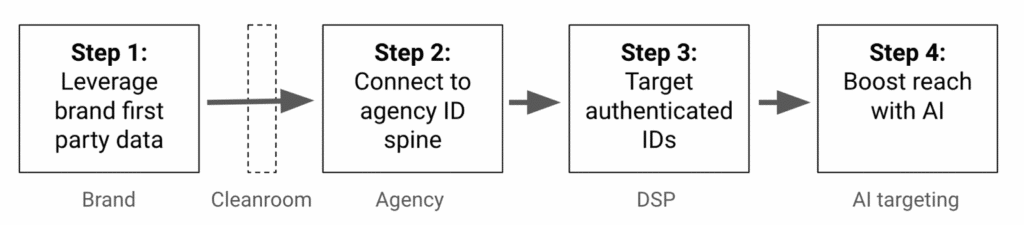
While there is definitely some complexity, a simple four-step approach will allow brands and agencies to clarify and unlock their post-cookie targeting strategy.
4 simple steps
1. Leverage brand first-party data. Building closer relationships with customers is always a good thing, and a strong first-party data set is a solid foundation for post-cookie success. But it is only a first step.
2. Connect to agency identity spine. Media agencies of all sizes have been building (or buying) identity spines that provide them with a broad understanding of mostly offline consumer behaviors, and deep demographic, psychographic, and behavioral profiles. Brands can connect their first-party data with these larger data sets via clean rooms to provide a privacy-safe path to activation.
3. Target authenticated IDs. There are a number of emerging alternative IDs that let advertisers find their customers, or lookalike customers, in the digital advertising ecosystem. Authenticated IDs like UID2 will drive performance that is superior to the less-precise third-party cookies, and will be a fundamental pillar of cookieless programmatic execution. Allocate the first budget dollars here for precision 1:1 targeting and measurement.
4. Boost reach with AI (this is where the magic happens!). Authenticated IDs are unlikely to deliver the scale of third-party cookies, so advertisers will need to spend more against impressions without IDs to drive reach and deliver brand KPIs. Some will default to classic contextual solutions, but new and emerging AI-driven targeting technologies offer a better way to fill the gap in reach left by cookie retirement. Delivering scale and performance that’s superior to contextual, they complement authenticated IDs by using the same behavioral signals and extend reach to the growing proportion of impressions without IDs. These innovative AI-driven technologies are the key to delivering reach, budget efficiency, and consumer privacy in a cookieless world.
Simplify your post-cookie targeting strategy
To simplify their approach to post-cookie targeting, brands should select best-in-class technology/partners at each step of this process. Choose your cleanroom partner, leverage your agency’s ID spine, work with your DSP in the authenticated space, and choose your AI reach boost partner.
Surely, there is a lot more complexity to work through than captured in this deliberate oversimplification. But by breaking the problem into just a handful of key decisions that fill the gaps left by cookie retirement, brands can create order from chaos, break the paralysis, and start executing an effective post-cookie programmatic targeting strategy.
Explore how Dstillery’s ID-free® targeting, an AI-powered technology that predicts ad impressions without user tracking, can enhance your programmatic campaigns in our frequently asked questions.
ID-free delivers performance and scale for advertisers’ programmatic campaigns. It also solves user privacy issues by not tracking users or creating user profiles. This makes ID-free a perfect solution for cookie deprecation and any privacy laws or regulations, including GDPR.
What are the use cases for ID-free?
ID-free is proven to drive both performance and scale. It can be modeled and optimized across the marketing funnel for most key performance indicators (KPIs), but it is most commonly used for upper-funnel campaigns driving qualified reach. By adding predictive bidding on The Trade Desk, it can also deliver up to 2.5x the performance of cookies for mid- and lower-funnel campaigns (more on this below).
What makes ID-free different from competitors’ solutions?
ID-free solves problems like performance, scale, and privacy for advertisers today. It’s not contextual nor an alternative ID; it’s patented technology in a category of its own.
ID-free uses AI to learn privacy-safe browsing patterns and applies these insights to inventory targeting. Think of it like this: ChatGPT understands words based on their use in a sentence. Similarly, ID-free understands website visits based on how they appear in browsing patterns. The result is privacy-safe behavioral targeting that reaches any display, in-app, or CTV ad impression with or without IDs.
How can I activate ID-free?
Partnering with Dstillery lets you choose the best ID-free activation method for your brand.
Activate via:
– PMP directly on your DSP.
– Predictive Bidding supported by The Trade Desk. Rather than making binary ‘buy’ or ‘don’t buy’ decisions, our AI predicts the precise value of each impression to your brand and exactly how much you should pay for it, maximizing every ad dollar.
– Contextual Integration found in The Trade Desk’s contextual marketplace.
How do I get started?
You can buy off-the-shelf ID-free audiences today on your DSP. If you’re looking for a custom, first-party data-powered ID-free audience, contact your Dstillery representative today or click here to get in touch.
In the fast-paced world of digital advertising, the ability to anticipate customer behavior isn’t just an advantage — it’s a game-changer. Predictive behavioral targeting offers advertisers a powerful way to unlock this potential, ensuring ads don’t just reach an audience, but the right audience at the right moment. But how exactly does predictive behavioral targeting work, and why should it be a part of your advertising strategy? In this blog, we’ll dive into the fundamentals of behavioral targeting and how predictive models can supercharge your campaigns.
Understanding Predictive Behavioral Targeting
What is behavioral targeting, and how does it differ from other forms of advertising? Simply put, behavioral targeting is a technique that uses data from a user’s online behaviors — such as search terms, website visits, or online purchases — to show relevant ads to individuals. The goal is to ensure the right message reaches the right person at the right time.
However, predictive behavioral targeting takes this a step further. It involves using machine learning algorithms and AI to predict future behaviors based on past actions. So, instead of just responding to customer behavior after it happens, you’re anticipating it, offering a more personalized and timely experience without compromising user privacy.
Examples of Behavioral Targeting
For example, if users frequently visit travel blogs and airline websites, predictive behavioral targeting might serve them ads for vacation deals, travel insurance, or hotel stays. Similarly, if someone has shown interest in fitness equipment, they may start seeing ads for gym memberships or nutritional supplements.
With predictive behavioral targeting, advertisers can go beyond simple demographic data and tap into the evolving preferences and needs of their audience, ultimately increasing engagement and conversion rates.
To learn more about how behavioral targeting is different than contextual targeting, click here.
How Predictive Behavioral Targeting Works
The mechanics of predictive behavioral targeting rely on data analytics, machine learning, and AI. By analyzing massive datasets, algorithms can identify patterns in user behavior and predict future actions.
Here’s a breakdown of how it works:
1. Data Observation: The process begins with collecting and observing data from various sources such as website interactions, purchase history, search queries, and social media activity. This data is critical for building a profile of each anonymous user.
2. Data Segmentation: Once the data is collected, users are segmented into different groups based on shared behaviors or characteristics. For example, users who frequently visit luxury car websites would be grouped as “high-end car buyers.”
3. Prediction Models: Using machine learning algorithms, the targeting technology then predicts what actions users in each segment are likely to take. For instance, it might predict that a user is likely to purchase a product within the next 30 days based on their previous browsing habits.
4. Ad Delivery: Finally, personalized ads are delivered to these segments, ensuring the right message is sent at the right time, boosting the likelihood of engagement and conversion.
Benefits of Predictive Behavioral Targeting
Now that we’ve covered how it works, let’s look at the benefits of using predictive behavioral targeting in your advertising campaigns. This advanced form of targeting offers multiple advantages for businesses looking to optimize their existing and new ad campaigns, no matter the vertical or campaign objective.
1. Increased Personalization: Predictive behavioral targeting allows for a more tailored approach to advertising. By understanding a user’s past behavior and predicting their future actions, brands, and agencies can create ads that resonate on a personal level, improving engagement rates and reducing wasted ad spend.
2. Higher Conversion Rates: With highly personalized ads, customers are more likely to take action. Whether clicking on an ad or making a purchase, behaviorally targeted ads are proven to increase conversions compared to generic, one-size-fits-all campaigns.
3. Better Resource Allocation: By focusing on the most relevant audiences, brands and agencies can spend their ad budgets more efficiently. Rather than casting a wide net, predictive targeting ensures that resources are directed toward users who are most likely to convert, leading to a higher return on ad spend.
4. Improved Customer Experience: By anticipating the needs of users, predictive behavioral targeting can enhance the overall customer experience. Ads are no longer seen as intrusive but as helpful suggestions based on individual preferences.
Getting Started with Predictive Behavioral Targeting with Dstillery
If you’re ready to implement predictive behavioral targeting into your marketing strategy, Dstillery can help. Our patented ID-free® targeting technology is the industry’s only predictive behavioral targeting technology without IDs. It delivers scale, performance, and privacy for advertisers’ campaigns by using AI to predict the best impressions without user tracking.
With ID-free, you can reach high-value audiences without relying on third-party cookies, ensuring your campaigns stay ahead as more and more users opt out of cookies. Start delivering ads that resonate with your audience and drive meaningful results.
As the days get longer and the sun shines brighter, we’re ready to make waves this summer at Dstillery. 2024 is expected to see a record-breaking 4.7 billion air travelers globally, up from the previous record of 4.5 billion in 2019. This uptick represents an opportunity for programmatic advertisers. Summer 2024 is not only a great time to capitalize on the traveling trend but also adapt and reorient your campaigns for a new adventure in the coming cookieless advertising landscape.
According to Google’s latest cookie deprecation timeline, cookies will go away in the first half of 2025. Brands and their agencies should consider expanding test budgets for solutions to reach travelers now and in the future as the cookie is retired. What’s out there? Fear not, explorer. We’ve identified a few solutions to help your summer travel campaigns run wild and free.
ID-free® Targeting. Okay, you’re right. We’re a bit biased in bringing this up, but let’s face it – we’ve got the only behavioral targeting solution without IDs on the market, and we’re proud to promote it. Our ID-free technology represents a paradigm shift in programmatic advertising by prioritizing performance and user privacy. Predicting the best impressions for a brand without knowing the user’s identity reshapes the landscape for advertisers seeking effective, privacy-safe targeting. It’s a vital tool for marketers looking to maximize their reach across inventory regardless of whether an ID is present.
First-party data. First-party data is more relevant than ever as the ability to target with cookies phases out, and it’s crucial for mid to lower-funnel campaigns. Embrace your first-party data and weave it into your campaign! Use it to seed your Dstillery Custom AI model, targeting inventory with ID-free technology or targeting users with 24-hour User Scoring technology, letting you expand beyond your known audience.
Use all available targeting solutions in your campaigns. Travelers who opt out of user tracking, today with cookies or in the future with alternative IDs, are just as valuable to your brand. Use all the tools available to reach your best customers. Your portfolio of solutions should include alternative IDs, contextual and ID-free, giving you a diversified, complete approach.
Seeking the Perfect Solution
All great journeys have a destination. Whether you’re traveling to Italy this summer or trying to get your best customers to go, there’s no shortage of searching for the best routes, places, and pit stops along the way. We know that identifying the best keywords for search-powered models is a significant pain point for travel marketers. Often, this is due to the general, often vague nature of single or common search keywords or phrases. The basic idea is that seeding your model with brand-centric search terms and long-tail search keywords and phrases allows you to understand a potential customer’s intent without identifying them with cookies. Simple, brand-specific search keywords, usually single words, are great for starting a campaign by casting a broad net.
One major benefit to utilizing Custom Search Lookalikes is that they help to identify the search terms and phrases that are the most relevant for your brand and campaign goals. Custom Search Lookalikes aren’t strictly built to target individual keywords; they can be utilized to discover and action on the phrases that people use when searching for, discovering, and making decisions about your brand. Painting the picture using precise numbers, 41% of business and 60% of leisure travelers steer their decision compass based on information unearthed from online research built on a mixture of basic search terms and phrases.
For example, suppose you are promoting tours and activities in Tokyo. In that case, you will most likely try to rank for keywords like “tours in Tokyo” or “best tours in Tokyo” to drive as much traffic as possible to your website. Those keywords will be pretty common compared to a phrase, such as “best sushi tours in Shibuya, Tokyo,” which will draw more relevant visitors and be easier to rank for, resulting in higher conversions.
Leveraging our advanced ID-free technology and data from a 2 million+ opted-in panel, our Custom Search Lookalikes gain unparalleled visibility into the digital behaviors of millions of users. We can determine where these users frequently visit online when searching for specific keywords. Our patented ID-free technology extends this user understanding to all websites. It assesses and ranks every ad impression based on its likelihood of reaching individuals actively searching for brand-specific keywords.
Your Destination Awaits
Custom Search Lookalikes specifically tune to your audience’s intent. This includes devices within our de-identified opt-in panel actively searching for your brand’s keywords. The solution effectively targets them to guide them further down the marketing funnel and brings the value of search keyword-based targeting to your summer travel campaigns. Using OpenAI embeddings for search queries from the largest search engines in the world in our panel data, we can identify the most relevant search keywords and phrases tailored to each audience brief. This allows us to create brand-specific keyword and search phrase clusters tailored to your brand and campaign goals.
So now that you’ve found the missing piece of your campaign solution, kick back and enjoy the summer breeze, maybe even a cool beverage. Forget the guesswork and rest easy knowing that your campaign uses cutting-edge AI to find your best prospects with the best key terms and phrases. Custom Search Lookalikes gain privacy-safe visibility into the digital behaviors of millions of users, including their search and site visitation behaviors. The best travel campaigns will use all of the tools at a programmatic buyer’s fingertips. Building a campaign that powers programmatic inventory solutions with search behavior data is a strategic and savvy way to maximize your campaign budget. Who knew it could be so easy?